At Minimally Invasive Neurosurgery of Texas (MINT), Dr. Scott Kutz, a board-certified neurosurgeon, Fellow of the American Association of Neurological Surgeons, and Fellow of the American College of Surgeons, focuses on advanced motion preservation. From our clinics in Lewisville and Plano, we provide specialized care for patients who want to maintain their natural spinal flexibility. This guide explores the latest surgical innovations that help you reclaim your active lifestyle without the limitations of traditional hardware.
Many patients feel trapped when a surgeon tells them they need a permanent fusion. You likely worry about a stiff back, a long hospital stay, or the potential for future surgeries on neighboring discs. You are searching for how to avoid spinal fusion because you value your ability to move freely and recover quickly. Dr. Scott Kutz shares this priority, emphasizing that modern spine care should focus on preserving your natural biomechanics whenever clinically possible.
In the following sections, we will detail the specific technologies and procedures that make motion preservation a reality in 2026. You’ll learn about sophisticated alternatives like artificial disc replacement and ultra-minimally invasive decompressions that treat the source of your pain. By the end of this guide, you’ll have the information necessary to discuss these advanced options with your surgical team in Lewisville or Plano and move forward with confidence.
Key Takeaways
- Understand the clinical differences between traditional fusion and modern motion preservation techniques offered by Dr. Scott Kutz at MINT.
- Discover how to avoid spinal fusion by utilizing endoscopic spine surgery to treat herniated discs without destabilizing your spine.
- Explore how artificial disc replacement maintains natural flexibility and prevents the long-term complications associated with traditional surgery.
- Learn how advanced robotic navigation systems like the Globus Excelsius ensure precision and safety during outpatient procedures in Lewisville and Plano.
- Gain insights into a patient-centered diagnostic process designed to restore your mobility and return you to normal activity as quickly as possible.
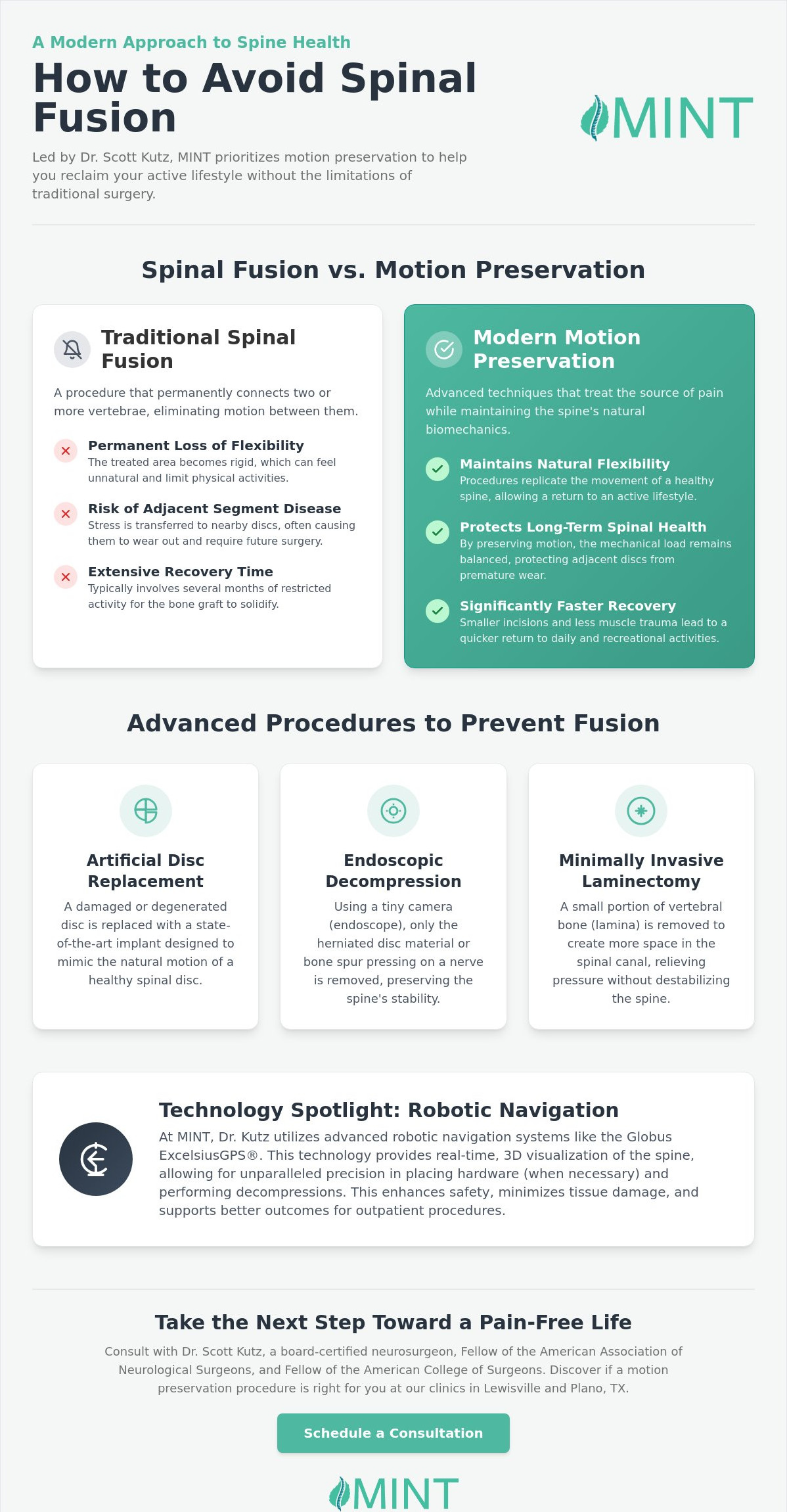
Minimally Invasive Neurosurgery of Texas (MINT) provides a sophisticated clinical path for patients seeking alternatives to traditional spinal surgery. Dr. Scott Kutz, a board-certified neurosurgeon, Fellow of the American Association of Neurological Surgeons, and Fellow of the American College of Surgeons, leads our offices in Lewisville and Plano, TX. Many individuals visit our practice specifically to learn how to avoid spinal fusion after receiving a diagnosis of degenerative disc disease or chronic instability. While Spinal Fusion creates stability by joining two or more vertebrae into a single unit, it also eliminates the natural movement of those segments. Dr. Kutz views fusion as a necessary stability fallback, but he recognizes that preserving the spine’s biomechanical integrity remains the ideal clinical goal for most active adults.
Understanding Spinal Fusion and the Search for Alternatives
One of the primary reasons patients seek alternatives at MINT is the concern over adjacent segment disease. When a surgeon fuses a portion of the spine, the discs directly above and below the surgical site must absorb the stress and motion that the fused segment no longer handles. This increased mechanical load often causes these neighboring discs to wear out prematurely, potentially leading to additional surgeries in the future. By focusing on artificial disc replacement and other motion-preserving techniques, Dr. Kutz helps patients protect the long-term health of their entire spinal column.
The Clinical Risks of Traditional Fusion Surgery
Traditional fusion surgery presents several challenges that can impact your daily life. The most immediate drawback is the permanent loss of flexibility in the treated area, which can make certain physical activities feel stiff or unnatural. The recovery timeline for a fusion is typically extensive. Patients often face several months of restricted movement while the bone graft matures and solidifies. There is also a documented risk of failed back surgery syndrome, where the patient continues to experience chronic pain despite the structural success of the fusion hardware.
Why Motion Preservation is the Modern Standard
Motion preservation represents the leading edge of minimally invasive spine surgery. These procedures aim to replicate the natural movement of a healthy human spine rather than locking it in place. Dr. Scott Kutz utilizes advanced technology to perform decompressions and disc replacements through smaller incisions, which results in less trauma to the surrounding muscles and ligaments. Patients in Lewisville and Plano report significantly faster recovery times and a more rapid return to their professional and recreational activities. This approach treats the underlying pathology while maintaining the flexibility you need for an active, pain-free lifestyle.
Minimally Invasive Procedures to Prevent the Need for Fusion
Dr. Scott Kutz, a board-certified neurosurgeon, Fellow of the American Association of Neurological Surgeons, and Fellow of the American College of Surgeons, utilizes a suite of advanced techniques to address spinal pathology without permanent hardware. Many patients in Dallas and Fort Worth search for how to avoid spinal fusion because they want to resolve nerve compression while keeping their natural anatomy intact. Procedures like microdiscectomy and foraminotomy achieve this by targeting only the specific tissue causing the problem. These minimally invasive spine surgery options allow the rest of the spinal structure to remain untouched and stable.
In a microdiscectomy, Dr. Kutz removes only the damaged or herniated portion of a disc to relieve pressure on the spinal nerves. By leaving the majority of the disc intact, the spine retains its shock-absorbing capabilities. Similarly, a laminectomy involves removing a small portion of the vertebral bone called the lamina, which is the back part of the vertebra that covers your spinal canal, to create space. A foraminotomy widens the foramen, which is the opening where nerve roots exit the spine. Unlike traditional open surgeries, these methods don’t destabilize the spinal column. This precision eliminates the clinical requirement for a bone graft or metal rods in many cases.
Endoscopic Spine Surgery: The Ultra-Minimally Invasive Choice
Dr. Kutz uses a specialized camera about the size of a pencil to visualize the surgical field with extreme clarity. This Endoscopic Spine Surgery requires an incision smaller than a centimeter. Because the tool separates muscle fibers rather than cutting them, patients often don’t even need stitches. Dr. Kutz utilizes this technique to treat stenosis, which is the narrowing of the spinal canal, and disc herniations with minimal tissue disruption. This approach leads to less postoperative pain and a faster return to daily activities in Lewisville and Plano.
Sacroiliac Joint Treatments Without Fusion
Sometimes the source of chronic pain isn’t a disc issue at all. Dr. Kutz carefully evaluates the sacroiliac joint, as SI joint dysfunction often mimics the symptoms of a lumbar herniation. At MINT, we offer specialized treatments like radiofrequency ablation to interrupt pain signals without surgery. Correctly identifying the pain source is a critical step for patients who want to schedule a consultation to explore non-fusion options in Plano or Lewisville. By addressing the actual cause of pain, we help you avoid unnecessary major surgeries and get back to your normal life quickly.
Dr. Scott Kutz, a board-certified neurosurgeon, Fellow of the American Association of Neurological Surgeons, and Fellow of the American College of Surgeons, often recommends artificial disc replacement (ADR) as the premier choice for patients researching how to avoid spinal fusion. While traditional surgery creates a rigid bridge between vertebrae, ADR utilizes a specialized mobile implant to mimic the natural function of a healthy intervertebral disc. This advanced technology allows the spine to bend, twist, and tilt, maintaining the natural biomechanics that a fusion would otherwise eliminate.
Dr. Kutz evaluates specific clinical criteria to determine if a patient can safely switch from a fusion recommendation to ADR. Success depends on high bone density and the absence of significant facet joint arthritis. The facet joints are the small stabilizing joints at the back of the spine. If these joints remain healthy, they support the motion provided by an artificial disc. If these joints have degenerated significantly, fusion might remain the more stable option. This personalized diagnostic approach ensures that patients in Lewisville and Plano receive the treatment most likely to facilitate a return to normal activity.
Cervical vs. Lumbar Disc Replacement
Dr. Kutz performs cervical disc replacements to treat radiculopathy, which is nerve pain that radiates down the arms. This procedure often resolves the numbness and weakness caused by a herniated disc in the neck. For chronic lower back pain stemming from degenerative disc disease, lumbar disc replacement offers a solution that preserves waist-level flexibility. Dr. Kutz uses high-resolution imaging to confirm that the disc is the primary pain generator before proceeding with this motion-preserving surgery. This precision helps prevent the adjacent segment disease mentioned earlier in this guide.
Comparing Outcomes: ADR vs. Spinal Fusion
Clinical data highlights a clear advantage for motion preservation. In a U.S. IDE study, the Synergy Disc, which received FDA approval in early 2026, demonstrated a composite clinical success rate of 87.1% at 24 months. This outperformed the fusion control group. Additionally, 91.7% of patients in the Synergy Disc group showed meaningful improvement on the Neck Disability Index, compared to 75.2% in the fusion group. Patients at MINT typically experience faster recovery timelines. Many individuals return to light activities within weeks rather than the months required for bone grafts to solidify. This rapid progress makes ADR a highly attractive option for the active residents of Plano and Lewisville.
Modern Technologies That Help Surgeons Avoid Fusion
Dr. Scott Kutz, a board-certified neurosurgeon, Fellow of the American Association of Neurological Surgeons, and Fellow of the American College of Surgeons, integrates proprietary technology to maximize surgical precision. Many patients in McKinney and Southlake wonder how to avoid spinal fusion when dealing with severe nerve impingement. The answer lies in the ability to perform a thorough decompression, which is the removal of bone or ligament to create space for nerves, without compromising the structural integrity of the spine. By using high-tech navigation, Dr. Kutz removes only the problematic tissue, preserving the natural stability that would otherwise require a fusion to fix.
The Globus Excelsius system serves as a cornerstone of this approach at MINT. This platform allows Dr. Kutz to plan every aspect of the procedure with sub-millimeter accuracy before the first incision. This level of detail ensures that surgical instruments follow a precise, pre-defined path. This minimizes trauma to surrounding muscles and ligaments, which is essential for patients in Plano and Lewisville who want to maintain their natural range of motion. Precision planning prevents the over-resection of bone, ensuring the spine remains strong enough to function without metal rods or bone grafts.
The Role of Robotic Guidance in Motion Preservation
Contrary to common belief, robotic systems aren’t reserved solely for fusion hardware placement. Dr. Kutz utilizes robotic assistance to guide instruments during complex decompressions. This technology provides a steady, digitized roadmap that reduces the risk of nerve injury. Because the robot enhances the surgeon’s accuracy, it allows for targeted work in tight spaces. This precision often makes it possible to resolve symptoms through a minimally invasive decompression alone, bypassing the need for a more invasive fusion procedure. It ensures that the surgical goals are met with the least amount of physical impact on the patient.
Augmented Reality in the Operating Room
MINT also utilizes Augmedics technology, which provides Dr. Kutz with “x-ray vision” during surgery. This augmented reality headset overlays a 3D digital map of the patient’s anatomy directly onto their spine in real-time. It allows the surgeon to see through skin and muscle to the underlying bone structure. This digital transparency ensures the surgical path remains as narrow as possible. Patients in the Dallas-Fort Worth Metroplex benefit from these high-tech hallmarks, which facilitate a faster return to normal activity. If you want to see if these technologies can help you, contact MINT today to schedule a consultation at our Lewisville or Plano office.
Navigating Your Treatment Path at MINT in North Texas
Patients from Lewisville, Plano, and neighboring communities like Southlake and McKinney often feel overwhelmed by the prospect of major spine surgery. They frequently seek out Dr. Scott Kutz to understand how to avoid spinal fusion through more advanced, motion-preserving techniques. As a board-certified neurosurgeon, Fellow of the American Association of Neurological Surgeons, and Fellow of the American College of Surgeons, Dr. Kutz provides a clinical environment where evidence-based medicine meets compassionate care. He views surgery as a specific tool to be used only when conservative measures no longer provide the relief necessary for a return to normal activity.
The diagnostic journey at MINT begins with a comprehensive evaluation of your medical history and current symptoms. Dr. Kutz performs a detailed review of your diagnostic imaging, such as an MRI (magnetic resonance imaging) or CT (computed tomography) scan. He looks for specific structural indicators that allow for motion preservation, such as the health of your facet joints and bone density. Can all patients avoid spinal fusion? Dr. Kutz explains that while motion preservation is the goal, patients with severe spinal instability, significant deformity, or advanced facet joint disease may still require the structural support of a fusion to ensure long-term safety. This thoroughness ensures that your treatment plan targets the exact source of your pain while maintaining clinical safety. By exhausting every conservative and minimally invasive spine surgery option first, the clinical team helps you maintain your spine’s natural mechanics for as long as possible.
Dr. Scott Kutz’s Patient-First Philosophy
Dr. Kutz believes that an informed patient is a confident patient. He prioritizes clear communication, ensuring you understand your specific diagnosis before any surgical discussion begins. Our practice doesn’t use fear-based language or high-pressure tactics. Instead, we empower you with medical guidance and realistic expectations for your recovery. Dr. Kutz doesn’t recommend surgery until he exhausts conservative options. His status as a Fellow of the American Association of Neurological Surgeons reinforces his authority in the field, yet he remains an accessible, local physician dedicated to the North Texas community. You can read about the experiences of others on our testimonials page to see how this personalized approach has helped neighbors in your area.
Scheduling Your Consultation in Lewisville or Plano
MINT operates two specialized locations to serve the growing needs of North Texas residents. Our Lewisville headquarters serves as a primary hub for diagnostic services and surgical planning. We also maintain a dedicated office in Plano to ensure local access to elite spine care. Both clinics offer the same high-tech hallmarks and specialized clinical focus that define our practice. If you’re ready to explore modern alternatives to traditional fusion, contact our team today. We’ll help you navigate your treatment path with precision and care, focusing on a rapid return to the lifestyle you enjoy.
Take the Next Step Toward a Pain-Free Life
Choosing a path for your spinal health doesn’t have to mean accepting the permanent restrictions of a traditional fusion. Modern surgical innovations like artificial disc replacement and endoscopic decompression allow you to maintain your natural flexibility while resolving chronic pain. Dr. Scott Kutz, a board-certified neurosurgeon, Fellow of the American Association of Neurological Surgeons, and Fellow of the American College of Surgeons, brings over 20 years of clinical experience to patients in Lewisville and Plano. His specialization in Globus Excelsius robotic-assisted surgery ensures that your procedure achieves sub-millimeter precision, protecting healthy tissue and maximizing your recovery potential.
If you’re researching how to avoid spinal fusion, you deserve a personalized evaluation that prioritizes your long-term quality of life. Dr. Kutz and the clinical team at MINT focus on motion-preserving alternatives that return you to your normal activity quickly. Don’t let chronic back or neck pain dictate your future. Schedule a consultation with Dr. Scott Kutz at MINT today to explore the advanced surgical technologies designed for your active lifestyle. We look forward to providing the expert care you need to move with confidence again.
Frequently Asked Questions
Is it possible to avoid spinal fusion if I have a herniated disc?
Yes, you can often treat a herniated disc using minimally invasive techniques such as microdiscectomy or endoscopic spine surgery. These procedures remove only the damaged portion of the disc to relieve nerve pressure without destabilizing the spine. Dr. Scott Kutz, a board-certified neurosurgeon, specializes in these methods to help patients understand how to avoid spinal fusion while still achieving complete symptom relief and a return to normal activity.
Can artificial disc replacement be done instead of a fusion for everyone?
Artificial disc replacement is not suitable for every patient. Ideal candidates must have good bone density and healthy facet joints to support the mobile implant. Dr. Scott Kutz performs a detailed diagnostic review in Lewisville and Plano to ensure your spinal structure can handle a motion-preserving device. If you have significant spinal instability or advanced arthritis in the facet joints, a traditional fusion might remain the safer clinical choice.
How long is the recovery for minimally invasive alternatives to fusion?
Recovery for minimally invasive alternatives is typically much faster than traditional fusion. Most patients return to light activities and office work within two to three weeks. Because these techniques involve less muscle trauma and smaller incisions, you’ll experience reduced postoperative pain. This efficiency allows patients in the Dallas-Fort Worth area to complete their rehabilitation and return to their active lifestyles much sooner than fusion patients.
What happens if I choose not to have a recommended spinal fusion?
Choosing not to proceed with a recommended fusion may lead to the progression of neurological symptoms like weakness or numbness if the underlying condition remains untreated. However, it also provides an opportunity to seek a second opinion regarding motion-preserving alternatives. Dr. Scott Kutz evaluates whether a less invasive decompression can resolve your pain and protect your nerve health without the permanent loss of flexibility associated with fusion hardware.
Are minimally invasive spine surgeries covered by insurance in Texas?
Most insurance providers in Texas cover minimally invasive spine surgeries, although specific procedures like artificial disc replacement often require a detailed appeals process. Some insurers initially label these newer technologies as experimental despite FDA approval. As of 2026, Medicare policy changes have removed many spine procedures from the Inpatient Only list. This shift allows more patients to receive advanced care in hospital outpatient settings or ambulatory surgical centers.
How does Dr. Scott Kutz determine if I am a candidate for motion-preserving surgery?
Dr. Scott Kutz determines candidacy through a combination of physical examinations and advanced imaging. He reviews your MRI and CT scans to assess the degree of disc degeneration and the health of the surrounding joints. This evidence-based approach ensures that your personalized treatment plan in Lewisville or Plano prioritizes the preservation of your natural spinal mobility. He focuses on matching the specific technology to your unique spinal anatomy.
What is the success rate of artificial disc replacement compared to fusion?
Clinical trials for modern implants demonstrate high success rates that often outperform fusion. For example, the Synergy Disc showed a composite clinical success rate of 87.1% at 24 months in a U.S. IDE study. This exceeded the success rate of the fusion control group. Patients also report higher scores on functional disability indexes, indicating that preserving motion leads to better long-term quality of life and higher patient satisfaction.
Can endoscopic surgery fix spinal stenosis without needing a fusion?
Endoscopic spine surgery can effectively treat spinal stenosis by widening the spinal canal without the need for fusion. Dr. Scott Kutz uses a tiny camera to visualize the area and remove thickened ligaments or bone spurs that compress the nerves. This precise decompression maintains the spine’s natural stability and structural integrity. It allows you to resolve the symptoms of stenosis, such as leg pain and cramping, without the installation of permanent metal hardware.