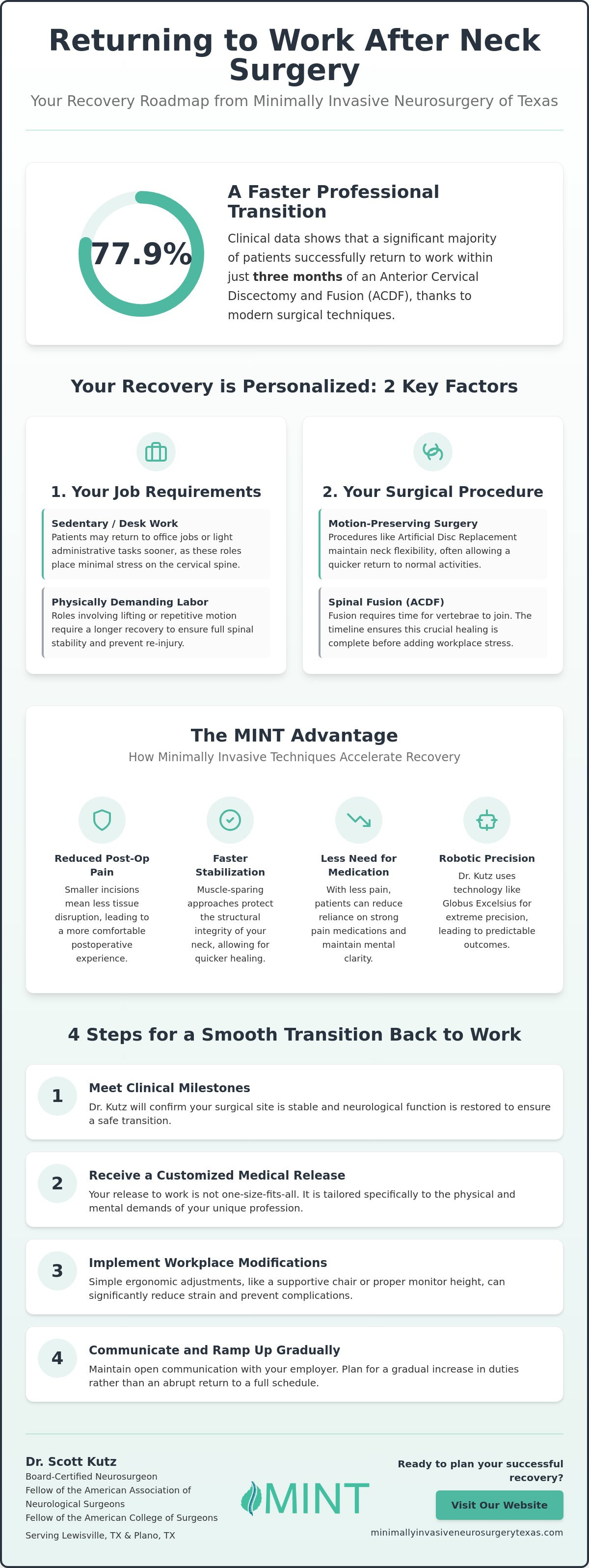
Minimally Invasive Neurosurgery of Texas (MINT), led by Dr. Scott Kutz, a board-certified neurosurgeon and Fellow of the American Association of Neurological Surgeons, offers advanced spine surgery in Lewisville, TX, and Plano, TX. Recent clinical data shows that 77.9% of patients successfully manage returning to work after neck surgery within just three months of an anterior cervical discectomy and fusion. While many people fear that spinal procedures lead to permanent physical limitations or extended periods of lost income, modern techniques often allow for a much faster professional transition than patients expect.
Dr. Scott Kutz, who is also a Fellow of the American College of Surgeons, recognizes that the uncertainty of recovery timelines can cause significant stress. You want to ensure your body is ready for the demands of your specific job, whether you sit at a desk or perform manual labor. This guide outlines what to expect during your recovery from procedures like artificial disc replacement or endoscopic spine surgery. We provide a clear roadmap for your transition, including expert tips on workplace ergonomics to help you regain your professional momentum with total confidence.
Key Takeaways
- Compare the distinct recovery timelines between cervical fusion and motion-preserving procedures like artificial disc replacement.
- Learn how Dr. Scott Kutz provides a customized medical release based on whether you perform sedentary desk work or physically demanding manual labor.
- Discover the specific clinical milestones necessary for returning to work after neck surgery while maintaining the integrity of your spinal health.
- Identify practical workplace modifications and ergonomic strategies that help manage fatigue and prevent postoperative complications.
- Understand how the precision of minimally invasive technology at MINT in Lewisville and Plano facilitates a more efficient return to daily professional activities.
Minimally Invasive Neurosurgery of Texas (MINT), led by Dr. Scott Kutz, a board-certified neurosurgeon and Fellow of the American Association of Neurological Surgeons, provides specialized cervical spine care in Lewisville and Plano, TX. Dr. Kutz focuses on minimally invasive spine surgery and motion-preserving procedures to help patients return to their active lifestyles safely.
Understanding Neck Surgery Recovery and Your Professional Life
Dr. Scott Kutz, who also serves as a Fellow of the American College of Surgeons, understands that your career is a vital part of your identity and financial stability. At Minimally Invasive Neurosurgery of Texas (MINT), we prioritize surgical strategies that facilitate a swift and safe return to your professional duties. The process of returning to work after neck surgery is not a universal timeline. Instead, it starts with a precise diagnosis and a surgical plan tailored to your specific occupational demands and physical health.
Modern neurosurgery has shifted away from traditional, highly invasive methods that require long periods of immobilization. Dr. Kutz utilizes motion-preserving technologies and muscle-sparing approaches to protect the integrity of the cervical spine. For many patients, this involves procedures such as Anterior cervical discectomy and fusion (ACDF) or artificial disc replacement. These advanced techniques minimize tissue disruption, which directly influences how quickly you can resume daily professional tasks without compromising your long-term surgical outcome.
The Role of Minimally Invasive Techniques in Recovery
Minimally invasive spine surgery at MINT utilizes specialized instruments and smaller incisions to access the cervical spine. This precision offers several clinical advantages that accelerate the healing process:
- Reduced post-operative pain and minimal blood loss during the procedure compared to open surgery.
- Faster stabilization of the cervical spine because Dr. Kutz avoids cutting through major muscle groups.
- Decreased reliance on heavy pain medications, which helps patients maintain the mental clarity required for complex professional tasks.
By choosing minimally invasive spine surgery, patients often find their recovery trajectory is shorter and more predictable. This allows for a more confident discussion with employers regarding expected return dates.
Setting Realistic Expectations for Your Workplace Transition
Recovery is a progressive journey rather than a single event. Dr. Kutz and his team at MINT in Lewisville and Plano focus on restoring full neurological function so you can perform your job safely. You should view the weeks following your procedure as a gradual ramp-up of activity. Open communication between you, your employer, and the surgical team ensures that workplace accommodations are in place before you step back into your role. Our team at Minimally Invasive Neurosurgery of Texas provides the guidance necessary to bridge the gap between surgery and a full professional schedule. This collaborative approach helps prevent setbacks and supports the long-term health of your spine.
Typical Timelines for Returning to Work After Neck Surgery
Every patient asks about the specific date they can resume their professional duties. While your body requires time to heal, the timeline for returning to work after neck surgery depends heavily on the surgical technique used and your individual healing rate. Dr. Scott Kutz, a board-certified neurosurgeon, monitors every patient individually at our Lewisville and Plano offices. He ensures the surgical site is stable before providing a medical release. Factors such as your age, nutritional status, and overall physical health influence how quickly your body repairs tissues. Dr. Kutz utilizes advanced technology like Globus Excelsius robotic navigation to achieve extreme precision, which often leads to more predictable recovery windows for his patients.
Artificial Disc Replacement vs ACDF Timelines
There is a significant difference between fusion procedures and motion-preserving surgeries. Artificial disc replacement often allows for a faster transition back to professional life. Because this procedure does not require a bone graft to fuse, many patients with sedentary office jobs return to work within two to four weeks. In contrast, patients undergoing an Anterior Cervical Discectomy and Fusion (ACDF) must wait for the vertebrae to begin the fusion process. This typically requires six to twelve weeks of recovery before resuming full office duties. Dr. Kutz frequently recommends artificial disc replacement for patients in Dallas and Frisco who need to maintain a high level of neck mobility for their careers. Managing your post-surgery recovery at home according to clinical instructions is vital for meeting these milestones.
Endoscopic Spine Surgery and Rapid Recovery
For patients who qualify, endoscopic spine surgery represents one of the least invasive options available at Minimally Invasive Neurosurgery of Texas. This technique uses an ultra-small incision and a tiny camera to address spinal issues with minimal disruption to surrounding muscles. Many patients can return to light office work within one to two weeks following an endoscopic procedure. This rapid recovery occurs because the muscle-sparing approach minimizes surgical site complications and post-operative pain. If you are concerned about how your specific surgery choice will impact your career, you can schedule a consultation with our team to discuss your surgical options in detail. Dr. Kutz uses his twenty years of experience to help you choose the path that best supports your professional and physical goals.
How Job Requirements Impact Your Return to Work Timeline
Dr. Scott Kutz, a board-certified neurosurgeon and Fellow of the American Association of Neurological Surgeons, emphasizes that your specific job duties dictate the pace of your recovery. A software developer in Plano faces different physical stressors than a logistics worker in Fort Worth or a teacher in McKinney. The path for returning to work after neck surgery is rarely identical for any two individuals. Dr. Kutz conducts a personalized assessment of your professional environment at Minimally Invasive Neurosurgery of Texas to ensure your return doesn’t jeopardize your surgical outcome. One of the first major milestones for professionals in the Dallas-Fort Worth area is the ability to drive safely. Dr. Kutz requires that patients no longer take narcotic pain medication and possess the neck range of motion necessary to check blind spots before they resume a daily commute.
Sedentary and Office-Based Roles
Office workers in Lewisville and Plano often return to their desks within two to four weeks. This timeline depends on your pain levels and your ability to maintain focus without heavy medication. Dr. Kutz frequently suggests that patients utilize work-from-home options during the initial transition period to manage fatigue. To prevent neck strain during long shifts, you must implement specific ergonomic adjustments. These include:
- Positioning computer monitors at eye level to avoid “tech neck” or downward tilting.
- Using a headset for phone calls to prevent cradling a receiver between your ear and shoulder.
- Taking micro-breaks every 30 minutes to perform gentle stretching and postural resets.
Manual Labor and Physically Demanding Positions
Jobs involving heavy lifting, operation of heavy machinery, or frequent overhead reaching require a more conservative approach. Dr. Kutz typically restricts lifting and high-impact activities for six to twelve weeks following a cervical fusion to protect the bone graft while it stabilizes. For patients who undergo artificial disc replacement, the timeline is often more aggressive because the procedure preserves natural motion. Light duty assignments serve as a critical bridge between full medical leave and full professional responsibilities. These modified roles allow you to maintain your income while your body continues to heal. Gradual re-entry programs ensure the muscles supporting your neck regain the strength required for physical labor without causing a setback.
Practical Steps for a Smooth Transition Back to the Workplace
Transitioning from a period of rest to a full professional schedule requires deliberate planning and physical awareness. Dr. Scott Kutz, a board-certified neurosurgeon and Fellow of the American Association of Neurological Surgeons, emphasizes that the first few weeks of returning to work after neck surgery represent a critical window for your long-term success. While the advanced methods used at Minimally Invasive Neurosurgery of Texas (MINT) reduce initial recovery time, the internal healing process continues for several months. Consistency in following post-operative instructions remains the most effective way to ensure the stability of your spinal repair and avoid the need for revision surgery. Patients in Southlake and Flower Mound should prioritize these adjustments to protect the surgical site while they regain their professional momentum.
Ergonomic Adjustments and Workplace Setup
A neutral cervical spine position is essential for minimizing stress on your vertebrae and supporting muscles. Dr. Kutz advises patients at Minimally Invasive Neurosurgery of Texas to audit their workspace before their first day back. Utilizing minimally invasive spine techniques often shortens the initial recovery window, but daily workplace habits determine your long-term outcome. Small changes in your environment can prevent the accumulation of micro-trauma that leads to chronic fatigue. Consider these clinical recommendations:
- Position your computer monitor so the top third of the screen is at eye level. This prevents the constant head tilting that strains the neck.
- Utilize a chair with dedicated lumbar support. Proper alignment of the lower back naturally supports the healthy curvature of the neck.
- Incorporate a wireless headset for all phone calls. Cradling a phone between your shoulder and ear creates significant lateral strain that can disrupt healing tissues.
Communication with Your Employer and Human Resources
Clear communication serves as your best defense against overexertion during your transition. You should provide your employer with a formal list of medical restrictions provided by our team in Lewisville or Plano. Discussing a phased return or flexible hours helps you manage the early post-operative fatigue that many patients experience. Your HR department should also understand the necessity of your follow-up appointments. These visits allow Dr. Kutz to monitor your progress and adjust your activity levels as you heal. If you have questions about how to prepare your office environment for your return, contact our patient coordination team to discuss your specific needs. By advocating for your health early, you create a sustainable path back to your full professional capacity.
Why Minimally Invasive Techniques at MINT Accelerate Recovery
Minimally Invasive Neurosurgery of Texas (MINT) utilizes cutting-edge technology to redefine the patient experience and improve clinical outcomes. Dr. Scott Kutz, a board-certified neurosurgeon and Fellow of the American Association of Neurological Surgeons, brings twenty years of surgical experience to every procedure. He plans each case with extreme precision to minimize the physical impact on the patient. By choosing a specialized boutique practice over a large, impersonal hospital system, you receive a level of personalized care that prioritizes your unique professional goals. Our focus on motion preservation allows many patients to resume their favorite activities and careers much sooner than traditional surgery allows. The goal of returning to work after neck surgery becomes a much more manageable milestone when the surgical approach preserves as much healthy tissue as possible.
Precision Technology: Globus Excelsius and Augmedics
The integration of advanced navigation systems directly supports a faster healing process. Dr. Kutz utilizes the Globus Excelsius robotic navigation system to achieve sub-millimeter accuracy during spinal procedures. This technology provides a rigid, GPS-like guide for instrument placement; this reduces the risk of trauma to surrounding nerves and tissues. Additionally, the Augmedics augmented reality system provides Dr. Kutz with “hidden vision” of the internal anatomy. This allows him to see through tissue to the underlying bone structure without making large incisions. Precision-based planning reduces the total time spent in the operating room and minimizes post-operative inflammation, which is the primary cause of delayed recovery and pain.
A Patient-Centered Approach in Lewisville and Plano
Our surgical center serves patients across the entire North Texas region, including Dallas, Fort Worth, and McKinney. We understand that a successful recovery requires clear guidance from the initial diagnosis to the final return-to-work clearance. Dr. Kutz, who is also a Fellow of the American College of Surgeons, ensures that every patient understands their surgical options. This includes procedures like artificial disc replacement, which maintains natural neck flexibility and prevents the stiffness often associated with older techniques. This specialized focus on motion preservation is essential for professionals who need to maintain a high level of physical activity. You can visit our testimonials page to see how other patients have successfully regained their professional lives after treatment at MINT. Our team remains dedicated to providing the high-tech healing and compassionate support necessary for a safe and efficient recovery.
Regain Your Professional Momentum with Confidence
Choosing the right surgical path is the first step toward a successful professional transition. As we have explored, the timeline for returning to work after neck surgery depends on the precision of the procedure and your specific job requirements. Dr. Scott Kutz, a board-certified neurosurgeon, Fellow of the American Association of Neurological Surgeons, and Fellow of the American College of Surgeons, specializes in advanced techniques like artificial disc replacement and endoscopic spine surgery. By utilizing cutting-edge robotic technology at our Lewisville and Plano offices, MINT provides the accuracy needed for a faster, more predictable recovery.
Whether you manage a desk in Frisco or perform manual tasks in Dallas, our team ensures you have a customized roadmap for your return. You don’t have to navigate the anxiety of physical limitations alone. Dr. Kutz combines twenty years of experience with a compassionate, patient-centered approach to help you return to your normal activity level safely. Schedule a consultation with Dr. Scott Kutz at MINT today to take the next step in your health journey. We look forward to helping you restore your quality of life and professional excellence.
Frequently Asked Questions
How long after neck surgery can I sit at a computer?
Most patients can begin sitting at a computer for short durations within one to two weeks. Dr. Scott Kutz, a board-certified neurosurgeon and Fellow of the American Association of Neurological Surgeons, recommends starting with 20 minute intervals to assess your comfort level. You must ensure your monitor is at eye level to maintain a neutral spine. If you feel increased tension or soreness, you should take a break and rest your neck muscles.
When is it safe to drive my car after a cervical procedure?
You can usually resume driving within two to four weeks once you no longer require narcotic pain medication. It is essential that you possess the full range of motion necessary to check your blind spots and react to traffic quickly. Dr. Kutz evaluates your physical readiness during your follow-up appointments in Lewisville or Plano. You should never drive if you feel any significant restriction in your ability to turn your head safely.
Can I return to work if I am still wearing a neck brace?
Yes, many patients return to sedentary or light-duty roles while still using a cervical collar for support. The brace serves to limit excessive motion and protect the surgical site during the initial healing phase. You must discuss your specific workplace environment with Dr. Kutz to ensure your employer can accommodate the brace. If your job requires looking down frequently or heavy physical activity, you may need additional time off.
What happens if my job requires heavy lifting after a fusion?
If your career involves manual labor, you must adhere to strict lifting restrictions for six to twelve weeks following a cervical fusion. Lifting heavy objects prematurely can disrupt the bone graft and lead to a non-union, where the vertebrae fail to fuse properly. Dr. Kutz provides a gradual re-entry plan that increases your weight limits as your imaging results confirm stability. Protecting the hardware and the biological fusion is the top priority during this window.
How do I know if I am pushing myself too hard at work?
Increased pain, new numbness in the arms, or significant fatigue are clear indicators that you are overexerting yourself. You might also feel “zings” or sharp electrical sensations if you move too quickly or maintain a poor posture for too long. Listen to these signals from your body and adjust your activity level immediately. Consistency in following your post-operative recovery plan is vital for a successful outcome and long-term spinal health.
Will I need physical therapy before I can go back to my job?
While not every patient requires physical therapy before resuming light office work, it is often a critical part of the recovery process. Therapy helps you regain strength in the muscles that support your neck and improves your overall posture. Dr. Kutz frequently recommends a structured program to help patients in McKinney and Fort Worth transition back to more physically demanding roles. This professional guidance ensures you move safely and efficiently during your workday.
What are the signs that I should stop working and call Dr. Kutz?
You should stop working and contact our office immediately if you experience a fever, sudden weakness in your hands, or worsening neurological symptoms. Other red flags include significant swelling at the incision site or a sudden, sharp increase in pain that does not resolve with rest. Your safety is our primary concern at Minimally Invasive Neurosurgery of Texas. Prompt communication allows Dr. Kutz to address potential complications before they impact your long-term recovery.
Does minimally invasive surgery always mean a faster return to work?
Minimally invasive techniques generally facilitate a much faster timeline for returning to work after neck surgery compared to traditional open methods. By using muscle-sparing approaches and smaller incisions, Dr. Kutz reduces the amount of tissue trauma and post-operative inflammation. This precision allows patients in Southlake and Flower Mound to heal more quickly and regain their professional capacity sooner. However, your individual timeline still depends on the specific nature of your procedure and your overall health.