Minimally Invasive Neurosurgery of Texas (MINT), led by Dr. Scott Kutz, a board-certified neurosurgeon and Fellow of the American Association of Neurological Surgeons, provides advanced spinal care to patients in Lewisville and Plano, Texas. Dr. Kutz, who is also a Fellow of the American College of Surgeons, specializes in minimally invasive spine surgery and artificial disc replacement to help patients return to their normal activities.
Imagine sitting at the dinner table in your Plano home, but instead of enjoying the meal, you are counting the minutes until you can lie down to escape the radiating pain in your lower back. You know that chronic pain is not just your burden; it strains your marriage and limits your ability to participate in family life. Your spouse likely sees your suffering but fears that traditional surgery might leave you in a worse position or create an overwhelming caregiver burden. It is common to feel stuck wondering how to convince my spouse I need back surgery when their primary concern is your safety and recovery timeline.
We understand that surgery is a family decision. This guide explains how to bridge that communication gap by sharing the clinical reality of modern procedures. You’ll learn how Dr. Scott Kutz uses advanced technology to minimize risks and why high success rates for minimally invasive procedures can help turn your spouse’s anxiety into shared optimism for your recovery.
Key Takeaways
- Recognize that your spouse’s hesitation often comes from a place of love and a desire to protect you from potential surgical complications.
- Discover how to convince my spouse I need back surgery by contrasting traditional methods with the faster recovery times of minimally invasive techniques.
- Learn why inviting your spouse to a consultation with Dr. Scott Kutz, a board-certified neurosurgeon in Plano or Lewisville, helps replace fear with clinical facts.
- Identify specific strategies to address the caregiver’s burden by utilizing North Texas resources in Dallas or Southlake and establishing a clear timeline for your return to independence.
- Find out how modern spinal technology at MINT reduces physical impact and supports your ultimate goal of returning to normal activity.
Understanding Why Your Spouse May Be Resistant to Back Surgery
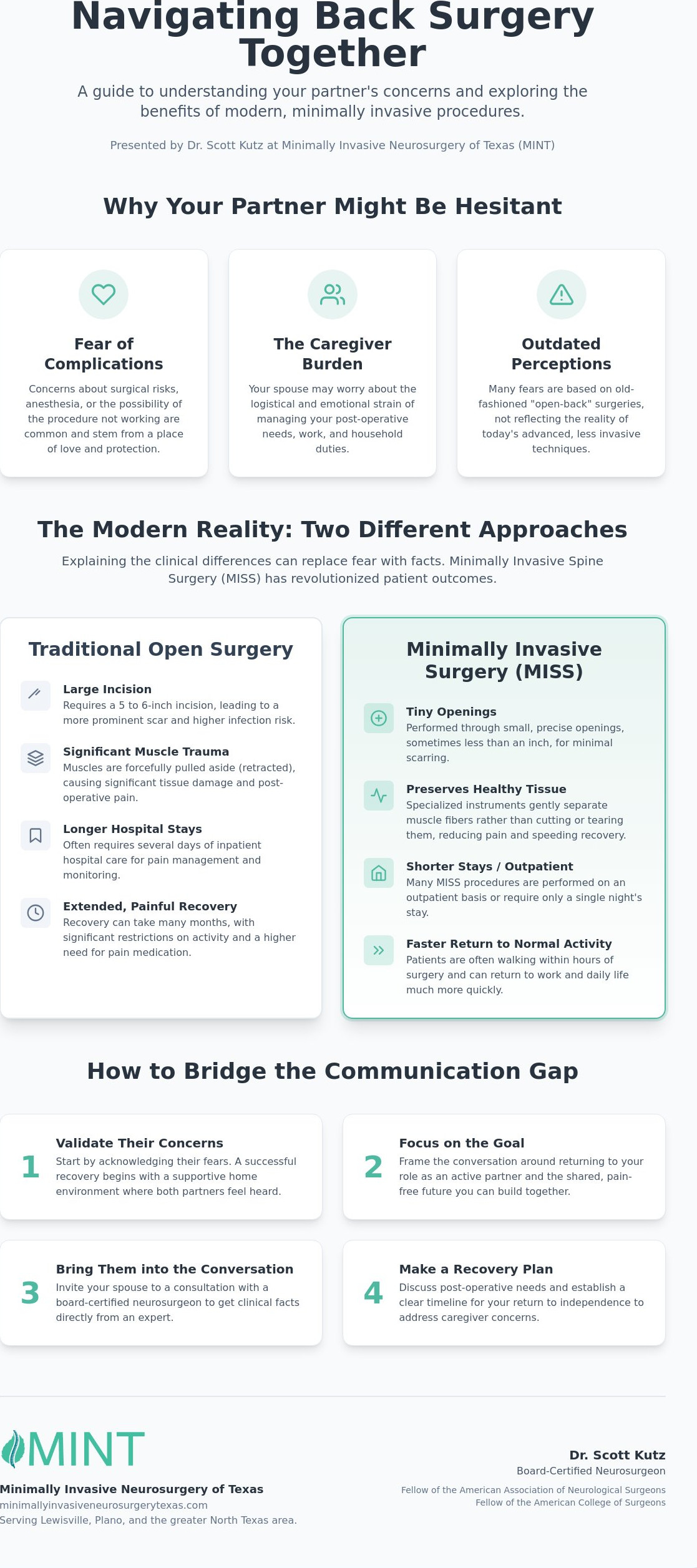
When you live with debilitating pain, the decision to seek surgical intervention feels like a lifeline. Your partner, however, might view it as a threat. Understanding how to convince my spouse I need back surgery begins with recognizing that their resistance often stems from deep-seated love and a desire to protect you. They aren’t trying to keep you in pain; they are trying to keep you safe from perceived dangers. Most spouses worry about the inherent risks of any medical procedure, such as anesthesia complications or the possibility that the intervention will not provide the relief you seek. By identifying these specific roots of anxiety, you can address them with clinical facts rather than emotions.
Validating your partner’s concerns is a critical first step. Before you present your medical needs, acknowledge their perspective. This approach reduces defensiveness and opens the door for a more logical discussion about your health. Dr. Scott Kutz, a board-certified neurosurgeon and Fellow of the American Association of Neurological Surgeons, frequently reminds patients that a successful recovery starts with a supportive home environment. When your spouse feels heard, they are more likely to listen to the benefits of modern surgical options.
The Fear of the Unknown in Spinal Care
Many people still associate spinal intervention with the invasive, open-back procedures common decades ago. These older methods required large incisions and significant muscle disruption, which often led to long hospital stays and extended recovery periods. Dr. Scott Kutz emphasizes that Minimally invasive spine surgery has revolutionized the field. Unlike traditional methods, these modern techniques use specialized instruments to treat the spine through tiny openings.
Your partner may also harbor the misconception that surgery leads to a permanent loss of mobility. In reality, modern minimally invasive spine techniques focus on preserving healthy tissue and stabilizing the spine. Additionally, your spouse might feel overwhelmed by the prospect of becoming a full-time caregiver. They may worry about balancing work, household duties, and your post-operative needs in Lewisville or Plano. Addressing these logistical fears directly helps demystify the process.
The Impact of Chronic Pain on the Household
Chronic pain doesn’t just affect the individual; it changes the entire household dynamic. Perhaps you can no longer help with chores, attend your children’s events in Dallas, or enjoy a simple dinner out in Plano. This shift places a heavy burden on your spouse, who must often take on additional responsibilities while watching you suffer. Over time, this creates a cycle of exhaustion and emotional strain for both of you.
Frame the conversation around returning to your role as an active partner. Explain that the long-term cost of inaction, such as progressive nerve damage or permanent disability, far outweighs the short-term recovery period. Dr. Scott Kutz, who is also a Fellow of the American College of Surgeons, focuses on helping patients return to normal activity through precise, high-tech solutions. By focusing on the potential for a shared, pain-free future, you move the discussion from a state of fear to a state of informed confidence.
Explaining the Difference Between Traditional and Minimally Invasive Spine Surgery
The most effective way to address how to convince my spouse I need back surgery is to shift the focus from the procedure itself to the advanced technology that makes it possible. Many people still envision traditional open surgery, which requires a five to six inch incision and the forceful pulling aside of back muscles. This older approach causes significant tissue trauma and often results in a long, painful recovery. In contrast, Minimally Invasive Spine Surgery (MISS) uses specialized instruments to achieve the same clinical goals through tiny openings, often no larger than a postage stamp. By preserving the integrity of the muscle tissue, Dr. Scott Kutz ensures that patients experience significantly less post-operative pain and a much faster return to their daily routines.
Dr. Scott Kutz, a board-certified neurosurgeon and Fellow of the American Association of Neurological Surgeons, emphasizes that modern spinal care prioritizes precision over disruption. Because MISS involves less blood loss and a lower risk of infection, many procedures at Minimally Invasive Neurosurgery of Texas (MINT) now take place on an outpatient basis. This means you can often return to the comfort of your own home in Lewisville or Plano on the same day as your procedure. For a spouse worried about hospital stays or long-term complications, the data-driven safety profile of MISS offers powerful reassurance.
What is Minimally Invasive Spine Surgery?
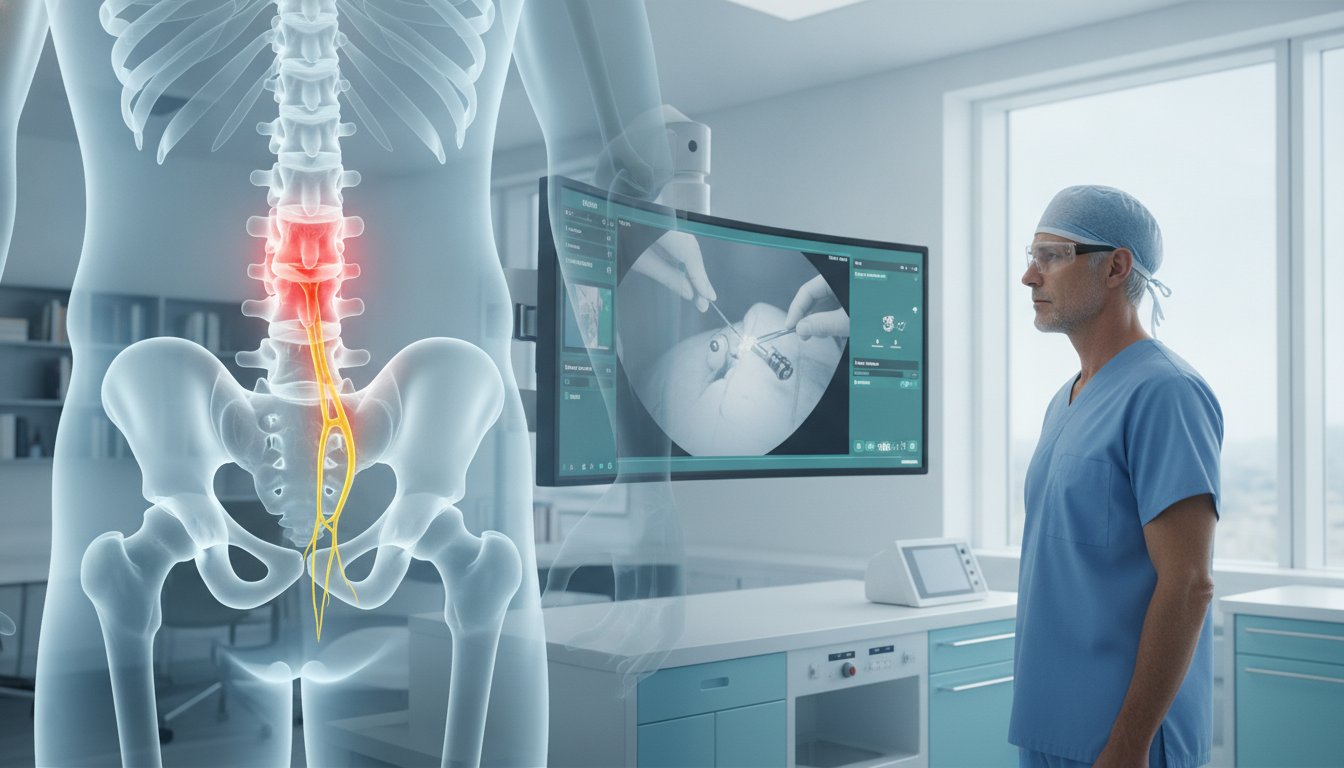
Minimally invasive techniques involve the use of a tubular retractor, which creates a narrow pathway to the spine without cutting through vital muscle groups. Dr. Scott Kutz uses these sophisticated methods to treat common conditions like herniated discs and spinal stenosis, which is a painful narrowing of the spinal canal. By using a microscope or a tiny camera to visualize the area, he can remove bone spurs or disc fragments with extreme accuracy. These smaller incisions lead to minimal scarring and reduced physical impact on the body, which directly translates to a smoother recovery for the patient and less stress for the family caregiver.
The Benefits of Endoscopic and Robotic Techniques
For patients seeking the highest level of precision, Dr. Scott Kutz offers endoscopic spine surgery. This ultra-precise option uses an endoscope, a thin tube with a camera and light, to view the spinal structures through an even smaller opening than standard MISS. Additionally, MINT utilizes robotic navigation technology like the Globus Excelsius system. This platform provides Dr. Kutz with a rigid robotic arm and GPS-like navigation to improve surgical accuracy to sub-millimeter levels. These high-tech hallmarks are available to families throughout the Dallas and Plano areas, ensuring that local residents have access to the absolute forefront of modern surgical innovation. If you want to explore how these technologies apply to your specific condition, you can request a consultation to discuss your options in detail.
Shared Decision-Making: Bringing Your Spouse into the Clinical Conversation
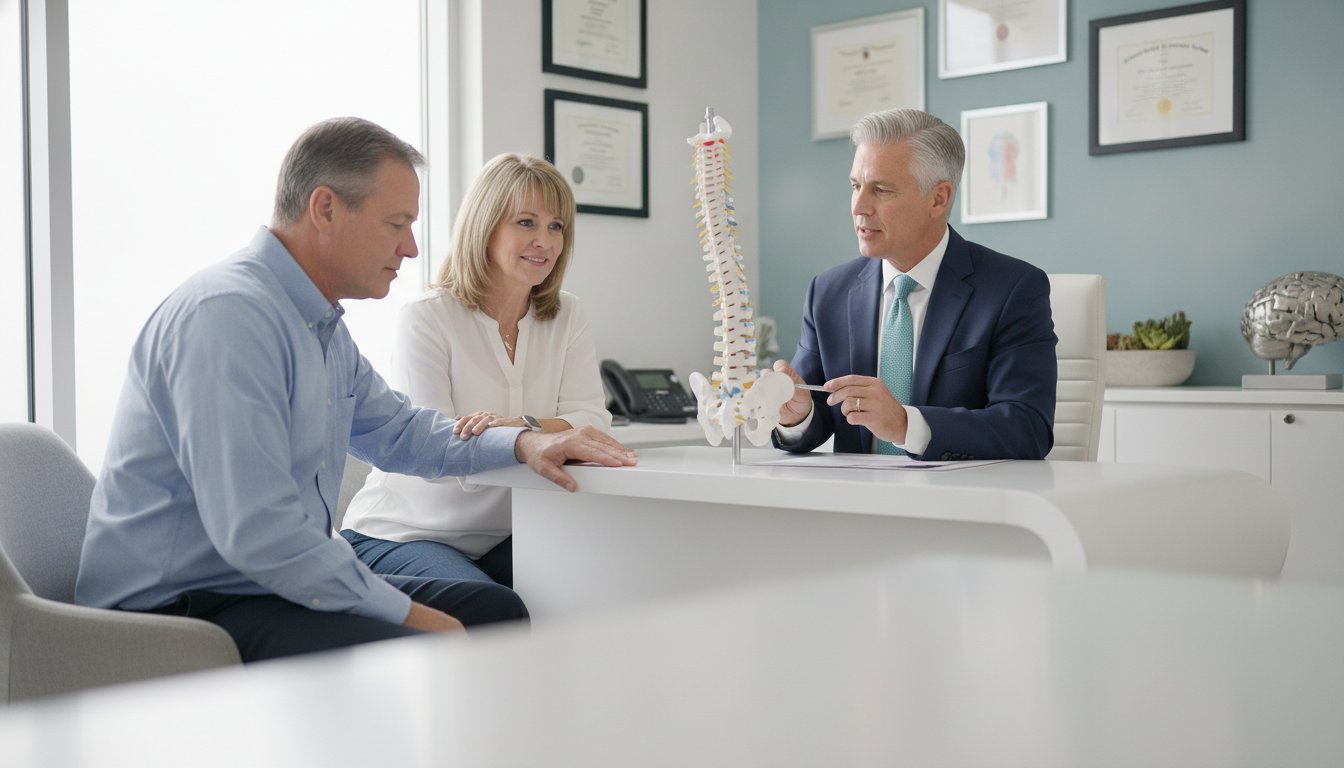
One of the most effective steps in determining how to convince my spouse I need back surgery is to transform the conversation from a private struggle into a shared clinical experience. Invite your partner to your next consultation with Dr. Scott Kutz in Plano or Lewisville. When a spouse hears clinical facts directly from a board-certified neurosurgeon, the weight of the decision no longer rests solely on your shoulders. Dr. Kutz, who is a Fellow of the American Association of Neurological Surgeons and the American College of Surgeons, provides an objective medical perspective that can settle disagreements and replace fear with data. Reviewing educational materials together ensures you both have access to the same information, which prevents misunderstandings about the surgical path forward.
The Value of a Second Set of Ears
Stress often clouds a patient’s ability to process complex medical information during a doctor’s visit. You might focus entirely on the potential relief of your symptoms while your spouse focuses on the logistics of the procedure. Having a second set of ears ensures that you capture every nuance regarding recovery timelines and post-operative care. Treat this appointment as a professional team meeting rather than a patient-only visit. Encourage your spouse to bring a written list of their specific concerns. This participation validates their role in your recovery and ensures that both of you leave the office with the same understanding of the surgical plan.
Addressing Specific Medical Questions Together
Use the consultation to ask about success rates for your specific diagnosis. For instance, clinical data shows that minimally invasive lumbar decompression has a success rate between 80% and 90%. Hearing these statistics from Dr. Scott Kutz helps build trust in the process. Discuss the conservative treatments you have already tried, such as physical therapy or injections, and why they no longer provide adequate relief. Confirming the extensive board certification and experience of Dr. Kutz helps build partner trust. You can learn more about our commitment to specialized, boutique surgical care on our about us page. Additionally, viewing patient testimonials together can provide the emotional reassurance your spouse needs to see that recovery and a return to normal activity are possible.
Planning for a Smooth Recovery: Addressing the Caregiver’s Burden
Addressing the logistical fears of your partner is a vital part of how to convince my spouse I need back surgery. Many spouses resist the idea of surgery because they worry about the physical and emotional toll of caregiving. They may imagine months of assisting you with every basic task or the stress of managing a complex recovery alone. By presenting a clear plan for post-operative life in Lewisville or Plano, you can replace this anxiety with a sense of control. Providing a transparent timeline of when you will regain independence helps your spouse see that their role is a temporary support position rather than a permanent lifestyle change.
Shortened Recovery Timelines with MINT
Dr. Scott Kutz, a board-certified neurosurgeon, utilizes minimally invasive spine techniques to significantly shorten the caregiving window. Traditional open surgery often requires weeks of bed rest and heavy assistance, but the specialized methods at MINT prioritize rapid mobilization. Many patients are walking within hours of their procedure and return to the comfort of their own homes the same day. Dr. Kutz, who is a Fellow of the American Association of Neurological Surgeons and a Fellow of the American College of Surgeons, often recommends motion-preserving approaches like artificial disc replacement. These advanced procedures allow for a much faster return to normal activity compared to traditional fusion techniques.
Preparing the Home Environment
You can further reduce the burden on your spouse by preparing your home in McKinney or Flower Mound before the procedure. Simple modifications increase your independence and prevent your partner from feeling overwhelmed by constant requests. Consider these proactive steps:
- Place frequently used items at waist level to avoid bending or reaching.
- Set up a recovery station on the ground floor with easy access to a bathroom.
- Organize a meal train or utilize local North Texas meal delivery services in areas like Southlake or Dallas.
- Establish a clear schedule for physical therapy and follow-up visits early in the process.
A “Recovery Roadmap” provides your spouse with a visual guide to your progress. Most patients achieve basic self-care milestones within the first week. By the second or third week, many individuals return to light office work and driving. This gradual return to independence ensures that the household returns to its normal rhythm as quickly as possible. If you are ready to build your personalized recovery plan, schedule an appointment with Dr. Scott Kutz today to discuss your surgical options.
Taking the Next Step with Dr. Scott Kutz in Lewisville and Plano
Choosing a surgeon with the right credentials and a proven track record is often the final piece of the puzzle when you are researching how to convince my spouse I need back surgery. Dr. Scott Kutz brings over 20 years of experience in complex spinal care to families across North Texas. He is a board-certified neurosurgeon and a Fellow of the American Association of Neurological Surgeons. Additionally, he serves as a Fellow of the American College of Surgeons. These certifications demonstrate a level of professional excellence that provides the clinical reassurance spouses need to feel confident in your care plan. At Minimally Invasive Neurosurgery of Texas (MINT), our patient-first philosophy prioritizes clear communication to ensure that both you and your partner understand every step of the journey.
Dr. Scott Kutz maintains a sophisticated practice that balances high-stakes medical expertise with a warm, local focus. Our team understands that chronic pain affects the entire family. We operate with a results-oriented rhythm that moves you from a state of concern to a state of informed confidence. By choosing a specialized, boutique surgical center rather than a large hospital system, you receive the personal attention necessary for a successful outcome. Our offices in Lewisville and Plano serve patients from surrounding areas like Flower Mound, Allen, and McKinney, providing easy access to world-class spinal care right in your community.
Why Choose MINT for Your Spinal Care
MINT focuses exclusively on spinal health and the treatment of complex disorders. We utilize precision-driven technological systems that act as a high-tech hallmark of our practice. Dr. Scott Kutz employs Augmedics AR, an augmented reality guidance system that allows surgeons to see a patient’s spinal anatomy as if they have x-ray vision. We also use the Globus Excelsius robotic navigation platform to ensure sub-millimeter accuracy. These innovations reinforce our commitment to smaller incisions, reduced blood loss, and faster recovery times. For North Texas residents, this means a safer procedure and a quicker return to the activities you love.
Schedule a Joint Consultation Today
We encourage you to call (972) 244-3491 to book an appointment for both you and your spouse. We offer consultations at our Lewisville headquarters and our satellite office in Plano. During this visit, Dr. Scott Kutz will explain how modern techniques can help you regain mobility and significantly improve your quality of life. Letting your partner participate in the clinical conversation helps them move past their fears of surgical complications. You can also visit our MINT testimonials page to see real outcomes from other patients who have successfully navigated this process. Our ultimate value proposition is your return to normal activity; let us help you and your family take that first step toward a pain-free future.
Moving Toward a Pain-Free Future as a Family
Navigating spinal health is a journey for the entire household. By focusing on the clinical benefits of modern technology and inviting your partner into the decision-making process, you can replace anxiety with informed confidence. Learning how to convince my spouse I need back surgery often comes down to demonstrating the safety and precision of minimally invasive techniques. These procedures significantly reduce tissue trauma and lead to a much faster return to normal activity compared to traditional methods.
Dr. Scott Kutz provides the specialized expertise necessary to help you regain your mobility. As a board-certified neurosurgeon with over 20 years of specialized spinal experience, he utilizes advanced robotic and endoscopic systems to prioritize patient safety and excellent clinical outcomes. You don’t have to manage chronic pain alone. Take the next step toward a shared future of health and activity in North Texas.
Schedule a consultation with Dr. Scott Kutz at our Lewisville or Plano office today to discuss your options and start your recovery journey together.
Frequently Asked Questions
Is it normal for my spouse to be afraid of my back surgery?
Yes, it is entirely normal for a spouse to feel anxious about any spinal procedure. Most fear arises from a lack of information about modern techniques or concerns about the recovery period. Sharing clinical details about how to convince my spouse I need back surgery involves explaining that modern procedures are much safer and less invasive than the open-back surgeries of previous decades.
How much time will my spouse need to take off work to care for me?
Most spouses only need to take one or two days off work to assist with the initial transition home. Because Dr. Scott Kutz performs many procedures on an outpatient basis in Lewisville or Plano, patients often regain basic independence within 24 to 48 hours. This rapid mobilization significantly reduces the caregiving burden compared to traditional open surgery.
What if my spouse thinks I should just keep doing physical therapy?
Dr. Scott Kutz typically recommends surgery only after a patient completes a trial of conservative therapy without sufficient relief. If you have already tried methods like physical therapy for six months and your quality of life continues to decline, surgery becomes the next logical clinical step. This transition is necessary when non-invasive treatments fail to resolve nerve compression or structural instability.
Can my spouse talk directly to Dr. Scott Kutz about their concerns?
Yes, Dr. Scott Kutz encourages spouses to attend consultations and ask questions directly to settle any disagreements. He believes that shared decision-making leads to better patient outcomes and a more supportive recovery environment. Your partner can bring a written list of concerns to our Plano or Lewisville offices to ensure they feel fully informed about the procedure.
Will I be able to drive myself to appointments after a minimally invasive procedure?
You cannot drive yourself immediately following a procedure, especially while taking prescription pain medication. Most patients return to driving within two to three weeks once they regain full range of motion and no longer require narcotics. We recommend arranging transportation for the first few follow-up visits to our North Texas clinics in areas like McKinney or Allen.
What are the most common risks of minimally invasive spine surgery that I should explain to my partner?
While minimally invasive spine surgery has a high success rate, patients should be aware of standard risks like infection, bleeding, or localized pain at the incision site. Dr. Scott Kutz uses advanced robotic navigation and microscopic visualization to minimize these risks significantly. Explaining these precautions helps your partner understand the safety protocols in place at Minimally Invasive Neurosurgery of Texas.
How do we know if Dr. Scott Kutz is the right surgeon for us?
You can verify the expertise of Dr. Scott Kutz by reviewing his board certification and his status as a Fellow of the American Association of Neurological Surgeons. With over 20 years of specialized experience in North Texas, he has helped thousands of patients return to normal activity. His focus on high-tech, motion-preserving techniques distinguishes his practice from general surgical centers.
What happens if we decide against surgery after the consultation?
A consultation is an educational meeting and does not require a commitment to surgery. If you and your spouse decide against a procedure, Dr. Scott Kutz will respect that choice and discuss alternative management strategies. Our primary goal is to provide you with the information necessary to make the best decision for your health and your family.