Minimally Invasive Neurosurgery of Texas (MINT), led by Dr. Scott Kutz, a board-certified neurosurgeon, Fellow of the American Association of Neurological Surgeons, and Fellow of the American College of Surgeons, provides specialized minimally invasive spine surgery for patients in Lewisville and Plano, TX. Dr. Kutz and his team focus on delivering high-tech surgical precision with a compassionate, patient-centered approach.
Ignoring a sharp, radiating pain in your lower back today can lead to permanent nerve death tomorrow. It’s natural to feel hesitant about seeking care when you fear the long recovery times associated with traditional back surgery. However, understanding what happens if a herniated disc is left untreated is vital for protecting your long-term mobility and neurological health. We recognize the confusion surrounding spinal symptoms and the anxiety that comes with persistent sciatica. This article outlines the serious risks of delayed treatment and reveals how modern, outpatient procedures in North Texas offer a safer path to relief. You’ll learn the specific clinical signs that require immediate intervention and how Dr. Scott Kutz uses advanced technology to facilitate a rapid return to normal activity.
Key Takeaways
- Identify the progression from acute back pain to chronic nerve damage and why early intervention is critical for protecting your long-term mobility.
- Discover what happens if a herniated disc is left untreated, including the risk of permanent nerve death or rare emergencies like cauda equina syndrome.
- Learn how Dr. Scott Kutz uses ultra-minimally invasive techniques to provide relief without the physical trauma or long recovery times of traditional open surgery.
- Explore how patients in Lewisville and Plano benefit from same-day procedures that prioritize a rapid return to normal activity.
Understanding Herniated Discs and the Risks of Delay
Minimally Invasive Neurosurgery of Texas (MINT), led by Dr. Scott Kutz in Lewisville and Plano, defines a herniated disc as a condition where the soft nucleus pulposus leaks through the tougher annulus fibrosus. While the body can sometimes reabsorb the protruding disc material through natural processes, knowing what happens if a herniated disc is left untreated is vital for preventing severe nerve root compression. Dr. Scott Kutz, a board-certified neurosurgeon, Fellow of the American Association of Neurological Surgeons, and Fellow of the American College of Surgeons, emphasizes that an untreated condition refers to a lack of professional clinical oversight. It doesn’t always mean you need surgery. However, it does mean you’re risking the unmonitored progression of a serious spinal condition. Spinal health is our priority.
The Anatomy of a Herniation
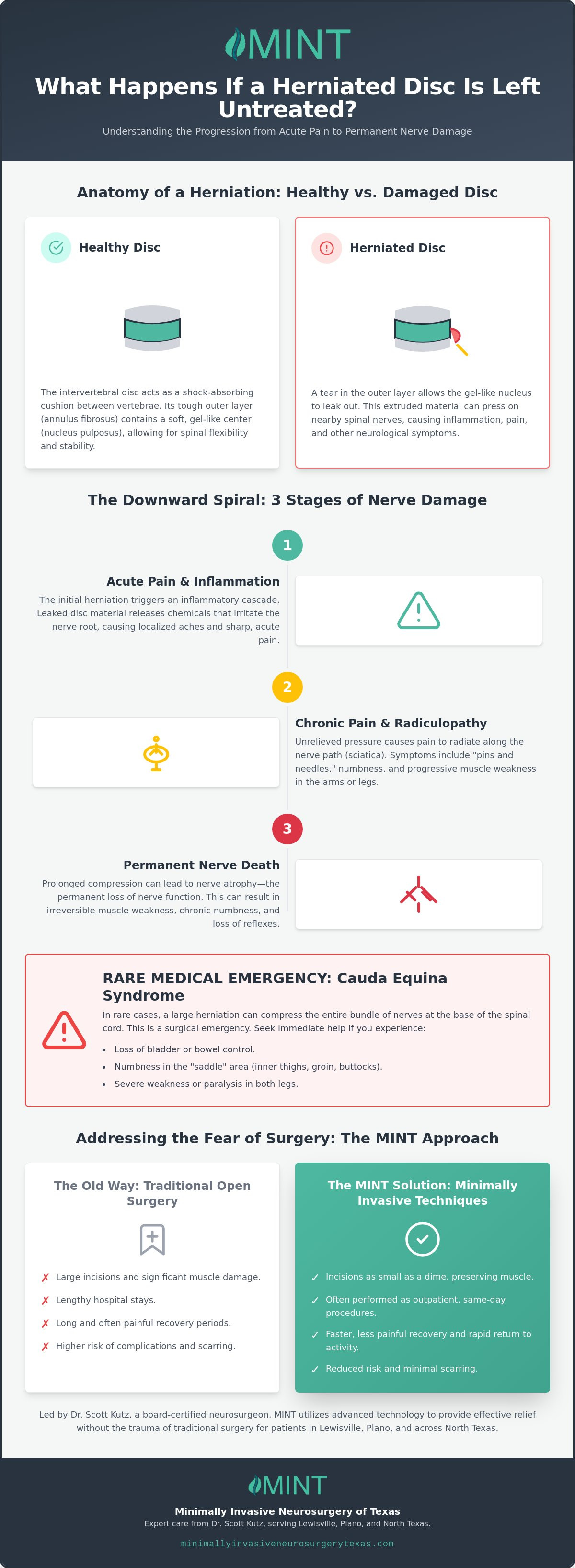
The human spine features 33 circular bones called vertebrae. Between these bones sit specialized cushions known as intervertebral discs. These discs provide the flexibility needed for bending and twisting while absorbing the impact of daily movement. A Spinal disc herniation happens when the gelatinous core of a disc pushes through a crack in the tougher exterior. Dr. Kutz notes that most herniations occur in the lumbar spine or the cervical spine. These regions experience significant mechanical stress, making them more susceptible to wear and tear. When the inner material escapes, it often irritates the surrounding nerves. This interaction leads to the debilitating symptoms that bring patients into our Lewisville clinic.
Why Early Diagnosis Matters in North Texas
Seeking an early diagnosis at our Plano or Lewisville offices can change the entire trajectory of your recovery. Early imaging allows our team to assess the structural integrity of your spine before minor issues become major complications. Dr. Scott Kutz prioritizes evidence-based spine care, which often starts with non-surgical conservative management. When we catch a herniation early, many patients find relief through lifestyle modifications or targeted therapies without ever needing an operating room. Early detection saves nerves. Dr. Kutz uses his expertise to monitor the disc’s behavior. He ensures that we only recommend minimally invasive spine techniques when conservative paths have been exhausted. This proactive approach helps patients in McKinney and surrounding areas avoid unnecessary procedures while ensuring that serious neurological risks don’t go unnoticed.
The Progression from Acute Pain to Chronic Nerve Damage
A herniated disc often begins as a localized ache, but it rarely stays confined to one spot. Dr. Scott Kutz, a board-certified neurosurgeon, Fellow of the American Association of Neurological Surgeons, and Fellow of the American College of Surgeons, observes that chronic pain frequently results from secondary changes in the nervous system rather than the initial herniation alone. Understanding what happens if a herniated disc is left untreated requires looking at the biological shift from acute injury to chronic disease. Constant pressure on a nerve root triggers an inflammatory cascade. The leaking nucleus pulposus releases irritating chemicals that bathe the nerve, causing persistent hypersensitivity and chemical radiculitis.
This irritation often forces patients into a destructive pain cycle. To avoid discomfort, many people reduce their physical activity. This sedentary behavior leads to muscle weakness and decreased spinal support. Without strong core muscles to stabilize the vertebrae, the disc experiences even more pressure, which worsens the herniation. Breaking this cycle is essential for maintaining your quality of life and preventing long-term disability.
Radiculopathy and Radiating Symptoms
Radiculopathy occurs when a compressed nerve sends pain signals along its entire path into the extremities. Patients in Dallas and Fort Worth often describe this as a “pins and needles” sensation or a sharp, electric shock that travels into the legs, commonly known as sciatica, or down the arms. If you ignore these signals, the damage moves beyond simple sensory irritation. When motor nerves are compromised, you may notice significant muscle weakness, such as difficulty lifting your foot while walking or a sudden loss of grip strength.
The Risk of Permanent Nerve Death
Nerve atrophy is the permanent loss of function due to prolonged compression. Once a nerve dies, surgical decompression may not restore the lost strength or sensation. Dr. Scott Kutz utilizes high-precision diagnostics to identify the specific “point of no return” for nerve health. This ensures that patients receive intervention before the damage becomes irreversible. If you are experiencing long-term back pain or leg pain, it is vital to seek a professional evaluation. You can schedule a consultation at our Lewisville or Plano offices to discuss your symptoms and explore your treatment options before they progress further.
Severe Complications: Cauda Equina Syndrome and Paralysis
While many spinal issues resolve with time and conservative care, understanding what happens if a herniated disc is left untreated becomes a matter of emergency safety when neurological deficits appear. Most patients experience a gradual progression of symptoms, but a significant herniation can occasionally cause sudden, catastrophic pressure on the spinal cord or nerve roots. Dr. Scott Kutz, a board-certified neurosurgeon, Fellow of the American Association of Neurological Surgeons, and Fellow of the American College of Surgeons, and his team at MINT monitor patients in Plano and Lewisville specifically for these “red flag” indicators. These symptoms do not suggest a routine consultation; they represent a surgical emergency that requires immediate intervention to prevent permanent paralysis.
Identifying Cauda Equina Syndrome
The most severe complication of an untreated lumbar herniation is Cauda Equina Syndrome (CES). This condition occurs when a massive disc protrusion compresses the cauda equina, which is a bundle of nerve roots at the lower end of the spinal cord that resembles a horse’s tail. Patients must seek immediate care if they experience a sudden loss of bowel or bladder control, as this indicates the nerves governing these functions are failing. Another hallmark sign is saddle anesthesia. This term describes a loss of sensation or numbness in the inner thighs, groin, and buttocks, essentially the areas that would touch a saddle. Research from 2024 indicates that CES occurs in approximately 3% of all disc herniation injuries, making it rare but medically urgent.
Loss of Mobility and Foot Drop
Prolonged nerve compression can also lead to a condition known as foot drop. This is the inability to lift the front part of the foot, which causes it to drag on the ground while walking. For North Texas seniors or active adults in Lewisville, foot drop significantly alters gait and increases the risk of dangerous falls. This motor deficit serves as a primary clinical indicator that conservative treatments like physical therapy or injections have failed. Dr. Scott Kutz emphasizes that once motor function begins to decline, the window for a full recovery narrows. At Minimally Invasive Neurosurgery of Texas, we prioritize rapid diagnostic imaging to determine if a patient requires urgent decompression to save their mobility. Ignoring these signs can lead to a permanent loss of leg strength and a lifelong reliance on assistive walking devices.
Why Patients Delay Treatment: Addressing the Fear of Surgery
Many patients in McKinney and Southlake live with persistent pain because they fear traditional open back surgery. They worry about long hospital stays and significant scarring. However, failing to seek a professional evaluation often leads to a worsening of symptoms. Understanding what happens if a herniated disc is left untreated can help patients realize that delay is often more dangerous than the treatment itself. Dr. Scott Kutz, a board-certified neurosurgeon, Fellow of the American Association of Neurological Surgeons, and Fellow of the American College of Surgeons, uses patient-first communication to demystify the surgical process. He ensures every individual feels heard and understood before making a decision. Our goal is always your return to normal activity with the least amount of physical disruption possible.
Conservative Management vs. Surgical Necessity
At MINT, we don’t rush into surgery. We typically recommend a 4 to 6 week window where conservative therapy is attempted first. Dr. Kutz monitors your progress carefully during this period to see how your body responds to non-operative paths. Common first-line treatments include activity modification to reduce mechanical stress and epidural steroid injections to manage localized inflammation. We only move toward minimally invasive spine techniques when these conservative paths are exhausted or if your neurological health is at immediate risk. This evidence-based approach ensures that you receive the right level of care at the right time.
The Myth of the ‘Large Incision’
Modern neurosurgery has evolved beyond the extensive muscle stripping required by traditional methods. In the past, surgeons had to make large incisions to see the affected area. Today, Dr. Scott Kutz utilizes advanced technology to perform procedures through much smaller openings. These smaller incisions lead to significantly less post-operative pain and lower infection rates. You can view our MINT testimonials to see real recovery stories from patients in Lewisville and Plano who returned to their daily lives faster than they thought possible. If you are ready to stop living in fear of your symptoms, contact our office today for an expert evaluation.
Minimally Invasive Solutions at MINT in Lewisville and Plano
Dr. Scott Kutz provides a sophisticated middle ground for patients who worry about what happens if a herniated disc is left untreated but fear the invasiveness of traditional procedures. At Minimally Invasive Neurosurgery of Texas (MINT), we utilize minimally invasive spine techniques to address nerve compression with extreme precision. These methods allow Dr. Kutz, a board-certified neurosurgeon and Fellow of the American Association of Neurological Surgeons, to resolve spinal issues while sparing healthy tissue. By avoiding the large incisions of the past, we minimize the physical impact on your body and accelerate your path to healing.
Endoscopic Spine Surgery and Artificial Disc Replacement
For many patients in Plano and Lewisville, endoscopic spine surgery represents the pinnacle of modern spine care. This procedure involves inserting a tiny tube, often smaller than a centimeter, to remove disc fragments and decompress nerves. Because the incision is so small, muscle damage is virtually non-existent. When the entire disc requires replacement, Dr. Kutz often recommends artificial disc replacement. Unlike traditional spinal fusion which locks bones together, an artificial disc maintains the natural mobility of the spine. This motion-preserving technology reduces the risk of adjacent segment degeneration, which is a condition where the spinal levels above or below a fusion site begin to wear out prematurely. Most of these procedures occur on an outpatient basis, allowing you to recover in the comfort of your own home on the same day.
Advanced Technology for Better Outcomes
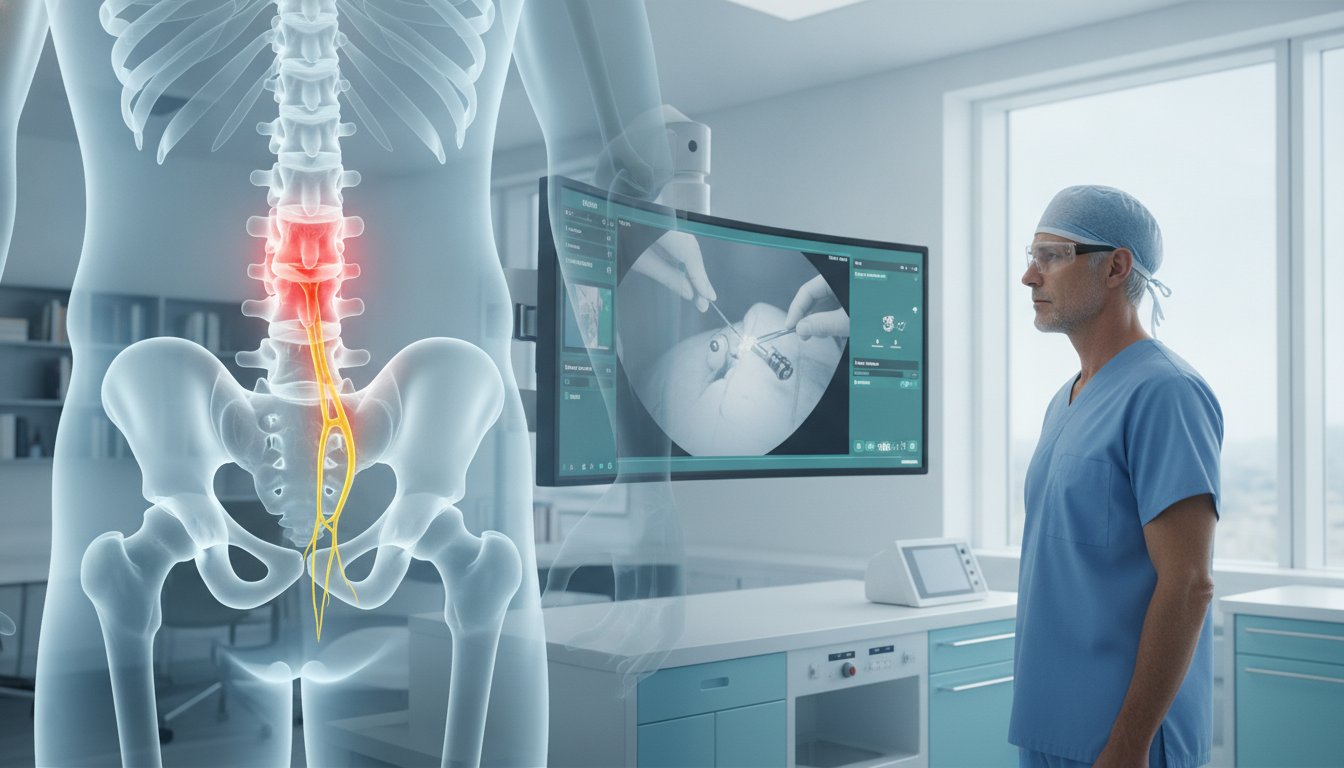
Our commitment to precision involves the integration of proprietary robotic and navigational systems that define the high-tech healer persona of our practice. The Globus Excelsius robotic navigation platform provides sub-millimeter accuracy for implant placement, ensuring that every movement is planned and executed with absolute certainty. Additionally, Dr. Kutz utilizes Augmedics AR, an augmented reality system that grants the surgeon “X-ray vision” through the skin and muscle. This advanced technology improves patient safety and clinical success rates. While traditional surgery might require months of downtime, our patients often return to light activity within days rather than months. If you live in Southlake or Flower Mound and your pain persists, seek a specialized second opinion from a Fellow of the American College of Surgeons. Dr. Scott Kutz and the MINT team remain dedicated to your return to normal activity through the most advanced surgical innovations available in 2026.
Protecting Your Neurological Health and Mobility
Protecting your mobility requires proactive care rather than a “wait and see” approach. You now understand that what happens if a herniated disc is left untreated can range from persistent sciatica to permanent nerve atrophy. Modern neurosurgery offers a path forward that avoids the physical trauma of traditional open procedures. By choosing precision technology and specialized expertise, you can address the root cause of your pain while preserving your spine’s natural motion.
Dr. Scott Kutz, a board-certified neurosurgeon, Fellow of the American Association of Neurological Surgeons, and Fellow of the American College of Surgeons, brings over 20 years of experience to every case. He is an expert in robotic-assisted and endoscopic spine procedures, focusing on motion-preserving surgery and artificial disc replacement. His dedication to innovation provides residents of Lewisville and Plano with access to sophisticated surgical care in a boutique, patient-centered environment. We are here to support your return to normal activity.
Schedule a consultation with Dr. Scott Kutz at our Lewisville or Plano office today to explore your treatment options. Your journey toward lasting relief begins with an expert evaluation.
Frequently Asked Questions
Can a herniated disc heal on its own without medical treatment?
Some herniated discs heal on their own through a process called resorption, where the body breaks down and absorbs the disc fragments. While this occurs in many cases, professional monitoring is essential to ensure the disc doesn’t compress vital nerves. Understanding what happens if a herniated disc is left untreated without this oversight is critical, as some injuries require intervention to prevent permanent damage.
What are the first signs that a herniated disc is getting worse?
The first signs that your condition is worsening include an increase in radiating pain, numbness, or tingling in your limbs. You may notice that pain previously confined to your back now travels down to your calf or foot. Muscle weakness, such as difficulty standing on your toes, indicates that the nerve compression is affecting motor function and requires a prompt clinical evaluation in Lewisville.
Is it possible to become paralyzed from an untreated herniated disc?
It is possible to experience paralysis if a massive herniation causes severe spinal cord compression or Cauda Equina Syndrome. While this outcome is rare, affecting roughly 3% of herniation patients, it represents a true medical emergency. Understanding what happens if a herniated disc is left untreated helps patients recognize these dangers. Ignoring red flag symptoms like saddle anesthesia or loss of bladder control increases the risk of permanent neurological deficits.
How long can I wait before seeing a spine specialist like Dr. Scott Kutz?
You should generally wait no longer than six weeks if conservative treatments like rest or anti-inflammatory medications don’t provide relief. However, if you experience sudden weakness or loss of sensation, you must see Dr. Scott Kutz, a board-certified neurosurgeon, Fellow of the American Association of Neurological Surgeons, and Fellow of the American College of Surgeons, immediately. Early intervention at our Plano office often prevents the need for more complex procedures later.
What is the difference between a bulging disc and a herniated disc?
A bulging disc involves the disc’s outer layer extending beyond its normal space while remaining intact, similar to a tire losing air. A herniated disc occurs when the tough outer layer cracks, allowing the soft inner core to leak out. Herniations are more likely to cause intense nerve irritation because the leaked material is chemically inflammatory and takes up more space in the spinal canal than a simple bulge.
Does every herniated disc eventually require surgery?
Most herniated discs do not require surgery, as approximately 80% to 90% of patients find relief through conservative management within two months. Surgery is only necessary when symptoms persist despite therapy or when neurological deficits like foot drop appear. Dr. Scott Kutz focuses on evidence-based care to ensure patients in Southlake and Flower Mound only undergo procedures when clinically required to protect their long-term health.
What happens during a minimally invasive discectomy at MINT?
During a minimally invasive discectomy at MINT, Dr. Kutz uses specialized tubes and microscopic cameras to remove the offending disc fragment. This approach requires an incision smaller than an inch, which preserves the surrounding muscle and bone structure. Patients typically experience significantly less post-operative pain and return to light activity within a few days of the outpatient procedure in Lewisville or Plano.
Are there non-surgical treatments available in Lewisville and Plano?
Yes, we offer several non-surgical pathways in Lewisville and Plano to manage disc pain before considering surgery. These include targeted epidural steroid injections to reduce nerve inflammation and guidance on specialized physical therapy. Dr. Scott Kutz and his team prioritize these conservative methods to help patients achieve a return to normal activity with the least invasive approach possible.