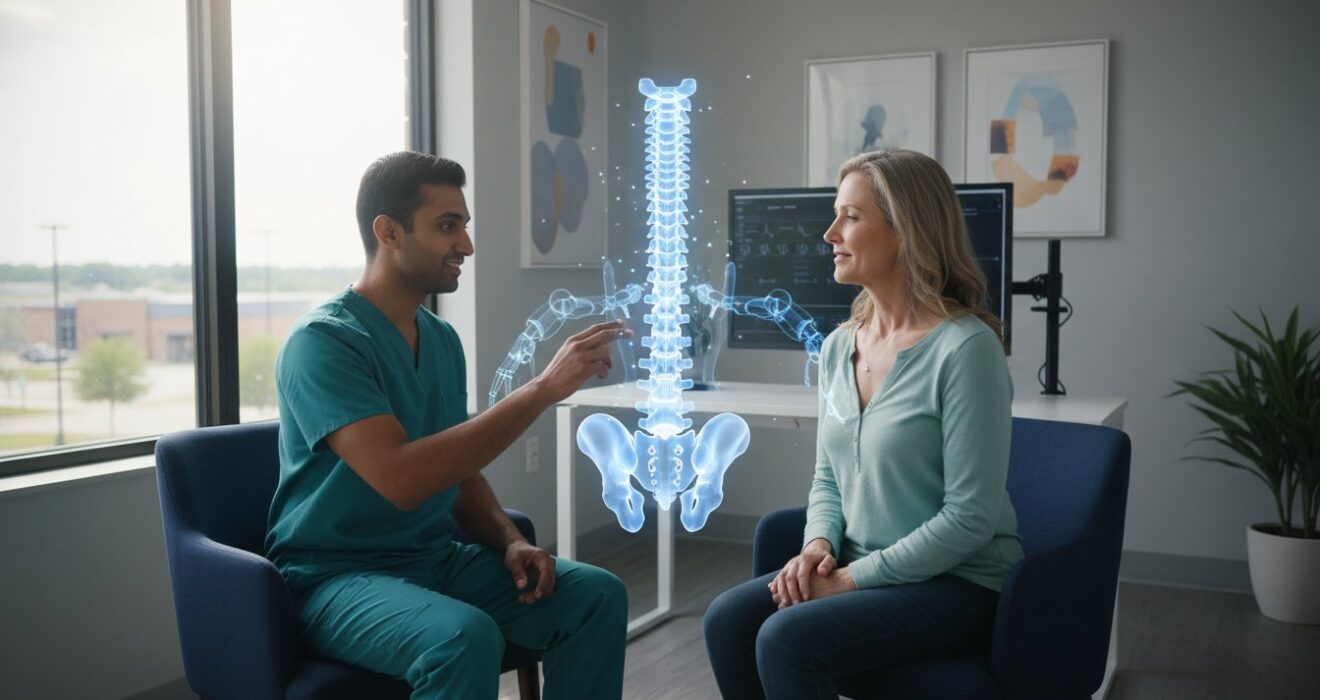
Surgery for spondylolisthesis isn’t a last resort; it’s a proactive, high-tech intervention designed to stop neurological decay and restore structural stability before damage becomes permanent. If you’ve spent months managing sciatica with failed injections or physical therapy, you’re likely part of the 10% of patients who eventually require more than conservative care. Seeking minimally invasive surgery for spondylolisthesis Texas specialists provide in Lewisville and Plano allows you to address spinal slippage with sophisticated precision rather than traditional, invasive methods.
We understand the anxiety surrounding back surgery, but modern advancements have fundamentally changed the recovery timeline. You’ll learn exactly when vertebral slippage necessitates surgical intervention and how our use of active spine robotics, which can achieve a 98% accuracy rate, minimizes physical impact. This article previews the journey from chronic pain to a fast return to your daily activities, detailing how specialized technology stabilizes your spine without the need for large incisions or lengthy hospital stays.
Key Takeaways
- Understand the “10% rule” to determine if your vertebral slippage has progressed beyond the reach of conservative physical therapy.
- Learn how minimally invasive surgery for spondylolisthesis Texas experts perform utilizes robotic-assisted navigation for sub-millimeter precision and faster healing.
- Identify critical “red flag” symptoms like radiating leg pain and muscle weakness that indicate surgery may no longer be optional to prevent nerve damage.
- Discover why the six-week mark is the industry standard for transitioning from conservative treatments to a surgical consultation.
- Explore the benefits of choosing a board-certified neurosurgeon in Plano or Lewisville to ensure a safe, efficient return to your normal activity.
The 10% Rule: Deciding When Spondylolisthesis Requires Surgery
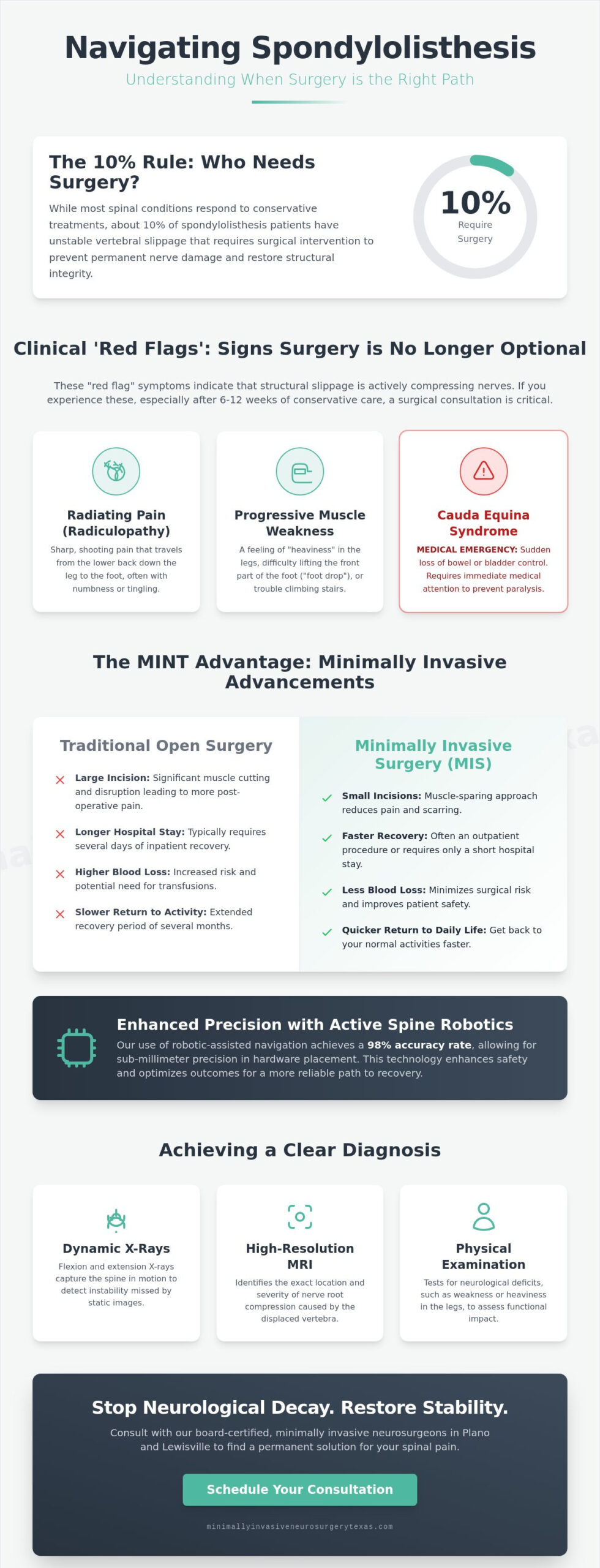
The “10% rule” is a clinical benchmark used to identify patients who truly require surgical intervention. While approximately 90% of spinal conditions resolve with non-operative care, Spondylolisthesis presents a unique challenge where one vertebra slips forward over another. When this slippage becomes unstable, muscular rehabilitation alone cannot restore structural integrity. In these cases, seeking minimally invasive surgery for spondylolisthesis Texas specialists provide is often the most effective path to preventing long-term damage.
Clinicians differentiate between stable and unstable slippage using dynamic, weight-bearing X-rays. If the vertebrae move significantly during flexion and extension, the spine is considered unstable. An MRI further clarifies the situation by showing the degree of nerve root compression. Delaying treatment when a spine is unstable often leads to irreversible nerve atrophy or “foot drop,” which is a permanent loss of motor control in the lower leg. Key diagnostic tools include:
- Flexion and Extension X-rays: These capture the spine in motion to detect shifting that standard still images miss.
- High-Resolution MRI: This identifies exactly which nerve roots are being pinched by the displaced bone.
- Physical Examination: Testing for “heaviness” or weakness in the legs that indicates neurological compromise.
Acute vs. Chronic Back Pain Milestones
Pain that persists beyond the 90-day window is classified as chronic and often suggests an underlying structural issue rather than a simple muscle strain. For those with slippage, this often manifests as “mechanical pain” that intensifies specifically when standing or walking but improves when sitting or leaning forward. Chronic spondylolisthesis is a progressive mechanical failure where the spine’s structural support has simply given way and can no longer support the body’s weight during activity.
The True Goal of Surgical Intervention
The objective of modern surgery has evolved. It isn’t just about masking pain; it’s about achieving neurological decompression and permanent stabilization. By realigning the vertebrae and securing them with advanced hardware, we prevent future spinal cord compression. Intervening with minimally invasive surgery for spondylolisthesis Texas patients can trust preserves mobility and stops the cycle of multi-level degeneration before it spreads to adjacent discs. The focus is on restoring your foundation so you can return to normal activity without the fear of sudden, sharp relapses.
Clinical ‘Red Flags’: Signs Surgery is No Longer Optional
Recognizing when back pain shifts from a daily nuisance to a neurological emergency is vital for long-term health. While most cases of spondylolisthesis are managed non-surgically, the presence of specific “red flags” signals that conservative measures like physical therapy or injections have reached their limit. For patients in Plano and Lewisville, identifying these markers early is the key to preventing permanent nerve damage. These symptoms indicate that the structural slippage is actively compromising the nervous system.
Radiculopathy is one of the most common indicators. This involves sharp, shooting pain that radiates from the lower back through the buttocks and down to the toes. It’s often accompanied by neurological deficits, such as a sudden “heaviness” in the legs or localized weakness that makes climbing stairs difficult. If you experience a loss of bowel or bladder control, this is a medical emergency known as Cauda Equina Syndrome and requires immediate attention. Beyond pain, progressive spinal deformity can alter your posture so severely that it eventually impacts internal organ function. Typically, if a dedicated 6-to-12 week clinical trial of conservative therapy fails to provide relief, it’s time to discuss minimally invasive surgery for spondylolisthesis Texas specialists recommend.
Identifying Nerve Compression in Texas Patients
Vertebral slippage often results in neural foraminal stenosis. This condition creates physical “bottlenecks” where spinal nerves exit the column. While temporary tingling or “pins and needles” might feel manageable, permanent functional weakness is a sign that the nerve is being starved of oxygen and nutrients. Localized bone spurs frequently develop as the body attempts to stabilize the slippage, which only further narrows the nerve pathways and exacerbates your symptoms. Intervening before these bottlenecks cause permanent atrophy is a clinical priority.
Structural Instability: Spondylolisthesis vs. Scoliosis
Clinical grading systems categorize the severity of the slip from Grade I (less than 25%) to Grade IV (75% to 100%). As the grade increases, the “shearing” force on your intervertebral discs intensifies, leading to rapid disc degeneration and increased instability. This structural breakdown often necessitates minimally invasive spinal fusion Texas experts use to restore height and stop the vertebral movement. If your mobility is declining, consulting with a specialist can help determine if high-tech stabilization is your best path forward for a return to normal activity.
Timing Your Care: Conservative Protocols vs. Surgical Intervention
Standard conservative management typically involves a combination of Physical Therapy (PT), non-steroidal anti-inflammatory drugs (NSAIDs), and epidural steroid injections (ESIs). For many patients, these steps are sufficient to manage mild symptoms. However, when structural slippage is the root cause of radiating leg pain, seeking minimally invasive surgery for spondylolisthesis Texas specialists provide becomes the logical next step. Relying on conservative care for too long can lead to diminishing returns, especially if the spine is inherently unstable and continues to shift during daily movements.
The 6-week mark serves as the industry-standard turning point for a surgical consultation. If symptoms do not improve or if neurological deficits progress during this initial clinical trial, surgery is often the most responsible path forward. We balance your personal lifestyle goals with the clinical reality of your spinal health. If your goal is a fast return to normal activity, continuing with treatments that provide only marginal relief may actually delay your total recovery time. Accuracy in the initial diagnosis is paramount to avoid Failed Back Surgery Syndrome. This condition often arises when the underlying instability of a slipped vertebra is overlooked, making the precision of minimally invasive surgery for spondylolisthesis Texas experts perform essential for a successful outcome.
The Limits of Physical Therapy
Physical therapy is an excellent tool for correcting muscular imbalances and improving core strength. It cannot, however, reverse a mechanical blockage or bone-on-bone contact caused by a Grade II slip or higher. While we refer our patients to high-quality external PT providers, we also monitor for “PT fatigue.” This occurs when a patient puts in the work but sees no functional gain because the bone is physically compressing a nerve root. In these scenarios, more exercise cannot fix the structural displacement, and further delay only risks more nerve damage.
The ‘Temporary Relief’ Trap of Injections
Epidural steroid injections are powerful diagnostic and therapeutic tools, but they can be deceptive. They reduce localized inflammation, which might mask the fact that the underlying slippage is actively worsening. We use these injections to map specific nerve involvement with precision. If an injection at a particular spinal level provides temporary relief, it confirms that level as the primary source of the pathology. This data allows us to transition from temporary chronic pain management to a permanent surgical solution with absolute certainty and high-tech accuracy.
Modern Alternatives: Minimally Invasive Advancements in 2026
In 2026, the standard for spinal care has shifted toward maximizing surgical precision while minimizing physical trauma. minimally invasive neurosurgery allows us to access the spine through small portals rather than traditional long incisions. This method protects the surrounding muscle tissue, which is the primary driver of post-operative pain and long recovery times. For those seeking minimally invasive surgery for spondylolisthesis Texas clinics offer, these advancements mean the difference between a multi-day hospital stay and returning home the same day.
We utilize Augmented Reality (AR) mapping, which allows surgeons to “see” through tissue in real-time by overlaying a 3D digital model of your spine onto your physical anatomy. This is paired with endoscopic spine surgery, often called the “keyhole” approach, to decompress pinched nerves with surgical accuracy that was impossible a decade ago. These tools allow for a level of detail that ensures every nerve is fully decompressed while maintaining the structural integrity of the spine.
Robotic Precision with Globus Excelsius
The Globus Excelsius robotic platform represents the absolute forefront of surgical innovation. By using this system, we significantly reduce human error in screw placement and spinal alignment. Research indicates that modern robotic-assisted spinal systems achieve a 98% accuracy rate in screw placement, compared to the 85% accuracy of traditional techniques. Robotic navigation ensures perfect vertebral stabilization by calculating the optimal trajectory for hardware before the first incision is even made. This technology also lowers radiation exposure for patients by reducing the need for repetitive intraoperative X-rays.
Preserving Motion and Faster Recovery
While lumbar slippage is common, neck disk replacement offers a modern solution for cervical spondylolisthesis. This procedure preserves natural motion rather than fusing the vertebrae together, which can prevent future issues in adjacent discs. Comparing the traditional “open” surgery scar to our “band-aid” approach highlights the dramatic reduction in physical impact. Outpatient spine surgery has become the standard for Texas patients in 2026, allowing for a faster return to work and family life. If you’re ready to explore these high-tech options, schedule a consultation with our surgical team today to reclaim your quality of life.
Finding Relief in Plano & Lewisville: Your Next Steps at MINT
Choosing a board-certified neurosurgeon like Dr. Scott Kutz is a critical decision for your long-term spinal health. At Minimally Invasive Neurosurgery of Texas (MINT), we provide a specialized, boutique environment that contrasts with the impersonal atmosphere of large hospital systems. Our practice is built on the “High-Tech Healer” philosophy, which balances cutting-edge robotic innovation with the personalized attention of a local physician. When you seek minimally invasive surgery for spondylolisthesis Texas experts provide at our clinics, you’re choosing a team dedicated to restoring your structural stability with sub-millimeter precision.
Your first consultation is a comprehensive clinical review designed to move you from a state of concern to informed confidence. We don’t just look at a single scan; we analyze the history of your condition to understand why conservative treatments failed to provide relief. Our goal is to identify the exact source of your radiating pain and develop a surgical plan that prioritizes the least invasive path to recovery. By utilizing advanced imaging and specialized surgical methodologies, we ensure that every patient receives a roadmap tailored to their specific anatomical needs.
The MINT Diagnostic Approach
Our diagnostic process begins with a meticulous review of your previous MRIs and a history of your non-operative treatments. We utilize Augmedics AR for personalized surgical mapping right here in Plano, allowing us to visualize your spinal anatomy in three dimensions before we enter the operating suite. This focus on the least invasive path ensures maximum neurological recovery while minimizing the impact on healthy tissues. We look for specific markers of instability that others might overlook, ensuring your diagnosis is accurate the first time.
Planning Your Recovery in North Texas
Recovery isn’t just about the absence of pain; it’s about a return to normal activity. We work with you to set realistic timelines for returning to the activities that define your quality of life, whether that is getting back on the golf course, returning to work, or simply playing with your grandchildren. Our commitment to patient-centered care in Lewisville and Plano means you’ll have a clear understanding of your progress at every milestone. If you are ready to stop managing pain and start your recovery, schedule your consultation at our Plano or Lewisville clinic today.
Reclaiming Your Mobility with Precision Spine Care
Living with the constant threat of radiating leg pain or neurological weakness doesn’t have to be your permanent reality. By understanding clinical red flags and the 10% rule, you can make an informed decision about your spinal health before permanent nerve damage occurs. Modern advancements have transformed the recovery landscape, offering high-tech solutions that prioritize long-term stability and structural integrity over temporary symptoms.
At MINT, board-certified neurosurgeon Dr. Scott Kutz utilizes advanced Globus Excelsius Robotic Navigation alongside specialized endoscopic and AR-guided techniques to ensure sub-millimeter accuracy. Choosing minimally invasive surgery for spondylolisthesis Texas experts provide means you benefit from smaller incisions and a significantly faster return to your normal activity. You don’t have to settle for failed injections or temporary relief when a permanent, precise solution is available right here in Plano and Lewisville.
Take the first step toward a pain-free life; schedule your MINT consultation today. We are dedicated to guiding you back to the life you love with the professional excellence and compassion you deserve.
Frequently Asked Questions
Is back surgery a last resort for chronic spondylolisthesis?
Surgery isn’t necessarily a last resort; it’s a proactive intervention when structural slippage overrides muscular rehabilitation. The “10% rule” indicates that for approximately 10% of patients, conservative care like injections or physical therapy will reach a point of diminishing returns. In these cases, waiting too long can lead to permanent nerve damage or chronic muscle atrophy that surgery cannot fully reverse.
What are the red flags that mean I need immediate spine surgery?
Critical red flags include progressive neurological deficits such as “foot drop” or a sudden heaviness in the legs that makes walking difficult. Intractable radiculopathy, which is shooting pain that travels from the back to the toes, also indicates severe nerve compression. If you experience a loss of bowel or bladder control, this is a medical emergency known as Cauda Equina Syndrome and requires immediate surgical attention.
Can minimally invasive surgery fix a Grade II spondylolisthesis?
Yes, minimally invasive surgery for spondylolisthesis Texas experts perform is highly effective for Grade II slips. We utilize robotic navigation to realign the vertebrae and secure them with precision hardware through small incisions. This approach stops the progressive shearing force on your intervertebral discs and provides the permanent stabilization needed to prevent the slip from advancing to a Grade III or IV.
How long is the recovery time for robotic spine surgery in Plano?
Recovery times for robotic-assisted procedures are significantly shorter than traditional open surgery. Many patients return home the same day or within 24 hours of their procedure. While full structural healing takes time, most individuals return to light work and normal activity within a few weeks because our techniques minimize damage to the surrounding muscle tissue.
Will I still need physical therapy after my spondylolisthesis procedure?
Yes, we typically recommend a course of external physical therapy to rebuild core strength after your spine surgery. While the procedure corrects the structural instability and removes nerve compression, PT is essential for long-term health. Rebuilding the muscles that support your spine ensures a more durable recovery and helps you maintain your return to normal activity without future relapses. This often means learning to delegate heavy-duty tasks—such as land clearing or major landscaping—to professionals like We Love Trees so you can focus on healing without risking a new injury.
What is the success rate of minimally invasive fusion compared to traditional surgery?
Modern robotic-assisted systems achieve a 98% accuracy rate in hardware placement, which is a significant improvement over the 85% accuracy found in traditional techniques. This high-tech precision reduces the risk of nerve irritation and revision surgery. By using specialized clinical methodologies, we provide a more predictable outcome with less blood loss and a lower risk of post-operative infection.
How do I know if my leg pain is coming from my back slippage?
If your leg pain radiates from the lower back through the buttocks and down the leg, it’s likely caused by nerve compression at the site of the slippage. This is often referred to as sciatica. We use weight-bearing X-rays and high-resolution MRIs to confirm if the vertebral displacement is physically narrowing the neural foramina and pinching the nerve roots.
Does Dr. Scott Kutz perform outpatient spondylolisthesis procedures?
Dr. Scott Kutz specializes in outpatient spine surgery for many spondylolisthesis cases at our boutique surgical centers in Plano and Lewisville. This “keyhole” approach allows for the stabilization of the spine without the need for a lengthy hospital stay. Most qualified candidates can recover in the comfort of their own homes while benefiting from our high-tech, robotic-assisted navigation systems.