What if the spine surgery you’ve been avoiding as a “last resort” is actually the precision-engineered key to reclaiming your active lifestyle? If you’re struggling with chronic radiating leg pain or the anxiety of a long recovery, your concerns are completely valid. Many Texans delay care because they’re worried about large surgical scars and losing their mobility for months. We believe you shouldn’t have to choose between your spinal health and your daily independence.
This guide reveals how modern minimally invasive spinal fusion Texas specialists use advanced robotic guidance to provide lasting stability with smaller incisions and a significantly faster recovery. You’ll discover how the 2026 Medicare WISeR model and the shift toward outpatient surgery centers are changing the landscape for patients across North Texas. We will walk you through the latest technological innovations and the clinical outcomes that allow our patients to return to normal activities with renewed confidence and lasting relief. By understanding these advancements, you can move from a state of concern to a state of informed confidence regarding your surgical journey.
Key Takeaways
- Learn how muscle-splitting techniques minimize physical trauma and preserve tissue compared to traditional, highly invasive “muscle-stripping” methods.
- Discover how the Globus ExcelsiusGPS robotic system functions as a high-tech GPS for the spine to ensure unmatched surgical precision.
- Identify the specific conditions, such as spondylolisthesis and degenerative disc disease, where surgical stability becomes the most effective path to pain relief.
- Understand the recovery timeline for minimally invasive spinal fusion Texas, including why early mobilization is essential for a successful return to normal activity.
- Explore the unique clinical benefits of having a board-certified neurosurgeon perform your procedure using specialized MISS protocols.
What is Minimally Invasive Spinal Fusion? Stability Without the Trauma
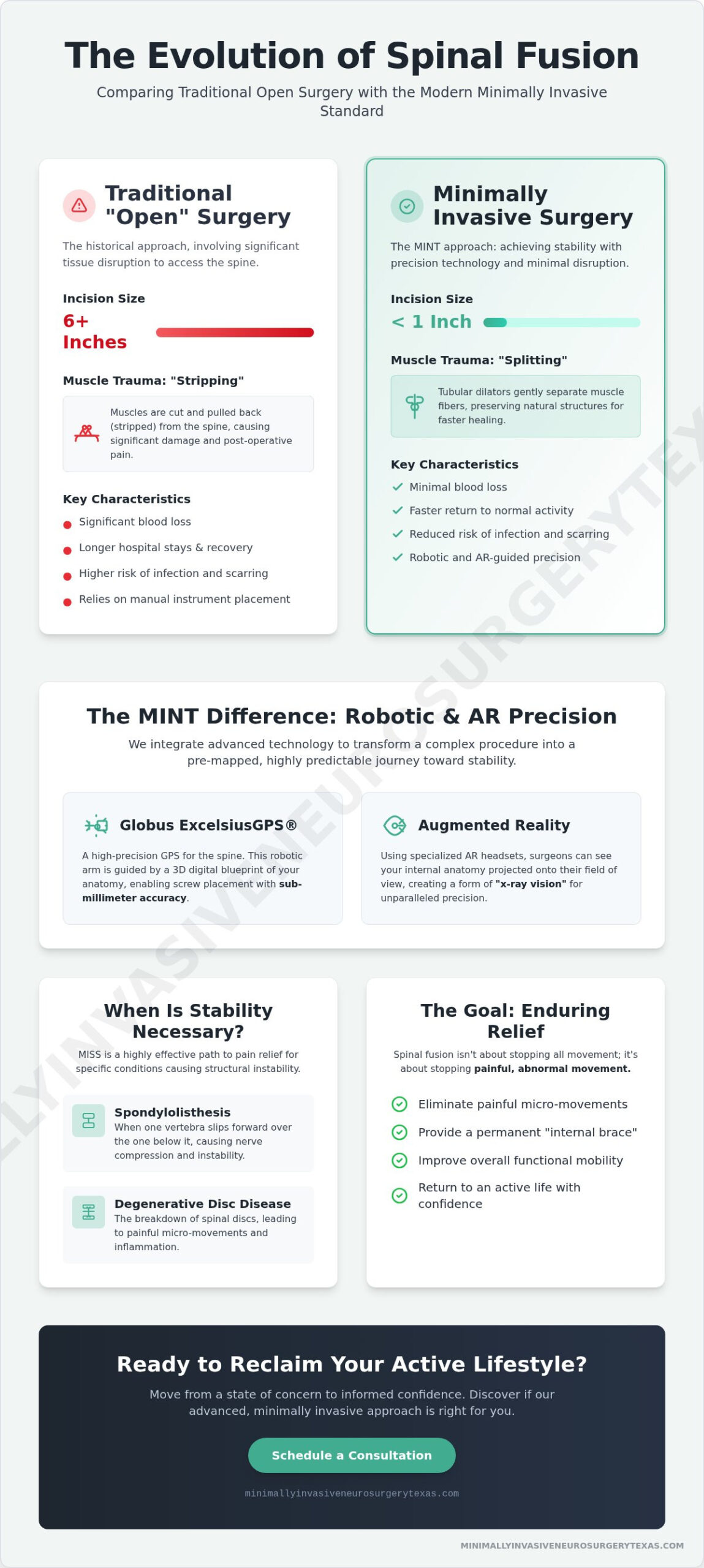
Minimally invasive spinal fusion is a specialized surgical technique designed to stabilize the spine while protecting the surrounding anatomy. For patients seeking minimally invasive spinal fusion Texas, the distinction lies in how we access the vertebrae. Traditional “open” surgery requires a long incision and “muscle-stripping,” where the surgeon peels back muscle tissue from the bone. This often leads to significant post-operative pain and longer healing times. In contrast, our approach utilizes a “muscle-splitting” technique. By using specialized tubular dilators, we create a narrow tunnel directly to the spine, gently pushing muscle fibers aside rather than cutting or tearing them. This allows us to address the root cause of instability with surgical precision while keeping the body’s natural support structures intact.
The Evolution from Open Surgery to MISS
The transition from traditional methods to modern standards has been driven by rapid technological advancements. Only a few decades ago, spinal fusion required a six-inch incision and significant blood loss. Today, we achieve the same structural stability through portals smaller than one inch. This reduction in incision size directly correlates with a lower risk of infection and minimal scarring. Because of these clinical benefits, minimally invasive neurosurgery has become the gold standard for patients who prioritize a swift return to their daily lives. Understanding What is Minimally Invasive Spine Surgery helps clarify why these smaller portals are so effective; they provide a direct path to the problem area without the collateral damage associated with older techniques. We now use high-definition visualization and specialized instrumentation to perform complex work through these tiny windows.
Why “Fusion” is Often Misunderstood
Many patients fear that a fusion procedure will leave them feeling like a “tin man,” rigid and unable to move. This is a common myth. The primary goal of a minimally invasive spinal fusion Texas is to stop painful micro-movements between unstable vertebrae that have structurally failed. When a segment of the spine is unstable, it causes inflammation and nerve irritation. By fusing that specific segment, we eliminate the source of the pain. Interestingly, many patients find their overall functional mobility actually improves after surgery. Because the sharp, radiating pain is gone, they can move more freely than they have in years. Spinal fusion is not about stopping movement; it is about stopping painful, abnormal movement. We are essentially providing a permanent internal brace that allows the rest of your back to function without the constant threat of a flare-up.
The MINT Difference: Robotic Navigation and AR Precision
Precision is the hallmark of a successful minimally invasive spinal fusion Texas. We don’t rely on traditional sightlines alone. Instead, we utilize robotic-assisted technology that functions as a high-precision GPS for the human spine. This technology allows us to plan every movement before the first incision is made. It transforms a complex Minimally Invasive Spinal Fusion procedure into a pre-mapped, highly predictable journey toward stability. By integrating these systems, we provide our patients with a level of accuracy that was simply unattainable in previous decades.
Globus ExcelsiusGPS: Precision Engineering
The process begins with advanced 3D imaging to create a digital blueprint of your unique anatomy. During the procedure, the Globus ExcelsiusGPS system uses this map to guide a robotic arm with sub-millimeter accuracy. This level of precision enhances screw placement accuracy to near 100%, which is critical for ensuring long-term hardware stability. While the robot provides the path, the surgeon remains in total control at all times. Think of the system as an expert co-pilot that ensures every instrument stays on the intended trajectory. This eliminates the margin for error often associated with traditional open techniques and manual placement.
Augmedics: The Power of Augmented Reality
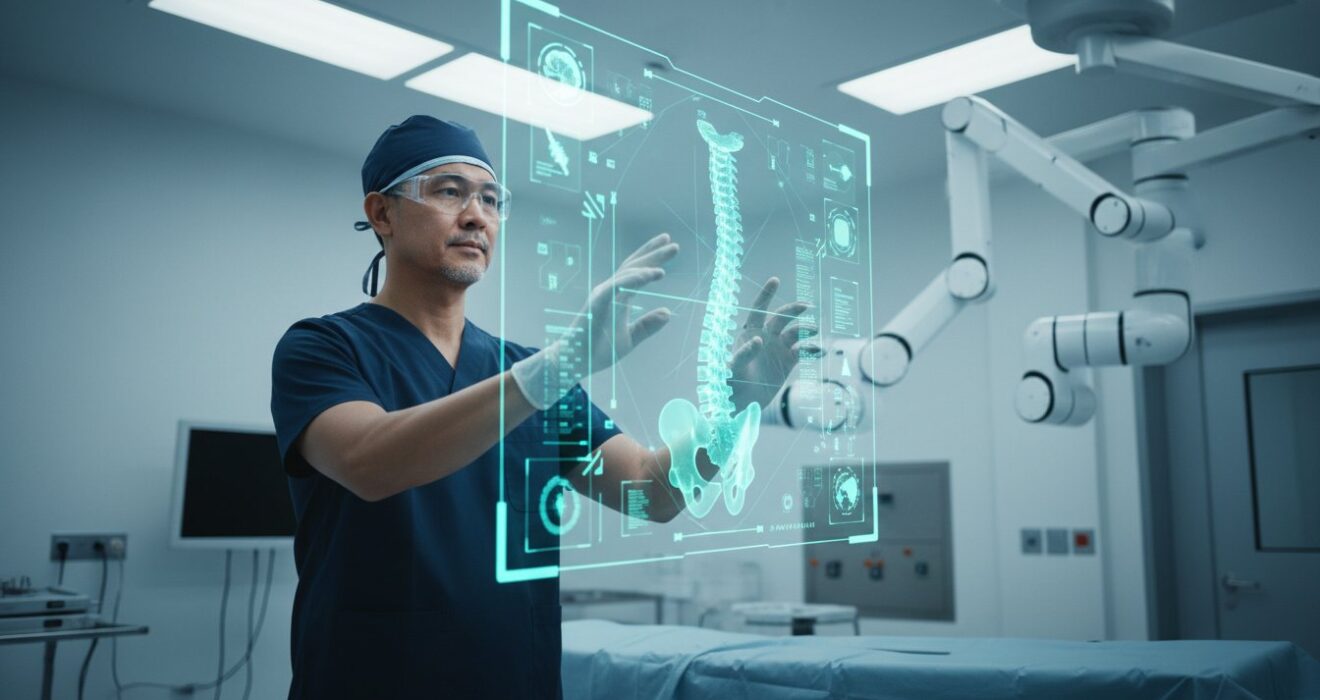
We further elevate our surgical standards by incorporating Augmedics technology. Using specialized AR headsets, our surgeons project your internal anatomy directly onto their field of view. This creates a form of “x-ray vision” that allows us to see through the skin and soft tissue without making large exploratory incisions. It’s particularly revolutionary for complex lumbar spine surgery, where navigating delicate neural pathways requires extreme care. This real-time visualization ensures that we can achieve the surgical goals with minimal disruption to your body.
Beyond precision, these systems significantly reduce radiation exposure. Traditional surgery relies heavily on live X-rays, known as fluoroscopy, to verify instrument placement. Our robotic and AR systems minimize the need for repeated imaging, protecting both you and our surgical team. This high-tech approach isn’t just about innovation; it’s about providing the safest, most effective path back to your daily life. If you’re ready to see how this technology can change your surgical outcome, you can schedule a consultation with our specialized team to discuss your options.
Are You a Candidate? When Stability Becomes Necessary
Determining if you’re a candidate for minimally invasive spinal fusion Texas begins with a clear understanding of your pain’s origin. We prioritize a “conservative first” philosophy. This means surgery is only discussed after non-surgical interventions, such as physical therapy, activity modification, and targeted injections, have failed to provide meaningful relief over a six to twelve-week period. When these treatments no longer manage your symptoms, it’s often because the underlying issue is structural instability rather than simple inflammation.
We typically recommend fusion for three primary conditions. Spondylolisthesis occurs when one vertebra slips forward over another, creating a mechanical misalignment. Degenerative Disc Disease involves the breakdown of the intervertebral discs, leading to a loss of cushion and height. Spinal Stenosis is the narrowing of the spinal canal which puts pressure on the nerves. According to clinical overviews of the Minimally Invasive Spinal Fusion procedure, the goal is to stop the “mechanical pain” caused by bones grinding or shifting unnaturally. This is distinct from “nerve pain,” though the two often coexist. When your imaging report references specific vertebrae numbers like L4-L5 or L5-S1, understanding what those designations mean can help you have a more informed conversation with your surgeon about which segment requires stabilization. North Texas patients researching their options can find a comprehensive overview of how robotic navigation and the 2026 Medicare WISeR regulations affect their care in our lumbar spine surgery guide for North Texas patients. For localized pain in the hip or lower back that resists standard treatments, we may also explore si joint fusion surgery to stabilize the sacroiliac joint.
Spinal Fusion vs. Artificial Disc Replacement (ADR)
A common question patients ask is why they should receive a fusion instead of a motion-preserving disc replacement. The choice depends largely on the health of your facet joints. If your joints are severely arthritic or the spine is significantly unstable, a fusion is necessary to provide the “internal brace” your body requires. Artificial Disc Replacement is designed for motion, but it cannot provide the structural support needed in a failing spinal segment. You can find a detailed breakdown of these differences in our neck disk replacement guide, which explores how we choose the right path for cervical stability.
The “Failed Back Surgery” Scenario
Many of our patients come to us after undergoing traditional open surgeries elsewhere that didn’t provide lasting results. In some cases, previous procedures involved over-decompressing a segment, which accidentally stripped away the spine’s natural stability. A minimally invasive spinal fusion Texas can act as a rescue procedure to stabilize these compromised areas. It’s also vital to monitor for the symptoms of failed si joint fusion if you’ve had prior pelvic work. Our goal is to correct these structural failures using high-tech guidance to ensure this surgery is your last.
The Path to Recovery: What to Expect Post-Fusion
Recovery from minimally invasive spinal fusion Texas is a structured journey toward lasting stability. Unlike traditional open surgery, which often requires lengthy hospital stays and significant downtime, our specialized approach focuses on early mobilization. We embrace a “walking is medicine” philosophy. Most patients are encouraged to stand and walk within hours of their procedure. This immediate activity helps prevent post-operative complications and jumpstarts the healing process by promoting healthy blood flow to the surgical site.
During the first four weeks, the priority is protecting the integrity of the fusion. You must strictly follow the “No BLT” rule: no bending, lifting, or twisting. This restriction ensures that the robotic-guided hardware remains perfectly aligned while your soft tissues begin to knit back together. While soft tissue heals in weeks, the biological bone fusion process typically requires 3 to 6 months of steady progress. During this window, you’ll transition from light walking to more demanding functional movements as the vertebrae permanently bridge together.
The First 48 Hours: A Boutique Surgical Experience
Patients in Plano and Lewisville benefit from a boutique surgical environment that prioritizes personal attention over the coldness of a large hospital system. Because we use muscle-splitting techniques rather than stripping tissue away from the bone, post-operative pain is significantly reduced. We utilize modern multimodal pain management protocols that minimize the need for opioids. This allows for a clearer recovery and a faster return to the comfort of your own home. MISS patients often leave the facility 2 to 3 days sooner than those undergoing traditional open surgery.
Returning to the Texas Lifestyle
We understand that your ultimate goal is a return to normal activity. Most patients return to sedentary office work within 2 to 4 weeks. Driving is typically permitted once you’re no longer taking prescription pain medication and have regained full reaction speed. For high-impact hobbies like golf or tennis, we usually recommend waiting until the three-month mark to ensure the bone has begun to fuse securely. This patience prevents strain on the adjacent segments of your spine.
A consistent walking program is your most valuable tool during the first month. Start with short trips around the house and gradually increase your distance as your comfort allows. This low-impact exercise maintains your cardiovascular health without straining the fusion site. If you’re ready to start your journey back to an active life, contact our North Texas office to discuss your personalized recovery plan and see if you’re a candidate for our advanced protocols.
Why Texas Patients Choose Dr. Scott Kutz at MINT
Selecting the right surgeon is the most important decision you’ll make on your path to recovery. Dr. Scott Kutz is a board-certified neurosurgeon who has dedicated his career to the specialized field of minimally invasive spine surgery. At MINT, we provide a distinct alternative to the often impersonal experience of a large hospital system. Our practice is a boutique surgical center where the focus is exclusively on the spine. We don’t treat cranial conditions or perform general neurosurgery. This singular focus allows us to maintain an elite level of expertise in minimally invasive spinal fusion Texas, ensuring our patients receive the most advanced care available in the DFW Metroplex.
A neurosurgeon’s perspective offers a unique advantage in spinal procedures. Because our training centers on the delicate protection of the nervous system, we bring a high level of microsurgical precision to every fusion. This expertise is especially critical when working through the small incisions required for MISS. Dr. Kutz combines this clinical authority with a compassionate, patient-centered style that prioritizes your individual quality of life. We believe that professional excellence and personal attention should never be mutually exclusive.
A Patient-Centered, High-Tech Approach
We operate with a philosophy that we treat the patient, not just the MRI. While high-definition imaging is an essential part of our diagnostic process, it’s only one piece of the puzzle. We listen to your story, understand your pain, and evaluate how your condition limits your daily Texas life. This thoroughness ensures that if we recommend a minimally invasive spinal fusion Texas, it is because it’s the most effective solution for your specific structural needs. As a “high-tech healer,” Dr. Kutz utilizes the robotic and AR systems mentioned previously to ensure your surgery is as precise and effective as possible. If conservative treatments have failed to restore your mobility, we invite you to explore how our specialized approach can help you reclaim your independence.
Convenient Care in Plano and Lewisville
MINT provides two convenient locations in Plano and Lewisville, making expert care accessible for residents of Frisco, Dallas, Denton, and the surrounding areas. We’ve optimized our clinical workflow to move you through the diagnostic journey with ease. From your first consultation to the final surgical plan, our team is dedicated to a results-oriented rhythm that respects your time. Our goal is to move you from a state of chronic suffering to a state of informed confidence. When you’re ready to take the next step toward a pain-free life, we’re here to guide you. Schedule your evaluation at MINT today.
Reclaim Your Active Texas Lifestyle with Precision Care
Living with chronic spinal instability doesn’t have to be your permanent reality. The evolution of spine surgery has replaced large incisions and long hospital stays with a precision-engineered approach that prioritizes your recovery. By leveraging the Globus ExcelsiusGPS and Augmedics AR systems, we ensure that every procedure is mapped with absolute accuracy. This high-tech foundation allows you to achieve lasting stability without the extensive trauma of traditional open surgery. Choosing a specialized minimally invasive spinal fusion Texas provider like Dr. Scott Kutz ensures that your care is managed by a board-certified neurosurgeon who focuses exclusively on spinal health.
You deserve a path to recovery that respects your time and your desire to return to normal activity. Whether you’re in Plano, Lewisville, or the surrounding North Texas area, our boutique surgical center is ready to provide the specialized attention you need to move past chronic pain. Don’t let the fear of a long recovery hold you back from the life you love. We invite you to Request an Appointment with Dr. Scott Kutz today. It’s time to move forward with informed confidence and start your journey toward a stronger, pain-free future.
Frequently Asked Questions
Is minimally invasive spinal fusion a major surgery?
Yes, this is still considered a major surgical procedure because it involves permanent structural changes to the spine. However, the “minimally invasive” designation refers to the approach we use to reach the vertebrae. By utilizing muscle-splitting techniques rather than traditional muscle-stripping, we significantly reduce the physical trauma to your body. This allows for a more manageable recovery while still achieving the necessary long-term stability.
How long does the actual spinal fusion procedure take?
A standard minimally invasive spinal fusion Texas procedure typically takes between two to four hours to complete. The exact duration depends on the complexity of your specific condition and how many levels of the spine require stabilization. Our use of robotic navigation often streamlines the surgical workflow, providing a pre-mapped path that ensures every movement is executed with high-tech efficiency and clinical precision.
Will I have a large scar after minimally invasive fusion?
No, you’ll not have the long, vertical scar associated with traditional open back surgery. MISS utilizes one or two small incisions, often less than an inch in length. Because we use specialized tubular dilators to create a narrow tunnel to the spine, the skin and muscle tissue experience minimal disruption. This results in much smaller, less noticeable scars that heal faster than traditional surgical sites.
Can I still play sports or exercise after a spinal fusion?
Yes, the ultimate goal of this procedure is to facilitate a return to normal activity, including your favorite sports. While high-impact activities are restricted during the initial three to six months of the bone-growth phase, many patients eventually return to golf, tennis, and swimming. Once the biological fusion is complete, the stabilized segment provides a strong, pain-free foundation for an active Texas lifestyle.
What are the risks of minimally invasive spinal fusion?
Like any surgery, risks include infection, blood loss, or nerve irritation. However, the MISS approach is specifically designed to minimize these concerns through smaller portals and advanced visualization. We also monitor for pseudoarthrosis, which occurs if the bone doesn’t fuse as intended. Our use of robotic guidance and AR technology significantly reduces the margin for error and enhances the overall safety profile of the procedure.
How soon can I return to work after fusion surgery?
Most patients return to sedentary office work within two to four weeks. If your job involves physical labor or heavy lifting, you’ll likely need to wait three to six months until the bone has fully fused. We provide a customized recovery timeline based on your unique healing progress to ensure you don’t return to strenuous activity before your spine is ready to support the load.
Does insurance typically cover minimally invasive spinal fusion in Texas?
Yes, most major insurance carriers and Medicare cover minimally invasive spinal fusion Texas when medical necessity is documented. It’s important to remember that as of January 2026, new Medicare WISeR regulations in Texas require prior authorization for certain spinal procedures. Our team handles the administrative burden by coordinating directly with your insurance provider to manage the documentation and authorization process on your behalf.