Minimally Invasive Neurosurgery of Texas (MINT) is a specialized spine practice in Lewisville and Plano led by Dr. Scott Kutz. As a board-certified neurosurgeon, Fellow of the American Association of Neurological Surgeons, and Fellow of the American College of Surgeons, Dr. Kutz provides motion-preserving alternatives to traditional spinal fusion. Many patients worry that their insurance provider will label modern spine technology as investigational to avoid payment. However, securing insurance coverage for artificial disc replacement is more achievable than ever in 2026 if you understand the specific medical necessity requirements.
You probably feel anxious about receiving a denial letter or facing high out-of-pocket costs for a procedure that could restore your quality of life. We understand that the difference between cervical and lumbar coverage rules can be confusing. This guide clarifies the latest 2026 policy updates from major Texas insurers like UnitedHealthcare and Blue Cross Blue Shield. You’ll learn exactly what documentation Dr. Kutz uses to prove medical necessity, including the mandatory six month trial of conservative therapy. We will also preview the clinical advantages of maintaining spinal mobility so you can move forward with your recovery in Lewisville or Plano with absolute confidence.
Key Takeaways
- Identify the specific medical necessity criteria Texas insurers require, including documented proof of failed conservative therapies like physical therapy or injections.
- Understand the current landscape of insurance coverage for artificial disc replacement and why cervical procedures often see higher approval rates than multi-level lumbar surgeries.
- Learn how Dr. Scott Kutz, a board-certified neurosurgeon and Fellow of the American College of Surgeons, utilizes minimally invasive techniques to improve patient outcomes and billing efficiency.
- Discover the financial advantages of performing motion-preserving procedures in ambulatory surgery centers (ASCs) to reduce overall facility fees and insurance friction.
- Navigate the pre-authorization roadmap with the dedicated verification team at MINT in Lewisville and Plano to avoid unexpected out-of-pocket expenses.
What is Artificial Disc Replacement and How Does Insurance View Arthroplasty?
Minimally Invasive Neurosurgery of Texas (MINT) provides advanced spinal care for patients in Lewisville and Plano. Dr. Scott Kutz, a board-certified neurosurgeon and Fellow of the American Association of Neurological Surgeons, leads the practice. He also holds a fellowship with the American College of Surgeons, ensuring that every patient receives care rooted in the highest clinical standards. Dr. Kutz specializes in artificial disc replacement, a procedure designed to maintain spinal mobility rather than eliminating it through fusion.
When we discuss insurance coverage for artificial disc replacement, we are referring to the reimbursement of a procedure called arthroplasty. During this surgery, Dr. Kutz removes a degenerated or herniated disc and replaces it with a prosthetic device. This device, often called Total disc replacement (TDR), mimics the natural function of a healthy spinal segment. It’s vital to distinguish between FDA approval and insurance coverage. While the FDA has approved several artificial disc devices for safety and efficacy, insurance companies determine coverage based on their own internal medical necessity policies. Dr. Kutz and the MINT team prioritize motion preservation because it helps patients return to their normal activities faster than traditional methods.
The Evolution of Arthroplasty Coverage
Insurance companies previously labeled motion-preserving spine surgery as investigational or experimental. This designation allowed them to deny claims despite FDA approval. However, the landscape has shifted significantly. By February 1, 2026, major payers like UnitedHealthcare updated their policies to recognize the clinical value of these procedures. Clinical evidence now proves that arthroplasty is a standard of care for specific diagnoses. Most major private insurers in Texas now have established criteria for both cervical and lumbar procedures. This shift reflects a growing recognition that maintaining spinal motion is often superior to permanent immobilization.
Why Insurance Preference Matters for Your Recovery
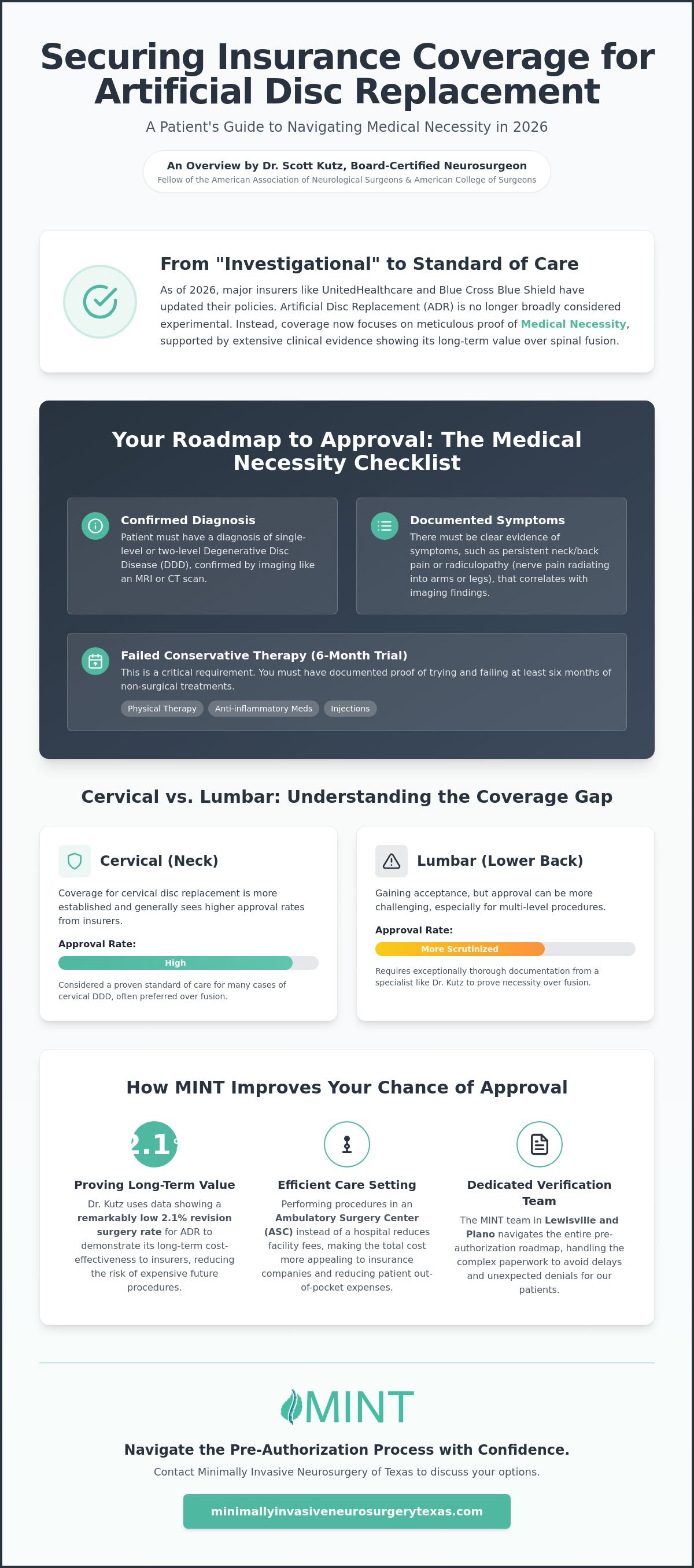
Insurers are beginning to favor artificial disc replacement because of its long-term cost-effectiveness. Traditional spinal fusion often leads to Adjacent Segment Disease (ASD). This condition occurs when the vertebrae above or below a fusion site take on extra stress, eventually requiring additional surgeries. A 2022 study analyzing data from 2008 to 2017 found that the revision surgery rate for cervical arthroplasty was remarkably low at 2.1%. Dr. Scott Kutz uses these statistics during the pre-authorization process to demonstrate that arthroplasty reduces the likelihood of expensive future complications. By choosing a procedure with lower revision rates, insurance companies and patients both benefit from more predictable long-term outcomes. You can learn more about our approach on our about us page.
Criteria for Securing Insurance Coverage for Artificial Disc Replacement
Securing approval for motion-preserving spine surgery requires a meticulous clinical paper trail. Dr. Scott Kutz and the team at Minimally Invasive Neurosurgery of Texas (MINT) specialize in helping patients in Lewisville and Plano meet the rigorous “Medical Necessity” standards set by major payers. As of July 2026, most Texas insurers, including UnitedHealthcare and Blue Cross Blue Shield, have moved away from labeling these procedures as investigational. Instead, they focus on specific patient qualifications. Obtaining insurance coverage for artificial disc replacement depends on your ability to prove that your condition is symptomatic, localized, and resistant to non-surgical interventions.
Insurance companies typically require you to be skeletally mature and diagnosed with single-level or two-level degenerative disc disease (DDD). Navigating insurance challenges often involves demonstrating that you don’t have significant facet joint arthropathy, which is a type of arthritis in the small joints of the spine. If these joints are too damaged, a motion-preserving disc may not provide the relief you need. Dr. Kutz, a board-certified neurosurgeon and Fellow of the American Association of Neurological Surgeons, uses advanced imaging to ensure you’re an ideal candidate for artificial disc replacement before submitting your case for approval.
Documenting Conservative Treatment Failure
The most common reason for a denial isn’t the surgery itself, but a lack of documented conservative care. Current 2026 policies, such as UnitedHealthcare’s Policy 2026T0437PP, require proof that you’ve attempted at least six months of non-operative treatment without success. This timeline must include specific modalities like supervised physical therapy, the use of anti-inflammatory medications, or spinal injections. At our offices in Lewisville and Plano, we help you compile these records from your primary care doctor or physical therapist. We ensure your medical record reflects that your pain remains “intractable,” meaning it hasn’t improved despite these efforts.
Diagnostic Evidence and Clinical Findings
Your insurance provider will demand high-resolution diagnostic imaging to confirm your candidacy. An MRI is essential to show the health of the disc, while X-rays or CT scans help Dr. Kutz assess the stability of your vertebrae. These images must show evidence of radiculopathy, which is nerve root compression causing pain or numbness, or myelopathy, which is spinal cord compression. It’s also important to note the coverage gap between spinal regions. While cervical coverage often extends to two levels, most insurers in 2026 still restrict lumbar coverage to a single level. If your symptoms persist after trying conservative methods, you might consider discussing your symptoms with Dr. Kutz to begin the verification process.
Cervical vs. Lumbar: Understanding the Coverage Gap
The anatomical location of your spinal condition significantly influences how payers evaluate your claim. While the medical community recognizes the benefits of motion preservation throughout the spine, insurance coverage for artificial disc replacement often varies between the cervical and lumbar regions. Cervical procedures, which involve the neck, currently enjoy the most widespread acceptance. Conversely, lumbar procedures for the lower back still face more rigorous scrutiny from insurance medical directors. Dr. Scott Kutz, a board-certified neurosurgeon and Fellow of the American Association of Neurological Surgeons, uses his clinical expertise to navigate these regional differences for patients across North Texas.
Neck Disk Replacement: The Gold Standard in Plano
Cervical arthroplasty, or neck disc replacement, is now a standard surgical option for many patients in Plano and McKinney. As of 2026, major Texas insurers generally cover one-level and two-level procedures between the C3 and C7 vertebrae. This broad acceptance stems from extensive clinical data showing that cervical ADR reduces the risk of adjacent segment disease, where vertebrae near a fusion site wear down prematurely. Dr. Kutz, who is also a Fellow of the American College of Surgeons, utilizes FDA-approved devices that allow for a return to normal activity faster than traditional fusion. You can explore these options further on the MINT artificial disc replacement service page.
Navigating Lumbar ADR Denials
Lumbar procedures for the lower back encounter a more complex landscape. Although a 2021 meta-analysis demonstrated that patients often report higher satisfaction with lumbar ADR than with fusion, some insurers still label multi-level lumbar procedures as investigational. For example, UnitedHealthcare policies in 2026 typically approve single-level lumbar replacement but may deny multi-level requests. When a denial occurs, the MINT team initiates a formal appeals process. We provide insurers with peer-reviewed evidence and specific clinical findings from your diagnostic journey in Lewisville or Dallas.
Dr. Scott Kutz remains a strong advocate for lumbar motion preservation because it maintains the natural mechanics of the lower back. The North American Spine Society (NASS) issued recommendations in 2024 supporting coverage for one-level or two-level lumbar procedures for patients under age 60 who meet specific criteria. We use these professional guidelines to challenge insurance denials for our patients in Fort Worth and Allen. By presenting a data-driven case, Dr. Kutz helps patients secure the advanced technology necessary for long-term spinal health and mobility.
How Minimally Invasive Techniques Influence Insurance Approval
The surgical methodology Dr. Scott Kutz selects directly impacts the likelihood of obtaining insurance coverage for artificial disc replacement. Insurance providers evaluate the total cost of a surgical episode, which includes the surgeon’s fee, the prosthetic implant, and the facility fees. By utilizing minimally invasive spine surgery, Dr. Kutz reduces both the physical impact on the patient and the financial burden on the payer. This specialized approach often makes motion-preserving procedures more attractive to insurance medical directors in Southlake and Flower Mound who prioritize value-based care outcomes.
Dr. Kutz, a board-certified neurosurgeon and Fellow of the American Association of Neurological Surgeons, understands that insurers are more likely to approve modern procedures when the associated risks and costs remain low. Minimally invasive techniques involve smaller incisions and less disruption to the surrounding muscle tissue. This precision leads to fewer post-operative complications and lower infection rates. Payers recognize these benefits as significant cost-saving factors, as they reduce the probability of expensive emergency room visits or prolonged rehabilitation stays after the initial surgery.
Outpatient ADR and Insurance Savings
Traditionally, spine surgery required multi-day hospital stays for monitoring and pain management. Today, Dr. Kutz performs many artificial disc replacements in Ambulatory Surgery Centers (ASCs). These specialized facilities offer a more cost-effective environment than large hospital systems. A typical 4-hour visit to an ASC for a same-day discharge costs significantly less than a 3-day inpatient hospital stay. Insurers favor this model because it lowers the facility fee, which is often the largest portion of a surgical bill. Our focus on muscle-sparing techniques allows for faster discharge times for patients in Lewisville and Plano. Recovering at home also improves patient satisfaction and further decreases the risk of hospital-acquired complications.
Precision Planning with Globus Excelsius
Precision is the cornerstone of a successful arthroplasty. Dr. Kutz uses robotic navigation to enhance surgical accuracy and ensure the longevity of the implant. We utilize Globus Excelsius technology to map the patient’s unique spinal anatomy in real-time. This system ensures perfect disc placement during the first procedure. For an insurance company, this precision reduces the long-term risk of revision surgery. Revision procedures are notoriously costly and carry higher clinical risks. By proving that we use advanced robotic systems to minimize these risks, we strengthen the argument for medical necessity. Dr. Kutz also holds a fellowship with the American College of Surgeons, which reinforces the clinical authority behind these high-tech methodologies. If you want to see if your plan qualifies for a minimally invasive approach, you can schedule a consultation with our team to review your diagnostic imaging.
Navigating the Pre-Authorization Process at MINT in Lewisville and Plano
The administrative path to surgery is often as complex as the clinical one. At Minimally Invasive Neurosurgery of Texas, we employ a dedicated insurance verification team to manage every detail of your claim. Dr. Scott Kutz, a board-certified neurosurgeon and Fellow of the American Association of Neurological Surgeons, oversees this process to ensure your medical records accurately reflect your need for motion preservation. We understand that securing insurance coverage for artificial disc replacement requires more than just a diagnosis; it requires a strategic presentation of your clinical history to payers like Blue Cross Blue Shield of Texas and UnitedHealthcare.
Our process begins during your initial consultation in Lewisville or Plano. Once Dr. Kutz determines you are a candidate for arthroplasty, our team initiates the pre-authorization request. This involves submitting your diagnostic imaging, records of failed conservative treatments, and a detailed surgical plan. Because we operate as a specialized boutique practice, we provide a level of personal attention that large hospital systems often lack. We track your authorization daily and keep you informed of any additional information requested by your provider. Patients from Dallas, Fort Worth, and Southlake trust our team to handle these hurdles so they can focus on their physical recovery.
The MINT Insurance Advocacy Approach
If an insurance company initially denies a request, Dr. Kutz often participates in a Peer-to-Peer review. This is a formal discussion between Dr. Kutz and a medical director from the insurance company. As a Fellow of the American College of Surgeons, Dr. Kutz uses his certified authority to explain why a motion-preserving artificial disc replacement is the superior clinical choice for your specific case. He highlights the reduced risk of adjacent segment disease and the faster return to work timelines associated with minimally invasive techniques. This direct advocacy is especially vital for our patients in Flower Mound and McKinney who are seeking lumbar procedures, which insurers sometimes scrutinize more heavily than cervical ones.
Your Next Steps Toward Motion Preservation
Preparing for your first appointment at MINT helps accelerate the approval timeline. We recommend that patients bring a physical copy or digital link to their most recent MRI or CT scans, a current insurance card, and a list of all previous non-surgical treatments. In the North Texas region, the pre-authorization timeline typically spans two to four weeks. Our goal is to move you through this process efficiently so you can experience the relief of suffering that our advanced technologies provide. You can read about the experiences of other patients on our testimonials page. By combining clinical excellence with rigorous insurance advocacy, we help you achieve a successful return to normal activity. Visit us at our MINT homepage to schedule your evaluation in Lewisville or Plano today.
Take Control of Your Spinal Health and Mobility
Securing insurance coverage for artificial disc replacement in 2026 is no longer an insurmountable hurdle. By documenting your conservative care history and choosing a surgeon who utilizes advanced robotic navigation, you position yourself for a successful approval. Dr. Scott Kutz, a board-certified neurosurgeon and Fellow of the American Association of Neurological Surgeons, provides the clinical expertise needed to navigate these complex requirements. He also holds a fellowship with the American College of Surgeons, ensuring your care meets the highest surgical standards.
Whether you require a cervical or lumbar procedure, our offices in Lewisville and Plano offer a clear path toward motion preservation and a return to normal activity. Don’t let the fear of insurance denials prevent you from seeking relief from chronic spinal pain. Our dedicated team is ready to advocate for your health and help you understand your specific policy benefits. Take the first step toward a more active, pain-free life today. Schedule a Consultation with Dr. Scott Kutz at MINT to begin your diagnostic journey and verify your coverage. We look forward to helping you regain your quality of life through precision-driven spinal care.
Frequently Asked Questions
Is artificial disc replacement covered by Medicare in Texas?
Does Blue Cross Blue Shield of Texas cover cervical disc replacement?
Blue Cross Blue Shield of Texas generally provides insurance coverage for artificial disc replacement in the cervical spine for up to two levels. This coverage applies to patients with degenerative disc disease who haven’t found relief through non-surgical methods. Dr. Kutz documents your symptoms, such as radiculopathy or nerve root compression, to satisfy BCBS requirements. Most plans require an FDA-approved device and clear evidence of nerve compression on an MRI or CT scan.
What can I do if my insurance denies ADR as “not medically necessary”?
How much does artificial disc replacement cost out-of-pocket if I have no insurance?
The total cost for patients without insurance includes the surgeon’s fee, the prosthetic device, and the facility fees for the surgery center. Because these costs vary based on the specific device used and the complexity of the procedure, we recommend a personalized financial consultation. Our team in Lewisville and Plano provides a detailed breakdown of expected expenses. This transparency allows you to plan effectively for your care while focusing on your recovery goals.
Are there specific insurance requirements for multi-level disc replacement?
Insurance requirements for multi-level procedures differ significantly between the neck and the lower back. Most Texas insurers cover two-level cervical disc replacement but restrict lumbar procedures to a single level. To qualify for multi-level cervical ADR, you must show symptomatic disease at both levels without significant spinal instability. Dr. Kutz reviews your diagnostic imaging to determine if you meet the specific clinical thresholds for a multi-level motion-preserving approach.
Will my insurance cover the facility fee at an outpatient surgery center?
Most insurance plans cover facility fees at Ambulatory Surgery Centers (ASCs), often with lower out-of-pocket costs for the patient compared to a hospital. Insurers prefer ASCs because they are more cost-effective than traditional hospital settings. Dr. Scott Kutz performs many minimally invasive procedures in these centers to ensure a streamlined experience. This approach reduces the financial burden on your insurance provider while allowing you to recover at home on the same day.
Does Aetna or Cigna cover lumbar artificial disc replacement in 2026?
Aetna and Cigna generally cover single-level lumbar artificial disc replacement for patients who meet strict medical necessity criteria. These criteria include at least six months of failed conservative treatment and a diagnosis of single-level degenerative disc disease. Dr. Kutz utilizes his expertise as a Fellow of the American Association of Neurological Surgeons to provide the precise clinical documentation these payers require. We verify your specific plan details during your initial visit to Lewisville or Plano.
How long does the insurance pre-authorization process take for spine surgery?
The insurance pre-authorization process for spine surgery typically takes between two and four weeks in the North Texas region. This timeline allows your insurer to review your medical history and diagnostic imaging. The MINT team manages this communication directly to prevent unnecessary delays. We advocate for a swift decision so you can move forward with your surgery and begin your journey back to normal activity as soon as possible.