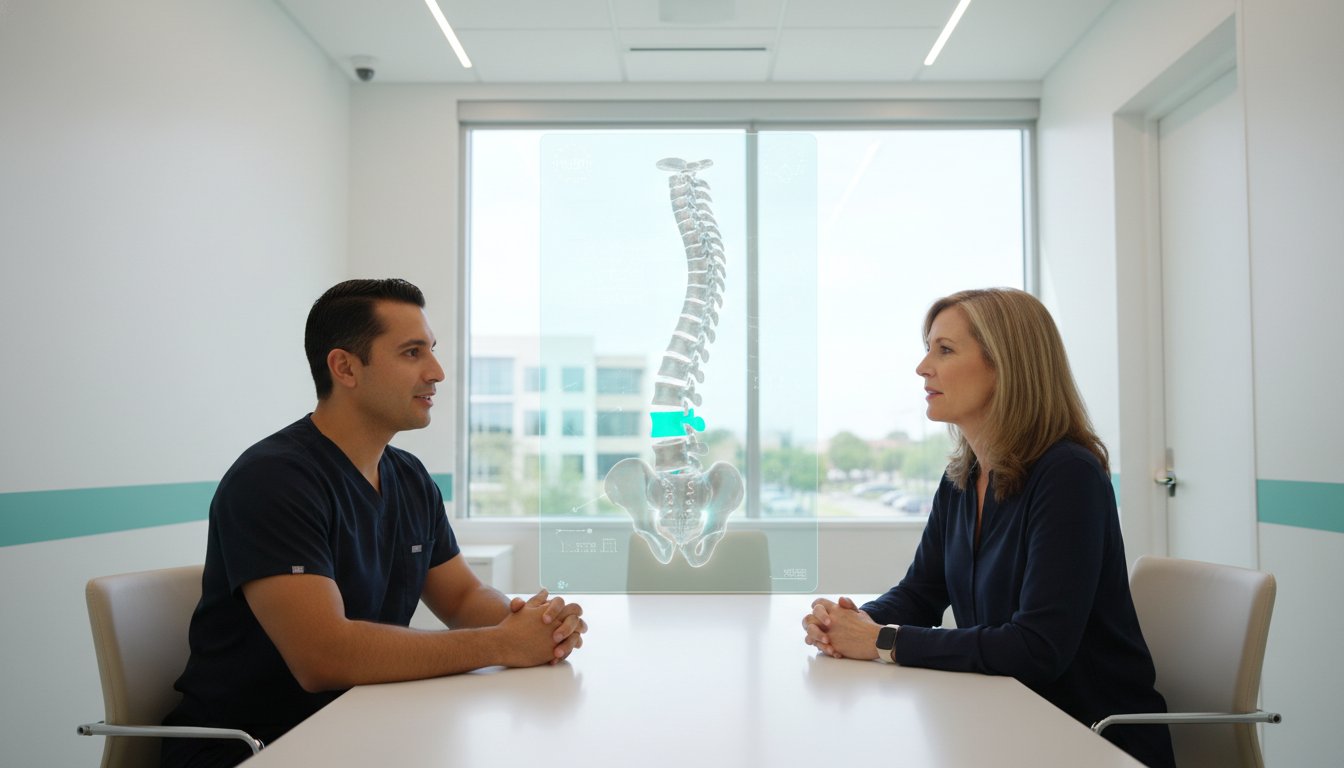
What if the surgery intended to fix your back actually becomes the reason you can no longer move with your natural, fluid grace? For years, patients have been told that a permanent fusion is the only path to relief, even if it means sacrificing flexibility and risking future issues like adjacent segment disease. It’s a heavy trade-off that causes understandable anxiety about long recovery times and the reality of living with permanent hardware in your spine.
In 2026, the clinical standard has shifted toward preserving your motion rather than locking it away. You can now access advanced alternatives to spinal fusion in Texas that prioritize your natural range of motion. We’re dedicated to helping you discover how minimally invasive techniques and artificial disc replacements can restore your quality of life without the limitations of traditional fusion. This article previews the latest motion-preserving innovations, including the TOPS System which has shown an 85% clinical success rate in trials. You’ll learn how these specialized procedures lead to a faster return to work and sports in Plano and Lewisville, allowing you to move beyond pain with informed confidence.
Key Takeaways
- Understand how motion-preserving surgeries prevent Adjacent Segment Disease, a common complication where neighboring discs wear out following a traditional fusion.
- Discover the benefits of Artificial Disc Replacement (ADR), which utilizes high-tech prosthetics to mimic natural spinal movement and maintain flexibility.
- Explore sophisticated alternatives to spinal fusion in Texas, including endoscopic techniques that allow for surgical precision through pencil-sized access points.
- Learn how the Globus Excelsius robotic navigation system enhances accuracy during minimally invasive procedures to ensure a faster return to normal activity.
- Access a practical checklist to help you discuss motion-preserving options with your surgeon and determine the best path for your recovery in Plano or Lewisville.
Beyond the Fusion: Why Patients Are Seeking Alternatives in 2026
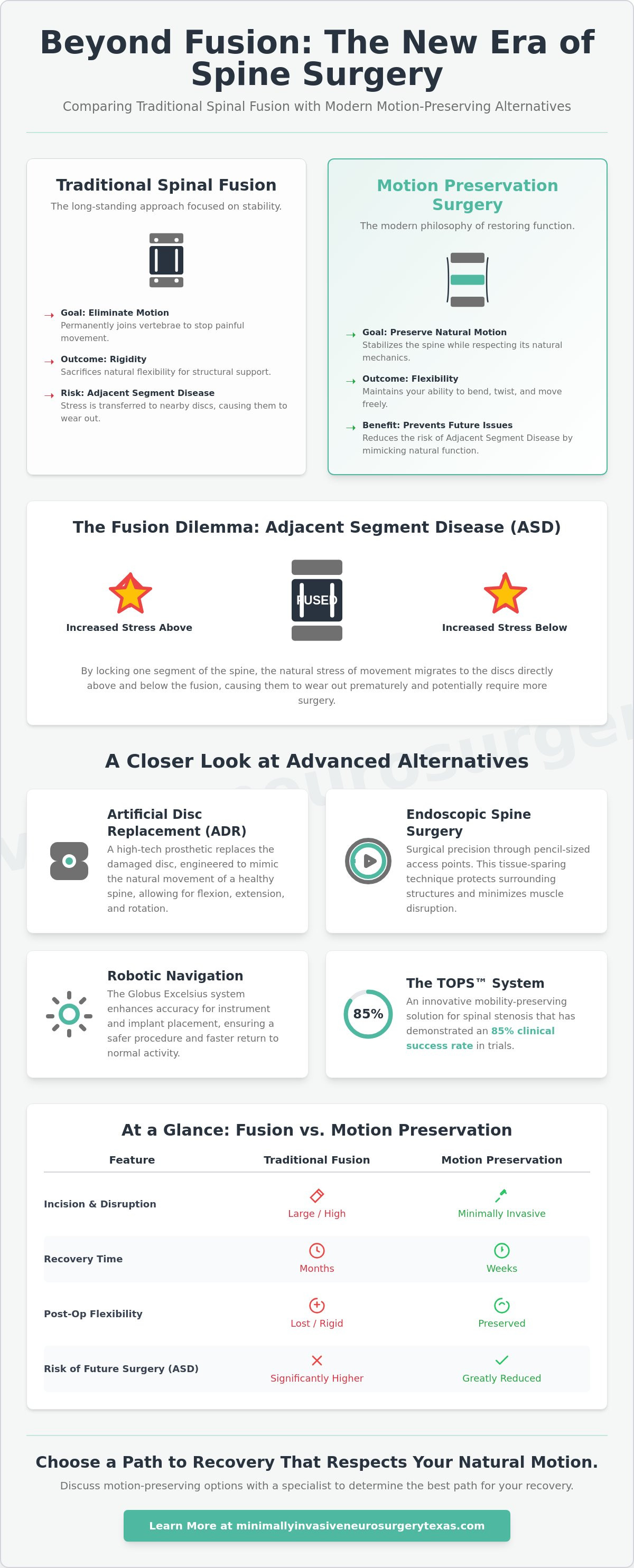
Spinal fusion involves the permanent joining of two or more vertebrae to eliminate painful motion. For decades, this procedure served as the primary solution for chronic back instability. While it successfully provides structural support, it creates what surgeons call the “Fusion Dilemma.” By locking segments of the spine together, the natural stress of movement doesn’t disappear; it simply migrates. This often results in Adjacent Segment Disease (ASD), where the discs directly above and below the fusion site wear out prematurely because they’re forced to compensate for the lost mobility.
In 2026, the Texas medical community has undergone a significant shift toward motion preservation. Patients are no longer satisfied with simply stopping the pain if it means sacrificing their ability to bend and twist. As more people research alternatives to spinal fusion in Texas, they’re finding that minimally invasive neurosurgery offers a more sophisticated path. These modern techniques focus on stabilizing the spine while respecting its natural mechanics, moving away from the “permanent hardware” approach that defined previous generations of spine care.
The Problem with Traditional Spinal Fusion
The loss of flexibility is the most immediate concern for patients undergoing traditional fusion. When multiple levels of the spine are fused, the resulting stiffness can make daily activities, such as tying shoes or reaching for a shelf, unexpectedly difficult. Traditional open-back surgery also requires large incisions that disrupt significant amounts of muscle tissue. This trauma leads to longer hospital stays and recovery periods that can stretch for months. Many individuals seeking new options have already experienced “failed back surgery syndrome,” a condition where traditional methods failed to provide lasting relief or created new biomechanical issues that require further intervention.
The Rise of Motion Preservation in North Texas
Modern spine care at MINT focuses on a clear, results-oriented goal: decompressing pinched nerves while maintaining the natural biomechanics of your body. Dr. Scott Kutz and his team prioritize tissue-sparing techniques that protect the delicate structures surrounding the spine. A cornerstone of this approach is Artificial Disc Replacement (ADR), which replaces a damaged disc with a high-tech prosthetic designed to mimic healthy movement. Motion preservation is the clinical philosophy of maintaining the spine’s natural ability to bend and twist. By utilizing these advanced methods, we help patients achieve a faster return to normal activity without the long-term restrictions of a rigid fusion.
Artificial Disc Replacement (ADR): Preserving Natural Spine Mobility
Artificial Disc Replacement (ADR) represents the pinnacle of motion preservation in modern neurosurgery. Unlike traditional fusion, which creates a rigid bridge between vertebrae, ADR involves replacing a diseased disc with a high-tech prosthetic. This device is engineered to mimic the natural movement of a healthy human disc, allowing for flexion, extension, and rotation. It’s a sophisticated solution for those who want to maintain their physical agility while eliminating chronic pain.
When we compare ADR to fusion, the primary distinction is mobility. Fusion eliminates motion at the surgical site to provide stability. ADR maintains it. This preservation is critical because it significantly reduces the risk of Adjacent Segment Disease (ASD). Because the prosthetic handles the mechanical load, the neighboring discs aren’t overworked. Additionally, ADR patients often experience a faster recovery and don’t require the bone grafting necessary for a successful fusion. It’s a key reason why patients seek alternatives to spinal fusion in Texas at our specialized center.
Success with these procedures depends heavily on the expertise of your surgical team. It is essential to choose a surgeon skilled in both cervical and lumbar disc replacement. Each region of the spine has unique biomechanical requirements. A specialist who understands these nuances can ensure the prosthetic is positioned with the absolute precision required for long-term success and a return to normal activity.
Cervical vs. Lumbar Disc Replacement
For many patients, neck disk replacement is the ideal solution to resolve chronic arm pain, weakness, or numbness caused by cervical disc herniation. In the lower back, lumbar ADR addresses debilitating pain while avoiding the heavy hardware associated with major fusions. In 2026, we utilize advanced prosthetic materials, including medical-grade titanium and specialized cobalt-chrome alloys. These components offer lifetime durability and a physiological response that feels natural to the patient. While ADR is highly effective, some cases benefit from Endoscopic Spine Surgery to address specific nerve compressions without the need for a full disc replacement.
Am I a Candidate for ADR?
Ideal candidates for ADR typically have healthy facet joints and single-level disc disease. If the joints behind the disc are severely arthritic, ADR may not be the best choice because the prosthetic requires healthy surrounding structures to function correctly. Patients with severe osteoporosis or multi-level instability might still require the structural support of a fusion. At our Plano clinic, we use high-definition MRI and specialized diagnostic imaging to assess your candidacy with absolute certainty. We prioritize your long-term health by ensuring the chosen procedure matches your specific anatomy.
Endoscopic Spine Surgery: The Precision Alternative to Traditional Fusion
Endoscopic spine surgery represents the ultra-minimally invasive frontier of modern back care. While traditional surgeries often require large incisions to visualize the spine, this technique utilizes a specialized camera about the size of a pencil. This endoscope allows surgeons to navigate through natural openings in the body to reach the source of pain with absolute certainty. By providing a high-definition view of the nerves and discs, we can treat herniated or bulging discs without the need for extensive tissue disruption or structural destabilization.
The primary reason patients seek alternatives to spinal fusion in Texas is the desire to avoid permanent hardware. Traditional fusion is often necessary because the surgeon must remove significant amounts of bone or ligament to access a pinched nerve, which leaves the spine unstable. Endoscopic methods change this equation entirely. If you don’t remove the bone to get to the nerve, you don’t have to fuse the bone back together. This approach maintains your natural anatomy and eliminates the need for the rods and screws that many patients fear.
Often referred to as “Band-Aid surgery,” endoscopic procedures are typically performed on an outpatient basis. The incision is so small it can often be closed with a single stitch and a small bandage. Because the surgeon isn’t cutting through major muscle groups, the physical impact on your body is drastically reduced. This precision allows for a sophisticated level of care that prioritizes your long-term mobility and comfort.
Endoscopic Discectomy and Foraminotomy
At our practice, endoscopic spine surgery is frequently used to address spinal stenosis and complex bulging discs. These procedures are designed to create space for the nerves by removing only the specific fragment of tissue causing the compression. We focus on sparing the vital muscles and ligaments that provide your spine with its inherent strength. Preserving spinal ligaments often eliminates the need for the stabilization hardware used in fusion.
Recovery: From Surgery to Plano Life in Days, Not Months
The timeline for recovery is perhaps the most striking difference between endoscopic care and traditional fusion. A typical fusion recovery can require six months of restricted activity and physical therapy. In contrast, most endoscopic patients experience a recovery timeline of approximately two weeks. Because tissue trauma is kept to an absolute minimum, there’s a significantly reduced need for post-operative opioids. This faster return to normal activity is a direct result of the high-precision tools we use. Performing these procedures requires specialized neurosurgical expertise and a commitment to the latest technological innovations in the field.
Is an Alternative Right for You? Evaluating Your Surgical Options
Choosing the correct surgical path is a significant milestone in your healthcare journey. It requires a sophisticated balance of clinical data and your personal lifestyle goals. While we’ve explored several alternatives to spinal fusion in Texas, the final determination rests on a meticulous diagnostic evaluation. Our clinical philosophy is simple: the “best” surgery is the most conservative intervention that successfully resolves the underlying pathology. We prioritize your long-term mobility by selecting the least invasive method that ensures a return to normal activity.
A common concern for many patients is whether a motion-preserving implant is “strong” enough to support the spine’s daily load. Modern prosthetics used in 2026 are engineered from medical-grade titanium and specialized polymers that provide structural integrity comparable to natural bone. These devices don’t just hold the spine together; they allow it to function as it was biologically designed. The goal isn’t just to stop the pain, but to restore a level of physical freedom that traditional, rigid fusions simply cannot match.
At MINT, our diagnostic process is rooted in absolute precision. We utilize high-resolution MRI to visualize soft tissue damage, CT scans for detailed bone architecture, and comprehensive physical exams to map your specific pain patterns. This data allows us to recommend a specialized treatment plan with informed confidence. If you’re ready to determine which procedure is right for your unique anatomy, schedule a consultation at our Plano or Lewisville clinic to begin your diagnostic journey.
When Fusion is Still the Best Choice
There are clinical scenarios where a minimally invasive spinal fusion Texas remains the gold standard for patient safety. Conditions like high-grade spondylolisthesis or severe spinal deformity often require the absolute stability that only a fusion can provide. However, a modern fusion at MINT is vastly different from the open-back surgeries of the past. We utilize the Globus Excelsius robotic navigation system to place hardware with sub-millimeter accuracy. This high-tech approach ensures that even when a fusion is necessary, it remains a tissue-sparing procedure with reduced physical impact.
Questions to Ask Your Texas Spine Surgeon
Advocating for your own health starts with asking the right questions during your consultation. We encourage our patients to be fully informed about their options. Consider asking the following during your visit:
- “Am I a clinical candidate for motion preservation or artificial disc replacement?”
- “What is my specific risk for adjacent segment disease if we proceed with a fusion?”
- “Do you utilize robotic navigation or endoscopic tools to minimize tissue trauma during this procedure?”
- “What is the expected timeline for me to return to my specific sport or profession?”
Why Choose MINT for Your Spinal Fusion Alternative in Plano and Lewisville
Minimally Invasive Neurosurgery of Texas (MINT) is defined by a commitment to professional excellence and personal attention. Led by Dr. Scott Kutz, our practice operates as a specialized boutique surgical center rather than a cold, impersonal hospital system. We recognize that your health is your top priority. This patient-centered approach ensures that every diagnostic journey begins with a focus on your specific quality of life goals. We maintain the professional distance necessary for a surgical practice while projecting the warm, compassionate reassurance you deserve during your recovery.
Our practice has become a premier destination for those researching alternatives to spinal fusion in Texas. We believe that permanent fusion should only be considered when more conservative, motion-preserving options have been exhausted. By specializing in “High-Tech Healing,” we provide our patients with access to the most advanced surgical methodologies available in 2026. This results-oriented rhythm moves you from a state of chronic pain to informed confidence, ensuring your treatment plan is tailored to your unique anatomy and lifestyle.
Advanced Technology: Globus Excelsius and Augmedics
Precision is the hallmark of modern neurosurgery. We utilize the Globus Excelsius robotic navigation system to ensure that every implant, whether in an ADR or a minimally invasive fusion, is placed with absolute accuracy. To further enhance safety, we incorporate Augmedics AR technology into our surgical suite. This augmented reality system provides the surgeon with a form of “X-ray vision” through the skin, allowing for real-time visualization of the spinal anatomy without the need for large incisions. These tools significantly reduce radiation exposure for the patient and lead to more predictable clinical outcomes and a faster return to normal activity.
Schedule Your Consultation in Plano or Lewisville
If you’ve been told that a traditional open fusion is your only option, we invite you to seek a second opinion at our clinic. Our offices in Plano and Lewisville are conveniently located for residents across the greater DFW area, offering world-class care close to home. We provide a streamlined diagnostic process that respects your time and prioritizes your long-term spinal health. Your path back to an active lifestyle begins with a specialized evaluation of your condition and a discussion about the latest motion-preserving innovations.
Schedule a consultation with Dr. Scott Kutz today to explore your options and reclaim your mobility without the need for permanent hardware.
Reclaim Your Mobility with Motion-Preserving Care
The landscape of spine care has evolved to prioritize your natural biomechanics. By choosing motion preservation over traditional rigid fusion, you protect the health of your entire spine and significantly reduce the risk of future complications like adjacent segment disease. Whether through advanced artificial disc replacement or ultra-minimally invasive endoscopic techniques, the goal remains a swift return to normal activity. These sophisticated alternatives to spinal fusion in Texas allow you to address the root cause of your pain without sacrificing your natural flexibility.
Dr. Scott Kutz is a board-certified neurosurgeon who specializes in these advanced methodologies. At MINT, we combine clinical expertise with the precision of the Globus ExcelsiusGPS™ robotic navigation system to ensure the highest standards of safety and accuracy. This high-tech approach ensures that your recovery is as efficient as possible, moving you from a state of concern to one of informed confidence. You don’t have to settle for the permanent hardware or the limitations of the past. Request an Appointment with Dr. Scott Kutz today to begin your journey toward a life without chronic back pain. We’re here to provide the optimistic, specialized care you need to move with strength once again.
Frequently Asked Questions
Is artificial disc replacement safer than spinal fusion?
Artificial disc replacement is generally considered as safe as fusion for the correct candidates, with the added benefit of preserving natural motion. It significantly reduces the long-term risk of adjacent segment disease, which is a frequent complication where vertebrae near a fusion site wear out. While every surgery carries risks, the motion-preserving approach avoids the permanent rigidity and bone grafting associated with traditional fusion procedures.
How long does recovery take for endoscopic spine surgery compared to fusion?
Recovery for endoscopic spine surgery is remarkably fast, typically allowing patients to return to normal activity within two weeks. In contrast, a traditional spinal fusion often requires six months or more of restricted movement and physical therapy. Because the endoscopic approach uses pencil-sized instruments and tiny incisions, there is minimal muscle trauma, which leads to less post-operative pain and a quicker return to work.
Will insurance in Texas cover alternatives to spinal fusion like ADR?
Most major insurance providers now offer coverage for alternatives to spinal fusion in Texas, including artificial disc replacement for specific clinical conditions. While many plans recognize these procedures as standard care, some newer technologies may require a prior authorization or an appeals process. We recommend verifying your specific benefits with your carrier or speaking with our billing specialists during your consultation in Plano or Lewisville.
Can I still have a fusion later if an alternative surgery fails?
Yes, choosing a motion-preserving procedure does not prevent you from having a spinal fusion in the future if it becomes medically necessary. One of the primary advantages of these alternatives is that they preserve your natural bone structure and anatomy for as long as possible. If your condition progresses or the initial implant fails, a traditional fusion remains a viable secondary option to provide permanent stability.
What is the success rate for motion-preserving spine surgery?
Success rates for motion-preserving implants are very high, with clinical trials for systems like the TOPS device showing an 85% clinical success rate. This is a significant improvement over the 64% success rate often reported for traditional fusion in comparable patient groups. These superior outcomes are largely due to the device’s ability to maintain natural spinal mechanics and reduce the mechanical stress placed on neighboring vertebrae.
Do I need a neurosurgeon or an orthopedic surgeon for these alternatives?
While both specialties perform spine surgery, neurosurgeons possess specialized training in the delicate management of the spinal cord and nerve roots. This expertise is vital for high-precision procedures like endoscopic surgery and artificial disc replacement where nerve decompression is the priority. Choosing a board-certified neurosurgeon ensures that your neural structures are protected using the most advanced microsurgical and robotic techniques available.
Is adjacent segment disease common after a spinal fusion?
Adjacent segment disease is a well-documented risk following traditional fusion because the locked vertebrae force the discs above and below to compensate for the lost motion. Studies indicate that a significant percentage of fusion patients may develop this condition within ten years of their surgery. Motion-preserving alternatives are specifically designed to distribute mechanical loads naturally, which helps prevent this secondary degeneration and the need for future surgeries.
How do I know if my DFW doctor is qualified to perform endoscopic surgery?
Qualification is determined by specialized fellowship training and a consistent track record with ultra-minimally invasive technology. You should look for a surgeon who utilizes advanced systems like the Globus ExcelsiusGPS and who maintains a specialized focus on minimally invasive neurosurgery. During your consultation, ask about their specific experience with endoscopic tools and their success rates in helping patients return to their specific sports or professions.