Minimally Invasive Neurosurgery of Texas (MINT), led by board-certified neurosurgeon Dr. Scott Kutz, provides advanced spinal care and artificial disc replacement in Lewisville and Plano, Texas. Chronic back pain is not an inevitable part of aging, yet many patients are told to simply endure it after a failed procedure. If you still struggle with mobility or find yourself stuck in a cycle of medication, it’s time to evaluate your provider. Recognizing the signs you need a new spine surgeon is the first step toward regaining your quality of life.
You likely feel frustrated when your concerns are dismissed or when your recovery plateaus. Dr. Scott Kutz, who is also a Fellow of the American Association of Neurological Surgeons and a Fellow of the American College of Surgeons, understands that persistent pain after initial treatment often signals a need for a more refined diagnostic approach. This article identifies the critical red flags in your current spinal care and explains how a specialized second opinion can transform your recovery. We will preview modern imaging techniques and minimally invasive alternatives to traditional fusion that prioritize your daily comfort and long-term mobility.
Key Takeaways
- Recognize communication red flags, such as when a provider dismisses your concerns or fails to explain imaging results in plain English.
- Understand why persistent pain after a procedure, known as failed back surgery syndrome, often requires a specialized second opinion for revision care.
- Identify signs you need a new spine surgeon when your current doctor lacks modern, minimally invasive alternatives like endoscopic spine surgery.
- Learn how Dr. Scott Kutz uses advanced motion-preserving technologies to help patients in Lewisville and Plano return to their normal activities.
- Discover how a precise diagnosis at MINT can overcome treatment plateaus and provide a clear path toward long-term relief.
What are the signs you need a new spine surgeon for your back care?
Patients in North Texas often start their journey with conservative care like physical therapy or injections. However, if symptoms persist, the quality of surgical intervention becomes the deciding factor in your recovery. One of the primary signs you need a new spine surgeon is when your current treatment plan reaches a plateau. This often happens when a provider relies on outdated protocols or lacks the specialized tools to address complex pathology. Minimally Invasive Neurosurgery of Texas (MINT), led by Dr. Scott Kutz, offers advanced care for residents in Lewisville and Plano who need a fresh perspective on their spinal health.
Dr. Scott Kutz is a board-certified neurosurgeon, a Fellow of the American Association of Neurological Surgeons, and a Fellow of the American College of Surgeons. His specialized training allows him to identify issues that general practitioners or less specialized surgeons might overlook. If you feel like just another number in a large hospital system, seeking a surgeon who prioritizes personalized attention and quality of life is essential for a successful outcome.
Defining the need for a specialized second opinion
A second opinion represents a standard of care in modern neurosurgery. It is not a sign of distrust; it is a proactive step toward health. Dr. Scott Kutz meticulously evaluates previous imaging and analyzes why prior treatments failed. This deep dive often uncovers missed diagnoses or subtle abnormalities, such as minor disc fragments or specific types of spinal stenosis. Choosing a surgeon who focuses exclusively on spinal health ensures your care aligns with the latest clinical advancements. Dr. Kutz brings his extensive credentials to every consultation to ensure patients understand every aspect of their diagnosis.
The difference between orthopedic spine and neurosurgery
While both orthopedic surgeons and neurosurgeons treat the spine, neurosurgeons undergo specific training focused on the spinal cord and nerve roots. This neurological focus is vital for patients experiencing nerve compression or sciatica. At MINT, the practice emphasizes minimally invasive spine techniques to protect delicate neural tissues. This specialized training often leads to better management of Persistent spinal pain syndrome (PSPS), where chronic pain persists despite previous interventions. Dr. Kutz uses his background to offer precision-driven care that prioritizes patient quality of life. The MINT practice moved its primary headquarters to Lewisville, TX, in 2026 to provide centralized, boutique care for patients across North Texas. You can learn more about our patient-centered philosophy on our about us page.
Communication breakdowns and lack of personalized care
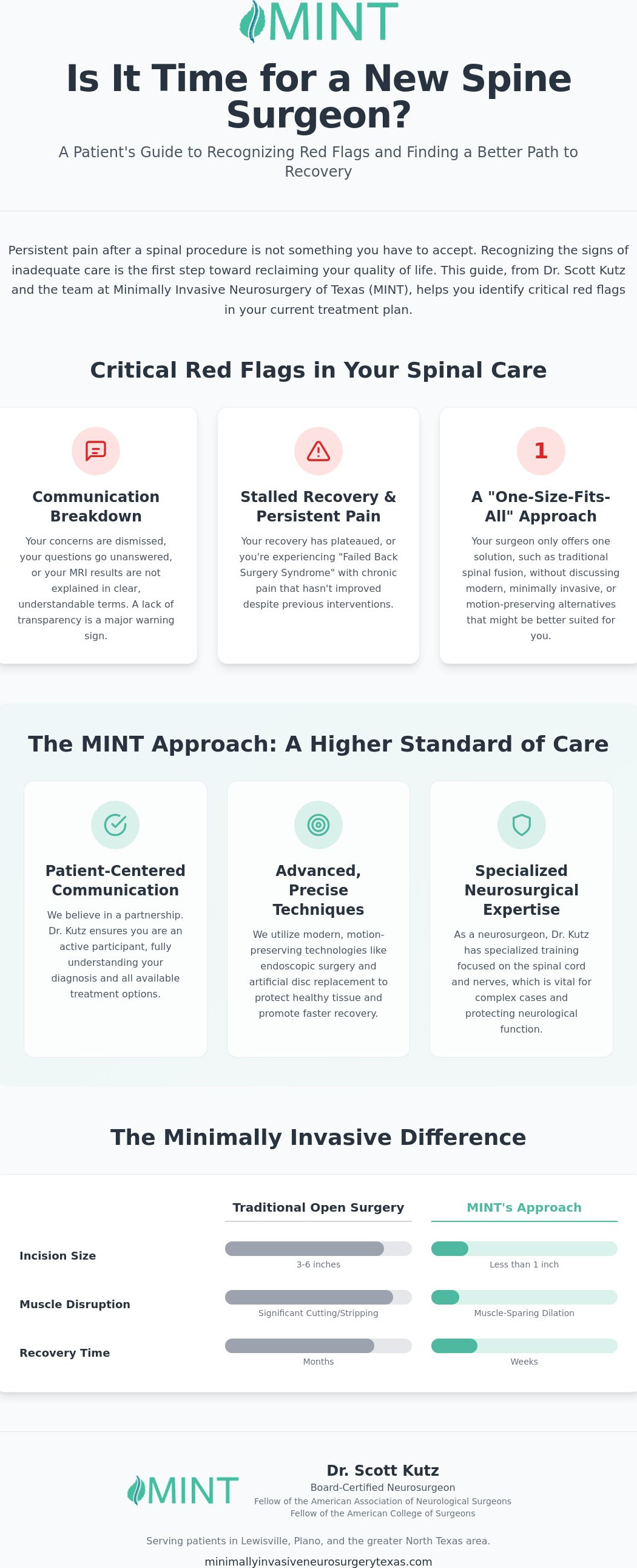
The relationship between a patient and their surgeon relies on mutual trust and absolute clarity. If your current provider dismisses your concerns or fails to explain your Magnetic Resonance Imaging (MRI), which uses magnets and radio waves to create detailed images of the spine, in plain English, these are clear signs you need a new spine surgeon. Dr. Scott Kutz prioritizes a patient-first communication philosophy at Minimally Invasive Neurosurgery of Texas (MINT). He ensures every individual understands their diagnosis completely before discussing any surgical intervention. A lack of transparency regarding potential surgical risks or realistic recovery timelines is a major red flag. Such behavior suggests you should look for care elsewhere in Lewisville or Plano where your health remains the primary focus.
Dr. Scott Kutz, a board-certified neurosurgeon and Fellow of the American College of Surgeons, believes in evidence-based spine care. In this model, the patient remains an active participant in the decision-making process. Clinical excellence requires more than technical skill; it requires a surgeon who listens to how pain impacts your daily quality of life and respects your individual recovery goals.
When your surgeon only offers one solution
A “one size fits all” approach to spinal health often leads to suboptimal outcomes and prolonged recovery. If your provider only suggests traditional spinal fusion, which involves joining two or more vertebrae to stop motion, you may be missing out on superior alternatives. Dr. Kutz offers a wide spectrum of care, ranging from conservative management to advancements in minimally invasive spine techniques. MINT focuses on motion-preserving surgical approaches, such as artificial disc replacement, rather than relying solely on traditional methods. This diversity in treatment options ensures that your surgical plan matches your specific pathology and long-term lifestyle needs.
Feeling rushed or unheard during clinical visits
Large hospital systems often prioritize patient volume over individual care, which leaves many individuals feeling like a number in a database. In contrast, the boutique environment at MINT provides specialized attention for residents across North Texas. This personalized focus allows for more precise surgical planning and significantly improved patient outcomes. When a surgeon takes the time to hear your specific story, they can tailor the recovery timeline to your occupation and lifestyle. You can see the direct impact of this approach by visiting the MINT testimonials page, where patients share their personal journeys toward relief. If you feel unheard in your current practice, you may want to schedule a consultation with a team that values your input and prioritizes your long-term wellness.
Persistent symptoms and failed back surgery syndrome
Surgery should ideally mark the end of your pain journey, but for some, it is merely a transition into a different type of discomfort. If you find that your mobility has not improved or your pain has actually intensified after an operation, these are significant signs you need a new spine surgeon. Failed back surgery syndrome (FBSS) occurs when a patient continues to experience chronic pain after a procedure. This condition often stems from a variety of factors, including a missed diagnosis, inadequate decompression of a nerve, or the natural progression of spinal disease in adjacent segments.
Persistent radiculopathy, which refers to radiating pain that travels from the spine into the arms or legs, suggests that the initial intervention did not fully resolve the neural compression. Structural changes in the spine can also progress despite treatment, requiring an expert neurosurgical evaluation to determine the next steps. Dr. Scott Kutz specializes in revision surgery for patients in Lewisville and Plano who did not find the relief they expected from their first surgeon. He brings a high-tech approach to these complex cases, ensuring that the second intervention addresses the root cause of the suffering.
Recognizing the signs of failed surgical intervention
Identifying why a surgery failed requires a keen clinical eye. Patients should watch for specific symptoms that indicate the need for a new evaluation:
- New or worsening weakness in the extremities.
- Numbness or tingling that does not resolve.
- A return of original pain levels after a brief period of relief.
- Limited range of motion that prevents a return to normal activity.
Improper hardware placement or the development of excessive scar tissue, also known as epidural fibrosis, can contribute to ongoing discomfort. Failed back surgery syndrome is a clinical condition that requires a highly specialized diagnostic approach to differentiate between mechanical failure and neurological issues.
The role of revision spine surgery
Revision surgery is inherently more complex than an initial procedure. Dr. Scott Kutz, a board-certified neurosurgeon and Fellow of the American College of Surgeons, uses advanced imaging like high-resolution CT scans and MRIs to identify the specific cause of a failed procedure. This precision allows him to plan a targeted intervention that avoids unnecessary trauma to the surrounding tissues. Choosing a board-certified neurosurgeon for these cases is essential; their specialized training in managing delicate neural structures is vital when navigating previously operated areas. MINT serves patients throughout the Dallas-Fort Worth Metroplex, including Southlake and Flower Mound, providing a source of optimism for those dealing with chronic physical conditions. By focusing on minimally invasive spine techniques, Dr. Kutz helps patients move toward a successful recovery and a return to their daily lives.
Advancements in minimally invasive spine techniques
Technology in neurosurgery evolves rapidly, and your surgeon’s tools should reflect that progress. One of the most telling signs you need a new spine surgeon is if your current provider only performs traditional open surgery. Traditional methods require large incisions and the detachment of muscles from the spinal column, which can lead to significant post-operative pain and extended hospital stays. Dr. Scott Kutz prioritizes Minimally Invasive Spine Surgery (MISS) to provide patients in Lewisville and Plano with a safer, more efficient path to recovery. These techniques offer smaller incisions, reduced blood loss, and a faster return to daily activities.
Precision is the hallmark of modern neurosurgery. Dr. Scott Kutz, a board-certified neurosurgeon and Fellow of the American Association of Neurological Surgeons, utilizes the Globus Excelsius robotic navigation system. This platform combines a rigid robotic arm with advanced software to ensure every screw and implant is placed with sub-millimeter accuracy. To further enhance safety, MINT employs Augmedics. This augmented reality platform allows Dr. Kutz to see the spinal anatomy in three dimensions through a specialized headset while he operates, ensuring he never loses sight of critical neural structures during the procedure.
Artificial disc replacement vs. traditional fusion
Traditional spinal fusion stops motion at a specific segment to treat pain, but it can increase stress on the levels above and below the site. Artificial disc replacement serves as a modern alternative that preserves the natural flexibility of your spine. This procedure involves removing a damaged disc and replacing it with a prosthetic device that mimics natural movement. Candidates for this motion-preserving surgery typically suffer from degenerative disc disease but still have healthy facet joints, which are the connections between the bones of the spine. Dr. Scott Kutz has performed these advanced procedures for 20 years, helping patients maintain their active lifestyles without the rigidity associated with traditional fusion.
The benefits of endoscopic spine surgery
Endoscopic spine surgery represents the absolute forefront of minimally invasive care. This technique uses a tiny camera, called an endoscope, to visualize the surgical field through an incision smaller than a thumbnail. It’s particularly effective for treating herniated discs and spinal stenosis with minimal tissue disruption. If your surgeon doesn’t offer endoscopic options, they may be providing outdated care that results in unnecessary trauma. You deserve access to the most refined surgical methodologies available today. If you’re ready to explore high-tech solutions for your back pain, contact our specialized boutique center to schedule your evaluation.
Why Dr. Scott Kutz is the preferred choice in Lewisville and Plano
Dr. Scott Kutz is a board-certified neurosurgeon, a Fellow of the American Association of Neurological Surgeons, and a Fellow of the American College of Surgeons. These credentials signify a rigorous commitment to the highest standards of surgical excellence and patient safety. In 2026, the MINT practice moved its primary headquarters to Lewisville, TX, to provide more centralized and advanced care for North Texas patients. Residents from Plano, McKinney, and Allen now have easier access to a surgeon who prioritizes motion preservation and the least invasive methodologies available. Recognizing the signs you need a new spine surgeon is essential if your current care has reached a plateau. Dr. Kutz offers the specialized expertise needed to navigate complex spinal pathology and previous surgical failures with a fresh, evidence-based perspective.
The clinical focus at MINT remains entirely on spinal health. By specializing in this specific area, the practice ensures a high volume of successful outcomes for complex procedures such as revision surgery and artificial disc replacement. Dr. Kutz maintains a boutique surgical environment that avoids the cold, impersonal atmosphere of large hospital systems. This personal attention allows for better surgical planning and ensures that every patient feels like an active participant in their own recovery journey.
Modern technology at the Lewisville headquarters
The Lewisville headquarters represents a significant investment in patient outcomes. Dr. Kutz utilizes Globus Excelsius robotic navigation, which allows him to plan a procedure with sub-millimeter accuracy. He also employs Augmedics, an augmented reality platform that provides a three-dimensional view of the patient’s anatomy during the procedure. These tools reduce the physical impact of surgery, leading to shorter recovery times and less reliance on post-operative medications. If you live in Lewisville or the surrounding areas, a comprehensive evaluation at this facility can reveal modern options your previous doctor may have missed.
Take the next step toward a pain-free life
Settling for persistent pain or a limited range of motion is not necessary. Dr. Scott Kutz focuses his entire clinical practice on spinal health, ensuring that every patient receives a tailored treatment plan designed for their specific lifestyle. We prioritize your long-term wellness and your ultimate goal: a return to normal activity. Recognizing that you need a new specialist is the first step toward reclaiming your independence. Take the next step toward a pain-free life today. Contact our office in Lewisville or Plano to schedule your consultation and find the advanced care you deserve.
Your Path to Lasting Relief and Mobility
Choosing the right provider is the most critical decision in your recovery journey. If you feel unheard or find that your current treatment has failed to deliver results, you don’t have to settle. Recognizing the signs you need a new spine surgeon allows you to transition from a state of chronic concern to informed confidence. Whether you’re dealing with a missed diagnosis or a previous surgical failure, a fresh perspective backed by modern innovation can change everything. You deserve a clinical partner who prioritizes your relief and uses the absolute forefront of surgical technology to ensure a successful outcome.
Dr. Scott Kutz is a board-certified neurosurgeon and a Fellow of the American Association of Neurological Surgeons with over 20 years of experience. As a specialist in Globus Excelsius robotic navigation, he provides the precision necessary for complex revision cases and motion-preserving procedures. Our team at MINT remains dedicated to your quality of life and your ultimate return to normal activity. Don’t let persistent pain dictate your future when advanced, minimally invasive solutions are available in Lewisville and Plano.
Schedule your specialized second opinion with Dr. Scott Kutz at MINT today. We are ready to help you move forward with a clear diagnosis and a customized plan for lasting health.
Frequently Asked Questions
How do I know if my current spine surgeon is giving me the best advice?
You can tell if advice is sound when your surgeon explains the pathology clearly and offers multiple treatment options beyond just fusion. If they dismiss your questions or push for surgery without trying conservative methods first, these are signs you need a new spine surgeon. Dr. Scott Kutz, a board-certified neurosurgeon, emphasizes evidence-based care where patient education is the priority. He ensures you understand the risks and benefits of every potential intervention.
Is it disrespectful to ask for a second opinion from a new spine surgeon?
It’s never disrespectful to ask for a second opinion; in fact, it’s a standard part of modern medical practice. Most surgeons expect patients to seek additional perspectives for major procedures to ensure the best outcome. Dr. Scott Kutz often provides second opinions in Lewisville and Plano to help patients feel confident in their diagnosis. This process helps you verify the medical necessity of a procedure and explore less invasive alternatives.
What should I bring to a consultation with a new neurosurgeon like Dr. Scott Kutz?
You should bring all recent imaging on a CD, your written surgical reports, and a list of previous treatments. Dr. Scott Kutz, a Fellow of the American Association of Neurological Surgeons, needs to review your actual MRI or CT scans rather than just the written report. Having a clear timeline of your symptoms and a list of current medications helps the MINT team create an accurate diagnostic profile during your first visit.
Can a new surgeon fix a failed back surgery from years ago?
Yes, a specialized neurosurgeon can often address complications from surgeries performed years ago through revision procedures. Dr. Scott Kutz evaluates the structural integrity of the spine and identifies issues like hardware failure or recurrent disc herniation. By using advanced robotic navigation at our Lewisville headquarters, he can navigate scar tissue to resolve chronic pain that previous operations failed to fix. This specialized care offers a new path toward mobility.
Why should I choose a minimally invasive specialist over a traditional surgeon?
Choosing a minimally invasive specialist like Dr. Scott Kutz ensures that your surgery involves less tissue disruption and smaller incisions. Traditional open surgery often requires stripping muscles from the bone, which causes more post-operative pain. At MINT, we use endoscopic and robotic techniques to target the problem specifically. This approach preserves your natural anatomy and reduces the risk of long-term complications like adjacent segment disease or excessive scarring.
What are the red flag symptoms that mean I need to see a spine surgeon immediately?
You must see a spine surgeon immediately if you experience a sudden loss of bladder or bowel control or significant leg weakness. These symptoms may indicate cauda equina syndrome, which is a medical emergency where the nerve roots are severely compressed. Other urgent signs you need a new spine surgeon include progressive numbness or radiating pain that prevents you from standing. Prompt intervention is vital to prevent permanent nerve damage.
Does Dr. Scott Kutz treat patients who have already had multiple back surgeries?
Dr. Scott Kutz frequently treats patients who have already undergone multiple back surgeries without success. As a Fellow of the American College of Surgeons, he has the expertise to manage complex cases involving extensive scar tissue and previous hardware. He focuses on identifying the specific source of persistent pain to determine if a revision procedure or a motion-preserving alternative like artificial disc replacement can finally provide the relief you need.
How long does it take to recover from a minimally invasive procedure compared to open surgery?
Recovery from a minimally invasive procedure typically takes a few weeks, whereas traditional open surgery can require several months of healing. Many patients at our Plano and Lewisville clinics return to light activity within days of a minimally invasive decompression. Because we minimize muscle trauma, you experience less pain during the initial healing phase. This faster timeline allows you to resume your normal activities and physical therapy much sooner than traditional methods.