Minimally Invasive Neurosurgery of Texas (MINT) is a specialized surgical practice led by Dr. Scott Kutz, a board-certified neurosurgeon and Fellow of the American Association of Neurological Surgeons (AANS). With primary locations in Lewisville and Plano, TX, MINT focuses on motion-preserving treatments for complex spine conditions. Dr. Scott Kutz provides advanced care to patients from surrounding areas like Allen, McKinney, and Southlake who seek relief from debilitating back and leg symptoms.
What if you could resolve chronic leg pain without the trauma of a traditional open back operation? You likely feel exhausted by the persistent numbness that limits your ability to walk even short distances. It’s normal to fear invasive procedures that require lengthy hospital stays and large incisions. This article helps you understand how lumbar stenosis surgery Plano TX uses cutting-edge, minimally invasive techniques to decompress, or remove pressure from, your nerves with minimal tissue disruption. You’ll learn the specific differences between endoscopic and traditional surgery and discover how Dr. Kutz uses his specialized experience to help you return to your favorite activities with a faster recovery timeline.
Key Takeaways
- Understand how lumbar spinal stenosis, which refers to the narrowing of the spinal canal, causes chronic leg pain and when you require surgical intervention.
- Discover how lumbar stenosis surgery Plano TX at MINT utilizes smaller incisions to reduce muscle damage and accelerate your return to daily activities.
- Learn about specialized procedures like laminectomy and foraminotomy that decompress nerves and widen exit points without the trauma of traditional open surgery.
- Explore the accelerated recovery timeline where most patients begin walking within hours of their procedure and experience significantly less post-operative pain.
- Identify why board-certified neurosurgeon Dr. Scott Kutz provides specialized, motion-preserving spine care for patients in Lewisville and Plano.
What Is Lumbar Spinal Stenosis and When Is Surgery Necessary?
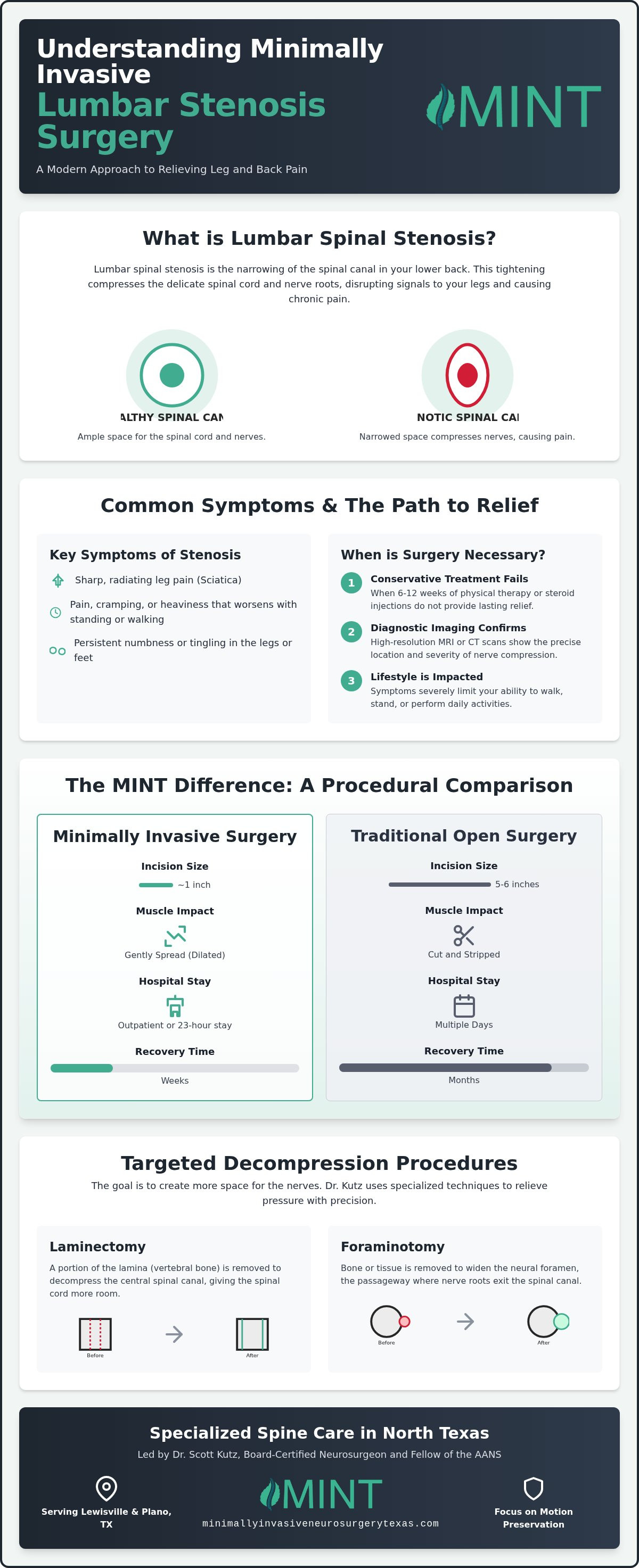
Lumbar spinal stenosis describes the abnormal narrowing of the spinal canal in your lower back. This canal serves as a protective tunnel for your spinal cord and nerve roots. When the space within this tunnel shrinks, the surrounding bone or ligaments press against the delicate neural tissues. This compression interferes with the signals traveling between your brain and your lower body. Patients often experience a heavy sensation in their legs, persistent tingling, or cramping that worsens when they stand or walk for long periods.
Surgery becomes a necessary consideration when these symptoms begin to dictate your lifestyle. Most patients first attempt conservative management, such as targeted physical therapy or epidural steroid injections, for at least six to twelve weeks. If these methods do not restore your mobility or reduce your pain, Dr. Scott Kutz may recommend lumbar stenosis surgery Plano TX. Surgical intervention aims to create more space for the nerves, which effectively stops the cycle of chronic inflammation and pain. At Minimally Invasive Neurosurgery of Texas (MINT), we prioritize techniques that stabilize the spine while relieving pressure.
Symptoms of Neural Foraminal Stenosis
Neural foraminal stenosis involves the narrowing of the neural foramina, which are the small exit windows on the sides of your vertebrae. These openings allow nerve roots to branch out from the spinal cord to reach your legs. When these paths tighten, you may feel a sharp, radiating pain known as sciatica. This discomfort often travels from the lower back through the buttock and down the back of the leg. Dr. Scott Kutz carefully evaluates your physical response to movement to determine if foraminal narrowing is the primary source of your distress. Understanding the exact location of the nerve compression allows for a more targeted surgical approach that preserves healthy tissue.
The Role of Diagnostic Imaging
Accurate diagnosis requires high-resolution imaging to see inside the complex spinal structure. Dr. Kutz utilizes MRI and CT scans to visualize the precise degree of spinal narrowing. MRI (Magnetic Resonance Imaging) scans use powerful magnets to create detailed images of soft tissues like nerves and discs, while CT (Computed Tomography) scans provide a clear look at bony changes. These diagnostic tools are essential for patients visiting MINT in Lewisville or Plano. Dr. Kutz reviews these images to develop a precision surgical plan tailored to your unique anatomy. You can learn more about our commitment to precision on our about us page. Detailed imaging ensures that your lumbar stenosis surgery Plano TX addresses the specific blockage with maximum accuracy.
The Advantages of Minimally Invasive Techniques for Spinal Narrowing
Traditional open back surgery requires a large incision and the forceful detachment of muscles from the spinal column. This invasive process often leads to significant tissue scarring and a lengthy, painful rehabilitation period. In contrast, lumbar stenosis surgery Plano TX at Minimally Invasive Neurosurgery of Texas utilizes advanced tubular retractors to reach the spine. These tools allow Dr. Scott Kutz to dilate, or gently move aside, the back muscles instead of cutting them. This muscle-sparing approach leaves the stabilizing structures of your spine intact and significantly reduces the physical impact of the operation.
Patients experience significantly less post-operative pain because the surgical site remains small and localized. This technique also drastically reduces the risk of blood loss and surgical site infections for our patients in Plano and Lewisville. According to an authoritative explanation of spinal stenosis, the primary objective of treatment is to relieve pressure on the neural elements. Dr. Kutz achieves this goal with higher precision and less collateral damage to healthy tissues than traditional methods allow. This approach transforms a major operation into a streamlined procedure that prioritizes your comfort and safety.
Motion Preservation vs Spinal Fusion
Dr. Kutz prioritizes motion-preserving surgical approaches to maintain the natural flexibility of your vertebral column. Many traditional operations rely on spinal fusion, which joins two or more vertebrae together to eliminate movement in that section. While fusion is sometimes necessary, it frequently leads to adjacent segment disease. This condition occurs when the spinal levels above and below the fused area experience accelerated wear and tear due to increased mechanical stress. By utilizing options like artificial disc replacement, Dr. Kutz helps you retain your mobility and protects the long-term health of your entire spine.
Precision Technology at MINT
Our facility integrates the Globus Excelsius robotic navigation system to enhance the accuracy of every procedure. This technology provides a real-time, three-dimensional digital map of your unique spinal anatomy. We also employ Augmedics augmented reality (AR) headsets. This specialized equipment allows Dr. Kutz to visualize your internal structures through the skin and muscle, acting like a high-tech guide for surgical instruments. These innovations ensure that every movement is precise, which maximizes patient safety and improves clinical outcomes. If you want to learn more about our advanced care, you can reach out to our clinical staff to discuss your specific symptoms.
Specific Minimally Invasive Procedures for Lumbar Stenosis
Dr. Scott Kutz uses precision-guided instruments to perform lumbar stenosis surgery Plano TX, focusing on the specific areas where bone spurs or thickened ligaments compress your nerves. He tailors each procedure to the patient’s unique anatomy to ensure the best possible relief from leg pain and numbness. By targeting only the tissues causing the compression, Dr. Kutz preserves the structural integrity of the spine while restoring your ability to walk and move without discomfort.
A minimally invasive laminectomy relieves pressure by removing the lamina, which is the bony arch on the back of your vertebra. If the compression occurs where the nerve exits the spine, Dr. Kutz performs a foraminotomy to widen the neural foramen, or the bony exit window. He accesses the spine through narrow tubes called tubular retractors. This method allows him to work between muscle fibers rather than cutting through them. Because of this refined approach, most patients return home the same day as their surgery.
Endoscopic Spine Surgery Benefits
Dr. Kutz often recommends endoscopic spine surgery for patients who require the least invasive option possible. During this procedure, the surgeon inserts an endoscope, or a tiny camera, through an incision smaller than a thumbnail. This camera provides a high-definition view of the spinal canal, which allows for extreme precision when removing obstructive tissue. This ultra-minimally invasive technique follows an evidence-based treatment algorithm for lumbar stenosis that prioritizes maximum nerve decompression with minimal physical trauma.
Robotic Assisted Decompression
Robotic technology further enhances the safety and accuracy of decompression procedures at MINT. Robotic arms guide Dr. Kutz with sub-millimeter precision, ensuring that he removes only the necessary bone or ligament tissue. This level of accuracy reduces the need for repeated X-rays during the operation, which lowers your exposure to radiation. Dr. Kutz combines his 20 years of experience with these robotic systems to ensure the most predictable clinical outcomes for your lumbar stenosis surgery Plano TX.
Recovery Timeline and Post-Operative Care in North Texas
Recovery begins immediately after your lumbar stenosis surgery Plano TX. Most patients at Minimally Invasive Neurosurgery of Texas (MINT) stand and begin walking within hours of their operation. This early mobility prevents blood clots and helps the body process anesthesia more efficiently. Because Dr. Scott Kutz uses muscle-sparing techniques, your body does not have to repair large areas of torn tissue. This streamlined recovery process allows you to return to the comfort of your own home the same day or following a brief observation period.
The first week focuses on short, frequent walks around your home to maintain circulation. During weeks two and three, you can typically increase your activity level to include light household chores and short trips outside. Many patients find that their preoperative leg pain disappears almost instantly, though some mild soreness near the incision is normal. By the fourth week, most individuals transition back to their daily routines with significantly improved mobility. MINT provides this specialized post-operative care to patients across Plano, Dallas, and Flower Mound, ensuring every individual reaches their recovery milestones safely.
Managing Post-Operative Pain
Smaller incisions and reduced muscle disruption significantly lower the intensity of post-operative pain. This approach often reduces the need for heavy narcotic pain medications, which can cause grogginess or digestive issues. Dr. Kutz recommends ice therapy for the first 48 hours to minimize local swelling and soothe the surgical site. Gentle movement also serves as a natural pain reliever by preventing stiffness in the lower back. The MINT clinical team provides constant support and clear instructions to help you manage initial discomfort effectively. You can read about the experiences of others in our patient testimonials to see how quickly others regained their quality of life.
Returning to Work and Exercise
Your professional and athletic goals dictate the specific timing of your return to full activity. Patients with sedentary desk jobs often return to work within one to two weeks, provided they can stand and stretch periodically. If your job requires heavy lifting or repetitive bending, Dr. Kutz may recommend a longer period of light duty to protect the healing spine. Athletic activities like golf or swimming usually require a six-week waiting period to ensure the structural integrity of the surgical site. Dr. Kutz provides personalized clearance based on your unique healing progress and physical demands. If you feel ready to address your chronic back pain, schedule a consultation with our team to discuss your surgical options.
Consulting Dr. Scott Kutz at MINT for Specialized Spine Care
Minimally Invasive Neurosurgery of Texas (MINT) provides world-class surgical care for patients suffering from degenerative spinal conditions. Dr. Scott Kutz leads our practice with a philosophy that centers on the patient’s long-term quality of life and a return to normal activity. He understands that chronic leg pain and numbness can feel overwhelming, which is why he prioritizes lumbar stenosis surgery Plano TX using the most advanced, muscle-sparing techniques available today. Our practice focuses on relieving your suffering through precision-driven care that minimizes the physical impact on your body. Patients from across North Texas choose MINT because we offer the high-tech capabilities of a large hospital within a compassionate, boutique environment.
Our clinical team guides you through a logical, results-oriented diagnostic journey. We begin by acknowledging your health as our top priority and then move into a technical explanation of specialized surgical methodologies that fit your unique needs. Dr. Kutz uses his 20 years of experience to ensure that every patient feels informed and confident before moving forward with treatment. By highlighting motion-preserving approaches over traditional fusion, we help you maintain your flexibility and prevent future complications in adjacent areas of the spine.
Why Board Certification Matters
Board certification represents the highest level of certified authority and professional excellence in the field of neurosurgery. It ensures that your surgeon has completed the most rigorous training and maintains a mastery of cutting-edge technology. Dr. Scott Kutz is a board-certified neurosurgeon and a Fellow of the American Association of Neurological Surgeons (AANS). This designation reflects his commitment to clinical authority and the successful outcomes of his patients. You can learn more about his credentials and the mission of our practice on our About Us page. Choosing a board-certified specialist provides you with the reassurance that your surgeon operates at the absolute forefront of modern surgical innovation.
Scheduling Your Visit in Plano or Lewisville
MINT offers convenient access to specialized spine care through our headquarters in Lewisville and our satellite office in Plano. We also serve residents in McKinney, Allen, and Southlake who seek a specialized local physician rather than a cold hospital system. Our team streamlines the process for new patient evaluations and provides detailed second opinions for those considering lumbar stenosis surgery Plano TX. We review your MRI (Magnetic Resonance Imaging) and CT (Computed Tomography) scans with extreme precision to determine the exact cause of your nerve compression. Whether you require an endoscopic laminectomy or a robotic-assisted decompression, we provide the specialized care necessary to help you reclaim your daily life without pain.
Reclaim Your Mobility with Precision Spine Care
The path to a life without chronic leg pain begins with an accurate diagnosis and a commitment to advanced surgical innovation. You don’t have to accept the limitations of spinal narrowing as a permanent part of your life. By choosing minimally invasive lumbar stenosis surgery Plano TX, you benefit from smaller incisions and a significantly faster return to your daily activities. Board-certified neurosurgeon Dr. Scott Kutz utilizes the Globus Excelsius robotic navigation system to achieve sub-millimeter precision during every decompression, or the removal of pressure from the nerves. This specialized focus on motion preservation protects the long-term health of your spine and helps prevent the accelerated wear of adjacent vertebrae.
Dr. Kutz and the MINT team serve patients throughout North Texas, including Allen, McKinney, and Southlake, from our convenient offices in Plano and Lewisville. We prioritize your recovery and comfort through every stage of your surgical journey. You can take the first step toward lasting relief by speaking with our clinical staff about your specific symptoms. Our 20 years of surgical experience ensure that you receive the highest standard of specialized care.
Schedule your consultation with Dr. Scott Kutz at MINT today to start your journey back to an active, pain-free lifestyle. We look forward to helping you regain your quality of life.
Frequently Asked Questions
Is lumbar stenosis surgery safe for elderly patients in Plano?
Minimally invasive techniques make surgery significantly safer for older adults. Spinal stenosis is the most common reason for spine surgery in patients over the age of 65. Because Dr. Scott Kutz uses smaller incisions and avoids the trauma of traditional open procedures, the physical stress on the body is lower. This approach reduces the risk of heart or lung complications and allows for a much faster recovery process.
How much time will I spend in the hospital after minimally invasive surgery?
Most patients spend only a few hours in the surgical center before returning home the same day. Minimally invasive lumbar stenosis surgery Plano TX typically functions as an outpatient procedure. Because Dr. Kutz preserves the back muscles and stabilizing ligaments, you don’t require the multi-day hospital stays associated with traditional open surgery. You will begin walking shortly after the procedure and recover in your own home.
Can lumbar stenosis return after I have the surgery?
While surgery effectively removes the current blockage, narrowing can occasionally develop at a different level of the spine over time. Recurrence at the exact same surgical site is rare. Dr. Scott Kutz focuses on motion preservation to prevent adjacent segment disease, which is the accelerated wear of the spinal levels above or below the treated area. Maintaining a healthy weight and performing regular core exercises helps prevent future narrowing.
What happens if I leave spinal stenosis untreated?
Untreated spinal stenosis often leads to progressive nerve damage and a significant loss of mobility. You may experience worsening leg weakness, permanent numbness, or a condition called cauda equina syndrome. This syndrome occurs when the nerves at the base of the spinal cord become severely compressed, potentially causing loss of bowel or bladder control. Early intervention at MINT prevents these irreversible neurological deficits and preserves your daily independence.
How long does the actual lumbar decompression procedure take?
A standard minimally invasive decompression procedure typically takes between 45 and 90 minutes to complete. The exact duration depends on the number of spinal levels that require treatment and the severity of the narrowing. Dr. Kutz uses tubular retractors, which are narrow tubes that create a path to the spine, to perform the work efficiently. This streamlined process minimizes the time you spend under anesthesia and reduces overall surgical risk.
Is minimally invasive surgery better than traditional open surgery for stenosis?
Minimally invasive techniques offer several advantages, including less post-operative pain and a faster return to work. Traditional open surgery requires a large incision and the detachment of muscles from the bone. This leads to more scarring and a longer recovery. Dr. Kutz utilizes robotic navigation to achieve the same decompression goals as open surgery but through much smaller openings, which preserves the natural stability of your spine.
Can Dr. Scott Kutz perform surgery without using spinal fusion?
Dr. Kutz prioritizes decompression procedures that avoid spinal fusion whenever possible. Spinal fusion involves joining two vertebrae together with hardware, which eliminates motion. By performing a laminectomy or foraminotomy, Dr. Kutz removes only the bone or ligament tissue causing the pressure. This preserves your natural range of motion and reduces the likelihood of developing pain in the neighboring sections of your spinal column, helping you maintain a more active lifestyle.
What is the success rate for endoscopic lumbar stenosis surgery?
Clinical studies and patient outcomes at MINT show that endoscopic decompression provides high satisfaction rates and effective pain relief. Most patients experience an immediate reduction in leg pain and a significant improvement in walking distance. While individual results vary, the use of a high-definition endoscope, or a tiny camera, allows Dr. Kutz to verify that the nerve is completely free from compression before finishing the procedure.