Did you know that up to 30% of chronic lower back pain cases are actually caused by the sacroiliac joint rather than the spine itself? If you’ve spent months struggling with debilitating pain every time you stand or walk, you know how frustrating it is when conservative treatments fail to provide lasting relief. At Minimally Invasive Neurosurgery of Texas, we believe you deserve a precision-engineered solution that helps you get back to life. This guide explores how modern si joint fusion surgery utilizes advanced MISS techniques to stabilize the joint and eliminate the source of your suffering.
We understand the fear surrounding surgical recovery, but 2026 clinical data shows that 80-90% of patients achieve meaningful pain relief with these innovative methods. You’ll learn exactly what to expect from the process, including the latest FDA-cleared technologies like the TiLink™ Navigation system and the specific diagnostic steps required for a successful outcome. We’ll preview the journey from your first consultation in Plano or Lewisville to your final milestone of pain-free movement, giving you the confidence to move forward with expert care and a clear path toward long-term recovery.
Key Takeaways
- Learn how specialized diagnostic tests, such as Gaenslen’s and Patrick’s maneuvers, confirm if your pain originates in the sacroiliac joint.
- Understand how si joint fusion surgery utilizes robotic-assisted navigation and titanium implants to provide permanent joint stability.
- Discover a recovery roadmap that’s designed for same-day discharge and a brief period of protected weight-bearing to ensure proper healing.
- Explore how our MISS approach minimizes tissue trauma, making it easier for you to get back to life without the long waits of traditional surgery.
- Gain confidence in choosing a board-certified specialist in Plano or Lewisville who prioritizes precision and patient-centered care.
What is SI Joint Fusion Surgery and Why is it Necessary?
Sacroiliac (SI) joint fusion is a specialized stabilization procedure designed to eliminate painful motion between the sacrum and the ilium. Your sacrum sits at the base of your spine, while the ilium bones form the wings of your pelvis. These structures are bound together by some of the strongest ligaments in the human body. When these ligaments become lax or the joint surfaces degrade, the resulting instability creates a cycle of chronic inflammation. Modern si joint fusion surgery addresses this by using medical-grade titanium implants to bridge the joint, allowing bone to grow across the space and create a single, solid structure. It’s a “High-Tech Healer” solution that restores the structural integrity of your pelvic girdle.
Several factors can lead to the breakdown of this critical junction. Trauma from a fall or a motor vehicle accident is a frequent culprit, as it can overstretch the supporting ligaments. For many women, postpartum changes lead to persistent joint laxity that doesn’t resolve after childbirth. Additionally, degenerative arthritis can wear down the articular cartilage, leading to bone-on-bone friction. Regardless of the cause, the objective remains the same: stop the abnormal movement to stop the pain.
Identifying Sacroiliac Joint Dysfunction
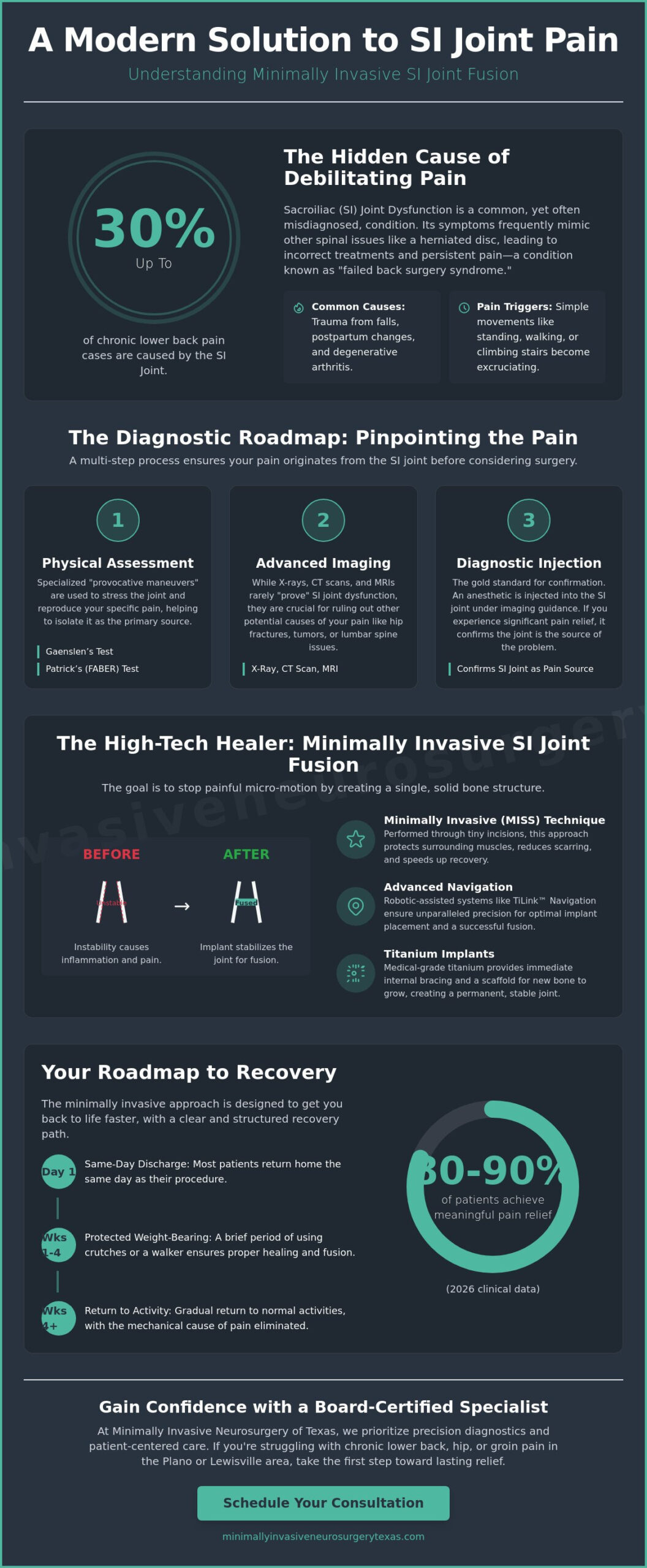
The challenge with SI joint issues is that they often mimic other conditions. The pain is typically “referred,” meaning you feel it in your lower back, groin, or down the back of your thigh, which frequently leads to a misdiagnosis of a lumbar disc herniation. This joint is your body’s primary shock absorber, responsible for transferring the weight of your upper body to your legs during movement. When it’s dysfunctional, simple tasks like climbing stairs or standing from a seated position become excruciating. It’s a well-documented reality that Surgery for the dysfunctional sacroiliac joint is often considered for patients who have already undergone unsuccessful lumbar procedures. In fact, SI joint dysfunction is a leading cause of what clinicians call “failed back surgery syndrome.”
The Goal of Stabilization
The primary enemy in SI joint disorders is micro-motion. Because this joint is only intended to move a few millimeters, even slight instability causes the surrounding nerves to fire in distress. This constant friction keeps the area in a state of chronic inflammation. By performing a si joint fusion surgery, we provide the immediate internal bracing necessary to halt this motion. We utilize Minimally Invasive Spine Surgery (MISS) techniques to achieve this stabilization through tiny incisions, which protects the surrounding muscle tissue. This precision-focused approach is the key to helping you get back to life. Once the joint is fused, the mechanical cause of your pain is removed, allowing you to walk, sit, and sleep without the constant shadow of discomfort.
How to Determine if SI Joint Fusion is Your Best Path
Determining if you’re a candidate for si joint fusion surgery requires a meticulous diagnostic roadmap. Because SI joint pain so closely mimics lumbar spine disorders, we don’t rely on a single test. At Minimally Invasive Neurosurgery of Texas, our process begins with a comprehensive physical assessment in our Plano or Lewisville offices. We utilize a series of “provocative maneuvers” designed to stress the sacroiliac joint specifically. These include Gaenslen’s test, where one leg is extended while the other is flexed to the chest, and Patrick’s (FABER) test, which involves rotating the hip outward. According to Yale Medicine, these tests are essential for reproducing the patient’s familiar pain, helping us isolate the joint as the primary culprit.
While physical exams provide vital clues, we use diagnostic imaging to rule out other potential causes. X-rays, CT scans, and MRIs are used to evaluate the structural integrity of your pelvic bones and the surrounding soft tissues. It’s important to understand that imaging alone rarely “proves” SI joint dysfunction; instead, its primary role is to ensure your pain isn’t coming from a hip fracture or a tumor. If you’ve been struggling with localized hip and back pain, reaching out to a specialist at Minimally Invasive Neurosurgery of Texas is the first step toward clarity.
The Diagnostic Injection: The Gold Standard
The most definitive part of our roadmap is the diagnostic SI joint injection. Think of this as a “test drive” for your surgery. Under precise fluoroscopic (X-ray) guidance, we inject a local numbing agent directly into the joint. We then ask you to keep a detailed pain diary for the next several hours. We look for a 75-80% reduction in your baseline pain while the anesthetic is active. If you experience significant relief during this window, it confirms that the joint is the source of your agony and that a permanent stabilization procedure will likely be successful.
Ruling Out Lumbar Issues
Dr. Scott Kutz carefully evaluates the lumbar spine concurrently with the SI joint. This is critical because many patients suffer from “tandem” issues where both the spine and the SI joint contribute to their discomfort. We distinguish between radiculopathy, which is nerve pain radiating from the spine, and true SI joint pain, which is mechanical and typically stays above the knee. In some cases, a patient might actually require information on what is back fusion surgery if the primary pain generator is a degenerative disc. Patients who want a comprehensive overview of their spinal treatment options can also consult our detailed resource on lumbar spine surgery in 2026 for North Texas patients to better understand how robotic-assisted navigation and modern techniques compare across different spinal conditions. By ruling out these sibling conditions, we ensure that your si joint fusion surgery is only performed when it’s the most effective path for you to get back to life.
The Minimally Invasive SI Joint Fusion Procedure: Step-by-Step
Once your diagnostic roadmap confirms that the sacroiliac joint is the primary source of your pain, we move forward with a precision-focused surgical plan. At Minimally Invasive Neurosurgery of Texas, we’ve refined the si joint fusion surgery into a streamlined, high-tech procedure that prioritizes your safety and long-term recovery. You’ll be placed under general anesthesia for your comfort, and the surgical team will position you prone on a specialized table. This setup provides the optimal angle for our robotic-assisted systems to map your unique pelvic anatomy with incredible detail.
The hallmark of our MISS approach is the size of the access point. We create a single incision, usually only 2 to 3 centimeters long, on the side of the buttock. This small window allows us to reach the joint without the extensive muscle stripping required in traditional open surgeries. Clinical reviews, such as Minimally Invasive Sacroiliac Joint Fusion: The Current Evidence, confirm that these refined techniques significantly reduce blood loss and post-operative discomfort compared to older surgical paradigms. Patients who want to understand how these same principles apply to spinal conditions can explore our guide on minimally invasive spinal fusion Texas specialists use to achieve lasting stability with smaller incisions.
Advanced Navigation with Globus Excelsius
Our commitment to being a “High-Tech Healer” is best demonstrated through our use of the Globus Excelsius robotic navigation system. This technology allows Dr. Kutz to achieve sub-millimeter accuracy when placing your implants. By syncing real-time imaging with robotic guidance, we ensure that every titanium component is positioned perfectly within the hard bone of the ilium and sacrum. This level of precision is vital for avoiding sensitive sacral nerves and reducing the risk of post-surgical irritation. Additionally, robotic navigation drastically reduces the patient’s exposure to radiation because we don’t need to rely on continuous X-ray loops to verify our progress.
The Fusion Mechanism
The stabilization itself is achieved by placing triangular titanium implants across the joint space. These aren’t just simple screws; they feature a specialized porous surface designed for osseointegration. This is a biological process where your natural bone actually grows into and around the metal. To accelerate this bond, we often pack the area with high-quality bone graft material. Over the following months, this biological bridge turns the two separate bones into one stable unit, permanently eliminating the micro-motion that caused your chronic pain. We finish the procedure with a meticulous layered closure technique. This method supports the deep tissues and skin independently, resulting in a smaller scar and helping you get back to life with minimal physical evidence of the si joint fusion surgery.
Your Roadmap to Recovery: Navigating Post-Operative Milestones
Recovery from si joint fusion surgery is a structured journey designed to protect the integrity of your new implants while allowing your body to heal. Because we utilize MISS techniques, the immediate post-operative phase is significantly shorter than traditional methods. Most patients qualify for same-day discharge, though some may require a single-night stay for observation. You’ll leave our facility with a clear set of instructions tailored to your specific needs, ensuring you have the support required to begin your path back to life.
The first 2 to 4 weeks are defined by “protected weight-bearing.” During this time, you’ll use a walker or cane to reduce the stress on the operative side. This precaution is vital. It allows the titanium implants to begin the process of osseointegration without being disturbed by the full force of your body weight. As you progress, we’ll guide your transition into physical therapy, where you’ll focus on gentle core strengthening and pelvic stability exercises. If you’re ready to start this journey, contact our North Texas team to discuss your options.
Weeks 1-6: The Healing Phase
Early stabilization is the cornerstone of a successful outcome. We often recommend wearing an SI belt, which provides external compression to the pelvic ring. This device acts as a secondary support system while the internal fusion takes hold. During these initial six weeks, you must adhere to strict activity restrictions. This means no heavy lifting (nothing over 10 pounds), no excessive twisting of the torso, and an absolute avoidance of high-impact activities like running. It’s normal to feel some surgical soreness, but it’s important to distinguish this from the symptoms of failed SI joint fusion, such as a sudden return of sharp, stabbing pain or new neurological deficits.
Months 3-6: Getting Back to Life
By the third month, your recovery enters a transformative stage. We’ll perform follow-up imaging, typically X-rays, to confirm that bone is successfully growing across the joint space. This radiographic evidence is the green light for many patients to increase their activity levels. Your “return to work” timeline depends on your profession. Those with sedentary office jobs often return within 3 to 4 weeks, while those in physically demanding roles may need the full 3 to 6 months to ensure the fusion is robust. The long-term benefits of si joint fusion surgery are profound. Patients consistently report a significant reduction in chronic pain and a renewed ability to engage in the daily activities they once feared.
While complications are rare, you should always monitor for red flags. Contact your specialist in Lewisville or Plano immediately if you experience persistent fever, redness at the incision site, or a sudden loss of bowel or bladder control. These signs require prompt clinical evaluation to ensure your recovery stays on track.
Why Choose MINT for Your SI Joint Fusion in Plano and Lewisville
Choosing where to undergo si joint fusion surgery is a decision that directly impacts your long-term quality of life. At Minimally Invasive Neurosurgery of Texas (MINT), we combine the precision of a world-class surgical center with the personalized attention of a boutique practice. Dr. Scott Kutz, a board-certified neurosurgeon, has dedicated his career to perfecting Minimally Invasive Spine Surgery (MISS) techniques. His expertise ensures that every patient receives care that isn’t just advanced but is also tailored to their specific anatomical needs. We don’t believe in a one-size-fits-all approach; we believe in precision medicine that helps you get back to life.
Our commitment to being a “High-Tech Healer” means we invest in the most sophisticated systems available in modern medicine. While many facilities rely on standard imaging, we utilize the Augmedics xvision™ Augmented Reality (AR) system alongside Globus ExcelsiusGPS® robotics. These tools provide Dr. Kutz with a “GPS” for the human body, allowing for sub-millimeter accuracy during the placement of titanium implants. This technological edge is a hallmark of our practice, ensuring that your si joint fusion surgery is performed with the highest level of safety and efficiency possible.
Local Care for North Texas Residents
Residents of Plano, Lewisville, and the broader DFW metroplex don’t need to navigate a massive, impersonal hospital system to find elite neurosurgical care. MINT provides a specialized, community-focused environment where your health is our top priority. We coordinate closely with local physical therapists throughout North Texas to ensure your post-operative rehabilitation is seamless and effective. This local synergy is critical for a successful recovery. If you’ve been told your leg pain is “sciatica” but traditional treatments haven’t provided relief, it’s time for a specialized evaluation. Many of our patients discover that their chronic discomfort is actually sacroiliac in origin, requiring the targeted stabilization we provide.
A Commitment to Better Outcomes
Our ultimate brand promise is helping you enjoy every single day of your life. We take particular pride in our success with patients who have previously undergone “failed back surgeries” elsewhere. By correctly identifying the SI joint as the primary pain generator, we can offer a solution where others have failed. The MINT difference lies in our comprehensive diagnostic roadmap and our dedication to using the least invasive methods possible to achieve permanent stability. We invite you to experience the relief that comes from expert, compassionate care. Schedule your consultation at MINT today and take the first step toward a future without chronic pain.
Reclaim Your Mobility and Comfort
Living with chronic lower back and hip pain shouldn’t be your permanent reality. By following a structured diagnostic roadmap and utilizing the precision of si joint fusion surgery, you can finally address the root cause of your discomfort. We’ve explored how advanced robotic navigation and minimally invasive techniques have transformed this procedure into a streamlined path to stability. You now understand that the right diagnosis, coupled with world-class technology like the Globus Excelsius system, makes all the difference in your surgical outcome.
Board-certified neurosurgeon Dr. Scott Kutz and the team at MINT are dedicated to helping you get back to life through specialized MISS care. With convenient locations in Plano and Lewisville, you don’t have to travel far for innovative medical solutions. Our boutique, patient-centered approach ensures you’re never just a number in a large hospital system. Take the first step toward a pain-free life—book your appointment at MINT. Your journey to lasting relief starts with a single consultation. We look forward to helping you enjoy every single day of your life again.
Frequently Asked Questions
How long does SI joint fusion surgery take?
The procedure typically takes between 45 and 60 minutes to complete. Because we utilize advanced robotic navigation and minimally invasive techniques, the surgical process is highly efficient. This shorter operative time reduces your exposure to anesthesia and helps you begin your recovery journey sooner.
Is SI joint fusion considered a major surgery?
SI joint fusion is a significant stabilization procedure because it involves the use of titanium implants to fuse the pelvic ring. However, our MISS approach means we use much smaller incisions than traditional open methods. This reduces tissue trauma and blood loss, allowing most patients to return home the same day or after a single-night stay.
What is the success rate of minimally invasive SI joint fusion?
Clinical data indicates that 80% to 90% of patients achieve clinically meaningful pain relief after si joint fusion surgery. This high success rate is largely due to our meticulous diagnostic process. By ensuring the joint is the true pain generator before operating, we maximize the likelihood of a successful, life-affirming outcome.
When can I drive after SI joint fusion surgery?
Most patients can resume driving within 2 to 4 weeks following the procedure. You must be completely off all narcotic pain medications and feel strong enough to perform an emergency brake maneuver without hesitation. We’ll evaluate your specific mobility during your post-operative follow-up in Plano or Lewisville to ensure you’re ready.
Will SI joint fusion surgery limit my flexibility or range of motion?
You shouldn’t notice a significant change in your overall flexibility or ability to move. The sacroiliac joint is a low-motion joint that naturally only moves about 2 to 4 millimeters. Fusing this joint eliminates the painful micro-motion without impacting the range of motion you use for daily activities like bending, sitting, or walking.
How do I know if my pain is from my SI joint or a herniated disc?
Disc pain often radiates below the knee and is frequently accompanied by numbness or weakness in the foot. SI joint pain typically stays localized in the buttock or upper thigh and is triggered by standing or climbing stairs. We use specialized provocative maneuvers and diagnostic injections to confirm the source of your suffering with absolute certainty.
Does insurance typically cover SI joint fusion surgery?
Most major insurance providers, including Medicare, cover si joint fusion surgery when specific medical necessity criteria are met. Generally, you must demonstrate that you’ve failed at least six months of conservative treatments and had a positive response to a diagnostic injection. Our administrative team helps navigate these requirements to ensure you receive the care you need.
What happens if SI joint fusion surgery fails?
If a fusion fails to provide the expected relief, we first investigate whether the bone successfully bridged the joint space using advanced imaging. Dr. Kutz specializes in evaluating complex cases and “failed back surgery syndrome” to determine if a revision or a different treatment path is necessary. We remain a beacon of hope for those who haven’t found relief elsewhere.