Minimally Invasive Neurosurgery of Texas (MINT) provides specialized care for complex spinal conditions under the direction of Dr. Scott Kutz, a board-certified neurosurgeon and Fellow of the American Association of Neurological Surgeons (AANS) and the American College of Surgeons (ACS). From our clinics in Plano and Lewisville, Texas, our team delivers advanced minimally invasive spine surgery designed to return patients to their normal activities quickly and safely.
Did you know that modern minimally invasive techniques for the mid-back now boast success rates as high as 95 percent for relieving chronic pain? You likely feel a heavy burden of anxiety regarding the complexity of the thoracic spine and the potential for nerve compression. We promise to clarify your path to recovery by detailing the most advanced thoracic herniated disc treatment options currently available in 2026. This guide previews everything from conservative management to the use of the Sonopet ultrasonic device. This high-tech tool allows Dr. Kutz to remove calcified disc material with extreme precision, often turning a complex procedure into an outpatient experience that prioritizes your long-term mobility and comfort.
Key Takeaways
- Understand why thoracic herniations of the nucleus pulposus are rare because the rib cage provides significant spinal stability.
- Learn why conservative care and specialized physical therapy protocols remain the safest first step for most patients.
- Identify neurological red flags like progressive weakness that signal the need for immediate surgical evaluation.
- Discover high-tech thoracic herniated disc treatment options like the Sonopet ultrasonic device and minimally invasive neurosurgery.
- Gain insight into how Dr. Scott Kutz applies precision technology at MINT in Plano and Lewisville to help patients achieve a rapid return to normal activity.
Understanding Thoracic Herniated Discs and Their Unique Challenges
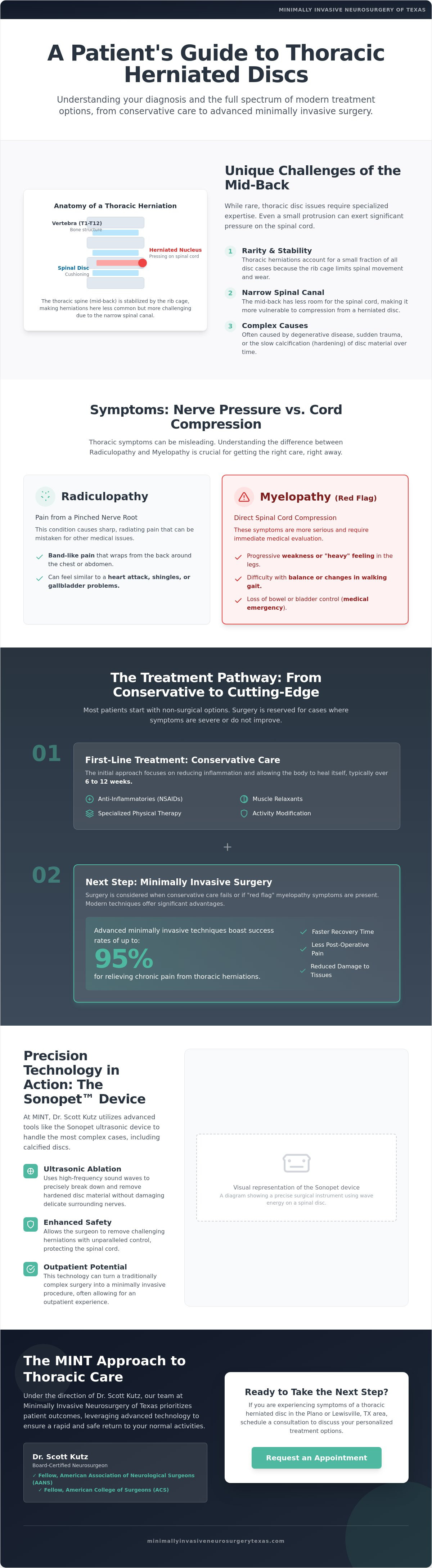
A thoracic disc herniation occurs when the nucleus pulposus, the soft inner material of a spinal disc, escapes through a tear in the annulus fibrosus, the tough outer layer. This specific condition occurs in the T1 through T12 region of the mid-back. While disc issues are common in the neck and lower back, thoracic herniated discs account for only a small fraction of clinical cases. The rib cage provides an external support system that limits movement and reduces the daily wear and tear seen in more mobile spinal segments.
Despite their rarity, these herniations present unique clinical challenges that require specialized expertise. The spinal canal in the thoracic region is significantly narrower than in the lumbar spine. This anatomical reality means even a minor protrusion can exert dangerous pressure on the spinal cord. Dr. Scott Kutz, a board-certified neurosurgeon and Fellow of the American Association of Neurological Surgeons (AANS) and the American College of Surgeons (ACS), emphasizes that these cases require extreme precision. Common causes include degenerative disc disease, sudden trauma, or the gradual calcification of disc material over many years. Identifying the right thoracic herniated disc treatment options early is essential to protect long-term nerve function.
Anatomy of the Mid-Back (T1-T12)
The thoracic vertebrae serve as the primary anchors for the rib cage and protect the most vulnerable portion of the spinal cord. The thoracic spinal segment is the longest portion of the spine. Unlike the large, mobile discs in the lower back, thoracic discs are thinner and designed for stability rather than flexibility. This structural rigidity helps maintain your posture but makes any internal pressure from a herniation more impactful on the surrounding neural structures. At Minimally Invasive Neurosurgery of Texas, we focus on preserving this stability during every procedure.
Symptoms: Radiculopathy vs. Myelopathy
Patients often struggle to find a diagnosis because thoracic symptoms frequently mimic other medical emergencies. Radiculopathy typically manifests as a sharp, band-like pain that radiates from the back around the chest or abdomen. This sensation can feel like a heart attack or gallbladder issue, leading many patients in Plano and Lewisville to seek help at an emergency room before realizing the problem is spinal.
In more severe cases, patients may experience myelopathy, which indicates direct spinal cord compression. You should watch for these specific warning signs:
- Progressive weakness or “heavy” feelings in the legs.
- Difficulty with balance or a sudden change in your walking gait.
- Numbness or tingling that travels down the torso or legs.
- Loss of bowel or bladder control, which constitutes a medical emergency.
When these symptoms appear, Dr. Kutz utilizes minimally invasive neurosurgery to address the compression while minimizing the physical impact on the patient. Understanding these distinctions helps you move from a state of concern to a state of informed confidence regarding your recovery path.
Non-Surgical Thoracic Herniated Disc Treatment Options
Most patients diagnosed with a mid-back disc issue begin their recovery journey with conservative care. This “wait and see” approach typically lasts six to twelve weeks, as many herniations naturally resorb or shrink over time. During this period, the primary goal involves managing inflammation to allow the body to heal. Physicians frequently prescribe non-steroidal anti-inflammatory drugs (NSAIDs) to reduce swelling around the nerve root. If spasms occur in the mid-back, muscle relaxants provide relief, while neuropathic agents specifically target the burning or tingling sensations associated with nerve irritation.
The clinical team at Minimally Invasive Neurosurgery of Texas prioritizes these conservative thoracic herniated disc treatment options before recommending any surgical intervention. We focus on a multi-modal approach that combines medication with lifestyle adjustments to maximize your comfort and mobility. By reducing the chemical irritation of the nerve, many patients in Plano and Lewisville find they can return to their daily routines without the need for an operating room.
Targeted Physical Therapy and Activity Modification
Physical therapy for the thoracic spine focuses on stabilization rather than just flexibility. Therapists design specific exercises to strengthen the paraspinal muscles, which act as a natural brace for the vertebrae. Strengthening these muscles reduces the mechanical load on the damaged disc. Postural correction plays a vital role here; sitting or standing with proper alignment alleviates the constant pressure on the T1-T12 segment. We also guide patients through “active rest.” This involves avoiding high-impact activities, such as heavy lifting or twisting, while maintaining gentle movement to prevent the joints from becoming stiff and painful.
Interventional Pain Management
When oral medications fail to provide sufficient relief, interventional procedures offer a more targeted solution. Epidural steroid injections (ESI) deliver concentrated anti-inflammatory medication directly into the epidural space near the affected nerve. Specialists perform these procedures using fluoroscopy, which is a type of real-time X-ray imaging. This technology ensures the medication reaches the exact site of the herniation with pinpoint accuracy.
These injections serve both diagnostic and therapeutic purposes. If the injection successfully eliminates the pain, it confirms the specific disc level responsible for your symptoms. While the relief from a single injection can last for several months, it’s a tool to facilitate physical therapy rather than a permanent cure for a mechanical defect. If you continue to struggle with radiating pain despite these efforts, you may want to explore advanced surgical alternatives that provide a more definitive solution.
When is Surgery Necessary? Evaluating Your Risk
Deciding between conservative care and surgical intervention requires a careful assessment of neurological function. While many patients find relief through the non-surgical thoracic herniated disc treatment options discussed earlier, certain “red flag” symptoms demand immediate attention. If you experience progressive weakness in your legs, persistent numbness, or a sudden loss of bowel and bladder control, the situation has become urgent. These symptoms indicate significant spinal cord compression that medications cannot resolve.
Timing plays a critical role in thoracic cases because the spinal canal in this region is naturally narrow. Delaying treatment when neurological deficits appear increases the risk of permanent nerve damage. Most clinical protocols suggest a six to twelve week window for conservative therapy. If your quality of life remains severely compromised by intractable pain despite these efforts, Dr. Scott Kutz, a board-certified neurosurgeon and Fellow of the American Association of Neurological Surgeons (AANS) and the American College of Surgeons (ACS), may recommend a surgical consultation. At Minimally Invasive Neurosurgery of Texas, we prioritize your safety by intervening before temporary symptoms become permanent disabilities.
Diagnostic Imaging: MRI and CT Myelogram
Magnetic Resonance Imaging (MRI) remains the gold standard for visualizing soft tissues, allowing Dr. Kutz to see the exact position of the disc material relative to the spinal cord. Thoracic discs frequently undergo calcification, where the herniated material hardens over time. A CT Myelogram provides essential details about these hardened structures that a standard MRI might miss. These high-tech imaging tools allow our team in Plano and Lewisville to map a precise surgical path, which is vital for a successful outcome in minimally invasive spine surgery.
The Decision-Making Framework
Surgery functions as a last resort for patients unless they exhibit clear neurological deficits. We weigh the risks of a surgical procedure against the very real risks of continued spinal cord compression, which can lead to myelopathy. Dr. Kutz evaluates your specific diagnostic journey, including your response to previous therapies and the severity of your imaging results. This authoritative approach ensures that every patient in North Texas cities like Dallas and McKinney receives a personalized plan focused on a safe return to normal activity. By choosing a specialist who understands the complexity of the thoracic spine, you move from a state of concern to a state of informed confidence.
Minimally Invasive Surgical Options for Thoracic Discs
Surgery becomes the necessary path when conservative measures fail to protect the spinal cord. Modern thoracic herniated disc treatment options have evolved significantly, moving away from large incisions toward precise, microscopic interventions. Dr. Scott Kutz utilizes advanced minimally invasive neurosurgery techniques to address herniations with minimal disruption to the surrounding muscle and bone. These procedures allow us to achieve decompression while preserving the natural stability of the mid-back.
Endoscopic Thoracic Discectomy represents the peak of this evolution. By using an incision smaller than a centimeter and a specialized high-definition camera, Dr. Kutz can remove the damaged disc material without disturbing the spinal cord. Similarly, microdiscectomy employs high-powered microscopes to provide enhanced visualization of the neural structures. These methods result in significantly reduced blood loss and a faster return to daily activities compared to traditional surgery. Patients often find that the precision of these tools transforms a once-daunting surgery into a manageable recovery process.
Endoscopic vs. Traditional Open Surgery
Historically, surgeons found the thoracic spine difficult to access from a posterior approach without performing a rib resection. This invasive step involved removing a portion of the rib to create a window to the spine, which increased post-operative pain and recovery time significantly. Modern minimally invasive techniques allow us to navigate around the ribs. While traditional open surgery often requires a hospital stay of three to five days, many of our patients in Lewisville and Plano return home the same day or after a single overnight stay. This shift reduces the physical impact of the surgery and lessens the risk of hospital-acquired infections.
Advancements in Surgical Navigation
Precision is paramount in the thoracic spine due to the proximity of the heart and lungs. At Minimally Invasive Neurosurgery of Texas, we integrate robotic-assisted navigation using the Globus Excelsius system. This technology allows for hardware placement that is accurate to within a millimeter, providing a level of safety that traditional manual methods cannot match. We also utilize Augmented Reality (AR) through systems like Augmedics, which allows Dr. Kutz to “see through” the anatomy using a digital overlay during the procedure. These high-tech hallmarks ensure that we operate at the absolute forefront of modern surgical innovation. If you are ready to discuss these advanced solutions, schedule a consultation at MINT today.
The MINT Approach to Thoracic Care in Plano and Lewisville
Minimally Invasive Neurosurgery of Texas (MINT) provides a specialized environment where high-tech innovation meets personal, patient-centered care. Dr. Scott Kutz, a board-certified neurosurgeon and Fellow of the American Association of Neurological Surgeons (AANS) and the American College of Surgeons (ACS), leads our practice with a focus on clinical excellence. We understand that exploring thoracic herniated disc treatment options can feel overwhelming for those dealing with radiating rib pain or mobility fears. Our team simplifies this journey by offering advanced diagnostics and low-impact surgical solutions in our boutique Plano and Lewisville facilities. This local access to world-class technology ensures that patients from Dallas and McKinney receive elite spinal care without the coldness of a large hospital system.
Why Specialized Neurosurgical Care Matters
Choosing a neurosurgeon for mid-back issues provides a distinct clinical advantage. While general orthopedic surgeons often handle bone-related conditions, neurosurgeons specialize in the delicate interface between the spinal cord and the surrounding structures. At MINT, we utilize the latest FDA-approved robotic systems to ensure the highest levels of safety and precision. We apply the same motion-preservation philosophies found in neck disk replacement to our thoracic care. Our goal remains the preservation of healthy tissue and the restoration of natural movement. This focus on minimally invasive neurosurgery allows patients to recover with less physical impact and a faster return to their daily lives.
Preparing for Your Consultation at MINT
Your first visit marks the transition from a state of concern to a state of informed confidence. We ask that you bring any previous imaging, such as an MRI or CT scan, along with a detailed history of your symptoms and previous treatments. Dr. Kutz performs a thorough neurological exam to assess your reflexes, strength, and sensation; this ensures we identify the precise source of your pain. This hands-on evaluation, combined with our high-resolution diagnostic tools, allows us to determine if your condition requires surgical intervention or if conservative therapies remain the safest path. We treat your health as our top priority and ensure you understand every step of your personalized recovery plan. If you are ready to reclaim your mobility, schedule your consultation with Dr. Scott Kutz today.
Common Questions About Thoracic Recovery
How long does recovery take after a minimally invasive thoracic procedure?
While every patient is different, most individuals undergoing a minimally invasive discectomy at our Lewisville or Plano centers return home within 24 hours. You can typically resume light office work within one to two weeks. Full recovery and a return to high-impact activities generally occur within six to twelve weeks, depending on your adherence to physical therapy protocols. Our team provides a rhythmic, results-oriented follow-up schedule to monitor your progress and ensure a successful clinical outcome.
Secure Your Path to Spinal Recovery
Recovery from a mid-back injury requires a balance of patience and clinical precision. You now understand how modern thoracic herniated disc treatment options prioritize spinal cord safety through advanced imaging and microscopic techniques. Whether your journey begins with targeted physical therapy or requires the millimeter-accuracy of the Globus Excelsius robotic navigation system, the goal remains a return to your normal daily activity. Dr. Scott Kutz, a board-certified neurosurgeon and Fellow of the AANS and ACS, applies these specialized methodologies to ensure every patient in Plano and Lewisville receives the most effective care available.
Don’t let the fear of complex surgery prevent you from seeking relief from radiating pain or weakness. At Minimally Invasive Neurosurgery of Texas, we combine clinical authority with a compassionate, patient-centered approach. Our focus on minimally invasive neurosurgery reduces recovery times and protects healthy tissue, giving you a clear path forward. If you are ready to move from a state of concern to informed confidence, we invite you to Request an Appointment with Dr. Scott Kutz at MINT. Your health and mobility are our top priorities, and we look forward to helping you achieve a pain-free future.
Frequently Asked Questions
Can a thoracic herniated disc heal on its own without surgery?
Most thoracic herniated discs heal on their own through a natural process called resorption. This happens when the body’s immune system identifies the escaped disc material as a foreign object and gradually breaks it down. Conservative management typically lasts six to twelve weeks. During this time, patients in Plano and Lewisville use non-surgical methods to manage pain while the body repairs the annulus fibrosus naturally.
What is the most common symptom of a herniated disc in the thoracic spine?
The most common symptom is radiating pain that travels in a band-like pattern around the chest or abdomen. This sensation, known as radiculopathy, happens when the herniated material irritates a specific nerve root. Because this pain often mimics heart or gallbladder issues, a thorough neurological exam at MINT is essential for an accurate diagnosis. Patients may also feel localized mid-back pain directly over the site of the injury.
Is thoracic spine surgery more dangerous than lumbar surgery?
Thoracic spine surgery historically carried higher risks than lumbar surgery due to the narrowness of the spinal canal and the proximity of the heart and lungs. However, modern thoracic herniated disc treatment options utilize minimally invasive techniques that significantly lower these risks. By using specialized cameras and robotic navigation, Dr. Scott Kutz can access the mid-back with extreme precision, avoiding the need for invasive rib resections and protecting the delicate spinal cord.
How long is the recovery period after a minimally invasive thoracic discectomy?
Patients typically experience a fast recovery after a minimally invasive thoracic discectomy, with many returning home the same day or after one overnight stay. You can usually return to light office work within one to two weeks. Full recovery, including a return to strenuous exercise or heavy lifting, generally takes six to twelve weeks. This timeline depends on your commitment to a specialized physical therapy program designed to stabilize the mid-back.
Can a thoracic herniated disc cause leg weakness or walking difficulties?
Yes, a thoracic herniated disc can cause leg weakness, balance issues, or walking difficulties if the disc material compresses the spinal cord. This condition is called myelopathy. Because the thoracic spinal canal is narrow, even a small herniation can impact the nerves that control the lower body. If you notice a “heavy” feeling in your legs or a change in your gait, seek an immediate evaluation from a board-certified neurosurgeon in Lewisville or Dallas.
What exercises should I avoid with a thoracic herniated disc?
You should avoid high-impact activities and exercises that involve significant twisting or bending of the mid-back. Heavy weightlifting, especially overhead presses or deadlifts, can increase the intradiscal pressure and worsen the herniation. Avoid contact sports that risk sudden trauma to the spine. Instead, focus on low-impact movements and paraspinal strengthening exercises recommended by your physical therapist to support the vertebrae without causing further irritation.
How do I know if my mid-back pain is a disc issue or just a muscle strain?
Muscle strains typically cause localized soreness that improves with rest and heat within a few days. In contrast, a disc issue often produces radiating pain, numbness, or tingling that travels around the rib cage. If your pain persists for more than two weeks or includes neurological symptoms like weakness, it likely indicates a more serious condition. Dr. Scott Kutz uses advanced imaging, such as MRI, to distinguish between soft tissue injuries and mechanical disc defects.
Does insurance typically cover minimally invasive spine surgery in Texas?
Most major insurance providers in Texas cover minimally invasive spine surgery when it is deemed medically necessary. Coverage typically requires documentation that you have attempted conservative thoracic herniated disc treatment options, such as physical therapy or injections, without success. Our team at MINT works closely with insurance carriers in Plano and McKinney to verify your benefits and ensure you understand your coverage before proceeding with any surgical intervention.