Success in spine surgery isn’t just measured by the precision of the incision; it’s defined by the biological milestones achieved during the weeks that follow. While modern techniques allow most patients to walk within hours of their procedure, the journey to a full return to activity requires a structured, patient-centered approach. Understanding your endoscopic discectomy recovery week by week is the best way to replace post-operative anxiety with informed confidence. It’s natural to feel a mix of relief and trepidation as you prepare to reclaim your daily quality of life from chronic disc pain.
We know you’re likely concerned about the risk of re-herniation or those confusing nerve awakening sensations that can occasionally mimic your old symptoms. This guide provides a granular roadmap for your journey, from the first hour post-op to your return to full physical activity. You’ll learn exactly which milestones to expect at each stage, helping you distinguish between normal healing pains and signs that require professional attention. We will preview everything from the initial rest period to the latest 2026 standards for returning to work, ensuring you have the clarity needed for a successful, long-term outcome.
Key Takeaways
- Learn why the first 72 hours are critical for the inflammatory response and why early mobilization is the standard for modern spine surgery.
- Understand your endoscopic discectomy recovery week by week, including when it’s safe to transition from gentle walking to light daily activities.
- Discover the biology behind nerve awakening to distinguish between normal phantom sensations and signs that require surgical consultation.
- Master the strategy for returning to professional life, including how to manage the sitting tax and when to resume cardiovascular exercise.
- Explore how muscle-sparing techniques and sub-centimeter incisions drastically reduce recovery time and infection risk compared to traditional methods.
Immediate Post-Operative Phase: The First 72 Hours
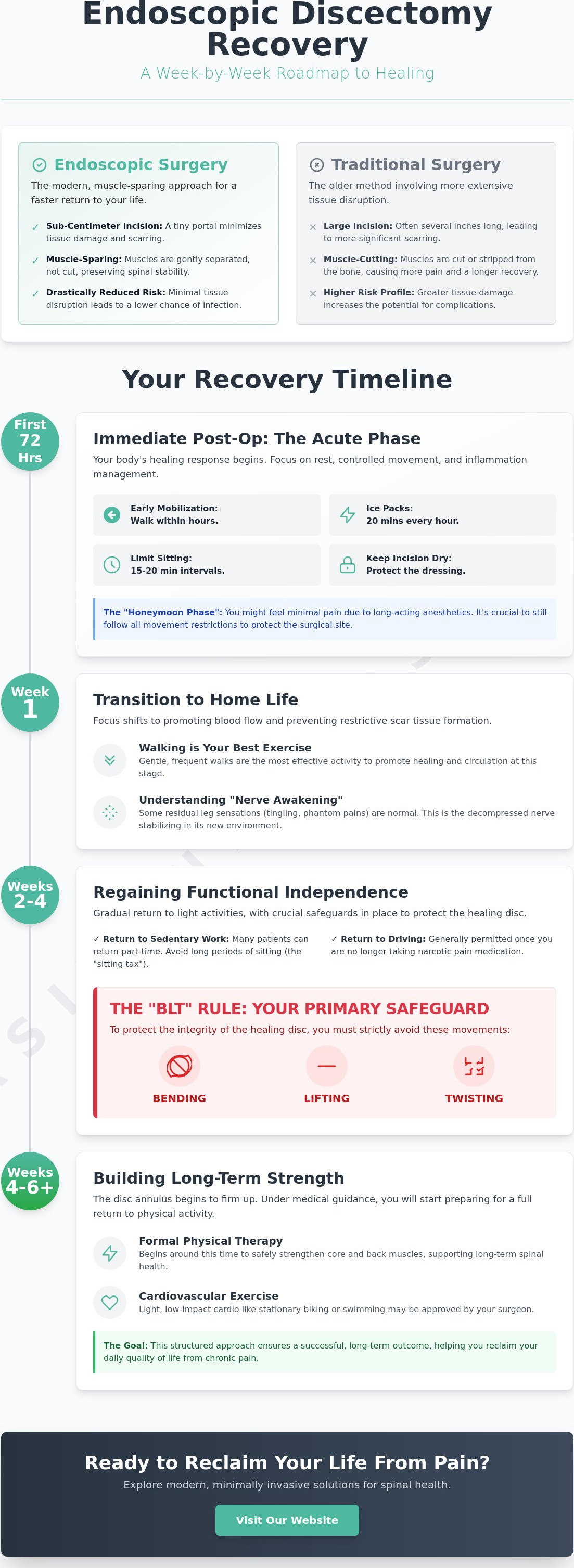
The first 72 hours following your procedure represent the acute inflammatory phase. This is the period when your body begins its targeted healing response at the sub-centimeter incision site. Because this technique is muscle-sparing rather than muscle-cutting, the initial trauma to your back is minimal. Tracking your endoscopic discectomy recovery week by week starts with these first few days of rest and controlled movement. It’s a time for patience and precise adherence to post-operative instructions.
In the recovery room, the clinical focus is on vital sign monitoring and early mobilization. You’ll likely be encouraged to stand and walk short distances within just a few hours of waking up. Many patients experience a “honeymoon phase” where they feel virtually no pain. This is usually the result of long-acting intraoperative local anesthetics applied during the surgery. While this comfort is a welcome relief, you must remain cautious. Following all movement restrictions is essential even if you feel like you’ve already achieved a full return to normal activity.
Gaining a clear understanding of what is a discectomy clarifies why these first few days are so manageable. The endoscopic approach allows for the precise removal of herniated material through a tiny portal, leaving the surrounding spinal architecture stable and intact. This precision is what sets modern minimally invasive neurosurgery apart from traditional, more invasive methods.
The Day of Surgery: Outpatient Expectations
In Plano, endoscopic discectomy is almost exclusively an outpatient procedure. You’ll be discharged once you can walk comfortably and manage basic self-care. You must have a designated driver; you’re strictly prohibited from driving for at least 24 hours due to the lingering effects of anesthesia. Your primary responsibility at home is maintaining the integrity of the surgical dressing. Keep the site dry and protected. This small barrier is your first line of defense against infection during the initial healing window.
Managing Early Inflammation
While the incision is small, deep tissues still react to the surgical intervention. Applying ice packs for 20 minutes every hour can significantly reduce swelling and improve your overall comfort levels. We recommend limiting your sitting duration to 15 or 20 minutes at a time to prevent unnecessary pressure on the healing disc. Your prescribed medication schedule is designed to keep you comfortable without causing excessive grogginess. Following this schedule strictly during the first three days prevents breakthrough pain and ensures a smoother transition into the next phase of your endoscopic discectomy recovery week by week.
Your Endoscopic Discectomy Recovery Timeline: Weeks 1 to 6
Moving beyond the immediate inflammatory phase, the next six weeks are foundational for long-term spinal health. Navigating your endoscopic discectomy recovery week by week requires a balance of progressive activity and strict adherence to structural protections. During this window, the disc annulus begins to firm up, and the decompressed nerve starts to stabilize in its new environment. While the temptation to rush back to a busy schedule is strong, biological healing follows a non-negotiable schedule.
Week 1: The Transition to Home Life
Your primary objective during the first week is gentle, frequent movement. Walking is the most effective “exercise” at this stage because it promotes blood flow and prevents the formation of restrictive scar tissue around the nerve root. You might notice a distinction between the dull surgical soreness at the incision and the sharp radicular pain you felt before surgery. Some residual leg sensations are normal as the nerve begins to heal. During your first post-operative check-up in Lewisville, your surgeon will examine the incision site to ensure the sub-centimeter portal is closing correctly and that your neurological reflexes are improving as expected.
Weeks 2-4: Regaining Functional Independence
By the second and third weeks, many patients with sedentary desk jobs can consider a part-time return to work. However, those in physically demanding roles must remain on restricted duty. You can typically return to driving once you are no longer taking narcotic pain medications and possess the leg strength necessary for emergency braking. Throughout this phase, the “BLT” rule is your primary safeguard. You must avoid Bending, Lifting, and Twisting to protect the integrity of the disc. For a broader perspective on these restrictions, you can review this endoscopic discectomy recovery overview from the AAOS. If you have questions about specific milestones, consulting with a specialist in minimally invasive spine surgery can provide the personalized clarity you need.
Weeks 5-6: Preparing for Full Activity
The six-week mark is a major clinical milestone. At this point, the initial risk of re-herniation significantly decreases, and many lifting restrictions are eased for objects over 10 to 15 pounds. We will evaluate your progress to determine if you are ready for formal physical therapy. While we do not offer in-house physical therapy, we provide referrals to specialized partners who understand the nuances of endoscopic recovery. This stage is also when you should implement long-term postural adjustments. Learning how to sit, stand, and lift with proper mechanics ensures that your return to normal activity remains permanent and pain-free.
Understanding Nerve Healing: Managing the “Awakening” Phase
The moment a herniated disc is removed, the mechanical pressure on the nerve root vanishes. However, the nerve itself does not return to a baseline state instantly. Years or months of compression create a biological memory that takes time to overwrite. As you track your endoscopic discectomy recovery week by week, you will likely encounter the “awakening” phase. This is a period where the nerve begins to fire again, often resulting in sensations that feel like a temporary regression, though they are actually signs of progress.
Many patients report a specific uptick in discomfort around the 10 to 14-day mark. This two-week inflammatory peak occurs as the initial surgical local anesthetics and steroid effects wear off, and the body’s natural healing response reaches its maximum intensity. You might feel “phantom” symptoms like itching, tingling, or even a cold sensation traveling down your leg. These are not signs of a failed procedure. Instead, they represent the nerve’s attempts to recalibrate its sensory signals. Staying calm and following your prescribed anti-inflammatory protocol is vital during this stage of the endoscopic discectomy recovery week by week journey.
Why Nerves Heal Slowly
Nerves are remarkably delicate structures. Unlike muscle tissue, which has a robust blood supply and heals relatively quickly, nerve fibers are more akin to bruised tissue that needs a quiet environment to stabilize. Nerve awakening is the recalibration of sensory pathways after chronic compression. Because this process is metabolic, it can take several months for the “static” in your sensory pathways to clear completely. Maintaining a steady walking routine and avoiding inflammatory triggers like smoking or excessive sugar can support this delicate cellular repair.
Distinguishing Normal Recovery from Re-herniation
It is natural to worry about re-injury, but understanding the nature of your pain can provide peace of mind. Normal recovery pain is typically fluctuating; it comes and goes and usually responds well to rest, ice, or your medication. Our ultra-small endoscopic incision significantly reduces the risk of scar-tissue-related pain, which is a common complication in traditional open surgeries. However, you should contact your Plano neurosurgeon immediately if you experience any red flags. These include a sudden, severe return of your pre-op leg pain, new-onset weakness in your foot, or any loss of bowel or bladder control. These symptoms are rare, but they require immediate clinical evaluation to ensure your long-term success.
Returning to Work and Exercise After Spine Surgery
Reclaiming your professional and athletic life is the ultimate goal of any spinal intervention. As you advance through your endoscopic discectomy recovery week by week, the focus shifts from protecting the surgical site to optimizing functional performance. This transition requires a strategic approach to what we call the “Sitting Tax.” Prolonged sitting increases intradiscal pressure by approximately 40 percent compared to standing, making it one of the most significant hurdles for office workers returning to the fold.
Adhering to the “10-pound rule” is non-negotiable for the first six weeks. This weight limit is designed to prevent excessive shear forces on the healing annulus. While you may feel capable of lifting more, the internal biological repair is still in a vulnerable state. Respecting this boundary ensures that your return to normal activity remains a permanent success rather than a temporary relief. If you are ready to discuss your specific path back to peak performance, the team at Minimally Invasive Neurosurgery Texas can provide a personalized clinical assessment.
The Ergonomic Office Return
Success in the office depends on movement. We recommend using a standing desk to alternate positions every 20 to 30 minutes. Ensure your monitor is at eye level to prevent the forward-head posture that strains the lumbar spine. For Plano drivers, the commute often presents the first real challenge. Use a high-quality lumbar roll and position your car seat to maintain the natural curve of your lower back. These small adjustments drastically reduce the cumulative stress on your spine during the workday.
Safe Exercise Progression
Exercise must be introduced in a tiered, logical sequence to allow for tissue adaptation. During Phase 1, which covers weeks one through four, low-impact walking remains your primary cardiovascular tool. Once you reach Phase 2 at the six-week mark, you can begin core stabilization exercises that avoid spinal flexion or “crunching” motions. This is the ideal time to transition to an elliptical or swimming, provided you avoid aggressive twisting. Phase 3, involving impact sports like running, golf, or tennis, typically requires a minimum of three months and a final clearance from your surgeon. This cautious progression is a hallmark of a specialized endoscopic discectomy recovery week by week plan, ensuring your spine is resilient enough for the demands of high-velocity movement.
Why Endoscopic Techniques Lead to Faster Recovery in North Texas
The primary driver behind an accelerated recovery is the preservation of local anatomy. Traditional spine surgery often requires significant muscle stripping to visualize the disc, which leads to extensive post-operative pain and long-term scarring. Even a standard microdiscectomy typically involves a one to two-inch incision and the use of tubular retractors. In contrast, our endoscopic approach utilizes a sub-centimeter portal. This ultra-minimally invasive method allows the surgeon to navigate through natural openings in the spine without cutting through vital stabilizing muscles. Because the biological “price” of the surgery is so low, your endoscopic discectomy recovery week by week is defined by rapid mobility rather than prolonged bed rest.
Precision is further enhanced through high-definition visualization and advanced robotic guidance systems. These technologies allow Dr. Scott Kutz to identify and remove only the specific fragment causing nerve compression while leaving healthy disc material and surrounding ligaments untouched. This level of accuracy reduces operative time and minimizes blood loss. It also keeps complication rates remarkably low; studies indicate that complication rates for endoscopic lumbar decompressions are consistently under 6 percent. By protecting the structural integrity of the spine from the outset, we create the ideal environment for the “nerve awakening” process to occur without interference.
The MINT Difference in Plano and Lewisville
Recovery is never a one-size-fits-all process. A disc herniation at the L4-L5 level requires a different mechanical approach than one at L5-S1, and our protocols reflect these anatomical nuances. We provide a boutique surgical experience where every aspect of your care is managed by a specialized team rather than a rotating hospital staff. This personal attention ensures that any deviations in your healing are identified and addressed immediately. For more information on how we are redefining spinal care, you can read our Minimally Invasive Neurosurgery in Plano: A Modern Guide.
The Long-Term Outlook
The clinical outcomes for this approach are compelling. Modern data shows that microdiscectomy and endoscopic techniques have a success rate of approximately 86.8 percent, compared to just 77.8 percent for traditional open procedures. To maintain these results, we emphasize long-term wellness strategies like weight management and core strengthening. These habits protect the remaining disc material and prevent future issues. If you are ready to stop managing pain and start reclaiming your life, schedule a consultation with Dr. Scott Kutz to discuss your path to a pain-free future. Your endoscopic discectomy recovery week by week starts with a commitment to the most advanced surgical standards available today.
Start Your Journey Toward Lasting Spinal Health
Navigating your endoscopic discectomy recovery week by week is a predictable process when you have the right clinical guidance. You now understand that the “awakening” of your nerves is a sign of biological progress and that the muscle-sparing nature of our sub-centimeter incisions drastically reduces your time away from work. By following a tiered return to activity and respecting the structural milestones of healing, you protect your long-term success while reclaiming the daily quality of life you deserve.
At Minimally Invasive Neurosurgery Texas, we combine the expertise of board-certified neurosurgeon Dr. Scott Kutz with the precision of Globus Excelsius robotic navigation. Our advanced surgical facilities in Plano and Lewisville provide the boutique attention and specialized protocols necessary for superior clinical outcomes. We are dedicated to ensuring your transition from chronic pain to full activity is as seamless and efficient as possible. Request an Appointment with Dr. Scott Kutz today to explore how our specialized approach can accelerate your return to normal activity. You don’t have to navigate the path to recovery alone; expert care and modern technology are here to support your progress every step of the way.
Frequently Asked Questions
How soon can I shower after an endoscopic discectomy?
You can typically shower 48 to 72 hours after your procedure. It’s vital to keep the sub-centimeter incision site dry and protected until this initial window has passed. When you do begin showering, avoid allowing direct water pressure to hit the surgical dressing and always pat the area dry gently with a clean towel. You must avoid submerging in baths, hot tubs, or pools for at least four weeks to prevent infection.
Is it normal to have leg pain return a week after surgery?
Yes, it’s common to experience a temporary return of leg sensations or mild “phantom” pain about a week after surgery. This often coincides with the inflammatory peak and the nerve awakening phase as the local anesthetics fully wear off. These sensations are usually fluctuating and respond well to ice or prescribed anti-inflammatories. However, if you experience sudden, severe weakness or a loss of sensation, you should contact our office immediately.
When can I resume sexual activity after a discectomy?
Most patients can safely resume sexual activity within two to four weeks. The key is to prioritize spine-neutral positions that avoid the “BLT” movements: bending, lifting, and twisting. If any particular activity causes sharp pain or significant discomfort in your lower back, you should stop and wait another week before trying again. Listening to your body is an essential part of navigating your endoscopic discectomy recovery week by week.
How long do I need to take off from a desk job?
Can I fly on a plane during my recovery weeks?
What happens if I accidentally bend or twist too soon?
An accidental bend or twist usually results in a temporary muscle spasm rather than a structural re-herniation. While you should strictly follow your movement restrictions, a single minor slip is rarely catastrophic. Monitor your symptoms closely over the next 24 hours. If you notice a sudden return of pre-operative leg pain, new weakness in your foot, or significant numbness, a clinical evaluation is necessary to ensure the disc remains stable.
Do I need a back brace during my recovery?
A back brace is rarely required following a modern endoscopic procedure. Unlike traditional open surgeries that compromise spinal stability by cutting through muscle, our minimally invasive approach leaves the supporting ligaments and architecture intact. In some specific cases, a soft corset may be provided for comfort or as a physical reminder to avoid bending. However, most patients recover successfully and regain their daily quality of life without any external bracing.
Will I need physical therapy after an endoscopic procedure?
Most patients benefit from formal physical therapy starting around the six-week mark. While we don’t offer in-house physical therapy at MINT, we provide referrals to specialized partners who focus on core stabilization and postural correction. This phase of your endoscopic discectomy recovery week by week is crucial for building the resilience needed to prevent future disc issues. Strengthening the deep stabilizers of the spine ensures a permanent return to normal activity.