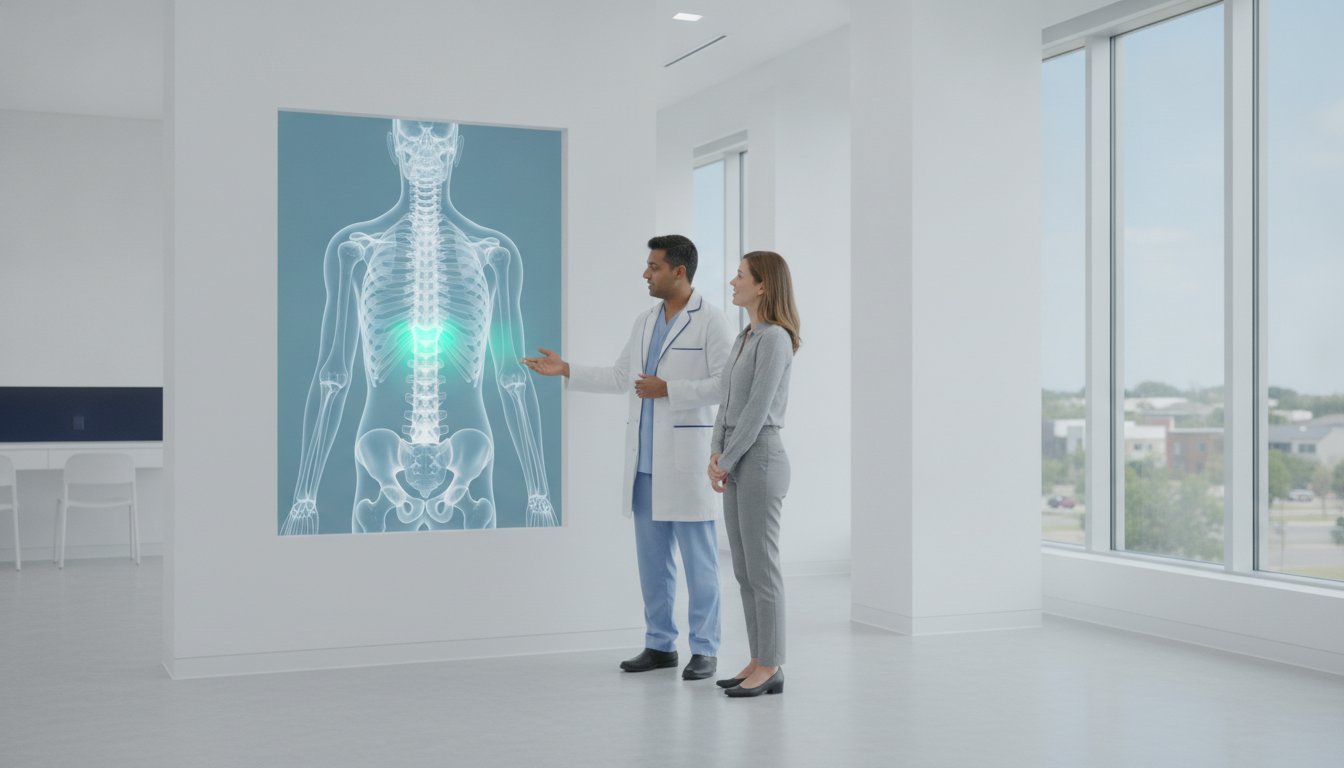
Did you know that nearly 90% of patients who undergo endoscopic spine surgery return to work within just 10 days? While traditional back surgery often requires months of downtime, modern endoscopic techniques allow for a much faster transition back to your daily life. It’s completely natural to feel a sense of anxiety about post-operative pain or the fear of a “failed back surgery” recurrence. Understanding exactly what to expect after endoscopic spine surgery is the first step toward a confident and successful recovery.
We understand that you want more than just a successful procedure; you want your life back. This 2026 recovery guide provides the expert-led roadmap you need to move from the operating room to full mobility with absolute certainty. We’ll explore the “active healing” philosophy that defines the first two weeks, break down the specific timeline for returning to physical activity, and clarify the common confusion surrounding movement restrictions. By the end of this article, you’ll have a clear grasp of normal versus abnormal symptoms, giving you total peace of mind as you reclaim your quality of life.
Key Takeaways
- Most endoscopic procedures are performed on an outpatient basis, allowing you to begin your recovery in the comfort of your own home in Plano or Lewisville on the same day.
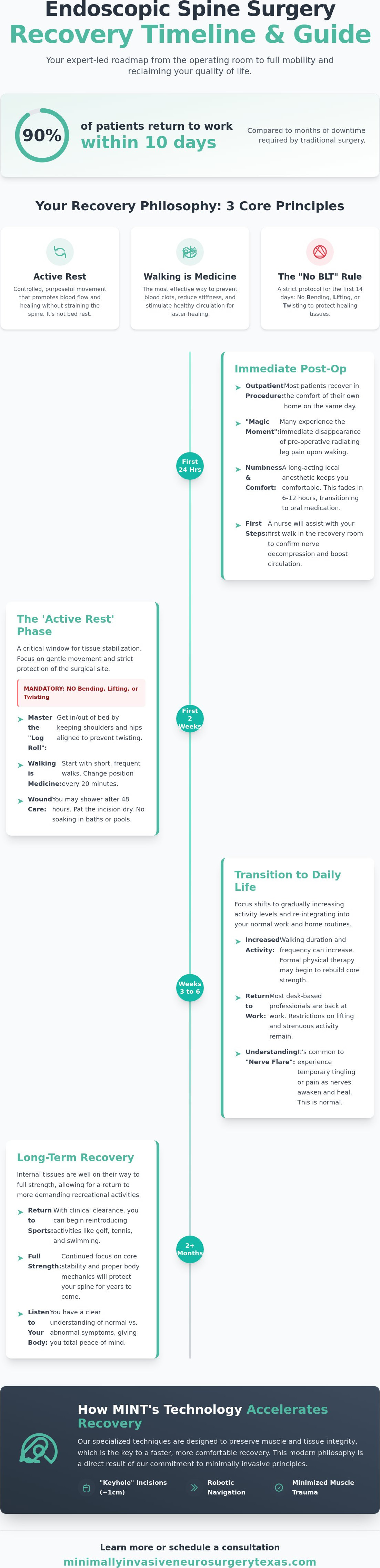
- Gain a clear understanding of what to expect after endoscopic spine surgery, including a detailed roadmap for managing the critical “active rest” phase during the first 14 days.
- Master the “Walking is Medicine” protocol and the “Log Roll” technique to maintain safe mobility and prevent post-operative stiffness or complications.
- Learn about the “Nerve Flare” phenomenon and the specific clinical criteria for returning to professional work and recreational sports like golf or tennis.
- Discover how specialized “keyhole” techniques and robotic navigation minimize muscle trauma to accelerate your return to normal activity.
The First 24 Hours: Immediate Post-Operative Expectations
The transition from the operating room to your home is swifter than most patients anticipate. Because we utilize a specialized “keyhole” approach, the physical trauma to your body is significantly reduced compared to traditional methods. Understanding what to expect after endoscopic spine surgery begins with the realization that your recovery starts almost immediately. Most of our procedures are performed on an outpatient basis. This allows you to recover in the familiar comfort of your own home in Plano or Lewisville rather than a clinical hospital setting. The primary goal of Minimally invasive spine surgery is to preserve the integrity of your spinal structures, and this modern efficiency is a direct result of that philosophy.
During these initial hours, you may notice a small, firm area at the incision site. This is a normal inflammatory response often referred to as a “surgical lump.” It’s a sign that your body’s natural healing process has begun. You will also likely experience some localized numbness. We use a long-acting local anesthetic to ensure your comfort immediately following the procedure. This sensation typically begins to wear off within six to twelve hours. As the numbness fades, you will transition to your prescribed oral medications to maintain a consistent level of comfort.
Waking Up from Endoscopic Decompression
When you wake up in the recovery room, the surgical site will feel remarkably small. Unlike the large incisions of the past, the endoscopic approach requires only a tiny opening. A recovery nurse will be by your side to monitor your vitals and assist with your first steps. For many, this is a “magic moment” where the sharp, radiating leg pain that existed before surgery has suddenly vanished. These first steps are a vital part of our clinical protocol. They confirm that the pressure on your nerves is gone and help stimulate healthy circulation throughout your lower body.
Your First Night at Home
Preparation is the key to a restful first night. We recommend setting up a “recovery station” before you leave for your procedure. This area should have pillows for support, your medications, and plenty of water within arm’s reach. Nutrition is important, but keep your meals light for the first 12 hours. Soup, toast, or crackers are excellent choices as your body adjusts. It is essential to have a designated caregiver stay with you for this 24-hour window. They provide the necessary support for moving around the house and offer the peace of mind you need to focus entirely on your healing. This initial day sets the foundation for your return to normal activity.
Navigating the First Two Weeks: The ‘Active Rest’ Phase
The initial 14 days following your procedure represent a critical window for tissue stabilization. While you are no longer in the immediate post-operative window, your body requires a specific environment to heal. Understanding what to expect after endoscopic spine surgery during this time involves balancing gentle movement with strict protection of the surgical site. We refer to this as the “active rest” phase. It’s not a period of total bed rest, but rather a time of controlled, purposeful activity designed to promote blood flow without straining your spine.
We implement a strict “No BLT” rule: no bending, lifting, or twisting. This protocol is a clinical necessity. Even though your incision is only about 1cm, the internal structures need time to mend. Bending or twisting puts torsional stress on the disc and the healing corridor. To move safely, you must master the “Log Roll” technique when getting in or out of bed. By keeping your shoulders and hips aligned and moving as a single unit, you eliminate the twisting forces that could compromise your results. For wound care, you can typically shower after 48 hours, but you must avoid soaking in baths or pools until the incision is fully closed. Pat the area dry gently; never rub the site.
Mobility and Movement Guidelines
We believe walking is medicine. It’s the most effective way to prevent blood clots and reduce post-operative stiffness. Start with short, frequent loops around your home or neighborhood in Lewisville. Adhere to the 20-minute rule: never sit or stand in one spot for too long. Change your position frequently to maintain circulation and reduce pressure on your lower back. A “reacher” or “grabber” tool is an essential investment during these two weeks, as it allows you to pick up items from the floor without breaking your BLT restrictions. If you have questions about specific movements, our team at minimally invasive neurosurgery is always available to provide guidance.
Pain Management and Medication
Our “Step-Down” approach focuses on transitioning you from prescription pain relief to over-the-counter anti-inflammatories within the first week. Ice is your most valuable tool during the first 72 hours to control internal swelling and numbing the area. After the third day, you may find that alternating with heat helps soothe muscle soreness. While mild aching is normal, you should contact MINT immediately if you experience “red flag” symptoms. These include a fever over 101.5 degrees, sudden drainage from the incision, or a significant, new onset of leg weakness.
Weeks 3 to 6: Transitioning Back to Daily Life and Work
By the third week, the initial post-operative soreness has typically faded. You are now entering a phase where the internal structures are beginning to knit together more firmly. Understanding what to expect after endoscopic spine surgery during this window is vital because many patients feel so good they are tempted to overexert themselves. This is the time to transition from simple walking to more structured recovery. We focus on a gradual reintroduction of your professional and personal responsibilities while prioritizing the long-term integrity of your spinal health. This period is less about “rest” and more about “recalibration” as your body adapts to its improved alignment.
One of the most significant milestones during this period is the start of a customized Physical Therapy (PT) program. While your surgeon has addressed the mechanical issue in your spine, PT addresses the functional habits that may have contributed to your pain. These sessions focus on core stabilization and “back-safe” movement patterns. Strengthening the transverse abdominis and multifidus muscles provides a natural internal brace for your spine. This professional guidance ensures that as you increase your activity level, you do so without placing undue stress on the surgical site.
Returning to the Office and the Road
Understanding Nerve Healing
Around the one-month mark, some patients experience the “Nerve Flare” phenomenon. This involves a brief return of mild tingling or “pins and needles” in the leg or arm. Do not be alarmed. This is a normal part of neuroplasticity. Your nerves were compressed for a long time, and as they “wake up” and receive full blood flow again, they can become hypersensitive. Nerves heal significantly slower than skin or muscle tissue because the biological process of axonal regeneration is complex. Nerve regeneration is a marathon, not a sprint. We monitor these sensations closely, but they usually resolve as the nerve root stabilizes in its new, decompressed environment.
Long-Term Recovery: 2 Months and Beyond
Long-term success depends heavily on your commitment to a “Back-Safe” lifestyle. Chronic spinal conditions often stem from years of micro-trauma or poor biomechanics. We don’t just want to fix the current issue; we want to prevent the next one. This involves maintaining a healthy weight to reduce the load on your lumbar discs and committing to smoking cessation. Nicotine is a potent vasoconstrictor that starves spinal discs of the oxygen and nutrients they need to remain pliable. Scheduling your long-term follow-up at Minimally Invasive Neurosurgery of Texas ensures that your progress remains on track and any minor concerns are addressed before they become significant setbacks.
Strengthening the ‘Internal Brace’
Your spine relies on a complex network of deep stabilizer muscles, specifically the multifidus and transverse abdominis. These muscles act as a biological “internal brace.” While the recovery path for minimally invasive spinal fusion Texas requires a different timeline for bone consolidation, endoscopic decompression allows you to begin targeting these stabilizers relatively early. Your clinical PT will eventually transition into a home-based routine. Consistency is more important than intensity here. Five minutes of daily core activation is far more beneficial than one hour-long session once a week.
Preventing Recurrence
Protecting your surgical results requires a permanent change in how you interact with the world. You must adopt proper lifting mechanics for every task, from picking up a laundry basket to lifting a child. We recommend mastering two specific movements:
- The Golfer’s Lift: Use this for light objects on the floor. Extend one leg behind you to act as a counterweight while keeping your back straight and pivoting at the hip.
- The Power Stance: For heavier items, widen your base and use your glutes and hamstrings rather than your lumbar spine to generate force.
Hydration is also a secret weapon for disc health. Spinal discs are primarily composed of water; staying hydrated helps maintain disc height and shock-absorption capacity. We also educate our patients on recognizing the early signs of adjacent segment disease. This occurs when the levels above or below a surgical site take on extra stress. If you notice new or changing symptoms, it’s time for a check-up to ensure your entire spine remains balanced. For personalized advice on your long-term movement goals, contact our surgical team to discuss your progress and ensure you are maintaining your return to normal activity.
Why Expert Endoscopic Care at MINT Accelerates Recovery
Dr. Scott Kutz has refined a specialized “keyhole” approach that fundamentally changes the recovery equation for our patients. Traditional spine surgery often involves significant muscle stripping to reach the surgical site, which leads to prolonged healing times and increased discomfort. At MINT, we use advanced dilators to gently separate muscle fibers instead of cutting them. This preservation of local tissue is the primary reason why what to expect after endoscopic spine surgery at our practice involves less post-operative pain and a much faster return to mobility. By minimizing the internal footprint of the procedure, we ensure your body’s resources are focused on healing the disc or nerve rather than repairing collateral damage to your back muscles.
The precision of our work is amplified by the synergy of robotic navigation and Augmented Reality (AR). These systems provide a high-definition, three-dimensional roadmap of your unique anatomy in real-time. This level of technological integration allows for sub-millimeter accuracy during every phase of the decompression. When a surgeon visualizes the target with such clarity, the procedure becomes more efficient and the incision remains remarkably small. This high-tech precision is a hallmark of our boutique surgical center. We offer a level of specialization and personal attention that large, impersonal hospital systems often struggle to replicate. Our goal is to provide a surgical experience that is as precise as it is effective.
Local care in Lewisville and Plano adds a layer of convenience that is vital for a seamless recovery. Healing isn’t just about the time spent in the operating room; it’s about the weeks of follow-up care that ensure you’re meeting your clinical milestones. Being close to your surgical team means you aren’t enduring long, exhausting car rides for routine checks or imaging. We tailor our recovery protocols to the active North Texas lifestyle. Whether your goal is returning to a corporate office in Legacy West or getting back to the hiking trails at Arbor Hills, our team provides a personalized roadmap to success. Having a dedicated local physician ensures that what to expect after endoscopic spine surgery is a predictable, well-supported transition back to your life.
Cutting-Edge Technology, Compassionate Care
The MINT philosophy is rooted in treating the patient, not just the MRI image. While we utilize the most advanced tools available, we never lose sight of the human being behind the diagnosis. This same commitment to innovation and rapid recovery is evident in our approach to neck disk replacement and other minimally invasive procedures. Every technology we adopt is chosen for its ability to reduce physical impact and speed up your recovery timeline. Our ultimate value proposition is a safe, efficient return to normal activity. We provide the clinical authority you need to feel secure and the compassionate reassurance you need to feel heard throughout your entire journey from the first consultation to the final follow-up.
Reclaiming Your Active North Texas Lifestyle
Your journey to a pain-free life is a carefully calibrated process that begins the moment you leave the operating room. By following a structured roadmap, from the initial “active rest” phase to the reintroduction of sports like golf and tennis, you ensure the longevity of your surgical results. Understanding what to expect after endoscopic spine surgery empowers you to navigate each milestone with confidence. This knowledge helps you distinguish normal nerve healing from symptoms that require clinical attention. Our focus remains on your seamless return to normal activity through precise, patient-centered care.
Success in modern spine care depends on the expertise of your surgical team and the technology they employ. Board-certified neurosurgeon Dr. Scott Kutz brings over a decade of dedicated service to the Plano and Lewisville communities, utilizing the advanced Globus Excelsius robotic navigation system to achieve superior clinical outcomes. Don’t let chronic back pain dictate your future any longer. Schedule your consultation with Dr. Scott Kutz at MINT today to discover how our specialized approach can accelerate your recovery. We are here to guide you back to the life you love with absolute certainty and compassionate care.
Frequently Asked Questions
How soon can I shower after endoscopic spine surgery?
You can typically shower 48 hours after your procedure. It is essential to keep the incision site dry and clean until the skin has fully closed. Avoid soaking in bathtubs, hot tubs, or swimming pools for at least two weeks to prevent infection. When you finish your shower, gently pat the area dry with a clean towel rather than rubbing it. Maintaining the integrity of the surgical dressing is a vital part of your early recovery protocol.
Is it normal to have leg pain return a few weeks after surgery?
Yes, experiencing a temporary return of leg pain or tingling around the two to three-week mark is quite common. This is known as a “nerve flare,” which occurs as the nerve root begins to heal and recalibrate after being decompressed. These sensations are usually milder than your pre-operative pain and tend to resolve quickly. Understanding this phenomenon is a key part of what to expect after endoscopic spine surgery, as it prevents unnecessary anxiety during your healing journey.
When can I drive my car again after a lumbar endoscopy?
Most patients can resume driving within one to two weeks, provided they are no longer taking narcotic pain medications. Your safety depends on your reaction time and your ability to perform an emergency brake maneuver without hesitation. We recommend starting with short trips in light traffic before attempting longer commutes on DFW highways. Always listen to your body; if sitting in the driver’s seat causes significant discomfort, you may need a few more days of rest.
How long do I need to take off work for an endoscopic procedure?
The timeline for returning to work depends on the physical demands of your job. Professionals with desk-based roles often return within 7 to 10 days, while those involved in manual labor may require four to six weeks of recovery. We provide specific clinical clearance based on your healing progress and your adherence to the “No BLT” rules. This personalized approach ensures you return to your professional life without compromising the long-term stability of your spine.
What are the ‘red flag’ symptoms I should watch for during recovery?
You should contact our clinical team immediately if you experience a fever over 101.5 degrees, persistent redness, or unusual drainage at the incision site. Other “red flags” include a sudden onset of new leg weakness, severe localized pain that does not respond to medication, or any changes in bowel or bladder control. While complications are rare with our specialized endoscopic approach, early intervention is essential for maintaining your health and the success of your procedure.
Can I fly on a plane shortly after my spine surgery?
Short flights are generally permissible after one to two weeks, but you should wait at least four weeks for longer international travel. The primary concern is the increased risk of blood clots due to prolonged sitting and changes in cabin pressure. We recommend getting up to walk the aisle every 30 minutes and staying well-hydrated during the flight. If you must travel sooner, please discuss specific precautions with Dr. Kutz during your follow-up appointment.
Do I need to wear a back brace after an endoscopic discectomy?
A back brace is rarely required after an endoscopic discectomy because our “keyhole” approach preserves the natural stability of your spinal muscles. Unlike traditional open surgery, which requires significant muscle detachment, the endoscopic method keeps your internal support structures intact. In some complex cases, a soft corset may be recommended for comfort or as a reminder to avoid bending and twisting. However, we typically prioritize early, gentle movement over external bracing to promote healthy circulation and muscle activation.
How soon can I resume sexual activity after spine surgery?
Most patients feel comfortable resuming sexual activity about two weeks after surgery, provided they follow all movement restrictions. It is important to avoid any positions that require significant bending, lifting, or twisting of the lumbar spine. Think of this as a gradual return to normal activity where you prioritize comfort and spinal alignment. If you experience any sharp pain or increased soreness, stop and allow your body more time to heal before trying again.