Minimally Invasive Neurosurgery of Texas is a specialized surgical practice led by Dr. Scott Kutz, a board-certified neurosurgeon and Fellow of the American Association of Neurological Surgeons (AANS) and the American College of Surgeons (ACS). From our clinics in Lewisville, TX, and Plano, TX, Dr. Kutz provides advanced treatments including minimally invasive spine surgery and artificial disc replacement to help patients regain their quality of life.
What if the conservative approach you’ve followed for months is no longer the safest option for your spine? If you’re struggling with chronic loss of sleep and the constant fear of permanent nerve damage, you aren’t alone. Approximately 8% of the U.S. adult population lives with chronic back pain, often feeling trapped between conflicting medical advice and anxiety. Determining when is back surgery necessary requires a clear understanding of clinical markers rather than just a reaction to pain. Dr. Scott Kutz emphasizes that while many patients find relief through conservative care, certain red flags like progressive muscle weakness or radiculopathy, which is pain that radiates into the limbs, demand precise intervention. This guide details the 6-week rule for non-emergency cases and the diagnostic milestones that indicate a shift toward surgical care. We explore how modern endoscopic techniques allow for a faster return to normal activity for residents across North Texas, including Dallas and McKinney.
Key Takeaways
- Identify the critical difference between mechanical muscle strain and structural spinal pathology to determine if your condition requires surgical intervention.
- Recognize the five major clinical red flags, including progressive neurological deficits and radiculopathy, that signal a need for an immediate specialist evaluation.
- Learn how to evaluate the success of conservative treatments to decide when is back surgery necessary after the standard 12 week recovery window.
- Discover how endoscopic spine surgery and modern precision technology at MINT minimize tissue damage and facilitate a faster return to normal activity.
- Understand how to prepare for a surgical consultation in Plano or Lewisville by organizing the specific imaging and diagnostic logs needed for an accurate assessment.
Understanding the Threshold: When Back Pain Becomes a Surgical Priority
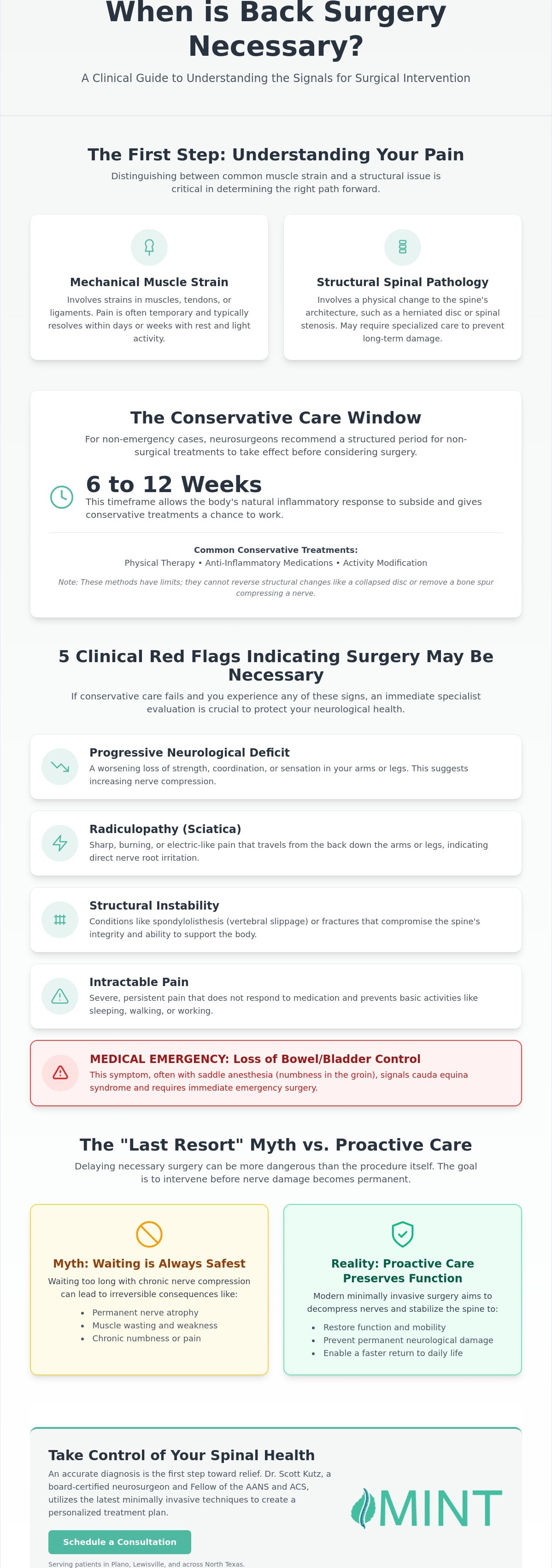
Most back pain originates from mechanical issues. These involve strains in the muscles, tendons, or ligaments that support the spinal column. These injuries typically resolve with rest and light activity. Structural spinal pathology, however, involves a physical change to the spine’s architecture, such as a herniated disc or spinal stenosis. Determining when is back surgery necessary starts with identifying which of these two categories your pain falls into. While mechanical pain often fades within days, structural issues may require a more specialized approach to prevent long-term complications.
Clinicians generally follow the 6-week rule for non-emergency cases. This timeframe allows the body’s natural inflammatory response to subside. It also gives conservative treatments like physical therapy and anti-inflammatory medications enough time to work. These methods have biological limits; they cannot physically move a bone spur or restore a collapsed disc. If symptoms persist beyond this window without improvement, the focus shifts toward neurological preservation. This is the primary goal of modern neurosurgery, ensuring that nerves remain functional and free from compression to maintain your mobility.
The Role of Diagnostic Imaging in 2026
Modern MRI and CT scans provide incredible detail, yet they are only one piece of the diagnostic puzzle. A bulging disc appearing on an image does not automatically mean a patient needs surgery. Many people live with spinal abnormalities without ever experiencing pain. Dr. Scott Kutz, a board-certified neurosurgeon at Minimally Invasive Neurosurgery of Texas, emphasizes clinical correlation. This means we treat the patient’s specific symptoms and physical exam findings, not just the image on the screen. For a broader perspective on how these diagnostics fit into the surgical field, you can review this Orthopedic Surgery Overview.
The “Last Resort” Myth vs. Proactive Care
Many patients view surgery as a last resort to avoid at all costs. While conservative care is the first line of defense, waiting too long can be detrimental. Chronic compression can lead to permanent nerve atrophy or muscle wasting, where the muscle tissue actually begins to shrink due to lack of nerve signals. Dr. Kutz, an AANS and ACS Fellow, utilizes minimally invasive neurosurgery to intervene before such damage becomes irreversible. This proactive approach aims to restore function in patients from Lewisville, TX, and Plano, TX, before the window for full recovery closes. Identifying when is back surgery necessary involves balancing the patience of conservative care with the clinical urgency of protecting your neurological health.
5 Clinical Signs That Surgery Is Likely Necessary
Identifying when is back surgery necessary depends on specific clinical indicators that suggest the spine can no longer heal through natural processes. While many conditions respond to rest, five specific signs indicate a need for surgical intervention. These include progressive neurological deficits, radiculopathy, structural instability, intractable pain, and loss of bowel or bladder control. Patients in Dallas and Fort Worth often seek clarity when these symptoms begin to interfere with their daily routines.
- Progressive Neurological Deficit: A worsening loss of strength or sensation in your limbs.
- Radiculopathy: Sharp, electric pain traveling down the arms or legs, often called sciatica.
- Structural Instability: Conditions like spondylolisthesis or fractures that compromise spinal integrity.
- Intractable Pain: Pain that prevents basic activities of daily living despite the use of medication or therapy.
- Bowel or Bladder Dysfunction: A critical emergency sign indicating severe nerve compression.
The National Institute of Arthritis and Musculoskeletal and Skin Diseases provides a comprehensive list of conditions that may be candidates for surgical treatment. These clinical markers serve as a roadmap for your diagnostic journey. If you find yourself struggling with these symptoms, scheduling a consultation for back surgery in Plano or Lewisville can provide the clarity you need for recovery.
Neurological “Red Flags” You Cannot Ignore
Clinical urgency increases when weakness replaces pain. Foot drop, a condition where you cannot lift the front part of your foot, requires immediate neurosurgical evaluation to prevent permanent disability. Numbness in the saddle area, which includes the parts of the body that would touch a saddle, is a surgical emergency. This symptom signals Cauda Equina Syndrome. Dr. Scott Kutz, a board-certified neurosurgeon and AANS and ACS Fellow, treats these cases with priority to ensure neurological preservation for his patients.
Radiculopathy and Nerve Compression
Radiculopathy is the clinical manifestation of compressed spinal nerves. This often results from a herniated disc that causes both chemical and mechanical irritation of the nerve roots. Patients describe this as a sharp, electric sensation. Radiating pain is often more surgically treatable than localized back pain because surgeons can directly decompress the specific nerve causing the distress. Dr. Kutz utilizes advanced diagnostics to pinpoint the exact level of compression to ensure the most effective intervention possible.
Conservative Care Failure: When Is It Time to Stop Waiting?
Clinical guidelines recommend that patients have tried nonsurgical or ‘conservative’ options for at least 6 to 12 weeks before escalating care. This period allows the body to utilize its own natural healing mechanisms. However, many patients in Plano and Lewisville find themselves stuck in a cycle of diminishing returns. This happens when physical therapy or medications stop providing incremental progress. Understanding when is back surgery necessary involves recognizing when these treatments have reached their biological limit and can no longer address the underlying structural issue.
Chronic pain cycles often lead to central sensitization. This is a condition where the nervous system stays in a high-alert state, making future recovery more difficult. If pain prevents you from performing basic exercise or stretching, it creates a downward health spiral. Weight gain and muscle loss place even more stress on your spine. Dr. Scott Kutz at Minimally Invasive Neurosurgery of Texas often sees patients who have waited until their mobility is severely compromised, which complicates the rehabilitation process.
The Checklist for Conservative Exhaustion
Patients should evaluate their progress using a specific checklist to determine if they’ve exhausted non-surgical paths. First, consider your physical therapy outcomes. If your program focused on core stabilization for two months but failed to reduce your pain, the issue likely involves a mechanical blockage. Second, review your response to epidural steroid injections. As of 2026, these procedures are under increased scrutiny due to the Medicare WISeR model, which aims to reduce inappropriate services. If these injections provide only transient benefits lasting less than 2 to 3 weeks, they aren’t a long-term solution. Finally, track your quality of life score. If you can’t walk around a grocery store in Dallas or McKinney without stopping, conservative care has likely reached its limit.
When Waiting Becomes Risky
Procrastination carries its own clinical risks. Long-term reliance on NSAIDs can lead to gastrointestinal or kidney issues, while chronic opioid use carries well-documented dangers. Uncorrected spinal issues also force the body to compensate. This shift in gait often leads to secondary injuries in the hips and knees. The psychological toll of unresolved pain is just as damaging as the physical symptoms. Dr. Kutz, an AANS and ACS Fellow, helps patients determine if a single spine surgery is a safer long-term choice than years of systemic medication. Moving from a state of concern to informed confidence is the first step toward a return to normal activity.
The Minimally Invasive Advantage: Why Surgery is Safer in 2026
Many patients hesitate to seek help because they fear “Failed Back Surgery Syndrome,” a term used to describe persistent pain after a procedure. In 2026, this fear is largely outdated due to advancements in MINIMALLY INVASIVE NEUROSURGERY. Determining when is back surgery necessary involves recognizing that modern techniques, such as endoscopic spine surgery, preserve muscle and ligament attachments rather than cutting through them. This approach results in significantly reduced blood loss and lower infection rates compared to traditional open surgeries. By using a tiny camera and specialized instruments through a thumbnail-sized incision, surgeons avoid the large-scale muscle stripping of the past. Consequently, many complex procedures have transitioned from multi-day hospital stays to efficient outpatient procedures. This shift allows patients from Dallas and Fort Worth to begin their recovery in the comfort of their own homes within hours of the operation.
Artificial Disc Replacement vs. Fusion
While spinal fusion remains a vital tool for certain types of instability, neck disk replacement offers a superior alternative for many patients in Lewisville and Plano. Motion-preserving technology maintains the natural flexibility of the spine, which helps prevent adjacent segment disease. This condition occurs when the vertebrae above or below a fusion site take on extra stress and eventually fail over time. Candidates for artificial disc replacement typically have good bone density and localized disc degeneration without significant facet joint disease. Dr. Scott Kutz, a board-certified neurosurgeon and AANS and ACS Fellow, evaluates each patient to see if motion preservation can facilitate a faster return to normal activity.
Precision Tools: Robotics and AR
Precision defines the modern surgical experience at Minimally Invasive Neurosurgery of Texas. Dr. Kutz utilizes robotic navigation systems, such as the Globus Excelsius, to increase surgical accuracy during hardware placement. These systems function as a real-time GPS for the spine, ensuring that every implant sits in the perfect anatomical position. Augmented Reality (AR) headsets further enhance this by allowing surgeons to see through tissue with sub-millimeter precision. Modern surgical robotics have reduced human error margins in spinal hardware placement to near zero. These tools ensure that every intervention is as minimally invasive as possible for residents in McKinney and Plano. If you are ready to explore your options, contact us to schedule a consultation for minimally invasive spine surgery today.
Finding the Right Spine Surgeon in Plano and Lewisville
Choosing a specialist is the most critical step in your diagnostic journey. A board-certified neurosurgeon provides the advanced training necessary to handle the delicate structures of the spinal cord and nerve roots. Dr. Scott Kutz, an AANS and ACS Fellow at Minimally Invasive Neurosurgery of Texas, focuses exclusively on these complex cases. Residents in North Texas, including Dallas and Fort Worth, benefit from our specialized approach that prioritizes neurological preservation over more invasive, traditional methods. Understanding when is back surgery necessary requires an expert who can distinguish between general muscle pain and structural issues that threaten your long-term mobility.
Common Patient Question: How do I know if I should keep waiting or schedule surgery?
If you have a clear structural issue like a herniated disc or spinal stenosis that correlates with neurological symptoms such as weakness or radiating pain, and you have completed 6 to 12 weeks of conservative care without relief, surgery is the recommended path. Waiting too long when these clinical markers are present can lead to permanent nerve damage or muscle wasting. Dr. Kutz evaluates these milestones to ensure you receive the right intervention at the optimal time for recovery.
The Consultation Process at MINT
Your first visit to our Lewisville or Plano clinic involves a deep dive into your medical history. You should bring your most recent MRI discs, a log of your daily symptoms, and a summary of previous treatments like physical therapy or injections. Dr. Kutz reviews your imaging with you to explain the mechanical cause of your pain. This collaborative approach ensures you understand the “why” behind every recommendation. If your condition involves instability, Dr. Kutz may discuss a minimally invasive spinal fusion in Texas to restore your spinal integrity. We coordinate closely with your existing pain management team to ensure a seamless transition into surgical care.
Preparing for Your Road to Recovery
Modern protocols emphasize “pre-hab,” which involves strengthening the core muscles before your procedure to support a faster recovery. Most patients undergoing minimally invasive procedures return home the same day and can resume light activity within a week. Dr. Kutz and the team at MINT provide a detailed timeline for your return to work based on your specific procedure and physical demands. Taking the first step toward a pain-free life begins with an accurate diagnosis. We invite patients from McKinney and across North Texas to schedule a consultation and regain their confidence in their health. Our ultimate goal is your return to normal activity with the least amount of physical impact possible.
Take Control of Your Spinal Health Journey
Deciding when is back surgery necessary requires a transition from chronic concern to informed action. You now understand that clinical red flags, such as progressive weakness and radiculopathy, signal a need for neurological preservation that conservative care cannot provide. Modern advancements in endoscopic and robotic-assisted spine surgery have transformed these procedures into precision tools that minimize recovery times and maximize outcomes. Dr. Scott Kutz, a board-certified neurosurgeon and Fellow of the AANS and ACS, utilizes these high-tech methodologies to help patients avoid permanent nerve damage.
At Minimally Invasive Neurosurgery of Texas, we prioritize your quality of life through specialized care in Plano and Lewisville. Our boutique surgical center focuses on personal attention and the absolute forefront of modern innovation. You don’t have to navigate conflicting medical advice alone. Schedule a consultation with Dr. Scott Kutz at MINT today to see if you are a candidate for minimally invasive care. We look forward to helping you achieve a successful return to normal activity and a life free from chronic physical limitations.
Frequently Asked Questions
Is back surgery a last resort?
Clinical guidelines generally position surgery as a secondary option after six to twelve weeks of conservative care. However, surgery is not a last resort when neurological damage is active. In cases involving progressive weakness or loss of sensation, early intervention prevents permanent disability. Dr. Scott Kutz evaluates the structural integrity of your spine to decide if waiting is clinically safe or if a proactive approach is necessary to preserve nerve function.
How long can I wait before back surgery causes permanent damage?
The timeline for permanent damage depends on the severity of nerve compression. If you experience progressive weakness or numbness, the window for full recovery may close within weeks. Clinicians often use the 6-week rule for non-emergency cases to monitor for improvement. If symptoms worsen during this period, determining when is back surgery necessary becomes a matter of neurological preservation to avoid muscle wasting or chronic nerve atrophy.
What are the red flags that mean I need surgery immediately?
Immediate red flags include a sudden loss of bowel or bladder control, which indicates Cauda Equina Syndrome. Other urgent signs include saddle anesthesia, which is numbness in the groin area, and foot drop, where you cannot lift the front of your foot. These symptoms represent surgical emergencies. Dr. Scott Kutz prioritizes these cases at our Lewisville and Plano locations to ensure immediate decompression and protect your long-term mobility.
Can a herniated disc heal without surgery?
Many herniated discs resolve through a process called resorption, where the body’s immune system breaks down the displaced disc material. Approximately 80% to 90% of patients experience significant relief from leg pain through conservative management like physical therapy. Surgery becomes necessary only when the disc material causes persistent mechanical irritation or neurological deficits that do not respond to these non-invasive treatments over a standard three-month period.
What is the success rate of minimally invasive spine surgery in 2026?
Success rates for minimally invasive procedures remain high in 2026. For example, artificial disc replacement shows an 85% to 95% success rate, while discectomies provide significant relief for 80% to 90% of patients with leg pain. These advanced techniques reduce postoperative pain and complication rates. Dr. Scott Kutz, an AANS and ACS Fellow, utilizes robotic-assisted systems to maintain these high standards of precision for patients across North Texas, including Dallas and McKinney.
Will I need physical therapy after my back surgery?
Post-operative physical therapy is a standard component of the recovery process. While minimally invasive techniques preserve muscle tissue, therapy helps restore core strength and flexibility. Most patients begin a structured program within a few weeks of their procedure to support their return to normal activity. This guided rehabilitation ensures that the structural repairs made during surgery are supported by a strong and stable muscular foundation to prevent future injury.
What happens if I have “Failed Back Surgery Syndrome” from a previous doctor?
Patients with persistent pain after a previous surgery require a comprehensive diagnostic re-evaluation. Dr. Scott Kutz specializes in revision cases to identify the root cause of the failure, such as adjacent segment disease or incomplete decompression. We use advanced imaging and precision technology to determine if a secondary, minimally invasive intervention can provide the relief that the initial procedure failed to deliver for patients in the North Texas region.
Does insurance usually cover minimally invasive spine procedures?
Most major insurance providers and Medicare cover minimally invasive spine procedures when they are clinically necessary. As of January 1, 2026, some procedures under traditional Medicare require prior authorization through the WISeR model. Our team in Lewisville and Plano works with your provider to navigate these requirements. We ensure that your diagnostic milestones are clearly documented to justify the medical necessity of your treatment plan and facilitate your care.