What if the sharp, radiating pain in your limbs isn’t a medical mystery, but a mechanical signal that your spine is in structural distress? For the 30 million Americans living with neuropathy, the search for effective nerve pain treatment often feels like a cycle of temporary fixes and returning symptoms. You might find that medications offer a brief reprieve, yet the underlying numbness and tingling continue to interfere with your sleep and daily productivity. It’s exhausting to manage a condition that feels like it’s winning, especially when the fear of invasive surgery keeps you from seeking a permanent fix.
We understand that you want to move beyond masking symptoms and finally address the root cause of your discomfort. You’ll discover how advanced, minimally invasive neurosurgery can decompress nerves and restore function without the risks associated with traditional open procedures. This article explores the mechanical roots of nerve distress and the modern surgical techniques available in Lewisville and Plano that facilitate a rapid return to normal activity levels. By focusing on structural solutions, we help you transition from a state of chronic concern to one of informed confidence in your recovery.
Key Takeaways
- Recognize the signature sensations of neuropathic pain, such as burning or stabbing, which indicate that the nerves themselves are the source of your discomfort.
- Understand how limited space in the spinal canal causes mechanical compression, creating a structural problem that requires more than just chemical management.
- Learn why effective nerve pain treatment often requires moving beyond temporary medications to address the physical source of the nerve signal.
- Discover the advantages of Minimally Invasive Spine Surgery (MISS) for reducing recovery times and minimizing impact on surrounding muscle tissue.
- Explore how advanced robotic navigation and augmented reality technologies provide the precision necessary for a safe and rapid return to normal activity.
What is Neuropathic Pain? Understanding the Signal of Nerve Damage
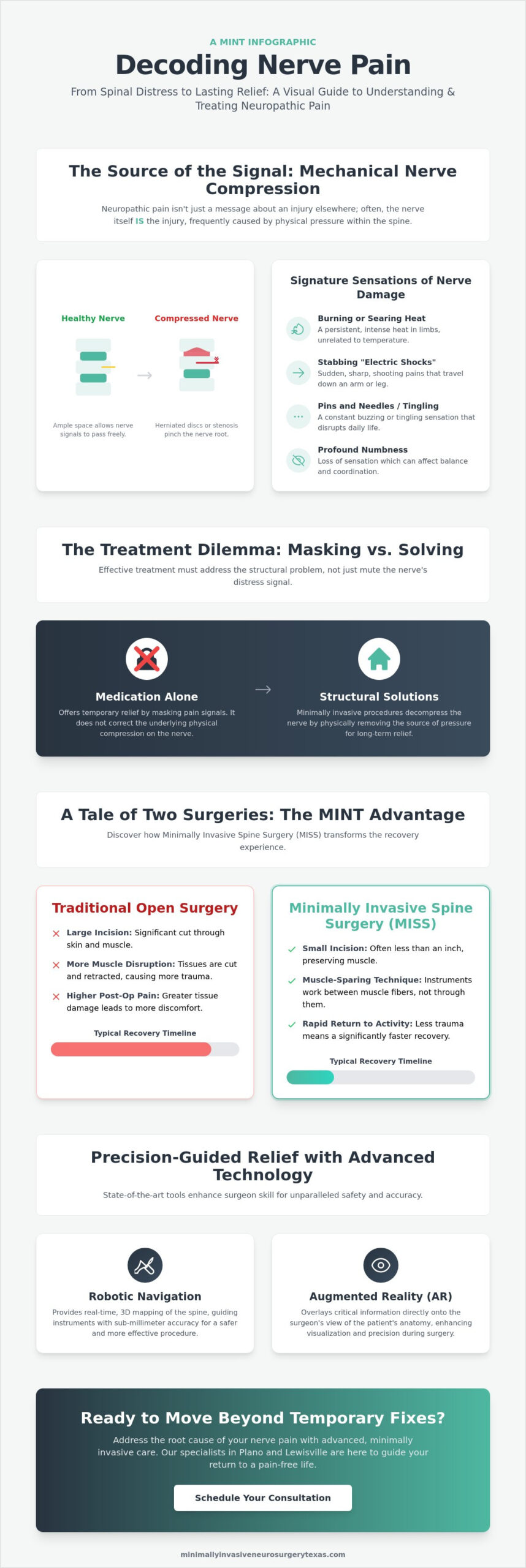
Most patients understand pain as a response to an external injury, like a bruise or a fracture. However, Neuropathic pain represents a malfunction in the communication system itself. Instead of the nerves reporting an injury located elsewhere in the body, the nerves are the injury. This distinction is critical because it dictates why traditional over-the-counter remedies often fail, necessitating a specialized approach to nerve pain treatment that targets the neural pathway directly.
The sensations associated with nerve damage are distinct and often debilitating. Patients frequently describe these feelings using specific descriptors that differ from the dull ache of muscle strain:
- Burning or searing heat that persists regardless of rest or activity.
- Stabbing or “electric shock” sensations that shoot through the limbs without warning.
- Persistent “pins and needles” or tingling that disrupts focus and sleep.
- Profound numbness that can lead to a loss of coordination or balance.
While systemic issues like diabetic neuropathy or chemotherapy-induced damage affect millions, many patients in Lewisville and Plano suffer from nerve pain rooted in spinal mechanics. When the structural integrity of the spine is compromised, it often places direct pressure on the delicate nerve roots exiting the spinal column. This mechanical distress requires a structural solution rather than just chemical suppression.
The Symptoms of Nerve Compression
When a nerve root in the spine is compressed, the resulting pain often isn’t felt at the site of the pressure. This is known as radiculopathy. It’s the reason a pinched nerve in your lower back can cause a searing sensation down your leg. Some patients also experience allodynia, a condition where even the light touch of clothing or bedsheets becomes intensely painful. This constant sensory bombardment takes a significant emotional toll, often leading to sleep deprivation and a diminished quality of life.
When Nerve Pain Becomes Chronic
The nervous system possesses a high degree of plasticity, which can be detrimental if pain is left untreated. Through a process called the “wind-up” phenomenon, the nervous system enters a state of high alert, amplifying even minor signals into intense pain. Early intervention is vital because prolonged compression can lead to permanent nerve fiber damage that is much harder to reverse. Clinically, the transition from acute discomfort to chronic nerve pain occurs at the three-month mark, making timely diagnosis essential for a successful return to normal activity.
Spinal Mechanics: Why Your Spine is Often the Source of Nerve Pain
Think of your spine as the central highway for your nervous system. Every signal that tells your legs to move or your hands to feel originates or passes through this complex structure. While many patients focus on Peripheral Neuropathy caused by systemic issues like diabetes, a significant portion of chronic discomfort arises from mechanical compression within the spinal column. The vertebrae and intervertebral discs are designed to house and protect these delicate fibers. However, when these structures shift, wear down, or fail, they transform from protectors into sources of irritation. When the space intended for these neural pathways narrows, the resulting friction and pressure create a cascade of symptoms that require a targeted nerve pain treatment strategy.
It’s helpful to view this relationship through the “messenger vs. source” analogy. Your nerves are the messengers. If a nerve is pinched in your lower back, it sends a distress signal to the brain. However, the brain often interprets that signal as coming from the end of the nerve line, such as in your calf or foot. You feel the searing pain in your leg, but the source of the trauma is actually in your lumbar spine. Treating the leg with topical creams or physical therapy won’t solve the problem because the messenger is simply reporting a crisis occurring at the source. This is why addressing the structural integrity of the spine is the only way to achieve lasting relief.
Common Structural Culprits: Herniated Discs and Stenosis
Intervertebral discs act as shock absorbers between your vertebrae. When a disc herniates, its soft inner material can leak out and compress nearby nerve roots. This doesn’t just cause physical pressure; the material itself is chemically irritating to the surrounding nerves. Similarly, spinal stenosis involves a gradual narrowing of the spinal canal. This reduction in space often leads to sciatica or arm weakness, as the “tunnels” designed to protect your nerves begin to constrict them instead.
Neural Foraminal Stenosis Explained
The foramina are the small exit holes in the spinal column through which nerves travel to reach the rest of your body. Neural foraminal stenosis occurs when these specific openings become obstructed by bone spurs or disc debris. Because these exits are so narrow, even slight changes in spinal mechanics can lead to severe nerve impingement. This condition often requires specialized neurosurgical decompression to restore the necessary space for nerve function. Understanding these nuances is a core part of the Minimally Invasive Neurosurgery of Texas pillar of care. If you’re experiencing radiating pain, exploring minimally invasive neurosurgery options can help identify the structural source of your symptoms.
Nerve Pain Treatment: Why Medications Often Fall Short
Many patients arrive at our practice after months or years of trying to manage their discomfort with a prescription bottle. The most common question we hear is why a pill hasn’t provided the lasting relief they were promised. While pharmaceuticals play a role in the initial stages of nerve pain treatment, they are rarely a permanent solution for structural issues. Standard anti-inflammatory drugs (NSAIDs) like ibuprofen or naproxen are designed to reduce swelling in soft tissues. They don’t, however, address the high-voltage electrical signals sent by a compressed nerve root. Nerve-specific medications attempt to dampen these signals, but they often come with a heavy cost to your daily performance.
Relying on narcotics or opioids for neuropathic pain is particularly problematic. These substances are designed to block pain receptors associated with acute tissue damage, such as a broken bone. They are notoriously ineffective for the complex, shooting sensations caused by nerve compression. Beyond their lack of efficacy, long-term pharmaceutical reliance often leads to systemic side effects. Patients frequently report persistent brain fog, chronic fatigue, and a general sense of detachment. These symptoms can be just as debilitating as the pain itself, interfering with your ability to work and engage with your family.
The Limitations of Pharmacological Management
The primary issue with medication is that it treats the symptom, the pain signal, while ignoring the cause, the mechanical compression. There is also a clinical “ceiling effect” to consider. This occurs when increasing the dosage of a medication no longer provides additional relief but significantly increases the risk of adverse reactions. When you rely solely on drugs, you risk masking the pain that serves as a vital warning sign. Ignoring these structural warnings can lead to further injury, as you might engage in activities that exacerbate the underlying nerve damage without feeling the immediate feedback of pain. Professional nerve pain diagnosis and treatment should always look beyond the medicine cabinet to identify what is physically happening in the spinal column.
Structural Repair vs. Symptom Masking
A “wait and see” approach supported by medication is often a recipe for chronic decline. Mechanical problems in the spine, such as a herniated disc or bone spur, require mechanical solutions. You can’t medicate away a physical obstruction that is crushing a nerve fiber. Proactive structural resolution through decompression is the gold standard for restoring nerve health. By physically removing the pressure, we stop the pain signal at its source. This transition from masking symptoms to fixing the underlying architecture is what allows our patients to achieve a true return to normal activity levels.
Advanced Minimally Invasive Solutions for Lasting Relief
For many patients, the word “surgery” conjures images of long hospital stays and painful recoveries. This outdated perspective often prevents people from seeking the very nerve pain treatment they need to stop permanent damage. Modern Minimally Invasive Spine Surgery (MISS) offers a sophisticated alternative to traditional open procedures. By utilizing specialized instruments and high-tech visualization, we can resolve the structural cause of your pain without the trauma of large incisions. This precision-focused approach ensures that we address the neural compression directly while sparing the surrounding healthy tissue. It’s a method built on the philosophy of maximum effect with minimal disruption.
The primary benefit of MISS lies in its muscle-sparing methodology. Traditional surgery requires stripping muscle away from the spine, which often leads to significant post-operative discomfort. In contrast, our techniques involve small incisions and dilators that gently move muscle fibers aside. This results in less blood loss, a reduced risk of infection, and a significantly faster recovery timeline. We utilize high-definition cameras and microscopic tools to navigate the delicate anatomy of the spinal canal. This high-tech precision allows us to decompress nerves with absolute certainty, providing a clear path for your return to normal activity. This specialized nerve pain treatment ensures you don’t have to choose between relief and physical integrity.
Endoscopic Spine Surgery: The Ultimate Precision
Endoscopic procedures represent the pinnacle of modern neurosurgical innovation. Through an ultra-small incision, often less than one centimeter, we insert a tiny camera called an endoscope. This provides a direct, magnified view of the herniated disc or bone spur causing your distress. We can then remove the offending material with microscopic tools, leaving the rest of the spinal architecture untouched. For cases where more extensive stabilization is required, we may utilize minimally invasive spinal fusion Texas techniques to provide long-term structural support without the heavy impact of open surgery.
Artificial Disc Replacement (ADR)
While traditional fusion is highly effective for many, Artificial Disc Replacement (ADR) offers a motion-preserving alternative. Instead of joining two vertebrae together, we replace the damaged disc with a high-tech prosthetic. This device mimics the natural movement of your spine, preventing the “adjacent segment disease” often seen with traditional fusion. ADR effectively decompresses the nerve while maintaining the natural flexibility of your neck or back. It’s a primary option for patients seeking neck disk replacement in Plano. If you’re ready to explore these structural solutions, you can contact our specialized surgical center to begin your journey toward recovery.
Minimally Invasive Care in Plano and Lewisville: The MINT Difference
Dr. Scott Kutz founded Minimally Invasive Neurosurgery of Texas (MINT) to provide a specialized alternative to the impersonal nature of large hospital systems. While major medical centers often treat patients as numbers in a vast queue, our practice offers a boutique surgical experience centered on individual results. This personal attention is paired with a level of clinical authority that rivals any national institution. By focusing exclusively on the spine and peripheral nerves, we ensure that every aspect of your care is handled by experts who understand the nuances of structural nerve pain treatment. Our goal is to move you from a state of chronic concern to a state of informed confidence.
High-Tech Healing with a Local Touch
Precision is the hallmark of modern neurosurgery. At MINT, we utilize the Globus Excelsius robotic navigation system alongside Augmedics AR technology. These proprietary systems allow for sub-millimeter accuracy during complex nerve decompression. Robotic-assisted surgery minimizes the margin for error, ensuring that hardware is placed perfectly and neural pathways are cleared with absolute certainty. Seeking a board-certified neurosurgeon for these issues is critical; neurosurgeons undergo the most rigorous training in handling delicate nerve tissues. For residents in Plano, Lewisville, and the broader DFW area, this means accessing world-class technology right in your own community without the coldness of a large institution.
Your Path to Recovery: What to Expect
The journey from chronic pain to recovery begins with a comprehensive diagnostic evaluation. We move beyond basic physical exams, utilizing advanced imaging to identify the exact site of mechanical compression. This thoroughness ensures that our surgical plan addresses the source, not just the symptom. Many of our procedures are performed on an outpatient basis, allowing you to recover in the comfort of your own home rather than a hospital room. This efficiency is made possible by our specialized surgical methodologies that prioritize tissue preservation and reduced physical impact.
Our ultimate value proposition is simple: a rapid return to normal activity. We don’t just aim to reduce your pain; we aim to restore your lifestyle. From your first consultation to your final follow-up, our team is dedicated to your health as our top priority. This commitment to professional excellence and certified authority has made us a trusted name for nerve pain treatment in North Texas. If you’re tired of temporary fixes and are ready for a structural solution that fixes the source of your suffering, contact our specialized surgical center today to begin your journey toward progress.
Take the Next Step Toward Lasting Structural Relief
Persistent nerve pain isn’t something you should have to manage with a lifetime of medication or the uncertainty of returning symptoms. Addressing the mechanical source of your distress through precision decompression is the most effective path to achieving lasting results. By choosing a structural solution over temporary symptom masking, you protect your neural health and prevent the risk of permanent fiber damage. This proactive approach is the key to reclaiming your daily quality of life and physical independence.
At Minimally Invasive Neurosurgery of Texas, Board-Certified Neurosurgeon Dr. Scott Kutz utilizes advanced Globus Excelsius robotic navigation to provide sub-millimeter accuracy for every procedure. Our specialized focus on motion-preserving Artificial Disc Replacement and endoscopic techniques ensures that your nerve pain treatment is as minimally disruptive as possible. You deserve a boutique surgical experience that prioritizes your recovery and rapid return to normal activity. Schedule Your Consultation with MINT in Plano or Lewisville Today. We’re ready to help you transition from chronic suffering to informed confidence and renewed mobility.
Frequently Asked Questions
How do I know if my pain is nerve-related or muscle-related?
Nerve pain is typically characterized by sharp, electric, or burning sensations that radiate away from the spine and into your extremities. Unlike the dull, localized ache of a muscle strain, neuropathic pain often includes “pins and needles” or profound numbness. If your discomfort is accompanied by weakness in a specific limb or travels down your leg, it is likely a neural issue requiring specialized evaluation.
Can nerve pain go away on its own without surgery?
Minor nerve irritation caused by temporary inflammation may resolve with rest and conservative care, but structural compression rarely fixes itself. If a herniated disc or bone spur is physically crushing a nerve root, the symptoms will likely persist or worsen over time. While medications can mask the signal, they don’t remove the physical obstruction that is causing the underlying trauma.
What is the most successful treatment for chronic nerve pain?
The most successful nerve pain treatment for structural issues is surgical decompression. By physically removing the material pressing on the nerve, we stop the pain signal at its source. Minimally invasive techniques, such as endoscopic spine surgery, provide this resolution with significantly less recovery time and muscle trauma than traditional open procedures, allowing for a faster return to normal activity.
Is minimally invasive spine surgery safe for older adults in Plano?
Minimally invasive spine surgery is often an ideal option for older adults because it involves smaller incisions and minimal blood loss. These advanced techniques reduce the overall physiological stress on the body, which is critical for patients with age-related health concerns. Because we avoid stripping muscle away from the bone, the risk of complications is lower than with traditional, highly invasive back surgery.
How long does it take for a nerve to heal after decompression surgery?
Nerves are slow-healing tissues, often regenerating at a rate of approximately one inch per month. While many patients experience an immediate reduction in sharp, radiating pain after decompression, lingering symptoms like numbness or tingling can take several weeks or months to fully resolve. The timeline depends on the severity and duration of the compression before the surgical intervention was performed.
What happens if I leave spinal nerve compression untreated?
Ignoring spinal nerve compression can lead to permanent nerve fiber damage, chronic muscle weakness, and even muscle wasting. Prolonged pressure can cause the nervous system to remain in a permanent state of high alert, a condition that makes the pain much harder to treat later. Early intervention is the most effective way to ensure a full recovery and prevent long-term disability.
Do I need a referral to see a neurosurgeon for nerve pain in Lewisville?
Whether you require a referral depends entirely on your specific health insurance plan’s requirements. Some PPO plans allow you to book directly with a specialist, while HMO plans typically require a primary care physician to provide a referral first. We recommend contacting your insurance carrier to verify your benefits before scheduling your initial consultation at our Lewisville or Plano offices.
Will insurance cover minimally invasive nerve pain treatments?
Most major health insurance plans, including Medicare, generally cover the diagnosis and nerve pain treatment when it is deemed medically necessary. Coverage for specific advanced procedures, such as Artificial Disc Replacement, can vary significantly between different providers and individual policies. It is essential to check with your insurance provider to understand your specific out-of-pocket responsibilities and coverage limits.