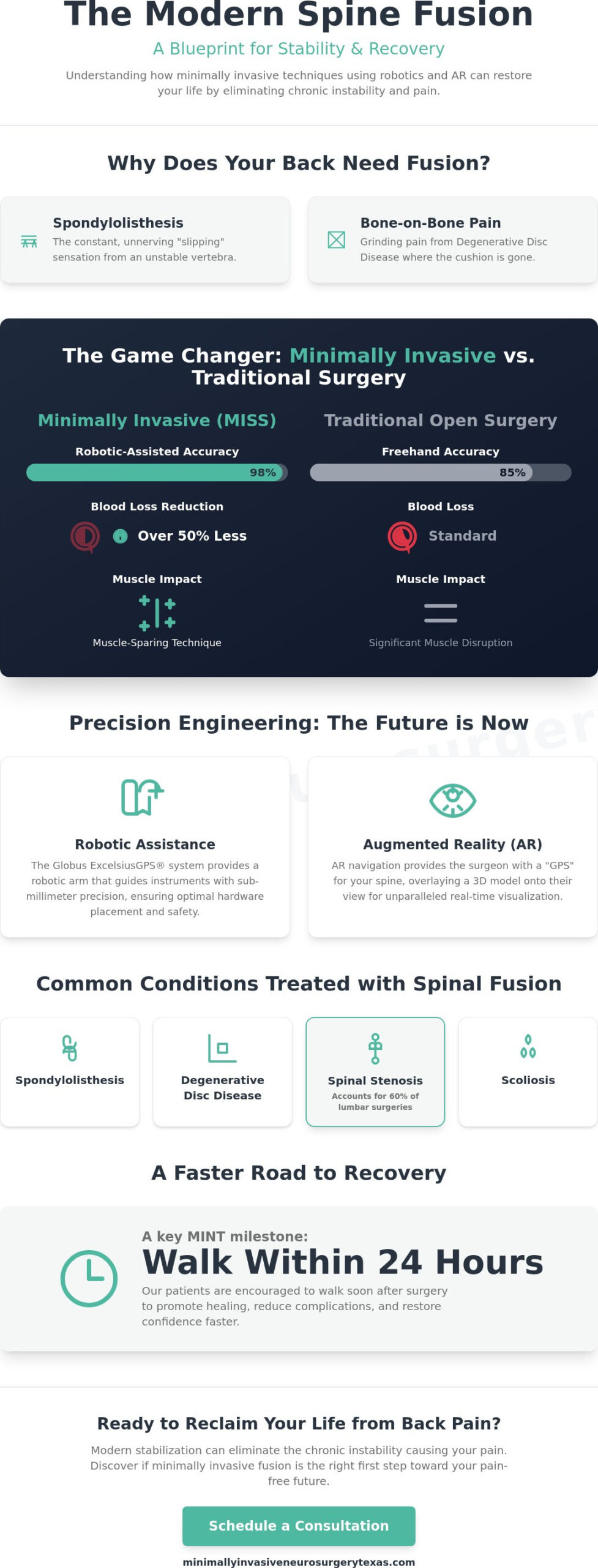
Did you know that modern robotic-assisted spinal systems now achieve a 98% accuracy rate, significantly outperforming the 85% accuracy of traditional freehand techniques? If you’re asking what is back fusion surgery, you’re likely dealing with the constant “slipping” sensation of spondylolisthesis or the grinding of bone-on-bone pain. It’s natural to feel overwhelmed by complex acronyms like TLIF or fear a long, grueling recovery that keeps you away from your family and daily passions.
We believe surgery should be a bridge to a better life, not a source of more trauma. This guide explores how modern MISS (Minimally Invasive Spine Surgery) provides permanent stability while reducing blood loss by over 50% compared to traditional open methods. We’ll preview the latest 2026 innovations in robotic precision and explain how these advanced techniques help you get back to life with confidence. You don’t have to choose between stability and mobility; modern neurosurgery is designed to restore both. By the end of this article, you’ll understand why a stabilized spine is the first step toward a pain-free future.
Key Takeaways
- Learn exactly what is back fusion surgery and how it acts as a biological “internal weld” to create permanent spinal stability.
- Compare the advantages of MISS techniques that preserve muscle tissue, resulting in lower infection rates and faster healing than traditional open surgery.
- Explore how Globus ExcelsiusGPS and Augmented Reality provide surgeons with unprecedented precision and real-time visualization during the procedure.
- Get a clear timeline for your recovery, including why patients at MINT are often encouraged to walk within the first 24 hours of surgery.
- Discover how modern stabilization allows you to get back to life by eliminating the chronic instability that causes bone-on-bone pain.
What is Back Fusion Surgery? Understanding the Internal Weld
If you’ve been struggling with chronic instability, you’ve likely asked: what is back fusion surgery? At its core, this procedure is a sophisticated biological process that mimics the natural healing of a broken bone. We often describe it as an “internal weld.” By using specialized bone grafts and instrumentation, we encourage two or more vertebrae to grow together into a single, solid unit. This medical phenomenon, known as spondylodesis, transforms a painful, shifting spinal segment into a stable foundation. While traditional views of fusion focus on restricted movement, our modern approach at MINT prioritizes the restoration of function so you can get back to life without the fear of sudden, sharp pain.
An unstable spine is like a loose hinge on a heavy door; every movement causes friction and wear. A fused spine, by contrast, eliminates that microscopic “slipping” that irritates nerves and causes muscle spasms. When you understand What is Spinal Fusion? through the lens of modern neurosurgery, you see it as a restorative tool. We don’t just stop motion; we provide the permanent stability required for long-term relief from “bone-on-bone” agony. This is the definitive answer to what is back fusion surgery: it’s the creation of a permanent biological bridge that protects your nervous system.
The Primary Goals of Spinal Stabilization
The objective of any fusion procedure is threefold. First, we aim to eliminate the painful motion between vertebral segments that have become unstable due to injury or age. Second, we work to restore proper spinal alignment and disc height, which often collapses as discs degenerate. Finally, the procedure allows us to decompress pinched nerves. By creating space for the neural pathways, we can stop the radiating leg pain and numbness that often accompanies spinal disorders. This comprehensive approach ensures that the spine isn’t just “fixed” but optimized for your daily activity.
Conditions That Require Fusion
Not every back problem requires fusion, but for certain conditions, it remains the gold standard for permanent relief. Degenerative Disc Disease (DDD) is a primary culprit; when the intervertebral cushion is completely gone, the resulting friction is often unbearable. Spondylolisthesis, where one vertebra slips forward over another, also requires the stability of a fusion to prevent neurological damage. Additionally, we use these techniques to treat severe Spinal Stenosis and Scoliosis. Recent 2026 data from the American Spine Registry indicates that spinal stenosis remains a leading diagnosis, accounting for 60% of lumbar surgery cases. At our Lewisville and Plano clinics, we evaluate these conditions with precision to determine if a minimally invasive fusion is your best path toward recovery.
How Spinal Fusion Works: The Biological Process of Healing
The success of a spinal procedure doesn’t end when the last stitch is placed; rather, that is where the biological journey begins. To truly understand what is back fusion surgery, you must view it as the construction of a “Biological Bridge.” Your body naturally wants to heal, and we provide the environment for it to create new bone across the disc space. This isn’t an instant fix. While the hardware provides immediate stability, the actual “weld” is a cellular process that unfolds over several months. You’re not just getting a mechanical repair; you’re undergoing a living transformation.
A critical component of this process is the preparation of the fusion bed. We meticulously clear away damaged disc material and prepare the vertebral surfaces to expose healthy, bleeding bone. This triggers the body’s inflammatory response, which is the initial step in bone regeneration. Understanding how spinal fusion surgery works involves recognizing that the surgeon sets the stage, but the patient’s biology performs the lead role. Bone morphogenetic proteins (BMP) act as a modern catalyst for fusion by signaling the body’s stem cells to transform into bone-forming cells.
Bone Grafts and Modern Biologics
The material used to spark this growth is called a bone graft. We often use an autograft, which is bone taken from your own body, or an allograft, which comes from a highly screened donor bank. At MINT, we also utilize synthetic bone substitutes and advanced growth factors to enhance this biological bridge. The specific choice of biologic determines the speed and strength of the fusion, and we tailor this selection to your unique health profile. If you’re ready to explore these advanced options, you can consult with our specialized team to see which approach fits your needs.
The Role of Spinal Hardware
Think of spinal hardware as an “internal cast.” While your body is busy growing new bone, pedicle screws and rods hold the vertebrae in a fixed, perfect position. This prevents the microscopic movement that could disrupt the delicate new bone cells as they form. We also use interbody cages, which are small spacers placed directly into the disc space. These cages restore the natural height of your spine and provide a hollow center where the bone graft can thrive. Modern neurosurgery favors materials like titanium, which is incredibly durable and integrates well with tissue, or PEEK, a high-performance polymer that mimics the flexibility of natural bone.
Minimally Invasive vs. Traditional Open Fusion Surgery
Traditional back surgery often involves long incisions and the detachment of large muscle groups from the spine, a process known as muscle-stripping. This invasive method frequently leads to significant post-operative pain and extended hospital stays. By contrast, our approach at MINT utilizes muscle-splitting techniques. We use specialized dilators to create a small tunnel through the muscle fibers rather than cutting them. This advanced method is a core component of minimally invasive neurosurgery, which has become the gold standard for patient care in 2026.
When patients ask what is back fusion surgery, they are often surprised to learn that modern MISS techniques result in over 50% less blood loss compared to traditional open procedures. Smaller incisions, often just an inch or two in length, also mean a lower risk of infection and minimal scarring. This precision allows us to achieve the same structural goals as open surgery while sparing the surrounding healthy tissue. As noted by resources explaining What is Spinal Fusion Surgery?, the ultimate goal is stability, but the path we take to reach that stability determines the quality of your recovery.
Common MISS Fusion Approaches (TLIF, ALIF, XLIF)
Dr. Scott Kutz selects the surgical path based on your specific anatomy and the location of the instability. Transforaminal Lumbar Interbody Fusion (TLIF) is a common posterior approach that accesses the spine from the back. Alternatively, Anterior Lumbar Interbody Fusion (ALIF) approaches from the front, while Lateral Interbody Fusion (XLIF) comes from the side. These varied paths allow us to avoid major back muscles and provide a customized solution for your unique spinal condition. By choosing the most direct route, we minimize disruption to healthy tissue and accelerate the healing process.
Recovery Advantages of the MISS Approach
The transition from the operating room to your living room is significantly faster with a minimally invasive approach. While traditional surgery can require a hospital stay of three to four days, many MISS patients go home within 24 hours. Because we split rather than strip the muscles, our patients experience a reduced reliance on opioid pain medications after surgery. This allows for an earlier start to physical therapy and walking, which are essential for a successful fusion. Our goal is to help you get back to life with as little downtime as possible, ensuring your recovery is as efficient as the surgery itself.
Precision Engineering: Robotics and AR in Modern Fusion
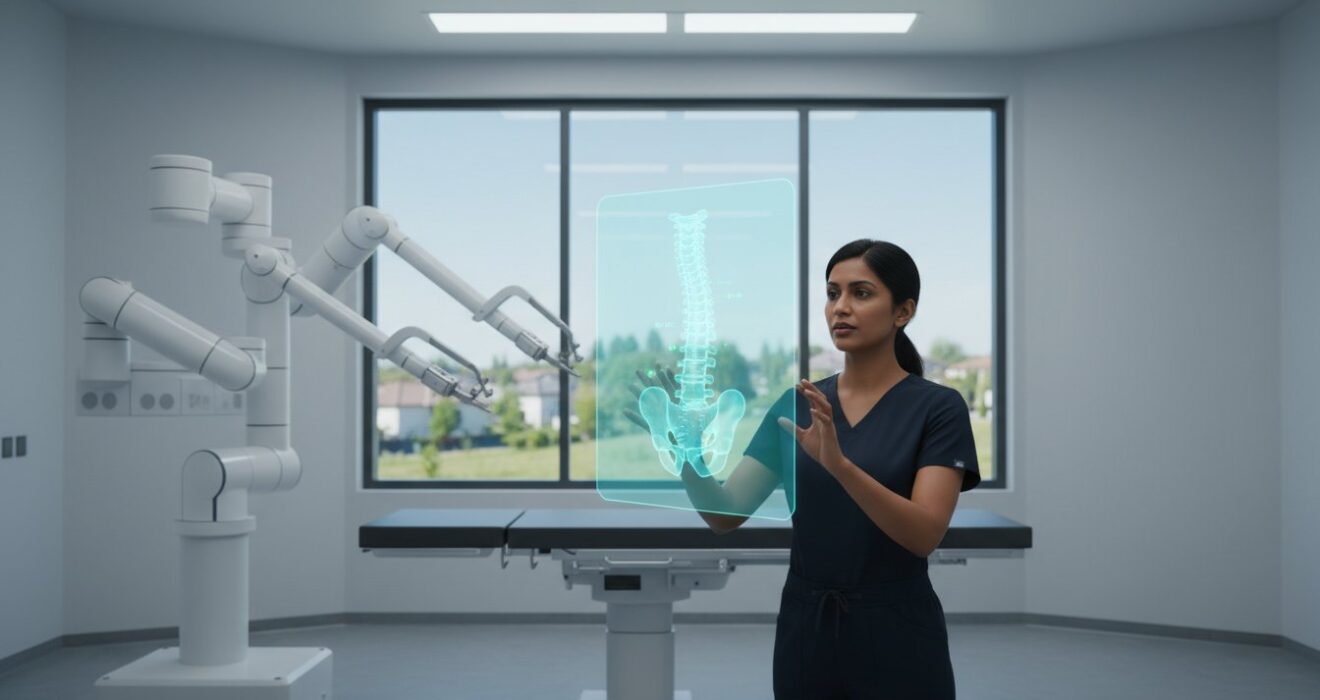
When considering what is back fusion surgery in a modern clinical setting, the conversation must shift from simple mechanical stabilization to precision engineering. At MINT, we’ve moved beyond traditional freehand techniques that rely solely on a surgeon’s tactile feel and standard X-rays. Instead, we utilize the Globus ExcelsiusGPS robotic navigation system and Augmedics Augmented Reality (AR) to ensure every screw and cage is placed with sub-millimeter accuracy. This high-tech approach isn’t just about using new gadgets; it’s about eliminating the margin for error that once characterized spinal procedures. Clinical data indicates that robotic systems achieve accuracy rates above 98%, which is a massive leap over the 85% to 90% accuracy often seen in traditional methods.
The integration of 3D mapping allows us to visualize your unique anatomy in high definition before we even make an incision. This “High-Tech Healing” philosophy ensures that the hardware is positioned perfectly the first time, which leads to fewer complications and significantly better fusion rates. By combining robotic stability with the surgeon’s expertise, we’ve turned what was once a high-stakes guessing game into a predictable, digitized process. This level of precision is exactly what defines modern back surgery at our specialized centers.
The Globus ExcelsiusGPS Advantage
The Globus ExcelsiusGPS system serves as a revolutionary tool for pre-operative planning. We map your entire surgery on a computer, creating a digital blueprint tailored to your specific spinal alignment. During the procedure, the robotic arm provides real-time feedback to the surgeon, maintaining a rigid path for hardware placement that doesn’t deviate. This system also significantly reduces radiation exposure for both the patient and the surgical staff by minimizing the need for repetitive intraoperative X-rays. It’s a safer, more efficient way to achieve permanent spinal stability.
Augmented Reality (AR) in the Operating Room
In addition to robotics, we utilize Augmedics xvision, the first AR guidance system designed specifically for the spine. Think of this as “X-ray vision” through the skin. By wearing a specialized headset, Dr. Kutz can see a 3D visualization of your spinal anatomy directly overlaid on your body. This allows the surgeon to maintain a constant line of sight on the patient rather than looking away at a remote monitor. It functions like a “GPS for the Spine,” providing a transparent view of the underlying structures and ensuring that every movement is guided by real-time data. If you’re ready to experience the safety of robotic-assisted care, contact Minimally Invasive Neurosurgery of Texas to discuss your options.
The Road to Recovery: Getting Back to Life in North Texas
The real measure of success for any spinal procedure is how quickly you can return to your normal routine. When patients research what is back fusion surgery, they often find daunting stories of months-long bed rest. At MINT, we’ve replaced that outdated model with a proactive recovery protocol. Within the first 24 hours of your MISS procedure, our team encourages you to begin walking. This immediate movement promotes circulation and prevents the stiffness associated with traditional open surgery. By the time you reach the six-week milestone, the biological bridge of new bone has typically begun to span the gap between your vertebrae, providing the structural integrity needed to increase your activity levels.
We understand that many patients come to us with a fear of “Failed Back Surgery Syndrome” (FBSS). This concern is valid; a 2026 report from the American Spine Registry noted a 13.9% reoperation rate for lumbar fusions across the broader surgical industry. However, our practice specializes in complex revision surgeries for those whose previous procedures at other facilities did not provide relief. It’s also essential to recognize that persistent pain isn’t always from the spine itself. Up to 30% of chronic lower back pain cases are actually caused by the sacroiliac joint, which is why patients who continue to experience discomfort in the lower back or buttocks after a previous surgery should explore si joint fusion surgery as a potential solution. If you continue to experience discomfort in the lower back or buttocks after a previous surgery, you should learn to identify the symptoms of failed si joint fusion to ensure every potential pain generator is addressed.
What to Expect in Lewisville and Plano
Choosing a boutique surgical center like MINT means you aren’t just another number in a large hospital system. Dr. Scott Kutz and our dedicated staff provide personalized follow-up care at our Lewisville and Plano locations. During the first few weeks of recovery, you’ll need to navigate some temporary driving restrictions to ensure your spine remains in an optimal healing position. We coordinate closely with you to manage these transitions, providing a level of attention that larger systems simply cannot match. This local, specialized focus is why so many North Texas residents trust us with their spinal health.
Long-Term Outcomes and Mobility
There is a common myth that fusion leads to a permanent feeling of stiffness. In reality, most of our patients report feeling more mobile after they’ve recovered. When the chronic, “bone-on-bone” pain is eliminated, you’re free to move in ways that were previously impossible. To maintain these results, we emphasize the importance of protecting adjacent spinal segments through proper posture and core strengthening. Ultimately, what is back fusion surgery if not a bridge to your future? It’s the foundation that allows you to finally get back to life and enjoy every day without the shadow of chronic pain.
Take the First Step Toward Permanent Spinal Stability
Living with chronic back pain often feels like a permanent barrier, but modern innovation has transformed the surgical experience into a path of hope. You now understand that what is back fusion surgery is actually a sophisticated biological process enhanced by 98% robotic accuracy and minimally invasive techniques. These advancements ensure that permanent stability doesn’t come at the cost of a grueling recovery. By choosing a path that prioritizes muscle preservation and sub-millimeter precision, you’re choosing a faster return to the activities you love.
Board-certified neurosurgeon Dr. Scott Kutz combines clinical excellence with the advanced Globus ExcelsiusGPS robotic navigation system to provide world-class care in a boutique environment. With convenient locations in Lewisville and Plano, our team is ready to guide you through every stage of your diagnostic and recovery journey. Don’t let spinal instability dictate your future any longer. Schedule Your Consultation with Dr. Scott Kutz at MINT today to explore your options. It’s time to leave the pain behind and finally get back to life.
Frequently Asked Questions
Is back fusion surgery a major surgery?
Back fusion is considered a major surgical procedure because it involves permanent structural changes to your skeleton. When exploring what is back fusion surgery, it’s essential to recognize that while the procedure is significant, modern MISS techniques have revolutionized the experience. We can now achieve these foundational changes through incisions smaller than two inches, which dramatically reduces the physical trauma compared to traditional methods.
How long is the hospital stay after a minimally invasive fusion?
Most patients stay in the hospital for only 23 to 48 hours following a minimally invasive procedure. This is a substantial reduction from the three to four-day stays required for traditional open surgeries. In specific cases, we can even perform these stabilizations as outpatient procedures, allowing you to recover in the comfort of your own home the same day.
Will I lose my ability to bend over after spinal fusion?
You’ll likely retain most of your ability to bend because the majority of spinal flexibility comes from the hips and the segments that aren’t fused. Many patients actually report feeling more mobile after they’ve healed. This happens because the chronic pain that once caused muscle guarding and stiffness is gone, allowing you to move more naturally.
What is the success rate of back fusion surgery in 2026?
Success rates for achieving a solid bone union now exceed 90% due to advancements in biologics and surgical navigation. When determining what is back fusion surgery success, we evaluate both the biological “weld” and your reported pain relief. Current 2026 clinical data indicates that over 85% of patients experience a meaningful improvement in their daily quality of life.
Can I avoid fusion surgery with an artificial disc replacement?
Artificial disc replacement is a motion-preserving alternative, but it isn’t suitable for everyone. If your spine shows significant instability or facet joint arthritis, a fusion is often the more durable and safer choice for long-term relief. We use advanced imaging to determine if your anatomy is better suited for stabilization or a replacement device.
What happens if the bones fail to fuse (pseudarthrosis)?
If a solid bone bridge fails to form, a condition known as pseudarthrosis, you may experience persistent pain or hardware issues. This occurs in approximately 5% to 10% of spinal cases across the industry. Our team at MINT specializes in revision surgeries to correct these failures, often utilizing bone-growth catalysts to ensure a successful secondary fusion.
How soon can I return to work after a lumbar fusion?
Patients with sedentary office positions often return to work within two to four weeks of their procedure. If your occupation requires heavy lifting or strenuous labor, you’ll typically need to wait three to six months until imaging confirms the bone is strong enough for those demands. We’ll create a specific timeline based on your unique healing progress.
Does insurance typically cover minimally invasive spinal fusion?
Most major insurance providers and Medicare cover minimally invasive spinal fusion when it’s medically necessary. This generally requires a documented history showing that conservative treatments like physical therapy haven’t worked over a six-week to three-month period. Our administrative team works directly with your provider to handle the pre-authorization process for you.