
Did you know that between 10% and 40% of patients continue to experience debilitating symptoms following their initial spine procedure? If you’re still battling persistent neuropathic pain or limited mobility, specialized failed back surgery syndrome treatment Plano offers a path forward that goes beyond temporary masks. You likely feel a sense of betrayal by the surgical process and frustration over a growing dependence on daily medication just to manage life in Plano or Lewisville.
We believe that a failed recovery isn’t a dead end; it’s an opportunity for a more precise, structural correction. Our approach combines clinical authority with a patient-centered focus to restore your quality of life. You’ll discover why initial surgeries often fall short and how advanced, minimally invasive neurosurgery can finally resolve the underlying issue. We’ll explore modern revision techniques that prioritize faster recovery and long-term stability, allowing you to move away from the cycle of pain management and back to your normal activities.
Key Takeaways
- Understand why persistent pain is often a result of specific structural oversights rather than a personal failure of the recovery process.
- Identify the primary biological triggers for post-surgical discomfort, such as epidural fibrosis and recurrent disc herniation.
- Discover how advanced failed back surgery syndrome treatment Plano utilizes muscle-sparing techniques to reduce physical impact and speed up your return to normal activity.
- Learn about the specialized diagnostic roadmap, including MRI with contrast and CT myelograms, necessary to pinpoint the exact source of your chronic pain.
- Explore the benefits of choosing a boutique surgical center that prioritizes precision technology and personalized neurosurgical expertise.
Understanding Failed Back Surgery Syndrome in Plano
Failed Back Surgery Syndrome (FBSS) is a clinical term used to describe persistent or worsening pain following a spinal intervention. It is not a specific disease; it is a label for a complex set of symptoms that remain after the initial procedure’s healing phase has passed. While the term includes the word “failure,” this is never a reflection of the patient’s effort or willpower. Instead, it often points toward a structural issue that wasn’t fully addressed or a diagnostic oversight. In some cases, the original surgery may have even contributed to new instabilities in the spinal column.
In the North Texas area, we see a significant number of patients seeking failed back surgery syndrome treatment Plano after traditional open procedures. It’s crucial to distinguish between expected post-operative discomfort and the long-term development of FBSS. While some soreness is normal during the first few weeks of recovery, FBSS involves neuropathic pain that lingers or even intensifies months after the surgery. For many, Understanding Failed Back Surgery Syndrome is the first step toward finding a definitive solution that restores functional movement.
Signs Your Surgery Did Not Meet Its Goals
When a spinal procedure is successful, patients typically experience a steady decline in pain and an increase in mobility. However, if you are experiencing sharp, shooting pain in your legs or lower back that feels identical to your pre-surgery symptoms, the underlying issue may still be present. New numbness or weakness in the extremities is another red flag that suggests nerve compression remains a factor. These symptoms indicate that the decompression was either incomplete or that a new issue has emerged at an adjacent level of the spine.
Many patients describe a “honeymoon period” where they feel significantly better for six to twelve months before their chronic symptoms return. This recurrence often happens because the initial surgery didn’t address the root cause of the instability. It can also occur because excessive scar tissue has begun to compress the nerve roots. This cycle of temporary relief followed by a return to chronic pain is a hallmark of FBSS that requires a more precise, technological approach to resolve.
The Emotional Toll of Continued Chronic Pain
Living with unresolved pain after undergoing a major surgical procedure is physically and mentally exhausting. Many patients in our community report feeling a sense of “medical gaslighting.” They are often told their imaging looks fine despite their clear physical suffering. This leads to a loss of trust in the healthcare system and a fear that they will be dependent on pain medication indefinitely. The psychological weight of a “failed” surgery can be just as heavy as the physical pain itself.
Seeking a second opinion from a specialized Plano neurosurgeon is a standard and necessary step in these cases. We prioritize a compassionate, patient-centered approach to revision. By utilizing advanced diagnostic tools, we can pinpoint the exact structural reason for your discomfort. Our goal is to offer a clear roadmap that leads you back to your normal activities with confidence and clarity. You deserve a solution that addresses both the physical pathology and the emotional burden of chronic pain.
Common Causes of Failed Back Surgery
Pinpointing the exact cause of persistent pain requires a rigorous clinical evaluation. While every patient’s case is unique, several recurring structural issues often explain why an initial intervention didn’t provide lasting relief. Identifying these factors is the cornerstone of effective failed back surgery syndrome treatment Plano. Understanding these triggers helps us move from a state of frustration to a clear, actionable recovery plan.
- Recurrent Disc Herniation: Even after a successful discectomy, new disc material can extrude at the same level. This often happens if the underlying weakness in the disc wall wasn’t fully stabilized.
- Epidural Fibrosis: This refers to the development of excessive scar tissue near the nerve roots. While some scarring is a natural part of healing, excessive fibrosis can bind nerves to surrounding structures, causing chronic irritation and sharp, radiating pain.
- Adjacent Segment Disease (ASD): This is particularly common after spinal fusion. When one segment is immobilized, the levels above and below must compensate for the lost motion. This added stress leads to accelerated wear, new herniations, and localized pain.
- Incomplete Decompression: In some instances, the original surgery failed to remove enough bone or ligament to fully free the compressed nerve. This “missed” pathology remains a constant source of discomfort.
Technical vs. Biological Causes
Clinical outcomes often depend on the intersection of surgical precision and the body’s natural healing response. Technical failures might involve misplaced hardware or surgery performed at the incorrect spinal level. Conversely, biological failures relate to how your body reacts to the intervention. Pseudarthrosis is the failure of a spinal fusion to solidify into a single bone. When doctors focus on diagnosing Failed Back Surgery Syndrome, they must determine if the issue is a lack of structural stability or a biological healing deficit.
The Problem with Traditional Open Revision
Traditional revision surgery often relies on large incisions that disturb already traumatized tissue. Repeating an “open” approach at the same site frequently triggers even more scar tissue formation, which can worsen the very problem it aims to fix. These large-scale revisions also carry higher risks of blood loss and infection compared to the primary surgery. If previous hardware is present, traditional methods may require extensive bone removal to gain access, further compromising the integrity of your spine. For those seeking a more refined approach, minimally invasive neurosurgery offers a way to address these complex issues without the trauma of traditional open revision.
Our team specializes in identifying these specific failure points using advanced imaging. By understanding the mechanical and biological reasons for your continued pain, we can apply targeted failed back surgery syndrome treatment Plano that prioritizes your long-term stability. This precision-based approach is designed to stop the cycle of revision and start your journey toward a return to normal activity.
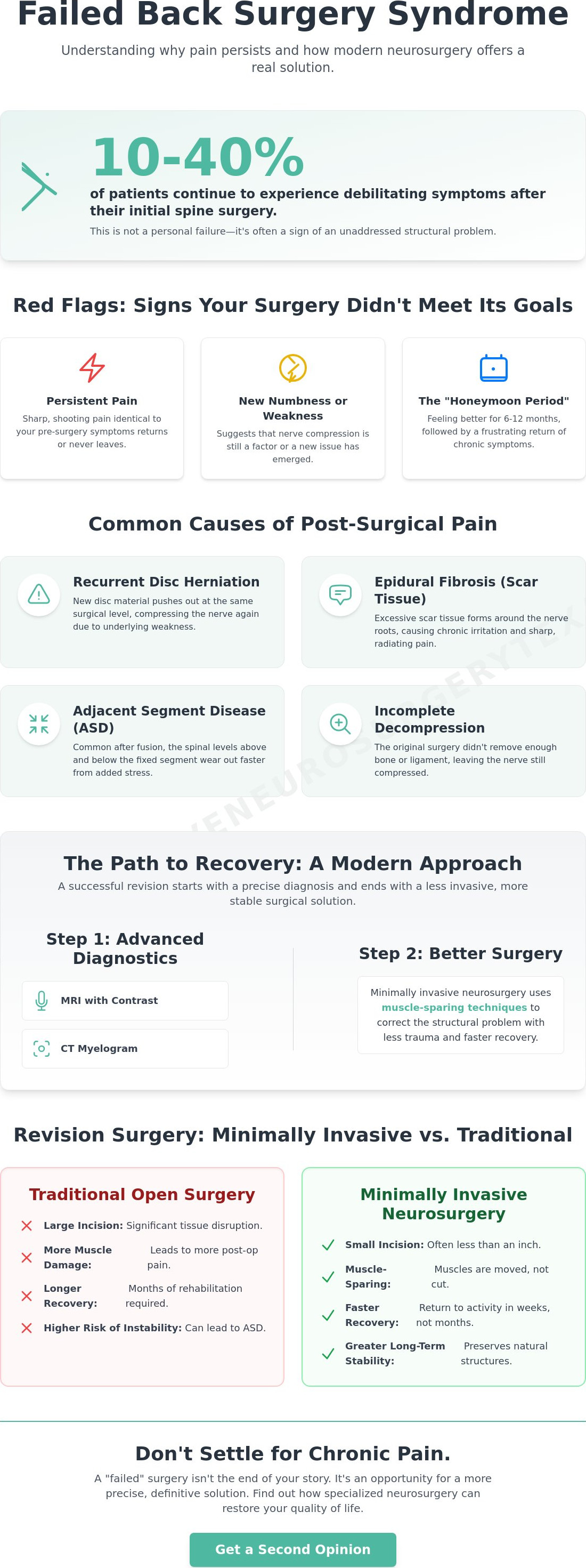
Revision Surgery: Minimally Invasive vs. Traditional Approaches
Many patients are told that their only option after a failed surgery is a lifetime of pain management or spinal cord stimulation. This is a common misconception that often stems from a lack of access to advanced surgical technology. While traditional open revision surgery carries significant risks, modern failed back surgery syndrome treatment Plano focuses on fixing the structural root cause through minimally invasive neurosurgery. This high-tech approach allows us to correct previous errors without the destructive trauma of large incisions.
Traditional revision often requires several days in the hospital and months of restricted movement. In contrast, minimally invasive revision techniques utilize muscle-sparing methods. Instead of cutting through healthy tissue, we use specialized dilators to create a path to the spine. This results in significantly less blood loss and a faster return to normal activity. Smaller incisions also drastically reduce the risk of creating new epidural fibrosis, which is the excessive scar tissue that often binds nerve roots after an open procedure.
You might ask, “Why would a second surgery work when the first one didn’t?” The answer lies in the intersection of diagnostic precision and specialized technology. Modern imaging provides a comprehensive overview of Failed Back Surgery Syndrome triggers that were likely missed or inaccessible during your first procedure. By using robotic guidance and advanced visualization, we can target the exact pathology with sub-millimeter accuracy. We are not just repeating the first surgery; we are correcting the specific mechanical failure that caused it to fall short.
The Role of Endoscopic Spine Surgery in Revision
Ultra-small incisions are the hallmark of Endoscopic Spine Surgery. This technique is particularly effective for revision because it provides high-definition visualization of the spinal canal. We can navigate around existing scar tissue to decompress specific nerves without disturbing the surrounding anatomy. This level of clarity is often the difference between a successful revision and continued suffering, as it allows us to address “hidden” compressions that traditional surgery might overlook.
Artificial Disc Replacement as an Alternative to Re-Fusion
Sometimes, a failed fusion occurs because the spine was meant to move, not be locked in place. If you’ve experienced a failed cervical fusion, neck disk replacement might be a superior alternative to a second fusion attempt. This motion-preserving technology restores the natural mechanics of the spine, reducing the stress on adjacent segments that often leads to further breakdown. We typically consider transitioning patients to disc replacement when the primary issue is a lack of mobility or a failed biological fusion at the initial surgical site.
The Diagnostic Roadmap to Recovery in Plano
Successful failed back surgery syndrome treatment Plano begins with an exhaustive investigative process. We don’t just look at where it hurts; we look at why the previous intervention failed to provide relief. This process requires a meticulous review of your surgical history, including previous operative reports and original imaging. Understanding exactly what was performed during your first procedure allows us to identify potential “missed” pathology or technical issues that might still be compressing your nerves.
Advanced imaging is the next critical step in our diagnostic roadmap. While a standard MRI is helpful for a first-time surgery, revision cases require more detail. We utilize MRI with gadolinium contrast to clearly differentiate between recurrent disc herniations and epidural fibrosis. If you have spinal hardware from a previous fusion, a CT myelogram is often necessary. This specialized scan uses dye to show exactly how your nerves are flowing around the metal, providing a level of clarity that standard imaging cannot match.
Beyond pictures, we use diagnostic injections to “map” your pain. If a targeted nerve block provides immediate, significant relief, we’ve confirmed the exact source of your symptoms. This functional testing ensures that any future intervention is highly targeted. We also perform a comprehensive physical examination to assess neurological deficits and biomechanical changes that may have occurred since your last surgery. This data-driven approach moves us away from guesswork and toward a definitive solution.
Why an Accurate Diagnosis is 90% of the Cure
It’s common for “referred pain” from the sacroiliac joint to mimic the symptoms of a failed lumbar surgery. If your surgeon only looks at your spine, they might miss the true generator of your discomfort. Minimally invasive SI joint fusion is often the solution for patients who failed a lower lumbar fusion because the pain was originating from the joint rather than the vertebrae. We treat the patient, not just the picture on the MRI. This distinction is vital because operating on a “bad-looking” disc that isn’t actually causing your pain will never lead to a successful outcome.
Consulting a Specialist in Plano and Lewisville
When you visit our boutique surgical center, come prepared with your previous imaging discs and written reports. Having this data on hand allows us to begin your evaluation immediately without waiting for records transfers. You should feel comfortable asking your neurosurgeon about their specific experience with complex revision cases and their success rates with minimally invasive techniques. Choosing a local, board-certified specialist in Plano or Lewisville ensures you have consistent access to care throughout your recovery. If you’re ready to find the true cause of your persistent pain, contact our specialized team to begin your diagnostic journey.
Why Choose MINT for Failed Back Surgery Treatment in Plano?
Selecting the right surgical partner for failed back surgery syndrome treatment Plano is a decision that impacts your long-term mobility and independence. At Minimally Invasive Neurosurgery of Texas, Dr. Scott Kutz and his team specialize in resolving the most complex revision cases that other facilities may deem too risky. As a boutique surgical center, we provide a personalized environment that contrasts with the impersonal nature of large hospital systems. This focus allows us to dedicate our full resources to your specific spinal pathology and recovery goals.
Dr. Kutz is recognized for his clinical authority in the field of minimally invasive neurosurgery, particularly in correcting structural failures from previous open procedures. We understand that patients seeking a revision often feel a sense of hesitation after an initial surgery fell short. Our practice bridges this gap by combining compassionate, patient-centered care with high-stakes medical precision. We don’t just offer another procedure; we offer a definitive plan for a return to normal activity using the most advanced tools available in modern medicine.
High-Tech Precision for Complex Revisions
Revision surgery requires navigating distorted anatomy and existing scar tissue with absolute certainty. To achieve this, we utilize the Globus ExcelsiusGPS, a robotic-assisted navigation system that ensures hardware placement is accurate to within a fraction of a millimeter. This technology is paired with Augmedics AR (Augmented Reality), which provides a three-dimensional visualization of your spinal structures in real-time. By integrating these systems, we can execute complex reconstructions with significantly less surgical time and reduced radiation exposure compared to traditional methods.
Your Journey Back to Normal Activity
The core philosophy at Minimally Invasive Neurosurgery of Texas is to minimize the physical impact of surgery to maximize your healing potential. We focus on muscle-sparing techniques that preserve the integrity of your spinal support system, which is vital when the area has already undergone trauma. Our patient success stories highlight the transformative power of a precise, technological revision. If you are ready to stop managing your symptoms and start fixing the cause, schedule a consultation with Dr. Kutz in Plano or Lewisville today to begin your recovery.
Your Path to a Pain-Free Future Starts Today
Living with the aftermath of a spinal procedure that didn’t meet its goals is exhausting, but you don’t have to accept chronic pain as your permanent reality. We’ve explored how identifying structural triggers like epidural fibrosis or adjacent segment disease is the first step toward recovery. By utilizing advanced failed back surgery syndrome treatment Plano, we can address these complex issues with the precision your spine deserves.
Our boutique surgical center combines the clinical authority of board-certified neurosurgeon Dr. Scott Kutz with the absolute forefront of modern innovation. We utilize advanced robotic navigation with the Globus ExcelsiusGPS to ensure every hardware placement is perfect. This commitment to specialized, minimally invasive revision techniques means less tissue damage and a faster journey back to normal activity. This high-tech approach allows us to correct previous errors without the destructive trauma of traditional open surgery.
If you’re ready to move past the frustration of unresolved pain, Request an Appointment with our Plano Failed Back Surgery Specialists. You deserve a solution that prioritizes your quality of life and long-term stability. Let’s work together to restore your mobility and reclaim the activities you love.
Frequently Asked Questions
Is failed back surgery syndrome permanent?
Failed back surgery syndrome is not a permanent condition, as it often identifies a treatable structural or mechanical issue. Many patients achieve lasting relief through specialized failed back surgery syndrome treatment Plano. While the term sounds final, it simply means the initial procedure didn’t reach its goals. By utilizing advanced diagnostics, we can pinpoint whether the pain is from a missed fragment or new instability and then apply a corrective surgical plan.
How long should I wait after my first surgery to seek revision treatment?
You should generally wait at least three to six months before considering a major revision, though this timeline varies based on your symptoms. This period allows the initial inflammation to subside and the bone to heal. However, if you experience sudden neurological deficits like foot drop or loss of bowel control, you need an immediate evaluation. Early intervention is often necessary when a technical failure, such as misplaced hardware, is clearly identified on imaging.
Can scar tissue from a previous surgery be removed safely?
Scar tissue, or epidural fibrosis, can be addressed through a process called neurolysis, but traditional open methods often trigger more scarring. We prefer endoscopic techniques that allow us to visualize and gently release the nerve roots from the fibrous tissue. This high-tech approach minimizes trauma to the surrounding area. By using ultra-small incisions, we reduce the body’s inflammatory response, which is the primary driver of excessive post-operative scar formation.
What are the risks of a second spine surgery compared to the first?
A second spine surgery carries a slightly higher risk of infection and dural tears compared to the first due to existing scar tissue. Traditional open revisions are more invasive and can lead to greater blood loss. However, our use of robotic-assisted technology and minimally invasive neurosurgery significantly mitigates these concerns. These precision tools allow us to navigate distorted anatomy with absolute certainty, making the revision process much safer and more predictable for the patient.
Does insurance cover revision surgery for failed back syndrome?
Most major insurance providers do cover revision surgery for failed back syndrome when it’s deemed medically necessary. This usually requires documentation that conservative treatments, such as physical therapy or injections, haven’t provided relief. Our team works closely with your insurance carrier to provide the necessary diagnostic evidence, including MRI and CT myelogram results. We prioritize your health by ensuring you have a clear understanding of your coverage before moving forward with any procedure.
Will I need a spinal fusion if my first discectomy failed?
A failed discectomy doesn’t automatically mean you need a spinal fusion. In many cases, we can perform a revision microdiscectomy or consider an artificial disc replacement to maintain your mobility. Fusion is typically reserved for cases where significant spinal instability or adjacent segment disease is present. We evaluate your biomechanics thoroughly to determine if a motion-preserving technique is a viable alternative, as our goal is always to minimize the impact on your natural movement.
What is the success rate for minimally invasive revision surgery?
Success rates for revision surgery are high when the underlying cause is correctly identified and treated with precision. For example, research indicates that spinal cord stimulation provides significant pain reduction for 50% to 70% of patients with chronic post-surgical pain. When we perform a structural revision using minimally invasive techniques, the goal is a permanent correction. Our focus on diagnostic accuracy ensures that we’re treating the actual pain generator, which is the most critical factor in achieving a successful clinical outcome.
How do I know if my pain is from the surgery or a new issue?
Distinguishing between surgical pain and a new issue requires a combination of advanced imaging and diagnostic nerve blocks. If your pain feels identical to your pre-surgery symptoms, it’s likely the original pathology wasn’t fully resolved. New symptoms often point to adjacent segment disease or a different spinal level. We use MRI with contrast to see exactly what’s happening in your spine, allowing us to build a precise failed back surgery syndrome treatment Plano that targets the correct area.