Minimally Invasive Neurosurgery of Texas (MINT), led by Dr. Scott Kutz, provides specialized spinal care for patients in Lewisville and Plano, Texas. Dr. Scott Kutz is a board-certified neurosurgeon, a Fellow of the American Association of Neurological Surgeons, and a Fellow of the American College of Surgeons. At MINT, we focus on restoring quality of life through advanced techniques such as minimally invasive spinal fusion and artificial disc replacement.
With over 1.3 million spinal fusions performed annually in the United States, you might wonder why so many people still hesitate to seek relief. If you live with debilitating back pain, you likely worry that the remedy involves a massive incision and months of downtime. You want to know exactly what is back fusion surgery and whether it can truly offer a path back to the activities you love without the risks of traditional open surgery.
Dr. Scott Kutz provides this guide to help you understand the mechanics of spinal stability and the sophisticated technology that makes modern recovery faster than ever. You will learn the specific differences between surgical approaches like TLIF and ALIF while discovering how robotic navigation improves precision. We will outline what to expect during your recovery journey so you can move from a state of concern to a state of informed confidence.
Key Takeaways
- Learn what is back fusion surgery and how Dr. Scott Kutz, a board-certified neurosurgeon, uses this procedure to join vertebrae and eliminate painful motion.
- Discover how MINT utilizes advanced robotic navigation in Lewisville and Plano to prioritize surgical precision and faster patient recovery.
- Understand the differences between surgical approaches and how Dr. Kutz selects the optimal path for your specific spinal anatomy.
- Gain clarity on the recovery process, which typically involves a short hospital stay followed by a gradual return to daily activities within weeks.
- Identify when to transition from conservative treatments like stretching exercises or injections to surgical stabilization for relief from chronic lower back pain.
Understanding Back Fusion Surgery: A Clinical Definition
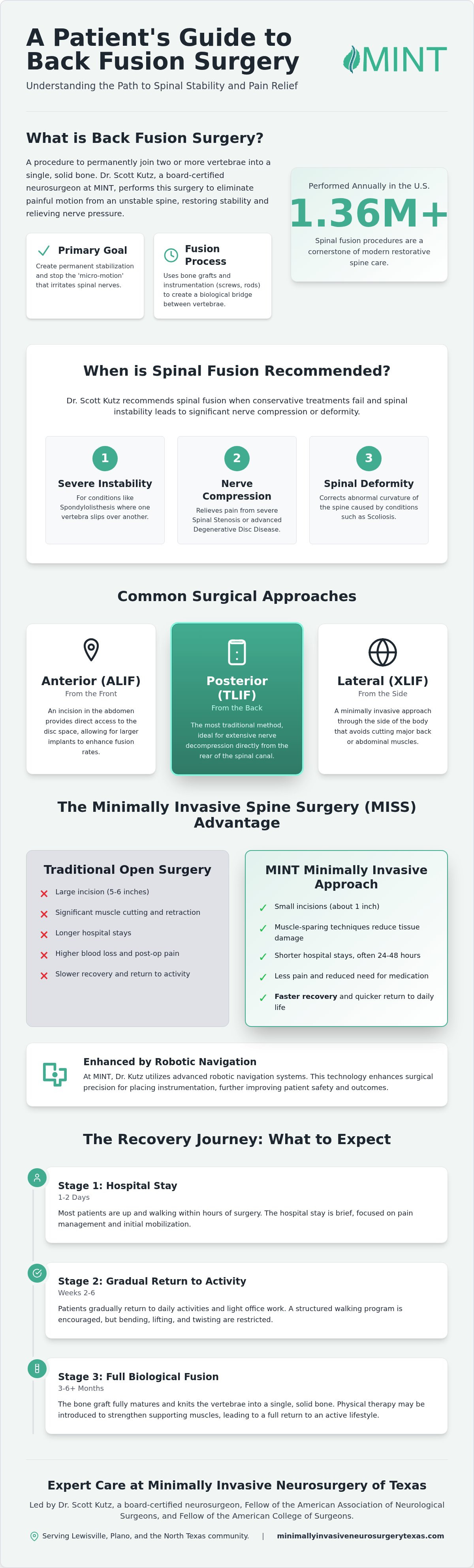
When patients visit our offices in North Texas to ask what is back fusion surgery, they are often seeking a solution to structural instability that causes daily suffering. At its core, this procedure joins two or more vertebrae together permanently so they heal into a single, solid bone. By welding these segments together, we eliminate the painful motion that occurs when spinal structures shift out of place. This surgery has become a cornerstone of modern restorative care; data suggests that medical professionals in the United States perform approximately 1.36 million spinal fusions every year to address chronic instability.
To facilitate the biological fusion process, surgeons use bone grafts that act as a scaffold for new bone growth. We also utilize high-tech instrumentation such as titanium screws, rods, or interbody cages to hold the spine in a fixed position while the bones knit together. Spinal fusion surgery essentially creates a bridge across the unstable segments of the spine. Dr. Scott Kutz, a board-certified neurosurgeon and Fellow of the American Association of Neurological Surgeons, emphasizes this procedure for patients dealing with spondylolisthesis, severe spinal stenosis, and advanced degenerative disc disease.
Why Dr. Scott Kutz Recommends Spinal Fusion
Dr. Kutz often recommends fusion when spinal instability leads to significant nerve compression. This compression causes sharp, radiating pain that travels from the back into the extremities, often limiting a patient’s ability to walk or stand. In cases of scoliosis, fusion helps correct the abnormal curvature of the spine to restore better posture and balance. Additionally, when a surgeon performs a discectomy to remove a damaged disc, the remaining vertebrae may require extra support. Fusion provides this necessary reinforcement, ensuring the spine remains aligned and secure. Our team at MINT utilizes minimally invasive spine techniques to achieve these results with less tissue disruption than traditional methods.
The Goal of Permanent Stabilization
The primary objective of this surgery is to create a single, solid bone structure over several months. By eliminating the ‘micro-motion’ that occurs between unstable vertebrae, we stop the constant irritation of surrounding spinal nerves. Dr. Scott Kutz, who is also a Fellow of the American College of Surgeons, prioritizes patient-centered treatment plans at our Lewisville headquarters and Plano satellite office. He ensures that every patient explores conservative options before moving forward with stabilization. This careful approach helps move the reader from a state of concern to a state of informed confidence regarding their surgical journey.
Common Approaches to Back Fusion Surgery
Surgeons select the most effective path to the spine based on the specific location of a patient’s pathology and their unique physical anatomy. While discussing what is back fusion surgery, clinicians often categorize the procedure by the approach, or the direction from which the surgeon reaches the vertebrae. Choosing the right entry point allows the surgical team to achieve maximum stability while minimizing disruption to healthy tissues. This patient guide to spinal fusion highlights how these variations impact the surgical experience and long-term outcomes.
The anterior approach involves entering through the front of the body, typically through the abdomen or neck. This path provides a direct view of the disc space and allows for the placement of larger interbody implants, which can improve the chances of a successful biological fusion. Conversely, the posterior approach remains the most traditional method, where the surgeon enters through the back. This approach is highly effective when the patient requires extensive nerve decompression from the rear of the spinal canal. For many patients in the Dallas area, Dr. Scott Kutz may utilize a lateral approach. By entering through the side of the body, the surgeon avoids cutting through major back or abdominal muscle groups, which leads to a smoother recovery process.
Lumbar Fusion Techniques: TLIF and ALIF
In the lower back, two common methodologies include Transforaminal Lumbar Interbody Fusion (TLIF) and Anterior Lumbar Interbody Fusion (ALIF). A TLIF procedure allows Dr. Scott Kutz to access the spine from the side of the spinal canal, which is particularly useful for addressing issues at a single level with minimal nerve retraction. ALIF, however, requires an entry through the front. This technique is often preferred for lower back stabilization when the surgeon needs to restore the natural curvature of the spine or place a larger support cage. Dr. Scott Kutz, a board-certified neurosurgeon, Fellow of the American Association of Neurological Surgeons, and Fellow of the American College of Surgeons, utilizes precision-based surgical planning to determine which technique offers the highest probability of pain relief for each individual.
Cervical Fusion: The ACDF Procedure
For patients suffering from debilitating neck and arm pain, Anterior Cervical Discectomy and Fusion (ACDF) is a standard surgical solution. During this procedure, the surgeon removes a damaged disc in the neck and replaces it with a bone graft or implant to stabilize the segment. Dr. Scott Kutz frequently recommends ACDF as a reliable alternative when artificial disc replacement isn’t a clinical option for the patient. He uses small incisions and microscopic visualization to minimize scarring and speed up the healing process. If you’re experiencing chronic pain, you can schedule a consultation at our Lewisville or Plano offices to explore your options.
The Advantage of Minimally Invasive Spine Surgery (MISS)
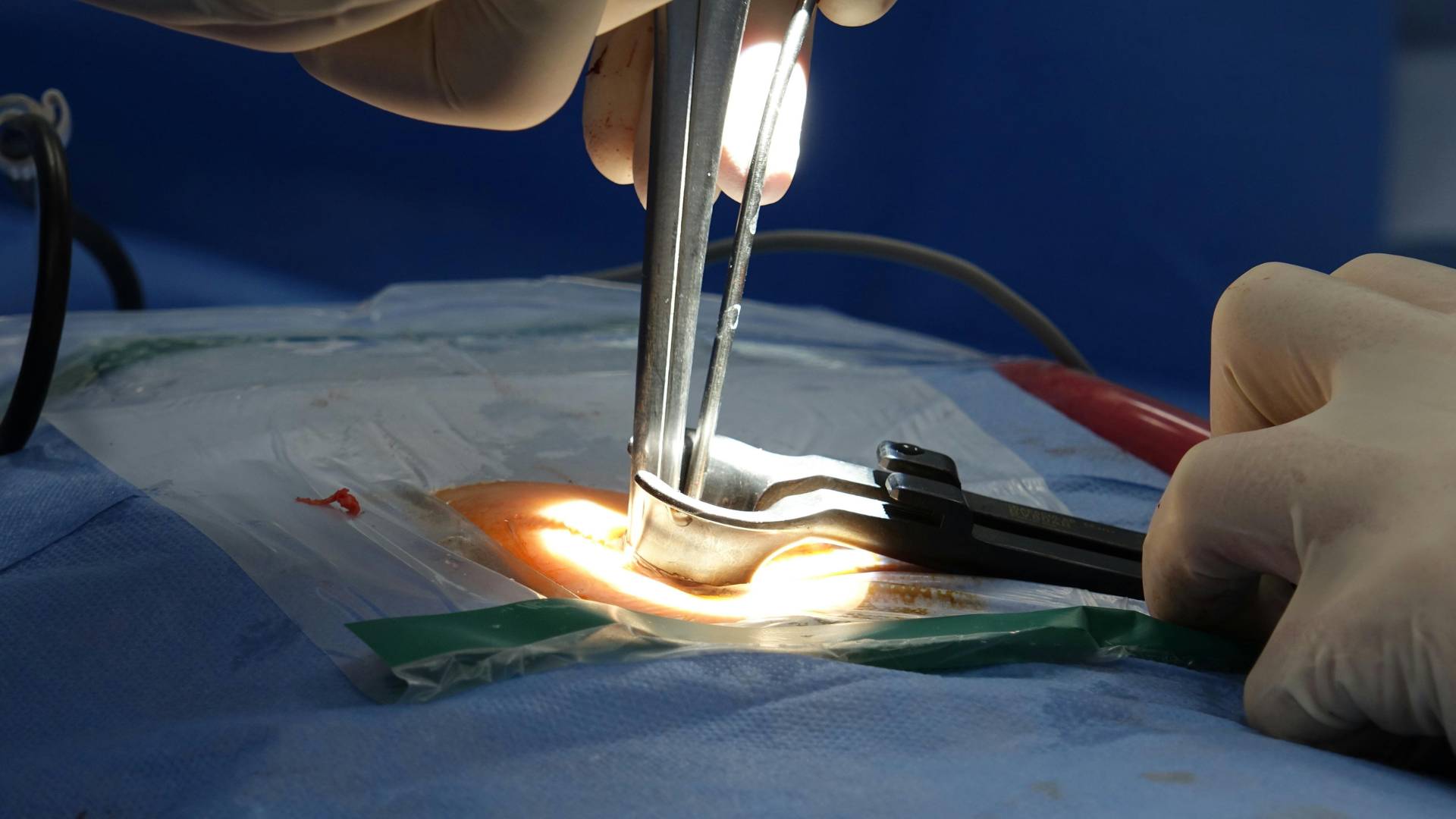
Traditional open spinal fusion typically requires a large incision, often five to six inches long, which necessitates stripping muscles away from the spine. In contrast, Minimally Invasive Spine Surgery at MINT prioritizes the preservation of healthy tissue. When patients ask what is back fusion surgery in the modern era, they’re often relieved to learn that advanced techniques allow us to stabilize the spine through much smaller openings. Dr. Scott Kutz utilizes tubular retractors to create a narrow tunnel directly to the surgical site. This specialized tool allows him to push muscle fibers aside rather than cutting through them, which preserves the structural integrity of the back.
The clinical benefits of this approach are substantial and well-documented. Patients undergoing MISS at our Lewisville and Plano facilities experience significantly less blood loss during the procedure compared to traditional methods. Because the surgical site remains small, the risk of post-operative infection also decreases. Dr. Scott Kutz, a board-certified neurosurgeon, Fellow of the American Association of Neurological Surgeons, and Fellow of the American College of Surgeons, leverages these minimally invasive spine techniques to help his patients return to normal activity faster. By reducing the physical trauma of the operation, we enable a more efficient path to recovery and long-term pain relief.
Robotic Precision with Globus Excelsius
Dr. Scott Kutz integrates the Globus Excelsius robotic navigation system into his surgical workflow to enhance patient safety. This technology functions like a GPS for the spine, assisting Dr. Kutz in placing spinal hardware with sub-millimeter accuracy. Robotic guidance also reduces the need for constant fluoroscopy, which lowers radiation exposure for both the patient and the surgical team. MINT stands as one of the specialized centers in the Plano and Lewisville area utilizing this level of robotic sophistication to ensure optimal clinical outcomes.
Augmented Reality in the Operating Room
Precision reaches a new level at MINT through the use of Augmedics augmented reality (AR). This system provides Dr. Kutz with a form of ‘x-ray vision’ via a specialized headset, allowing him to see the patient’s internal anatomy in three dimensions while looking directly at the surgical site. This real-time visualization improves safety during the placement of screws in the vertebrae by providing a clear, digital overlay of the spinal structures. This commitment to high-tech innovation is a hallmark of modern neurosurgery at MINT.
Recovery Timeline: What to Expect After Surgery
Understanding what is back fusion surgery involves looking past the operating room and into the healing process. Because Dr. Scott Kutz utilizes advanced minimally invasive techniques, the recovery timeline is more efficient than traditional open surgery. Most patients at our Lewisville or Plano facilities spend only 1 to 2 days in the hospital before returning home. This rapid transition is possible because we minimize tissue trauma and blood loss during the procedure. You’ll likely stand and walk with assistance within hours of your operation, which helps prevent complications and promotes early circulation.
During the first 2 to 4 weeks, your focus remains on wound healing and gentle activity. Dr. Kutz encourages frequent, short walks to promote blood flow and prevent muscle stiffness. You’ll notice a significant reduction in the sharp, radiating pain that likely brought you to MINT. However, the biological magic happens between 3 and 6 months. This is the window where your vertebrae begin to knit together into a single structure. While you’ll feel much better long before this, the actual fusion requires time to reach full strength. Dr. Scott Kutz, a board-certified neurosurgeon and Fellow of the American Association of Neurological Surgeons, monitors this progress through imaging at regular follow-up appointments in the Dallas-Fort Worth Metroplex.
Managing Pain and Mobility
Patients typically experience significantly less post-operative pain with MISS compared to traditional methods. We manage your comfort through a combination of medications and activity modification. It’s vital to follow the ‘BLT’ rule during the early stages of recovery, which means you must avoid bending, lifting, or twisting your spine. This restriction protects the hardware and the bone graft while the fusion stabilizes. Our team at MINT provides a personalized recovery roadmap to ensure you stay on track for a successful outcome.
The Role of Physical Therapy
While MINT doesn’t offer in-house physical therapy, Dr. Kutz works with local specialists in Lewisville and Plano to coordinate your care. Physical therapy helps strengthen the core muscles that support your newly fused spine, which is essential for long-term stability. Proper rehabilitation also prevents failed back surgery syndrome. Failed back surgery syndrome describes a condition where a patient continues to experience chronic pain after a spinal operation, often due to inadequate healing or structural issues. By following Dr. Kutz’s minimally invasive spine techniques and a dedicated rehab plan, you maximize your chances of a full return to daily life. Schedule your recovery consultation today to discuss your path to a pain-free life.
Is Back Fusion Surgery Right for You?
When is back fusion surgery necessary? Dr. Scott Kutz recommends this procedure when spinal instability causes debilitating pain that fails to respond to non-surgical treatments like injections or physical therapy. Deciding to undergo a surgical procedure is a significant step in your healthcare journey. Dr. Scott Kutz always prioritizes conservative treatments before recommending intervention. Many patients find relief through targeted injections, specialized stretching exercises, or core-strengthening protocols. However, when these methods fail to alleviate chronic pain or when diagnostic imaging reveals structural instability, it becomes necessary to define exactly what is back fusion surgery in the context of your specific needs.
A board-certified neurosurgeon’s evaluation is the only way to determine if your condition requires the permanent stabilization that a fusion provides. For residents in Lewisville, Plano, and McKinney, MINT offers a specialized approach to diagnostics. Dr. Scott Kutz, a board-certified neurosurgeon, Fellow of the American Association of Neurological Surgeons, and Fellow of the American College of Surgeons, reviews each case with clinical precision. He looks for specific indicators like spondylolisthesis or severe degenerative changes that make the spine unsafe or painful during movement. If your daily quality of life has suffered due to mechanical instability, fusion offers a source of optimism by restoring the structural integrity of your back.
Alternatives to Fusion: Artificial Disc Replacement
In some cases, what is back fusion surgery might not be the only answer for your condition. Artificial disc replacement serves as a modern alternative for patients who wish to maintain spinal mobility. While fusion focuses on eliminating motion to stop pain, disc replacement preserves the natural movement of the spinal segment. Dr. Scott Kutz, who brings over 20 years of experience to every diagnosis, helps patients weigh the motion-preserving benefits of an artificial disc against the absolute stability of a fusion. His background as a Fellow of the American Association of Neurological Surgeons ensures that you receive a recommendation rooted in the latest surgical innovations.
Consulting with Dr. Scott Kutz at MINT
The path to relief begins with a personal evaluation at one of our North Texas facilities. Our Lewisville headquarters and Plano satellite office provide convenient access to high-tech neurosurgical care without the coldness of a large hospital system. We maintain a patient-first communication style, ensuring you understand every aspect of your evidence-based care plan. We invite you to visit our testimonials page to see the successful clinical outcomes achieved by other patients in your community. Taking this next step moves you from a state of concern to a state of informed confidence as you pursue a return to normal activity. Schedule your consultation at MINT today to discuss your symptoms and explore your treatment options.
Restore Your Mobility with Advanced Spinal Care
Modern advancements in neurosurgery have transformed the patient experience. You now understand that what is back fusion surgery has evolved from a highly invasive procedure into a precise, technology-driven solution for chronic instability. Dr. Scott Kutz, a board-certified neurosurgeon, Fellow of the American Association of Neurological Surgeons, and Fellow of the American College of Surgeons, utilizes Globus Excelsius robotic navigation and Augmedics augmented reality to ensure sub-millimeter accuracy. These tools allow for smaller incisions and significantly less tissue disruption than traditional methods.
With over 20 years of spinal surgical experience, Dr. Kutz provides the clinical authority necessary to guide you through a successful recovery. Our Lewisville and Plano offices offer a boutique surgical environment where your health is the top priority. We focus on a results-oriented path that returns you to your daily activities with minimal downtime. You don’t have to live with debilitating pain when evidence-based, high-tech options are available in North Texas. This commitment to innovation ensures that every patient receives the highest standard of specialized care.
Schedule your consultation with Dr. Scott Kutz at MINT today to take the first step toward lasting relief. We look forward to helping you reclaim your quality of life and your independence.
Frequently Asked Questions
How long does a back fusion surgery procedure take?
A typical minimally invasive fusion procedure performed by Dr. Scott Kutz, a board-certified neurosurgeon, usually takes between 2 to 4 hours. Traditional open surgeries may take longer due to the extensive tissue dissection required. MISS techniques allow for a more efficient workflow compared to these older methods, which often result in less time under anesthesia for the patient.
Will I be able to walk after back fusion surgery?
Yes, Dr. Scott Kutz encourages most patients at Minimally Invasive Neurosurgery of Texas to begin walking within hours of their procedure. Early mobility is a critical component of the recovery process because it helps prevent blood clots and promotes faster healing. While you must avoid strenuous activity, walking serves as the primary form of exercise recommended during the first several weeks.
Is back fusion surgery considered a major surgery?
Yes, any procedure that involves the permanent joining of vertebrae is considered a major surgical event. If you are asking what is back fusion surgery in terms of physical impact, the minimally invasive techniques used by Dr. Scott Kutz in Lewisville and Plano reduce trauma. Dr. Kutz, a Fellow of the American College of Surgeons, uses robotic guidance to minimize the overall impact on your system.
How long is the total recovery time for spinal fusion?
When patients ask what is back fusion surgery recovery like, we explain that most people return to sedentary office work within 2 to 4 weeks. Full biological fusion, which describes the process where the bones grow together into a solid structure, typically takes 3 to 6 months. Dr. Scott Kutz uses imaging such as X-rays or CT scans during follow-up visits to confirm that the fusion is progressing as expected.
What are the risks of back fusion surgery?
Like all surgeries, spinal fusion carries risks such as infection, bleeding, or nerve injury. A specific risk for this procedure is pseudarthrosis, which occurs if the bones fail to fuse properly into a single unit. Dr. Scott Kutz, a Fellow of the American Association of Neurological Surgeons, mitigates these risks by using advanced robotic navigation and precision planning to ensure the best possible environment for bone growth.
Can I avoid fusion with artificial disc replacement?
Many patients avoid fusion by opting for artificial disc replacement, which is a motion-preserving alternative. This technology replaces a damaged disc with a prosthetic device instead of joining the vertebrae together. Dr. Scott Kutz, a board-certified neurosurgeon, evaluates each patient at MINT to see if they are a candidate for this approach, which is often preferred for maintaining a full range of motion.