
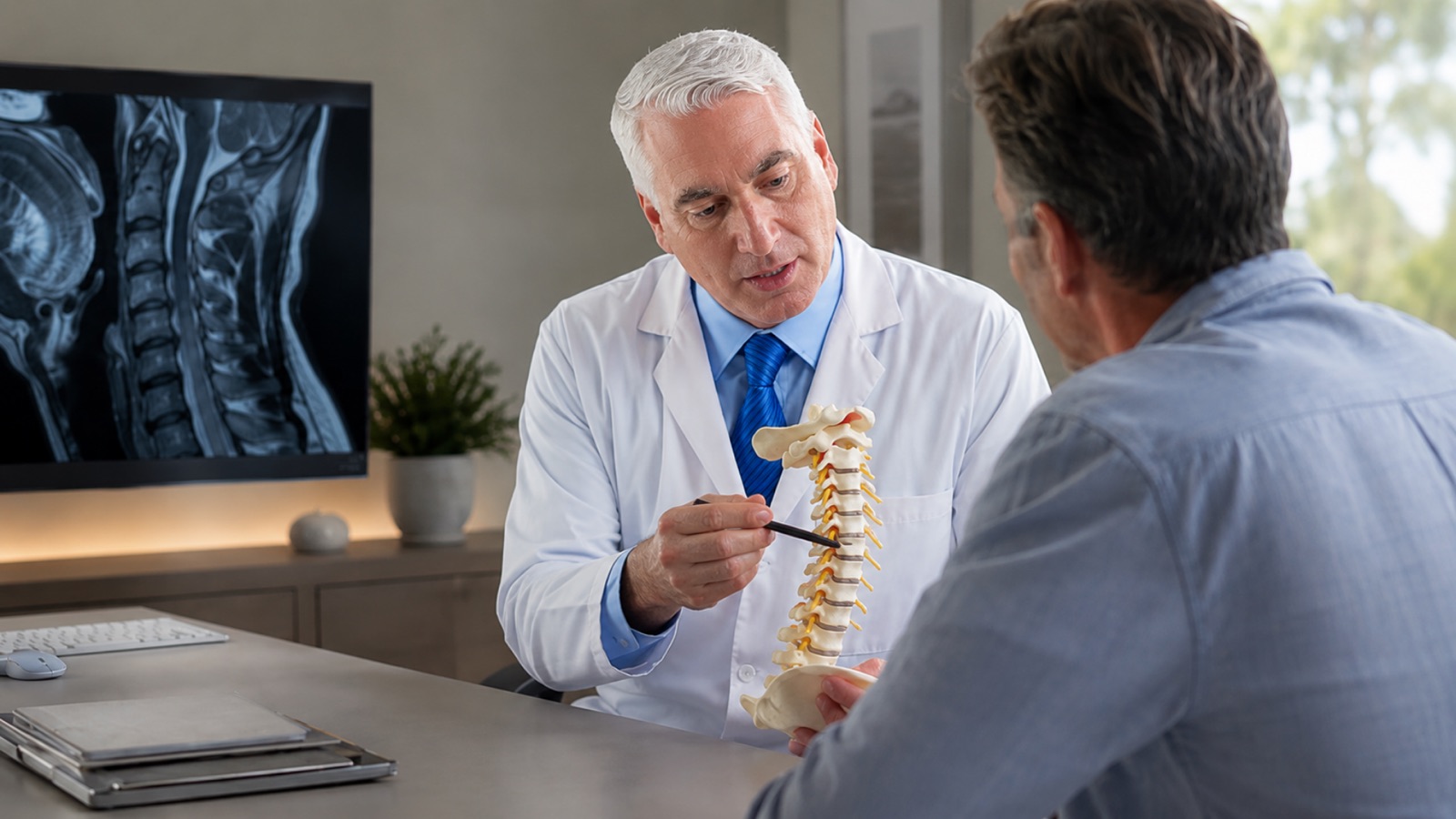
What Is Cervical Disc Replacement in Lewisville TX?
Cervical disc replacement, also called cervical disc arthroplasty (CDA), is a motion-preserving surgical procedure that removes a damaged disc in the neck and replaces it with an artificial implant. The implant restores normal disc height, relieves pressure on the spinal cord and nerve roots, and allows the treated segment to continue flexing, extending, and rotating. This approach contrasts with anterior cervical discectomy and fusion (ACDF), which permanently eliminates movement at the treated level by joining the vertebrae.
Scott C. Kutz, MD, a board-certified neurosurgeon at Minimally Invasive Neurosurgery of Texas, performs cervical disc replacement using multiple FDA-approved implant systems at the practice’s Lewisville and Plano, Texas locations. Dr. Kutz is a Fellow of the American Association of Neurological Surgeons and the American College of Surgeons, with over 6,000 successful spine surgeries in his 27-year career. The practice stocks cervical disc devices from Zimmer Biomet, Centinel Spine, Orthofix, and NuVasive, allowing Dr. Kutz to select the implant best suited to each patient’s anatomy.
Over the past decade, the rate of cervical disc arthroplasty procedures has increased by over 650 percent as clinical evidence supporting its safety, effectiveness, and long-term durability has grown. A 20-year prospective randomized controlled trial confirmed that cervical disc replacement produces sustained pain and disability improvement with lower reoperation rates compared to ACDF (PubMed, 2024).
What Conditions Does Cervical Disc Replacement Treat?
Cervical disc replacement treats conditions where a damaged cervical disc is the primary source of nerve compression or pain in the neck, arms, or hands.
A cervical herniated disc is the most common indication. When the soft inner material of a cervical disc pushes through a tear in the outer wall, it can compress a nerve root or the spinal cord. This compression can cause neck pain, arm pain, numbness, tingling, or weakness that radiates along the affected nerve’s path. Cervical disc replacement removes the herniation and replaces the damaged disc in a single procedure.
Degenerative disc disease in the cervical spine develops when a disc loses its height, hydration, and structural integrity over time. As the disc collapses, the space around the nerve roots narrows, and bone spurs may form along the edges of the vertebrae. When these changes produce persistent neck or arm symptoms that conservative treatment cannot adequately control, disc replacement offers a motion-preserving surgical solution.
Cervical radiculopathy is the clinical term for radiating arm pain caused by a compressed cervical nerve root. Patients often describe this as sharp, burning, or electric pain that travels from the neck into the shoulder, arm, or hand. When the compression results from a disc herniation or disc-related bone spur, disc replacement relieves the pressure while maintaining neck motion.
Select cases of cervical myelopathy caused by anterior disc herniation may be treated with disc replacement when the spinal cord compression comes primarily from the front, and the patient meets the specific candidacy criteria. Severe or multilevel myelopathy typically requires a different surgical approach.
Who May Be a Candidate for Cervical Disc Replacement?
Patient selection is the most important factor in achieving a successful outcome. Cervical disc replacement works best for patients who meet specific clinical and anatomical criteria.
Symptomatic cervical disc disease at one or two levels (C3-C7). The patient must have neck pain, arm pain, numbness, or weakness that correlates with a damaged disc visible on MRI. FDA approval covers single-level and two-level cervical disc replacement for degenerative disc disease with radiculopathy or myelopathy.
Failed conservative treatment. Candidates should have completed at least six weeks to six months of nonsurgical care, including physical therapy, anti-inflammatory medications, and when appropriate, cervical epidural injections, without adequate symptom relief.
Adequate bone quality. The vertebrae above and below the replacement must be strong enough to support the implant. Patients with osteoporosis may not be suitable candidates because weakened bone increases the risk of the device sinking into the vertebral body.
Healthy facet joints at the treated level. The small joints behind the disc share the load of spinal movement with the artificial disc. Significant facet joint arthritis can compromise the replacement’s function and longevity.
No significant cervical instability or deformity. The spine must maintain its normal alignment and stability. Conditions such as cervical spondylolisthesis, where one vertebra has slipped forward, generally require fusion rather than disc replacement.
Skeletal maturity. Patients must have completed bone growth before receiving an artificial disc.
Dr. Kutz evaluates each patient’s imaging, symptoms, physical examination, and overall health to determine whether cervical disc replacement is the right approach. Contact Minimally Invasive Neurosurgery of Texas at (972) 244-3491 to schedule a consultation.
Who May Not Be a Candidate?
Understanding who is not a candidate helps patients and referring physicians make informed decisions.
Significant facet joint arthritis at the affected level prevents the facet joints from properly guiding motion with the artificial disc, which can lead to pain or suboptimal device function.
Cervical instability or spondylolisthesis requires stabilization that disc replacement cannot provide. Fusion is the appropriate choice for these patients.
Severe osteoporosis weakens the vertebral bone and increases the risk of implant subsidence, where the device sinks into the vertebral body.
Active infection or spinal tumor at the affected level requires different treatment approaches.
Multilevel disease involving more than two levels may exceed the current FDA indications for cervical disc replacement. Some experienced surgeons perform three-level replacements when the anatomy supports it, but this requires careful evaluation.
Prior fusion at the same level means the segment is already permanently joined and cannot accept a motion-preserving implant.
Significant cervical kyphosis or deformity can alter force distribution across the artificial disc, potentially compromising its function.
Ankylosing spondylitis or diffuse idiopathic skeletal hyperostosis (DISH) can cause spontaneous fusion of spinal segments and may not be compatible with a motion-preserving device.
How Is Cervical Disc Replacement Performed?
Cervical disc replacement is performed through a small incision at the front of the neck, using the same surgical corridor as the well-established ACDF procedure.
Preparation and anesthesia. The patient lies face-up on the operating table and receives general anesthesia. The surgical team prepares and drapes the neck area.
Surgical access. The surgeon makes a small transverse incision, typically two to three centimeters, in a natural skin crease on the front of the neck. The soft tissues, including the platysma muscle, esophagus, and trachea, are gently retracted to expose the front surface of the cervical spine. Fluoroscopy (live X-ray) confirms the correct spinal level.
Disc removal and decompression. The surgeon completely removes the damaged disc, including any herniated fragments. Bone spurs that have formed along the edges of the vertebrae are carefully removed. The surgeon ensures that the spinal cord and nerve roots are fully decompressed and free from pressure.
Disc space preparation. The endplates (the surfaces of the vertebrae above and below the disc space) are prepared to receive the implant. Proper preparation ensures good contact between the device and the bone, which is essential for long-term stability.
Implant placement. The surgeon selects the appropriately sized artificial disc based on measurements taken during surgery. The surgeon inserts the device into the prepared disc space under fluoroscopic guidance. The implant’s bearing surfaces allow controlled, multi-directional motion that mimics natural cervical disc movement.
Closure. The retractors are removed, the tissues return to their normal positions, and the incision is closed. The procedure typically takes one to two hours depending on whether one or two levels are treated.
Artificial Disc Implants Used at MINT
Dr. Kutz uses FDA-approved cervical disc devices from multiple manufacturers, selecting the implant that best matches each patient’s anatomy, disc space dimensions, and cervical alignment.
Zimmer Biomet Mobi-C features a mobile-bearing design with a polyethylene core that moves between two cobalt-chromium endplates. It is FDA-approved for both one-level and two-level cervical disc replacement and is the only cervical disc currently approved for two-level use in the United States.
Centinel Spine ProDisc C uses a ball-and-socket articulation with a fixed polyethylene core. Its design provides controlled motion with inherent stability at the treated segment.
Orthofix M6 incorporates an artificial annulus and nucleus that mimic the complex motion characteristics of a natural disc, including compression, flexion, extension, lateral bending, and axial rotation.
NuVasive Simplify Disc features a self-centering core design that promotes natural motion patterns while maintaining segmental stability.
Having access to multiple implant platforms allows Dr. Kutz to match the device to the patient rather than using a single device for every case.
Potential Benefits of Cervical Disc Replacement
Preserved neck motion. The artificial disc maintains flexion, extension, and rotation at the treated level. Patients retain a more natural range of neck movement compared to fusion, which permanently eliminates motion.
Reduced risk of adjacent segment disease. When a cervical level is fused, the levels above and below absorb additional mechanical stress. Over time, this increased stress can accelerate degeneration at neighboring segments, a condition called adjacent segment disease. By preserving motion, disc replacement distributes forces more naturally and may reduce this long-term risk.
Lower reoperation rates. Multiple FDA IDE trials with follow-up extending to 10 and 20 years have shown lower reoperation rates at the treated level and adjacent levels for cervical disc replacement than for ACDF.
Faster rehabilitation. Because the artificial disc begins functioning immediately after placement, patients do not need to wait for bone healing. This typically allows a faster return to normal activities compared to fusion.
No bone graft required. Unlike ACDF, disc replacement does not require harvesting bone from the patient’s hip or using a bone graft substitute, eliminating donor-site pain.
Effective pain relief. Clinical studies demonstrate that disc replacement produces pain relief and functional improvement comparable to or better than ACDF for appropriate candidates.
Individual results vary, and no surgical procedure guarantees a specific outcome. Dr. Kutz discusses realistic expectations with each patient during the consultation.
Risks and Complications
General surgical risks include infection, bleeding, blood clots, and adverse reactions to anesthesia. These risks apply to any surgical procedure.
Hoarseness or difficulty swallowing may occur temporarily after surgery because the esophagus retracts and the recurrent laryngeal nerve is close during the anterior approach. This usually resolves within days to weeks.
Nerve injury is a rare but possible complication of any cervical spine surgery. The surgeon works in proximity to the spinal cord and nerve roots throughout the procedure.
Implant migration or subsidence occurs when the device shifts from its intended position or sinks into the vertebral body. Modern implant designs and careful surgical technique have reduced these risks.
Heterotopic ossification is the formation of unwanted bone around the artificial disc that can limit the motion the device was designed to preserve. Not all heterotopic ossification causes symptoms or requires treatment.
Incomplete symptom relief may occur if the damaged disc was not the sole source of pain or if additional structural problems contribute to the patient’s symptoms.
Need for future surgery is possible. While disc replacement has demonstrated lower reoperation rates than fusion, some patients may eventually require additional procedures at the same or different levels.
Recovery After Cervical Disc Replacement
Recovery from cervical disc replacement is generally faster than recovery from ACDF because the artificial disc provides immediate stability and requires no bone healing.
Hospital stay. Most patients spend one night in the hospital. Some single-level cervical disc replacements may be performed on an outpatient basis for appropriate candidates.
First one to two weeks. Patients walk the same day as surgery. A soft cervical collar may be recommended for comfort but is not always required. Light activities such as walking, dressing, and basic household tasks are encouraged. Driving is typically safe within one to two weeks once the patient is alert and off any narcotic medications. Most patients manage pain with over-the-counter medications supplemented by a short course of prescribed medication when needed.
Two to six weeks. Most patients return to desk work and resume daily activities during this period. Light exercise such as walking and gentle stretching may begin with clearance from Dr. Kutz.
Six to twelve weeks. Gradual return to more demanding physical activities. Low-impact exercise, swimming, and recreational activities typically resume during this window.
Three to six months. Full activity clearance, including physically demanding work and contact sports, is individualized based on the patient’s progress and the number of levels treated.
When to seek immediate medical attention. Contact the office or go to the emergency room if you experience sudden or progressive weakness in your arms or hands, difficulty swallowing that worsens instead of improving, loss of bladder or bowel control, high fever, or severe pain not controlled by prescribed medication.
Cervical Disc Replacement vs. ACDF (Fusion)
Both cervical disc replacement and ACDF effectively relieve nerve compression and pain caused by cervical disc disease. The fundamental difference is what happens to motion at the treated level.
Motion. Disc replacement preserves motion. ACDF eliminates motion by permanently joining the vertebrae. For patients who value maintaining neck flexibility and want to reduce the long-term risk of adjacent segment disease, disc replacement may be the better option.
Reoperation rates. Long-term FDA IDE trial data consistently show lower reoperation rates for cervical disc replacement compared to ACDF, both at the treated level and at adjacent levels.
Recovery. Disc replacement patients generally recover faster because the implant provides immediate stability and requires no bone-healing period. ACDF patients must wait for the bone graft to heal, which takes three to six months, during which activity restrictions may be more conservative.
Bone graft. ACDF requires bone graft material (autograft from the patient’s hip, allograft from a bone bank, or synthetic substitute). Disc replacement does not, which eliminates donor site pain and graft-related complications.
When ACDF is the right choice, fusion remains the standard of care for cervical instability, spondylolisthesis, significant facet joint arthritis, severe osteoporosis, multilevel disease that does not meet disc replacement criteria, and revision cases where disc replacement is not feasible. ACDF is a proven, reliable procedure with decades of outcome data.
Dr. Kutz recommends the procedure that best fits each patient’s specific condition, anatomy, and long-term goals.
Why Choose Minimally Invasive Neurosurgery of Texas?
Dr. Kutz brings 27 years of neurosurgical experience, board certification from the American Board of Neurological Surgery, and fellowships in both the American Association of Neurological Surgeons and the American College of Surgeons. He has performed over 6,000 successful spine surgeries and published peer-reviewed content on Spine-Health. The practice stocks cervical disc devices from four manufacturers, enabling Dr. Kutz to match the implant to each patient’s anatomy rather than using a single device for every case.
Minimally Invasive Neurosurgery of Texas serves patients at two North Texas locations:
Lewisville office: 1850 Lakepointe Drive, Suite 500, Lewisville, TX 75057 Plano office: 5465 Legacy Drive, Suite 650, Plano, TX 75024
The practice also serves patients from Frisco, Flower Mound, Denton, McKinney, Allen, and the greater Dallas-Fort Worth area. Patients exploring cervical disc replacement Lewisville TX can schedule a consultation by calling (972) 244-3491 or visit the contact page.
Frequently Asked Questions
What is cervical disc replacement?
Cervical disc replacement removes a damaged disc in the neck and replaces it with an FDA-approved artificial implant that preserves motion. Unlike fusion, which permanently eliminates movement at the treated level, disc replacement allows the neck to continue flexing and rotating naturally.
How is cervical disc replacement different from ACDF?
Both procedures remove the damaged disc and relieve nerve compression through an incision at the front of the neck. ACDF fuses the vertebrae, eliminating motion. Disc replacement inserts an artificial disc that maintains motion, which may reduce the long-term risk of adjacent segment disease.
Am I a candidate for cervical disc replacement?
Ideal candidates have symptomatic disc disease at one or two cervical levels confirmed by MRI, have completed conservative treatment without adequate relief, have adequate bone quality, healthy facet joints, and no significant cervical instability. Dr. Kutz evaluates each patient individually.
How long does the surgery take?
The procedure typically takes one to two hours depending on whether one or two levels are treated.
What is the recovery time after cervical disc replacement?
Most patients return to desk work within one to two weeks and resume full activity within six to twelve weeks. Recovery is generally faster than ACDF because it requires no bone healing.
Does insurance cover cervical disc replacement?
Many insurance plans cover cervical disc replacement when conservative treatment has failed, and specific clinical criteria are met. The MINT team assists patients with insurance authorization.
What artificial disc brands does Dr. Kutz use?
FDA-approved devices from Zimmer Biomet (Mobi-C), Centinel Spine (ProDisc C), Orthofix (M6), and NuVasive (Simplify Disc). The specific device is selected based on the patient’s anatomy and condition.
Can cervical disc replacement treat myelopathy?
Select cases of myelopathy caused by anterior disc herniation at one or two levels may be treated with disc replacement. Severe or multilevel myelopathy from posterior compression typically requires a different surgical approach.
How long does an artificial cervical disc last?
FDA IDE trials with follow-up extending to 20 years have demonstrated durable outcomes with sustained pain relief and preserved motion. The artificial disc is designed to function for the patient’s lifetime.
Who performs cervical disc replacement in Lewisville and Plano TX?
Scott C. Kutz, MD, at Minimally Invasive Neurosurgery of Texas. Call (972) 244-3491 to schedule a consultation.
Schedule a Consultation for Cervical Disc Replacement
Scott C. Kutz, MD, is a board-certified neurosurgeon serving patients at Minimally Invasive Neurosurgery of Texas in Lewisville and Plano, Texas. To discuss whether cervical disc replacement is appropriate for your condition, call (972) 244-3491 or request an appointment online.
- Lewisville: 1850 Lakepointe Drive, Suite 500, Lewisville, TX 75057
- Plano: 5465 Legacy Drive, Suite 650, Plano, TX 75024