
Minimally Invasive Neurosurgery of Texas (MINT), led by Dr. Scott Kutz, a board-certified neurosurgeon who has completed specialty training and certification, provides minimally invasive neurosurgery and spine surgery in Lewisville and Plano, Texas. For patients weighing spine surgery, how to choose between two qualified surgeons starts with comparing the training, credentials, and procedure-specific experience behind each surgeon’s title.
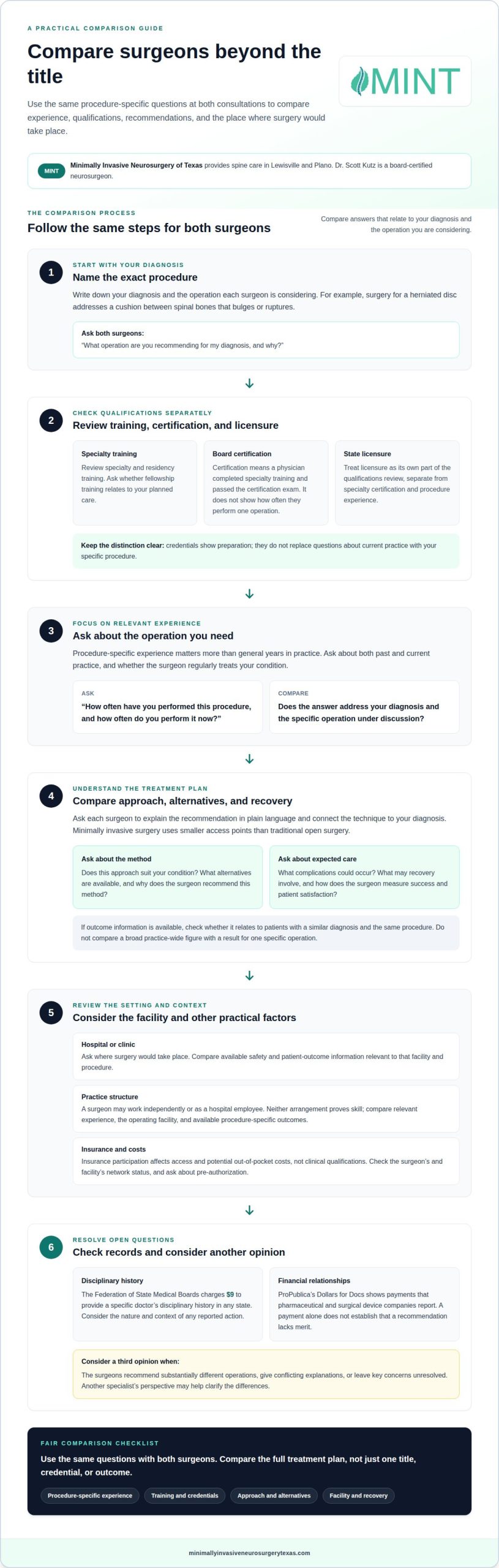
Two surgeons may both be qualified yet have different experience with the procedure you need. Look beyond credentials: compare how often each performs that operation, verify board certification and state licensure, and ask where the surgery would take place. Use the same questions at both consultations so you can assess their answers and recommendations side by side.
Key Takeaways
- Compare each surgeon’s experience with the exact procedure you need, not just their overall surgical background.
- Look at specialty training, board certification, and state licensure as separate parts of a surgeon’s qualifications.
- Consider the hospital or facility where surgery will take place, including its safety record, location, and support services.
- Use consultation discussions to understand each surgeon’s approach, possible complications, and expected recovery.
- For spine care in Lewisville or Plano, Minimally Invasive Neurosurgery of Texas offers minimally invasive spine surgery, artificial disc replacement, and endoscopic spine surgery.
How do you choose between two qualified surgeons?
To understand how to choose between two qualified surgeons, compare their experience with the exact procedure you need. Start with your diagnosis and the proposed operation, such as surgery for a herniated disc, where the cushion between spinal bones bulges or ruptures. Ask each surgeon how often they perform that operation. Experience with the procedure matters more than general years in practice.
Ask each surgeon about their specialization and training related to the operation. A fellowship provides focused training after residency and may help explain a surgeon’s expertise, but it doesn’t replace questions about current practice. Find out whether the surgeon regularly treats your condition and performs the operation you’re considering.
Ask each surgeon to explain their approach in plain language. Minimally invasive surgery uses smaller access points than traditional open surgery. Ask whether it suits your condition, what alternatives are available, and why the surgeon recommends a particular method. The explanation should connect the technique to your diagnosis, not rely on technology alone.
Discuss outcomes directly. Ask how the surgeon handles complications and what recovery may involve after your procedure. You can also ask how they measure success and patient satisfaction, and whether the information relates to patients with a similar diagnosis. Avoid comparing a broad practice-wide figure with a result for one specific procedure.
Consider whether each surgeon works independently or as a hospital employee, but don’t treat that distinction as proof of skill. An independent physician may practice outside a hospital’s employment structure, while a hospital-employed physician works within that system. In either case, compare experience with your procedure, the facility where the surgeon operates, and any available outcomes for that operation.
Use the same questions at both consultations to compare answers fairly. Ask how often each surgeon has performed your procedure and performs it now, which techniques they consider appropriate, and where they plan to operate. Ask whether the hospital or clinic tracks outcomes for that procedure, and note whether each answer addresses your diagnosis.
Consider a third opinion if the surgeons recommend substantially different operations, give conflicting explanations, or leave key concerns unresolved. Another specialist’s perspective may help you understand the differences before deciding.
Compare the full treatment plan, not just one credential or outcome. For example, one surgeon may recommend an endoscopic approach, using a small camera and instruments through a limited opening, while another recommends a different method. Ask each to explain the reasoning, recovery considerations, and possible complications. How to choose between two qualified surgeons ultimately depends on whose relevant experience and explanation best address your needs.
Checking qualifications, certifications, and training
Compare each surgeon’s education, specialty training, and certification with the procedure under consideration. Board certification means a physician completed specialty training and passed the certification exam. It is evidence of specialty preparation, but it doesn’t show how often a surgeon performs a particular operation. Review each surgeon’s specialty and residency training, then consider whether any fellowship training relates to your planned care.
Look for clear, consistent descriptions of qualifications in a surgeon’s professional profile and consultation materials. If a physician recommends surgery for spinal stenosis, for example, ask how their training relates to spine procedures and your diagnosis. Make sure you understand which credential reflects specialty certification and which reflects additional training. Recommendations should explain the relevance of that background rather than rely on titles alone.
Disciplinary history adds context to a credentials review. The Federation of State Medical Boards charges $9 to provide a specific doctor’s disciplinary history in any state. Consider the nature and context of any reported action, rather than treating every record as equivalent. A disciplinary entry warrants a clear explanation of what happened and how it relates to the surgeon’s current practice.
Financial relationships also deserve a measured review. Patients can use ProPublica’s Dollars for Docs to see payments that pharmaceutical and surgical device companies report. A payment alone does not establish that a physician’s recommendation lacks merit. Consider whether a relationship that a company reports relates to a device or treatment discussed during the consultation, and ask the surgeon to explain the clinical reasoning behind the recommendation.
Insurance participation affects access and potential out-of-pocket costs, not a surgeon’s clinical qualifications. Before scheduling, compare the surgeon’s and facility’s network status with your insurer, especially if you have HMO or PPO coverage. Ask your insurer and the surgeon’s office about participation and pre-authorization so you can understand whether the proposed care fits your plan.
Facility safety reports offer a separate perspective from a surgeon’s credentials. Compare available safety and patient-outcome information for the hospital or clinic where each surgeon operates. Focus on reports relevant to the procedure and facility rather than general ratings alone. A surgeon’s certification does not answer questions about the setting where the operation would take place.
Warning signs include unclear answers about training, reluctance to discuss disciplinary history or financial relationships, and pressure to proceed without an explanation of alternatives. Ratings and recommendations can provide context, but they should not replace a review of credentials and direct answers to your questions.
Use the same review process for both physicians. Note each specialty certification, relevant fellowship training, disciplinary record, financial relationships that companies report, and network participation. Then compare those details with available facility safety information. This side-by-side review helps distinguish a strong professional profile from qualifications that specifically fit your planned procedure.
Evaluating hospital affiliations and facilities
A surgeon’s hospital affiliation tells you where they operate, but it doesn’t establish whether the facility suits your procedure. Compare the hospital or clinic each surgeon uses, then review its accreditation and available information about safety and patient outcomes. Look for details connected to the type of surgery you’re considering. General reputation offers context, while procedure-related information helps you compare the setting more directly.
Ask which facility will host the operation and what support it provides. Find out how patients receive care before surgery, during their stay, and after discharge. These details clarify the practical path through treatment. Consider travel to the facility and how easily you can reach follow-up care from your home in Plano or elsewhere in North Texas.
Compare the two surgeons’ affiliations without assuming that a larger hospital automatically means better care. Focus on the facility’s safety information, available support, and experience with the procedure the surgeon plans to perform. If a surgeon recommends an operation for spinal stenosis, a narrowing around spinal nerves, ask whether the proposed facility regularly handles that type of surgery.
Use each consultation to assess how clearly the surgeon explains the plan. A useful discussion connects your diagnosis, the operation the surgeon proposes, and the facility where they plan to operate. Ask what the hospital or clinic will handle and what follow-up the surgeon expects. Notice whether the physician answers directly, explains unfamiliar terms, and gives you time to consider the information.
Professionalism shows in specific interactions, not just a polished office or hospital affiliation. Notice whether the surgeon reviews your records, listens to your concerns, and explains why they recommend a particular facility. Ask who will coordinate care around surgery. Compare both consultations rather than relying only on online ratings or recommendations.
Ask each surgeon how the facility tracks outcomes for the procedure under discussion. Outcomes describe results of care, such as recovery or complications. If a hospital or consultant publishes clinical outcomes for that procedure, use the information to frame questions about facility performance. Compare like with like: information about a different operation may not help you judge the setting for the surgery your surgeon proposes.
Before deciding, write down each facility’s name, location, available safety information, and support services. Add notes about each surgeon’s explanation and your unanswered questions. This helps distinguish the surgeon’s qualifications from the care environment. Choose the setting that aligns with your procedure and practical needs, based on the information each surgeon provides.
Verifying board certification and state licensure
Board certification and state licensure answer different questions. Board certification shows that a physician completed specialty training and passed a certification exam. A state license concerns a doctor’s authority to practice in that state. Check both credentials for each surgeon, then compare the specialty named on the certification with the procedure under consideration.
Match each surgeon’s full name and specialty to the certification record. A neurosurgeon’s specialty certification, for example, is more relevant to spine surgery than a credential in an unrelated specialty. Confirm that the credential belongs to the surgeon you consulted, not another physician with a similar name. Record the specialty and status for both candidates.
Distinguish board-certified from board-eligible. A board-eligible physician completed residency but has not passed the certification exam, so that status does not mean the physician is board-certified. Ask how the surgeon’s training relates to your planned operation, then compare the answer with the listed specialty and any relevant fellowship training.
Verify each doctor’s state license through the Federation of State Medical Boards, which provides a way to check license information. Use the doctor’s name and state to identify the correct record, especially when names are similar. For a procedure the surgeon plans to perform in Plano, focus on the Texas license record and compare it with the surgeon’s identity and specialty information.
Read the record carefully rather than stopping at a search result. Look for the license status and any disciplinary information shown. If an entry raises questions, note its specific wording and ask the surgeon for an explanation during the consultation. This can help you understand the record without confusing licensure with board certification.
Use written notes or a comparison table to keep the two doctors’ credentials distinct. Include each surgeon’s specialty certification, state license information, residency completion, and relevant fellowship training. Then identify any difference that matters to your procedure. For example, one surgeon may hold the relevant specialty certification while the other is board-eligible.
These distinctions can make your decision more informed, but credentials are only one part of the comparison. A valid Texas license doesn’t show how often a surgeon performs your procedure. Board certification doesn’t describe the facility where surgery would take place. Keep these questions separate so each credential answers the question it actually addresses.
Before deciding, summarize what you verified for both surgeons: specialty certification, Texas license record, and training relevant to your planned care. If either record or explanation remains unclear, resolve that specific point before weighing it against procedure experience and the proposed treatment plan.
Minimally Invasive Neurosurgery of Texas
Minimally Invasive Neurosurgery of Texas helps patients in Lewisville and Plano compare spine surgery options through a focus on minimally invasive neurosurgery. Consider the practice when you’re weighing recommendations for a spine procedure, want to understand the proposed approach, or need to discuss whether minimally invasive techniques fit your condition. The goal is a clear explanation of the surgical options relevant to your care.
Dr. Scott Kutz is a board-certified neurosurgeon and Fellow of the AANS and ACS. Those credentials describe his professional background; your comparison should also consider whether the recommended procedure matches your diagnosis and goals. Bring your imaging results, prior treatment information, and any recommendations you’ve received to help focus the discussion on your options.
Minimally Invasive Neurosurgery of Texas provides Minimally Invasive Spine Surgery (MISS) and Endoscopic Spine Surgery (ESS). Endoscopic surgery uses a small camera to help the surgeon view the treatment area through a limited opening. The appropriate technique depends on your condition and the operation the surgeon is considering. Ask how the proposed method addresses your diagnosis, what alternatives exist, and what risks and recovery considerations apply.
A useful comparison separates the surgeon’s qualifications from the treatment plan. For example, if one physician recommends an endoscopic procedure and another recommends a different approach, focus on each physician’s explanation of why that method fits your case. The practice’s endoscopic spine surgery information can help you understand the technique the practice discusses, while your clinical conversation should address its relevance to your needs.
Organize your questions around experience, credentials, facilities, and communication. Note what each physician says about the procedure, possible complications, and expected recovery. Identify unanswered concerns, such as why the surgeons recommend different techniques or where the operation would take place. A structured comparison helps make your next discussion more specific and keeps you from relying on a single credential or recommendation.
Minimally Invasive Neurosurgery of Texas focuses on spine care, including Minimally Invasive Spine Surgery (MISS) and Endoscopic Spine Surgery (ESS). The practice serves patients in Lewisville and Plano. If you’re comparing spine surgeons, use the consultation to connect your diagnosis with the proposed procedure, alternatives, and priorities for recovery.
If you’re considering spine surgery in Lewisville or Plano, contact Minimally Invasive Neurosurgery of Texas to discuss your options.
Frequently Asked Questions
How can I compare surgeons’ experience and outcomes for a specific procedure?
To decide how to choose between two qualified surgeons, compare their experience with the same operation and similar diagnoses. Ask how often each surgeon performs it and which outcomes they track, such as complications, recovery, or symptom improvement. Check whether they use comparable definitions and patient groups. Results for a different spinal procedure may not help you assess surgery for a herniated disc.
How do I verify a surgeon’s board certification and medical license in the United States?
Verify the license in the state where the surgeon plans to practice, then confirm specialty certification with the relevant certifying board. The Federation of State Medical Boards provides a way to check state license information. Match the surgeon’s full name and specialty carefully, especially if search results include physicians with similar names. Keep licensure and board certification separate because they represent different credentials.
How can I check a surgeon’s disciplinary history, malpractice claims, and hospital privileges?
Review state license records for disciplinary information, and distinguish those records from malpractice claims. A claim alone does not establish that a surgeon made an error. Ask the surgeon about any relevant record and request a clear explanation. For hospital privileges, identify where the operation would take place and ask whether the surgeon has privileges there for the planned procedure.
What questions should I ask two surgeons during consultations?
A practical way to choose between two qualified surgeons is to ask both the same focused questions. What diagnosis supports your recommendation? Which procedure do you propose, and why? What alternatives and complications should I understand? What recovery considerations apply to my situation? Ask how your experience relates to the exact operation, then compare each surgeon’s reasoning, clarity, and treatment plan.
How can I compare surgeons’ complication rates and patient outcomes reliably?
Ask each surgeon how they define a complication and which patients their figures include. Then compare results for the same procedure and similar diagnoses, using the same measurement period where available. A broad practice-wide rate may not reflect results for one operation. Treat online ratings as context about patient experience, not as a substitute for procedure-specific clinical outcomes.
How should I compare surgical treatment plans, techniques, and risks?
Write down each procedure the surgeon proposes and why the surgeon recommends it. Compare how each approach addresses your diagnosis, which alternatives the surgeon considers, and what risks apply. For example, ask why one physician recommends an endoscopic technique using a small camera while another proposes a different approach. Each explanation should connect the method to your condition and treatment goals.
How can I compare surgeon fees, facility costs, anesthesia fees, and insurance coverage?
Request an itemized estimate separating surgeon, facility, and anesthesia charges, then ask your insurer which costs fall within your plan. Confirm network participation and whether the insurer requires pre-authorization. Ask about potential out-of-pocket costs and what could change the estimate. Compare the expected care pathway, not only the surgeon’s professional fee, since facility and anesthesia charges may be separate.
How do surgeon experience and procedure volume affect surgical outcomes?
Surgeons who regularly perform a specific procedure may refine their technique and gain experience managing complications. A 2016 paper compiled results from 32 large studies about surgical volume and patient outcomes. Volume alone does not show whether a surgeon’s approach fits your diagnosis. Ask how frequently the surgeon performs your operation and how that experience informs the recommended plan.