
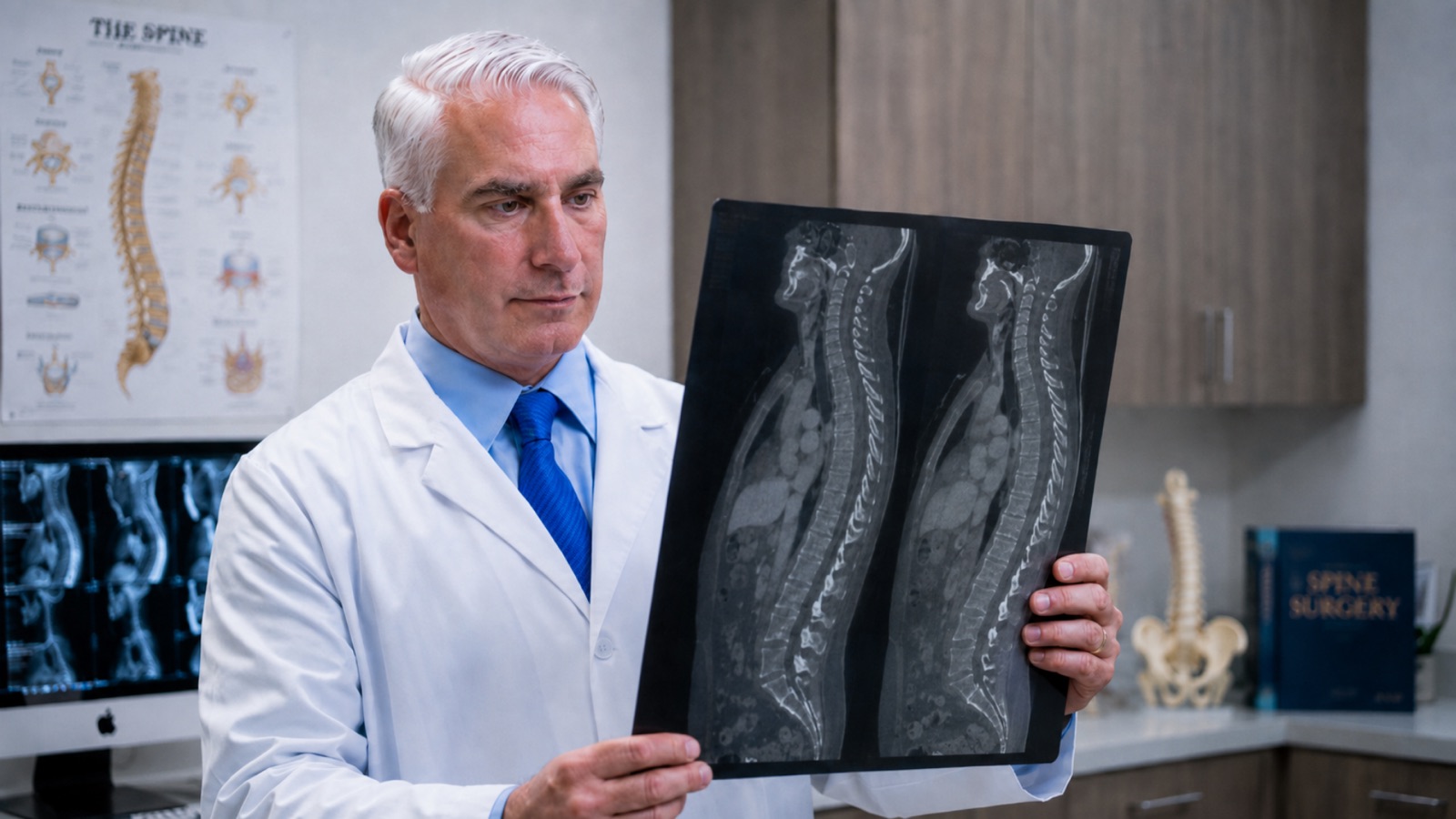
What Is Revision Spine Surgery in Lewisville TX?
Revision spine surgery is a secondary operation performed to address complications, new problems, or persistent symptoms following a prior spine procedure. Patients may seek revision surgery because their original procedure did not achieve the expected pain relief, because new structural issues have developed at the same or a different spinal level, or because hardware from the first surgery has failed. The clinical term for persistent or worsening pain after a spinal operation is Failed Back Surgery Syndrome (FBSS), though this name can be misleading because it does not always mean the original surgery was performed incorrectly. In many cases, the first surgery was technically successful, but the patient’s spine has developed new pathology over time.
Scott C. Kutz, MD, a board-certified neurosurgeon at Minimally Invasive Neurosurgery of Texas, specializes in evaluating patients with persistent pain after prior spine surgery. Dr. Kutz uses advanced diagnostic imaging and, when needed, diagnostic injections to identify the exact source of ongoing pain before recommending any revision procedure. The practice provides revision spine surgery Lewisville TX, at its Lewisville and Plano, Texas locations.
Revision surgery differs fundamentally from primary spine surgery. The surgeon must navigate scar tissue, work around existing hardware, and account for anatomy altered by the previous operation. This requires advanced imaging, meticulous surgical planning, and extensive experience with complex spinal anatomy. Dr. Kutz uses the Globus Excelsius GPS Robotic Navigation Platform to guide instrument placement with sub-millimeter accuracy during revision cases, which is particularly valuable when scar tissue obscures normal anatomical landmarks.
What Conditions Does Revision Spine Surgery Treat?
Adjacent segment disease develops when spinal levels above or below a previous fusion degenerate at an accelerated rate due to altered biomechanics. This is the most common long-term reason patients require revision after a spinal fusion. The fused segment no longer moves, so the neighboring segments absorb additional mechanical stress with every movement. Over months and years, this extra stress can cause disc herniation, stenosis, or instability at those adjacent levels.
Pseudoarthrosis occurs when the bone graft from a fusion procedure fails to heal into a solid mass. The spine remains unstable at the fusion site, producing persistent pain that often worsens with activity. Pseudoarthrosis may not become apparent until months after the original surgery, when follow-up imaging reveals the lack of solid bony union.
Hardware failure includes loosened pedicle screws, broken rods, or migrated interbody cages. Hardware can fail because of pseudoarthrosis (the unstable spine places excessive stress on the implants), poor bone quality, infection, or mechanical wear over time. Symptoms may include new pain, a clicking sensation, or a change in spinal alignment.
Recurrent disc herniation can occur at the same level as a prior discectomy or at a new level. Studies report that recurrent herniation after primary microdiscectomy occurs in approximately five to fifteen percent of patients. The recurrence may involve the same disc fragment re-herniating through the annular defect or new disc material protruding at the operative level.
Scar tissue (epidural fibrosis) forms naturally after any surgery, but it can sometimes compress or tether nerve roots, mimicking the original symptoms. Not all scar tissue causes symptoms, and distinguishing symptomatic fibrosis from other causes of persistent pain requires careful diagnostic evaluation.
Inadequate decompression from the first surgery, where not enough bone or ligament was removed to free the compressed nerve fully. Residual stenosis or retained disc fragments may continue to compress the nerve root or spinal cord.
New pathology at a different spinal level entirely unrelated to the original surgery. The spine is a dynamic structure, and degenerative changes can develop at any level over time regardless of whether surgery was performed elsewhere.
Infection following a prior spine surgery, either acute (within weeks) or delayed (months to years), may require surgical debridement, hardware removal, and sometimes staged reconstruction.
Who May Be a Candidate for Revision Spine Surgery?
Candidates for revision surgery are patients whose persistent or recurrent symptoms correlate with identifiable structural findings on imaging. The connection between what the patient feels and what the imaging shows is critical. Revision surgery is most successful when the surgeon can point to a specific, surgically correctable cause of the ongoing pain.
Patients with documented hardware failure. Loosened, broken, or migrated hardware that is causing pain, instability, or nerve compression is a clear indication for revision.
Patients with adjacent segment disease causing new symptoms. When levels above or below a prior fusion develop symptomatic stenosis, disc herniation, or instability, extending the fusion or decompressing the new level may provide relief.
Patients with confirmed pseudoarthrosis. If a fusion has not healed and the nonunion is the identifiable source of pain, revision surgery to repair the fusion with new bone graft and possibly additional instrumentation may be appropriate.
Patients with recurrent or residual nerve compression. When imaging demonstrates ongoing nerve compression from a recurrent disc herniation, retained disc fragments, or inadequate bony decompression, targeted revision decompression can address the problem.
Patients whose quality of life is significantly limited by symptoms that have a clear structural explanation. Functional limitation, not just pain severity, is an important factor in the decision to pursue revision surgery.
A thorough diagnostic evaluation is essential before recommending revision surgery. Dr. Kutz reviews all prior operative reports and imaging, obtains new high-resolution MRI or CT imaging, and may use diagnostic injections to pinpoint the pain source.
Contact Minimally Invasive Neurosurgery of Texas at (972) 244-3491.
Who May Not Be a Candidate?
Patients whose pain does not correlate with structural findings. Persistent pain after spine surgery is not always caused by a structural problem that another operation can fix. When imaging does not show a clear, surgically correctable abnormality that matches the patient’s symptoms, additional surgery is unlikely to help.
Patients with pain driven primarily by central sensitization. In some patients, the nervous system becomes hypersensitive after surgery, amplifying pain signals even when the structural problem has been resolved. This condition requires pain management strategies rather than additional surgery.
Patients with psychosocial factors contributing significantly to their pain experience. Sleep, mood, stress, and other factors influence chronic pain. When these factors are the dominant contributors, address them directly rather than through revision surgery.
Patients who have not completed appropriate conservative management after their initial surgery. Try physical therapy, pain management, and adequate healing time before considering revision.
Patients with unrealistic expectations. Revision surgery can improve specific structural problems but may not eliminate all pain, especially in patients who have undergone multiple prior procedures.
Dr. Kutz approaches the decision to operate again with particular caution. He discusses the realistic likelihood of improvement, the specific goals of surgery, and the risks with each patient before recommending revision.
How Is Revision Spine Surgery Performed?
The surgical approach for revision depends entirely on the specific problem being addressed. No single “revision surgery” technique exists. Dr. Kutz selects the approach based on the diagnosis, spine location, type of prior surgery, and the amount and location of scar tissue and existing hardware.
Revision decompression for recurrent disc herniation or residual stenosis may involve removing recurrent disc material, additional bone, or thickened ligament that is compressing a nerve. When possible, Dr. Kutz uses minimally invasive techniques or endoscopic approaches to perform revision decompression through small incisions, reducing additional scar tissue.
Revision fusion for pseudoarthrosis involves removing the failed bone graft, refreshing the bony surfaces, applying new bone graft material, and often adding or revising instrumentation to improve stability. Biologic agents such as bone morphogenetic protein (BMP) may be used to enhance healing in revision cases.
Hardware revision involves removing failed implants and replacing them with new hardware. This may require a different approach or supplemental fixation to achieve stability in bone weakened by prior surgery.
Extension of fusion for adjacent segment disease involves adding new levels to an existing construct, decompressing the affected segments, and placing additional interbody cages and pedicle screws.
The Globus Excelsius GPS Robotic Navigation Platform is especially valuable in revision cases. The robotic arm provides sub-millimeter guidance accuracy when placing new screws near existing hardware and through scarred tissue where normal anatomical landmarks may be distorted. The Augmedics augmented reality system can overlay three-dimensional spinal anatomy onto the surgeon’s view, providing additional spatial orientation during complex revisions.
Potential Benefits
Revision surgery can correct specific, identifiable structural problems that are causing persistent symptoms after a prior procedure. When the cause of ongoing pain is accurately identified and is surgically correctable, revision surgery can provide meaningful improvement.
Correcting hardware failure restores spinal stability and eliminates pain caused by loose, broken, or migrated implants.
Addressing pseudoarthrosis by revising the fusion with fresh bone graft and improved fixation can achieve the solid bony union that the first surgery did not.
Relieving recurrent nerve compression from a new herniation, residual stenosis, or scar tissue adhesions can reduce radicular pain, numbness, and weakness.
Treating adjacent segment disease with decompression or extension of fusion can relieve new symptoms that developed at levels neighboring the original surgery.
Revision surgery can restore function and quality of life for patients whose daily activities, work, and sleep have been limited by ongoing structural problems.
These benefits depend heavily on accurate diagnosis and patient selection. Patients with clearly identified, surgically correctable pathology have the best outcomes from revision surgery.
Alternatives to Revision Surgery
Not every patient with persistent pain after spine surgery needs a revision procedure. Dr. Kutz evaluates all options before recommending additional surgery.
Continued conservative management, including physical therapy, pain management, and guided exercise, may improve symptoms without surgery, especially when pain is related to deconditioning or myofascial sources rather than a structural problem.
Interventional pain procedures such as epidural steroid injections, nerve blocks, radiofrequency ablation, and spinal cord stimulation can provide meaningful relief for some patients. They may eliminate or delay the need for revision surgery. Spinal cord stimulation has shown particular effectiveness for certain FBSS patients with neuropathic pain.
Medication management, including anti-inflammatory medications, neuropathic pain agents such as gabapentin or pregabalin, and muscle relaxants, may adequately control symptoms for patients whose structural findings do not clearly warrant surgical intervention.
Psychological and behavioral approaches including cognitive behavioral therapy, mindfulness-based stress reduction, and pain psychology can be important components of a comprehensive pain management strategy, especially for patients whose pain has a significant central sensitization component.
Watchful waiting is appropriate when symptoms are stable, functional limitations are manageable, and imaging shows no progressive structural problems.
Dr. Kutz discusses all alternatives with each patient and recommends revision surgery only when there is a clearly identifiable, surgically correctable cause of ongoing pain.
Risks and Complications
Revision surgery carries all the standard surgical risks plus additional risks specific to operating in previously scarred tissue. Complication rates for revision procedures are higher than for primary surgery.
Nerve injury risk is elevated in revision cases because scar tissue can obscure and tether nerve roots, making them more difficult to identify and protect during surgery.
Dural tear is more common in revision surgery because the dura (the membrane surrounding the spinal cord and nerves) may be adherent to scar tissue or existing hardware. Most dural tears are repaired during the procedure.
Infection risk is higher in revision cases, particularly when the original surgery involved hardware. Revision surgery through scarred tissue has longer operative times and greater tissue exposure, both of which increase infection risk.
Bleeding may be more significant due to scar tissue vascularity and the need for more extensive dissection.
Hardware complications including screw loosening, rod fracture, or cage migration can occur, particularly in patients with poor bone quality.
Pseudoarthrosis can recur after revision fusion, especially in patients with risk factors such as smoking, diabetes, or osteoporosis.
Incomplete pain relief is a realistic possibility with any revision procedure. Even when the structural problem is successfully corrected, some patients continue to experience pain from irreversible nerve damage, central sensitization, or other factors.
The need for further surgery remains possible after revision, as the underlying degenerative process continues.
Dr. Kutz discusses all relevant risks during the pre-operative consultation and ensures patients have realistic expectations about what revision surgery can and cannot achieve.
Recovery
Recovery after revision spine surgery varies significantly based on the complexity of the procedure.
Simple revisions such as removing a broken screw, decompressing a recurrent herniation, or replacing a single failed implant may have recovery timelines similar to primary surgery. Patients undergoing straightforward revision decompression may return to desk work within two to four weeks, with full activity at six to twelve weeks.
Complex revisions involving multilevel reconstruction, fusion extension, or staged procedures require longer recovery. Full activity clearance typically takes three to six months. Weight-bearing restrictions, bracing, and activity limitations during the early recovery period protect the new construct while bone healing occurs.
General recovery guidelines apply to all revision patients. Walking begins the day of or the day after surgery. Pain is managed with a structured medication plan. Physical therapy is introduced based on the type of revision performed. Follow-up imaging monitors hardware position and fusion progress.
When to seek immediate medical attention. Contact the office or go to the emergency room if you experience sudden or progressive weakness in your arms or legs, loss of bladder or bowel control, high fever with severe back pain, or worsening pain that is not controlled by your prescribed medications.
Dr. Kutz provides individualized recovery instructions and follow-up schedules based on the complexity of each revision case.
Why Choose Minimally Invasive Neurosurgery of Texas for Revision Surgery?
Revision spine surgery demands a surgeon with deep experience in complex spinal anatomy, comfort working in scarred and distorted tissue planes, and access to advanced navigation technology. Dr. Kutz brings 27 years of neurosurgical experience, board certification from the American Board of Neurological Surgery, and fellowships in both the American Association of Neurological Surgeons and the American College of Surgeons.
The practice integrates the Globus Excelsius GPS Robotic Navigation Platform and the Augmedics augmented reality system into revision cases where these technologies improve safety and accuracy. Dr. Kutz uses minimally invasive approaches for revision procedures whenever the patient’s anatomy and specific pathology allow, reducing the additional scar tissue created by the revision surgery itself.
Dr. Kutz has published peer-reviewed content on Spine-Health, and approaches every revision evaluation with the understanding that the most important part of revision surgery is deciding whether to operate at all. An honest, thorough diagnostic workup underpins every revision consultation at MINT.
Minimally Invasive Neurosurgery of Texas serves patients at two North Texas locations:
Lewisville office: 1850 Lakepointe Drive, Suite 500, Lewisville, TX 75057 Plano office: 5465 Legacy Drive, Suite 650, Plano, TX 75024
Patients considering revision spine surgery Lewisville TX can schedule a consultation by calling (972) 244-3491 or visit the contact page.
Frequently Asked Questions
What is revision spine surgery?
Revision spine surgery is a secondary operation to address persistent pain, hardware failure, or new problems that develop after a prior spine procedure. The term covers a broad range of procedures depending on the specific problem being corrected.
What is Failed Back Surgery Syndrome?
Failed Back Surgery Syndrome (FBSS) describes persistent or worsening pain after spine surgery. The name is misleading because it does not necessarily mean the first surgery was performed incorrectly. Causes include adjacent segment disease, pseudoarthrosis, scar tissue, recurrent herniation, hardware failure, and central sensitization.
Is revision surgery more risky than the first surgery?
Revision procedures carry higher complication rates due to scar tissue, altered anatomy, and the complexity of working around existing hardware. An experienced surgeon using advanced navigation technology such as the Globus Excelsius GPS can minimize these additional risks, but cannot eliminate them.
How do you determine the cause of ongoing pain after spine surgery?
Dr. Kutz uses high-resolution MRI, CT scans, review of prior operative reports, physical and neurological examination, and sometimes diagnostic injections to identify the specific structural or mechanical cause of persistent pain. Each diagnostic step narrows the list of possible pain generators.
Can revision surgery be performed minimally invasively?
In many cases, yes. Revision decompression for recurrent herniation or residual stenosis can often be performed through small incisions using minimally invasive or endoscopic techniques. Complex revisions involving multilevel reconstruction may require an open approach depending on the extent of scar tissue and hardware involved.
What if no structural cause is found for my ongoing pain?
When diagnostic evaluation does not reveal a surgically correctable structural problem, Dr. Kutz recommends nonsurgical management. Options may include physical therapy, pain management procedures, spinal cord stimulation, medication optimization, and psychological support strategies. Operating without a clear structural target is unlikely to improve symptoms.
How long does recovery take after revision spine surgery?
Recovery depends on the revision’s complexity. Simple revisions, such as removing a recurrent herniation, may allow a return to desk work within two to four weeks. Complex multilevel revisions require three to six months for full activity clearance. Dr. Kutz provides individualized recovery timelines based on each patient’s procedure.
What should I bring to a revision consultation?
Bring copies of your MRI, CT, and X-ray imaging on disc (not just the reports), operative reports from all prior spine surgeries, a list of treatments you have tried and their results, a list of current medications, and notes about your symptoms including when they started, what makes them better or worse, and how they affect your daily life.
Who performs revision spine surgery in Lewisville and Plano TX?
Scott C. Kutz, MD, at Minimally Invasive Neurosurgery of Texas. Call (972) 244-3491.
Schedule a Consultation for Revision Spine Surgery
Scott C. Kutz, MD, is a board-certified neurosurgeon serving patients at Minimally Invasive Neurosurgery of Texas in Lewisville and Plano, Texas. To discuss whether revision spine surgery is appropriate for your condition, call (972) 244-3491 or request an appointment online.
- Lewisville: 1850 Lakepointe Drive, Suite 500, Lewisville, TX 75057
- Plano: 5465 Legacy Drive, Suite 650, Plano, TX 75024