
Minimally Invasive Neurosurgery of Texas provides minimally invasive spine surgery in Lewisville and Plano, Texas. Dr. Scott Kutz, a board-certified neurosurgeon and Fellow of the AANS and ACS, evaluates spinal conditions and treatment recommendations. A second opinion on a lumbar fusion recommendation in Lewisville gives another specialist the opportunity to review your diagnosis, imaging, and proposed plan. Lumbar fusion joins bones in the lower spine.
It’s understandable to want clarity before deciding about surgery. Seeking another opinion doesn’t mean you distrust your first surgeon. It can help you understand why fusion was recommended, what benefits and risks to consider, and whether another approach may suit your condition. The right choice depends on how your symptoms, examination, and imaging findings align.
This guide explains what to bring and expect at an appointment, which questions can help you understand your options, and how minimally invasive procedures may differ from fusion. You’ll also learn when a surgeon may discuss alternatives such as endoscopic spine surgery, which uses small incisions and a camera to reach the spine. Not every option suits every diagnosis, so the goal is a clear, informed discussion of a plan that addresses your needs.
Key Takeaways
- A second opinion can help clarify whether your symptoms, diagnosis, and imaging support the recommended fusion.
- Ask why fusion is being considered and what non-surgical options may address your symptoms.
- Bring your imaging and medical records so the specialist can review your diagnosis and treatment plan.
- Ask which spinal level the treatment targets and how each option could affect movement and daily activities.
- Learn whether a minimally invasive approach may fit your diagnosis, including endoscopic spine surgery or artificial disc replacement.
1. Does Seeking a Second Opinion Offend Your Surgeon?
Asking another surgeon to review a lumbar fusion recommendation is a reasonable part of a major treatment decision. A second opinion on a lumbar fusion recommendation in Lewisville gives another specialist the opportunity to compare your symptoms, examination, imaging, and proposed plan. You can tell your first surgeon you want to understand your options before deciding. A respectful request keeps the discussion focused on your care.
A specialist’s credentials and experience with lumbar fusion shape the quality of the review. Look for a board-certified neurosurgeon or orthopedic spine surgeon who regularly evaluates complex lower-back conditions and can explain why fusion may or may not suit your case. Dr. Scott Kutz is a board-certified neurosurgeon and Fellow of the AANS and ACS. Ask the consulting surgeon to explain how your diagnosis, imaging findings, and recommended treatment relate to one another.
For a second opinion near Lewisville, seek an independent review from a spine surgeon, such as a board-certified neurosurgeon or orthopedic spine surgeon with lumbar fusion expertise. The key is a separate assessment of the diagnosis and treatment plan, not simply a repetition of the first recommendation. Experience with complex spine conditions can help clarify which findings support fusion and which call for further discussion.
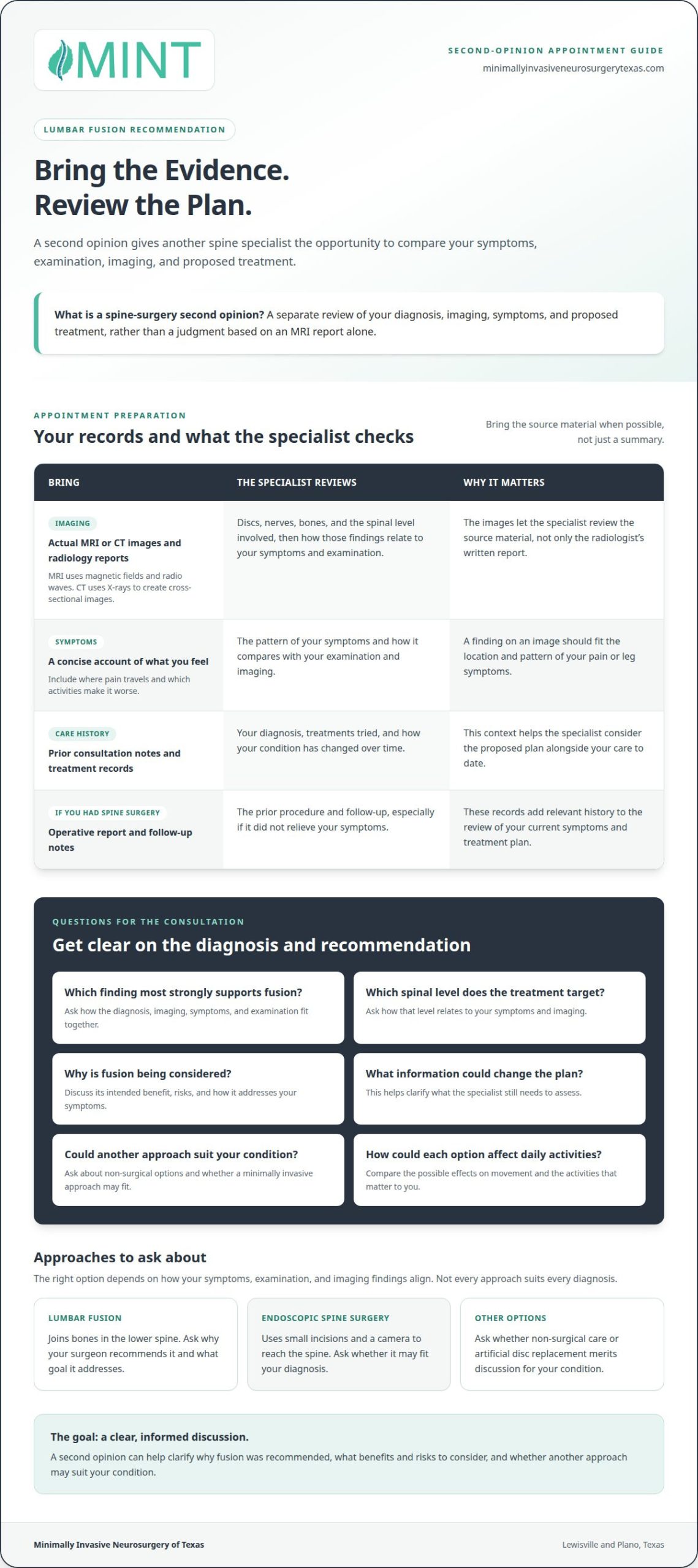
A spine surgery second opinion involves another surgeon reviewing your diagnosis, imaging, symptoms, and proposed treatment. The specialist considers those details together rather than judging the recommendation from an MRI (magnetic resonance imaging, which uses magnetic fields and radio waves to create detailed images of the body) report alone. For example, a disc finding on an MRI should fit the location and pattern of your pain or leg symptoms. Comparing the findings helps assess whether the images explain what you feel.
Imaging review may include MRI scans or CT (computed tomography, which uses X-rays to create detailed cross-sectional images) scans, along with the radiologist’s written report. The images show structures such as discs, nerves, and bones; the report summarizes the radiologist’s observations. The surgeon may check which spinal level affects you and whether it matches your symptoms and examination. Bring the actual images, not only the report, so the specialist can review the source material.
Before the appointment, gather radiology reports, imaging files, prior spine consultation notes, and relevant treatment records. Include a concise account of your symptoms, such as where pain travels and which activities worsen it. These details help the surgeon understand how your condition has changed over time. If you have had previous spine surgery without symptom relief, include the operative report and follow-up notes.
Patients seek another opinion when the diagnosis is unclear, symptoms don’t seem to match the proposed treatment, or the plan involves complex surgery such as fusion. A review can also help explain possible complications and whether other approaches merit consideration. For some spine conditions, you can take time to discuss alternatives with your surgeon. New or worsening neurological symptoms, such as weakness, deserve prompt discussion with a medical professional.
During the consultation, the specialist reviews your records, asks about your symptoms, and considers how they relate to the imaging. Expect to discuss the diagnosis, the spinal level involved, the reason for fusion, and other possible approaches. Before leaving, ask which finding most strongly supports the recommendation and what information could change the plan. Clear answers can help you decide what to discuss next with your care team.
2. Reasons to seek a second opinion before spinal fusion
Spinal fusion joins two or more vertebrae, the bones that form the spine. Another consultation can clarify why a surgeon recommends joining those bones instead of pursuing another treatment. It can also help determine whether the diagnosis, symptoms, and imaging findings support the same explanation. This review helps you understand the goal of surgery and how the proposed plan addresses your symptoms.
Consider another opinion when lower-back or leg symptoms persist despite non-surgical treatment, or when worsening nerve symptoms change the picture. Nerve symptoms can include numbness, tingling, or weakness. A surgeon considers how long symptoms have lasted, what treatments you’ve tried, and whether imaging findings match your examination. A second review can clarify which factors support surgery and which deserve further discussion.
Spinal stenosis means narrowing around the spinal nerves or spinal cord, the bundle of nerves that carries signals between the brain and body. Spinal cord compression means pressure on that bundle. Imaging can show narrowing or pressure, but a specialist also considers your symptoms and examination. Ask which spinal level appears affected and how that finding relates to your pain, numbness, or weakness.
Spondylolisthesis occurs when one vertebra shifts forward over another. Spinal deformity describes a change in spinal alignment, such as an abnormal curve. These findings can affect a fusion decision, but their presence alone doesn’t explain every symptom. A second opinion can assess whether the shift or alignment change matches your functional limits and whether the surgeon’s stated goal is to stabilize the spine.
Fusion is one possible treatment, but it isn’t the only topic to discuss. Depending on the diagnosis, a specialist may consider physical therapy, image-guided injections, activity modification, or pain-management strategies. Image-guided injections use imaging to direct medicine toward a targeted area. Ask which non-surgical options remain, what each aims to improve, and what clinical findings would support moving to surgery.
A second opinion can also clarify the proposed procedure and its tradeoffs. Ask which spinal level the surgeon plans to treat, what outcome the procedure aims to support, and which complications apply to your case. Discuss how fusion could affect movement, daily activities, and future treatment decisions. Specific answers can make the conversation about expected outcomes more informed.
For a focused consultation, bring your questions about diagnosis, treatment choices, and spinal function. A specialist can compare the proposed plan with your symptoms and examination, then explain the reasoning in plain language. If you want to discuss your fusion recommendation with a spine specialist, request a consultation.
3. What can I expect during my second opinion appointment?
A second-opinion consultation begins with arranging a review of your diagnosis and proposed treatment. When scheduling, explain that another surgeon recommended lumbar fusion and ask how to send your records and imaging. The specialist needs enough information to assess your symptoms alongside the scans. If something has changed recently, such as new leg weakness, mention it when arranging the appointment.
Gather records that show how your condition developed and what care you’ve already tried. These can include:
- MRI or CT images and the matching radiology reports
- Notes from spine consultations and the original fusion recommendation
- Records of treatments, such as physical therapy, injections, or pain medication
- Details of prior spine surgery, including the operative report when available
- A current medication list and a brief description of your symptoms
MRI means magnetic resonance imaging, which creates detailed pictures of spinal structures. CT means computed tomography, which uses X-rays to show bones and other structures. The specialist may need the actual image files, not just the written reports. Reviewing the images lets the surgeon assess the areas the radiologist describes and compare them with your symptoms.
At the appointment, the surgeon reviews your medical history, asks how pain affects daily activities, and examines relevant symptoms. For example, describe whether your lower-back pain stays in one area or travels into a leg. Explain what worsens it, what eases it, and how it has changed during treatment. Those details help the specialist connect your experience with the imaging.
The review then focuses on the proposed procedure. The surgeon can identify the spinal level involved, explain which finding supports fusion, and discuss how the diagnosis relates to your examination. If a scan shows a change that doesn’t match your symptoms, ask how the specialist interprets the difference. This discussion can bring clarity to a decision that has felt difficult to assess.
Consider another medical opinion if the diagnosis remains unclear, the recommended surgery is difficult to understand, or your symptoms and scan findings seem inconsistent. A second review may also help when treatment hasn’t relieved your symptoms or previous spine surgery didn’t address them. Bring those concerns to the consultation rather than relying on a scan report alone.
Before the consultation ends, ask the surgeon to summarize the diagnosis, the reasoning behind the recommendation, and options for next steps. You can also ask which records informed the opinion and whether missing information could change it. A clear summary helps you discuss the recommendation with your care team and make a more informed decision with greater confidence.
4. Questions to ask about diagnosis and treatment options
A second opinion can clarify the reasoning behind a proposed lumbar fusion and whether another treatment plan suits your symptoms. Use the consultation to understand the diagnosis, compare procedures, and discuss how each option may affect movement and daily activities. Focus on questions that connect your symptoms, examination, and imaging to the recommendation.
- What condition explains my lower-back or leg symptoms, and which spinal level causes them?
- Which examination or imaging findings support fusion in my case?
- What does the proposed procedure aim to improve, and how will we assess progress?
- Which non-surgical treatments could still address my symptoms?
- How might fusion affect motion, activity, and function over time?
Ask the surgeon to explain unfamiliar findings in plain language. For example, spinal stenosis means narrowing around nerves in the spine. If a scan shows narrowing, ask how it matches your pain, numbness, or weakness. A treatment plan should explain how the diagnosis relates to the symptoms it aims to treat.
A second opinion may confirm the original recommendation, suggest a different procedure, or identify non-surgical care worth discussing first. Surgeons generally consider spine surgery when symptoms persist despite non-surgical treatment, neurological symptoms worsen, and imaging findings match the clinical picture. Neurological symptoms involve nerve function, such as weakness or numbness. Ask which of these factors applies to you.
Non-surgical options may include physical therapy, image-guided injections, activity modification, and pain-management strategies. Physical therapy uses guided exercises to support strength and movement. Image-guided injections use imaging to direct medication toward a targeted area. Ask what each option aims to change, how progress will be assessed, and what would prompt a new discussion about surgery.
If a surgeon recommends an operation, ask why that procedure suits you better than the alternatives. Find out which spinal level the surgeon plans to treat, what structures the procedure addresses, and how it could affect movement. Ask about possible complications and activities you may need to adjust during recovery. Clear answers help you compare surgical options without assuming every procedure is interchangeable.
Insurance coverage for a second opinion or lumbar fusion depends on your specific plan and benefits. Prior authorization requirements also vary by plan and procedure, so ask your insurer whether approval is required and which records it needs.
Before ending the consultation, ask for a plain-language summary of the diagnosis, recommended treatment, alternatives, and next decision point. Write down any terms that remain unclear. A useful second opinion gives you specific reasons to discuss, whether you continue considering fusion or explore another approach with your care team.
5. Minimally invasive alternatives to fusion
A key distinction can make a second opinion more useful: minimally invasive describes how a surgeon reaches the spine, while fusion describes joining vertebrae. A minimally invasive operation can still include fusion. Ask whether the proposed alternative changes the procedure itself, the surgical approach, or both. This helps you compare options accurately instead of assuming every smaller-incision procedure avoids fusion.
For some diagnoses, a surgeon may discuss decompression, a procedure that removes or reduces pressure on spinal nerves. The key question is whether nerve compression explains your symptoms and whether treating it requires stabilizing the spine. Ask what the surgeon would address, which spinal level is involved, and why the plan fits your imaging and examination. The answer should connect the procedure to a specific treatment goal.
Endoscopic spine surgery uses an endoscope, a narrow instrument with a camera, to view the surgical area through a small access point. A surgeon may discuss this approach when it suits the diagnosis and treatment target. It doesn’t automatically replace fusion or fit every condition. Ask what the endoscopic procedure would treat in your case and how its purpose differs from the proposed fusion.
Minimally invasive spine surgery can involve specialized techniques that limit how the surgeon accesses the spine. The approach depends on the condition, spinal level, and planned procedure. A smaller access route alone doesn’t establish that an operation will resolve symptoms or preserve movement. Ask which tissues the surgeon must reach, what the procedure changes, and how those details relate to your goals.
Compare the options using the same questions. What problem does each procedure address? Does it stabilize the spine, relieve nerve pressure, or do both? Which findings make one option more suitable than another? What possible complications and activity changes should you understand? These questions focus the comparison on purpose, tradeoffs, and expected recovery without treating one approach as universally preferable.
Recovery depends on the procedure and individual health factors. Recovery from minimally invasive spine surgery may take several months. Some patients may return to basic activities within a few weeks, while other parts of recovery take longer. Ask which activities your care team classifies as basic, what restrictions apply, and how the planned procedure affects your personal recovery expectations.
An informed evaluation weighs the diagnosis, imaging, symptoms, and treatment goals together. A specialist can explain whether a minimally invasive option addresses the same problem as fusion or serves a different purpose. For an overview of minimally invasive spine techniques, consider how each approach relates to the proposed plan. To discuss your options, request a spine evaluation.
Minimally Invasive Neurosurgery of Texas
Minimally Invasive Neurosurgery of Texas helps patients in Lewisville and Plano, Texas, review spine surgery recommendations and understand their options. Dr. Scott Kutz, a board-certified neurosurgeon and Fellow of the AANS and ACS, evaluates the diagnosis, imaging, symptoms, and proposed treatment plan during a second-opinion consultation.
This review can clarify why a surgeon recommends fusion and whether minimally invasive spine surgery or another approach may suit your diagnosis. The specialist explains the reasoning and answers questions so you can make an informed decision with your care team. A second opinion doesn’t require you to proceed with surgery.
If you want another professional perspective on a lumbar fusion recommendation, contact Minimally Invasive Neurosurgery of Texas to discuss a consultation.
Take Your Next Step With Clarity
Your next step is to decide what information would help you feel ready to discuss treatment. A second opinion on a lumbar fusion recommendation in Lewisville can add another clinical perspective. Dr. Scott Kutz emphasizes that the diagnosis, symptoms, examination, and imaging should support the treatment plan together.
Use your consultation to clarify any remaining questions about the reasoning behind the recommendation and how it relates to your goals. You can take time to consider what you learn and discuss the options with your care team.
Request a consultation to discuss your next step. A clear, informed decision can help you move forward with confidence.
Frequently Asked Questions
Does Seeking a Second Opinion Offend Your Surgeon?
No. You can tell your surgeon that you want another specialist’s perspective before making a major treatment decision. Keep the conversation focused on understanding the recommendation, not challenging the surgeon personally. For example, explain that you want to compare the reasons for fusion with other approaches. Your surgeon can help you access records, imaging, and consultation notes so another specialist can review the same clinical information.
How a Second Opinion Supports Better Decision-Making?
A second opinion can help you compare the reasoning behind different treatment recommendations. If two surgeons agree, ask which diagnosis and findings support their shared conclusion. If they disagree, ask what specific information explains the difference, such as how they interpret a scan or weigh your symptoms. This gives you a clearer basis for discussing benefits, risks, and priorities with your care team before choosing a treatment path.
What can I expect during my second opinion appointment?
Expect a focused discussion of your health history, symptoms, examination, and proposed treatment. The specialist may ask how back pain affects activities such as walking, sitting, or sleeping, then explain how those details inform the evaluation. You can bring a support person to help take notes if you wish. Before the appointment ends, ask for the main conclusion and any questions that need follow-up.
What do I do after receiving my second opinion?
After the consultation, write down the specialist’s main conclusion and the reasons behind it. Note any differences from the original recommendation, including what each surgeon believes causes your symptoms and which treatment goal they prioritize. If a term or recommendation remains unclear, ask the specialist to explain it in plain language. Then use those points in a follow-up conversation with your care team before deciding on next steps.
When is a Second Opinion Especially Important?
A second opinion can be particularly useful when a proposed operation is complex, your diagnosis remains unclear, or symptoms continue after earlier treatment. It may also help if prior spine surgery did not relieve your symptoms. If your condition changes while you consider options, tell your treating clinician promptly. A fresh review can help you understand whether the diagnosis and proposed plan still match your current symptoms and examination.
What records and imaging should I bring for a lumbar fusion second opinion?
Bring the original surgeon’s recommendation, relevant consultation notes, radiology reports, and the image files themselves. A brief symptom timeline can add useful context: note when the pain began, where it travels, and what changes it. Include records of previous treatment and any prior spine operation. Organizing documents by date helps the specialist follow how your condition and treatment have progressed.
When do surgeons recommend lumbar fusion, and what alternatives should they consider?
Surgeons generally consider spine surgery when symptoms persist despite non-surgical treatment, neurological symptoms worsen, and imaging findings match the clinical condition. Neurological symptoms involve nerve function, such as weakness or numbness. Depending on the diagnosis, alternatives may include physical therapy, image-guided injections, activity changes, or pain-management strategies. Ask what each option aims to address and which findings support considering surgery rather than continuing non-surgical care.
What are the risks, recovery time, and success rates of lumbar fusion?
A second opinion can help clarify possible complications. Most spinal fusion patients require a hospital stay of 2-3 days, and healing and physical therapy may take up to 6-12 months.