
Minimally Invasive Neurosurgery of Texas, with Dr. Scott Kutz, a board-certified neurosurgeon and Fellow of the AANS and ACS, leading the practice, provides minimally invasive spine surgery in Lewisville and Plano, TX. A Plano TX spine surgery second opinion offers another doctor’s evaluation of your diagnosis and treatment recommendation.
A recommendation for spine surgery deserves careful consideration. A second opinion can help you understand the reasons for the proposed plan and whether other approaches may better fit your needs.
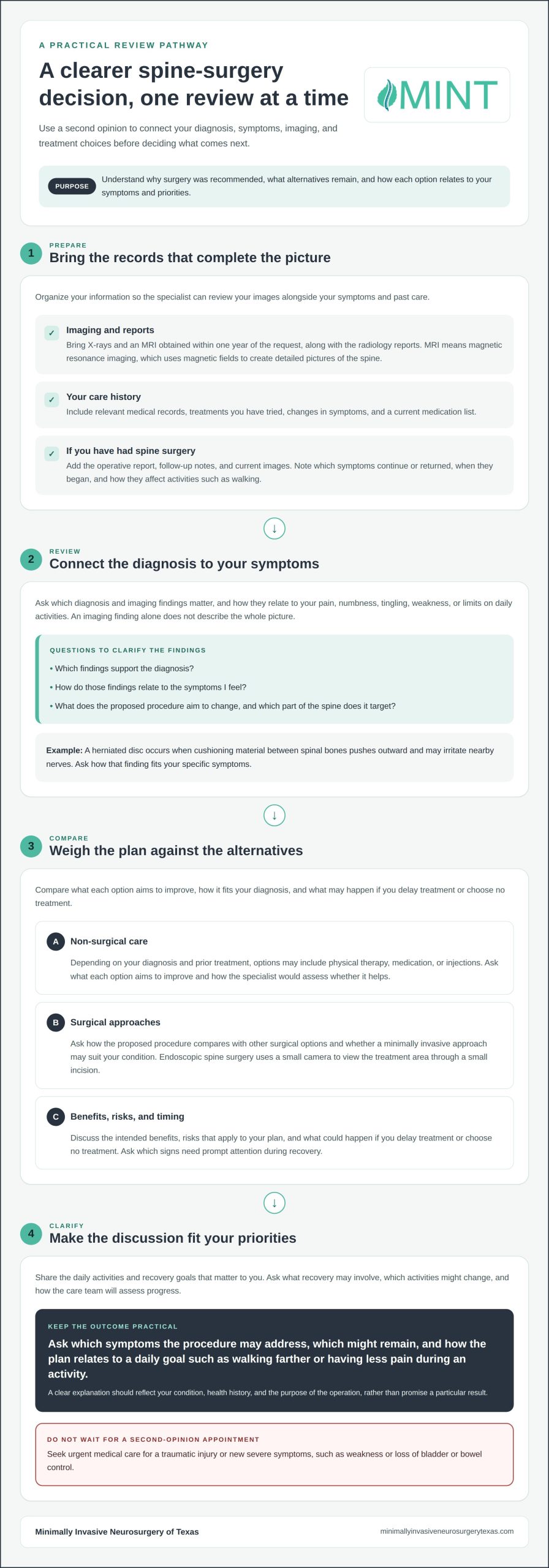
Bring your imaging and reports, treatment records, medication list, and notes on care you’ve tried. Ask whether surgery is necessary, which options suit your condition, and what recovery may involve. Endoscopic spine surgery uses a small camera to view the treatment area through a small incision. These details can help you make a more informed decision about your next step.
Key Takeaways
- A second opinion can help clarify a diagnosis or treatment plan, especially when recommendations differ or symptoms persist despite non-surgical care.
- Organize your imaging, reports, medication list, treatment history, and prior spine surgery records before the appointment.
- Ask about the benefits and risks of each option, including what could happen if you delay treatment or choose no treatment.
- Share the daily activities and recovery goals that matter to you so the discussion reflects your priorities.
- Ask whether a minimally invasive approach, such as endoscopic spine surgery or artificial disc replacement, may suit your condition.
Why a Second Opinion Can Help You Evaluate Spine Surgery
Consider another medical opinion if your diagnosis is unclear, treatment recommendations conflict, or conservative care has not eased your symptoms. If a traumatic injury or new severe symptoms, such as weakness or loss of bladder or bowel control, need urgent attention, seek urgent medical care rather than waiting for a second-opinion appointment.
Reasons to Seek Another Opinion
A second opinion gives another doctor a chance to review your diagnosis, symptoms, images, and treatment history. It can be helpful when clinicians recommend different next steps or when the proposed plan does not seem to match how your back or neck feels. For example, ask how an imaging finding relates to your pain, numbness, or limits on daily activities.
It may also help if physical therapy, medication, or injections have not significantly improved your symptoms. A second evaluation can clarify whether the current plan still makes sense or whether another approach warrants discussion. Understanding the reasoning behind a recommendation can provide greater clarity and peace of mind.
Before-Surgery Considerations
Before a major spine operation, ask another specialist to review why surgery may help and what alternatives remain. Discuss the intended benefits, possible risks, and what could happen if you delay treatment or choose no treatment. If a surgeon recommends a complex procedure, ask how your diagnosis and specific symptoms support that choice.
Use the appointment to clarify the treatment sequence. Ask whether nonsurgical care remains appropriate, what the proposed procedure aims to change, and how recovery will be assessed. A careful review helps you compare recommendations instead of deciding based only on a procedure’s name or an imaging report.
After Surgery
A second opinion can also help after spine surgery if symptoms continue, return, or differ from what you expected. Bring the operative report, follow-up notes, and current images so the reviewing doctor can understand what procedure you had and how your condition has changed. Describe specific concerns, such as persistent leg pain or difficulty walking, and when they began.
If another operation comes up, ask what evidence supports it and whether other options could address the problem. An evaluation of endoscopic spine surgery, which uses a small camera to view the treatment area, may be relevant when discussing less invasive surgical approaches. The goal is a clear explanation of the next step, not pressure to repeat or reject surgery.
Follow-up discussion of findings and surgical options
A follow-up review connects your diagnosis, symptoms, and imaging with a practical treatment plan. Ask the specialist which findings matter and how each option could affect your daily activities.
Reviewing Findings and Options
Start with the diagnosis and the findings that support it. For example, a herniated disc occurs when cushioning material between spinal bones pushes outward and may irritate nearby nerves. Ask how that finding relates to symptoms such as pain, tingling, or weakness, rather than treating an image as the whole answer.
Then compare the proposed procedure with other surgical options. Ask what each approach aims to address, how it relates to your symptoms, and which factors make one option more suitable than another.
Questions About the Surgical Plan
Ask the specialist to explain the planned procedure in plain language, including its goal and the part of the spine it targets. Clarify what recovery may involve, which activities might change, and how the care team will assess your progress. A clear explanation should connect each step to your diagnosis and specific symptoms.
Also ask what could happen if you delay treatment or choose no treatment. The answers can help you understand the recommendation’s urgency and make a decision that reflects your priorities.
Outcomes and Surgical Risks
Discuss the intended outcome in practical terms, such as walking farther or having less pain during a daily task. Ask which symptoms the procedure may address and which might remain. The answer should reflect your condition, health history, and the operation’s purpose, rather than promise a particular result.
Every operation carries risks, and relevant concerns depend on the procedure and your health. Ask the surgeon to explain the risks that apply to your plan, how the team works to reduce them, and which signs need prompt attention during recovery.
Non-surgical care may include physical therapy, medication, or injections, depending on the diagnosis and prior treatment. Ask which options remain reasonable, what each aims to improve, and how the specialist would judge whether it helps. For spinal stenosis, a narrowing around nerves, the discussion should connect the narrowing to symptoms and function. A review of minimally invasive spine techniques can also help clarify how a less disruptive surgical approach differs from the proposed plan.
Spine imaging and medical records to bring to an appointment
A complete record helps a spine specialist connect your symptoms with imaging and previous care. For an image review, bring X-rays and an MRI that you obtained within one year of the request. MRI, or magnetic resonance imaging, uses magnetic fields to create detailed pictures of the spine. Include radiology reports, which describe the findings that the images show.
Ask your current doctor for copies of relevant medical records and imaging. Include the history behind your diagnosis, treatments you have tried, and any changes in symptoms. If you have had spine surgery, add the operative report and follow-up records. A medication list gives the specialist context about current and previous treatment.
- Spine images, including X-rays and MRI, plus the corresponding reports.
- Medical records describing your diagnosis, symptoms, and treatment history.
- A medication list and notes about physical therapy, injections, or other conservative care.
- Reports from previous spine surgeries, if applicable.
Before mailing an imaging CD, label it with your name and appointment details. Include the written radiology report and records explaining why each study was ordered. The receiving team can review the images and report together, then compare the findings with your medical history and symptoms. The CD contains the image files; the report summarizes the radiologist’s interpretation.
Keep a copy of the records you send, and note the imaging dates on the CD. At the appointment, the specialist reviews the images alongside your reports, prior treatments, and current concerns. For example, a report may describe a disc bulge, while your history explains whether pain travels into a leg. This comparison frames the discussion around your overall condition, not just one image. If a record or report is missing, tell the specialist which document you still need so the review can account for the available information.
Choosing a surgeon and discussing recovery goals
For a second opinion in Plano, choose a spine specialist whose knowledge and experience relate to your diagnosis. Look for a physician who can explain how your symptoms, examination, and imaging support the proposed treatment plan.
A specialist’s experience matters because spine conditions may call for different approaches. Ask whether the physician regularly evaluates your condition, such as a herniated disc or spinal stenosis, and how that experience informs the options under discussion. A clear answer connects your diagnosis to your symptoms and explains why an approach may suit you.
Consider how the doctor explains your choices, not only which procedure they recommend. Can the physician explain why the surgeon is considering surgery, discuss nonsurgical options, and outline what could happen if you delay treatment? Ask what goal a proposed operation addresses and how the specialist would measure progress afterward.
Bring your priorities into the conversation. Name specific activities you hope to resume, such as walking around the neighborhood, sitting through a workday, or lifting groceries. Explain what currently limits those tasks. These details help the specialist discuss recovery goals in practical terms, beyond an image or diagnosis.
Share your goals with both your primary physician and the second-opinion specialist. Clear communication helps each clinician understand the recommendations already discussed and supports continuity of care. If your primary physician in Dallas has records or treatment notes, include them so the specialist can consider your full history.
Comfort and communication matter, too. Choose a physician who listens to your concerns, answers questions directly, and gives you enough information to weigh the plan. Before scheduling, check whether the specialist participates in your insurance network, since coverage depends on your individual plan. Use the appointment to discuss both the medical reasoning and your concerns about surgery.
At the end of the visit, summarize what you understood: the diagnosis, recommended next step, and alternatives. Ask the specialist to correct any misunderstanding. A written note can help you discuss the second opinion with your primary physician and decide based on your health needs and recovery priorities.
Minimally invasive spine surgery
Minimally invasive spine surgery uses smaller incisions and specialized instruments to reach the treatment area. A surgeon may discuss it when evaluating conditions such as a herniated disc, which occurs when cushioning material pushes outward and can irritate nearby nerves. The approach still requires a clear diagnosis and a reason to operate.
During an evaluation, the specialist connects your symptoms with examination findings and imaging. For example, leg pain and numbness may prompt a review of the lower back and nearby nerves. The surgeon then considers whether the images show a problem that matches those symptoms. An image alone does not establish that surgery will help.
Endoscopic spine surgery is one minimally invasive option. It uses a small camera to help the surgeon view the treatment area through a small incision. Ask what the procedure would address, how the surgeon plans to reach the affected area, and why that method suits your diagnosis. Discuss alternatives, including continued nonsurgical care.
Minimally invasive techniques are not appropriate for every spinal condition or every patient. The decision depends on the problem’s location and nature, your symptoms, prior treatment, and overall health. A specialist should explain whether the approach targets the source of your symptoms and what trade-offs it involves. Smaller incisions do not eliminate surgical risks or guarantee a faster recovery.
Ask how the procedure may affect your hospital care and return to everyday activities. Recovery planning should cover pain management, movement restrictions, follow-up visits, and signs that need medical attention. Request practical guidance, such as when you may resume desk work or household tasks, based on the procedure the surgeon is considering. Avoid relying on a general timeline from someone with a different diagnosis or operation.
Use your second-opinion visit to compare the surgical plan with your goals. Ask what changes the surgeon expects, which symptoms the procedure may not address, and how the team will assess progress. A clear recommendation connects the diagnosis, symptoms, surgical method, and recovery plan. If those pieces do not align, ask the specialist to explain why before making a decision.
Minimally Invasive Neurosurgery of Texas
Minimally Invasive Neurosurgery of Texas offers a specialist’s perspective on a spine diagnosis or proposed operation. Dr. Scott Kutz, a board-certified neurosurgeon and Fellow of the AANS and ACS, provides spine care in Lewisville and Plano, Texas. A second-opinion discussion can help you understand how your symptoms, imaging, treatment history, and recovery priorities relate to the options the care team is considering.
Bring your questions and records to the appointment. Dr. Kutz can discuss your diagnosis, explain the purpose of a proposed procedure, and review surgical options within the practice’s spine care scope. Ask how each option may address your symptoms, what alternatives remain, and what recovery planning involves. Clear answers can help you weigh the recommendation against your own goals.
Minimally invasive spine surgery uses specialized techniques to reach and treat a spinal problem through smaller incisions. This approach may be relevant when a surgeon evaluates whether surgery suits your condition and whether a less disruptive technique could address it. Suitability depends on your diagnosis, the problem’s location, your symptoms, and your medical history.
For some conditions, endoscopic spine surgery uses a small camera to help the surgeon view the treatment area. Artificial disc replacement is another surgical option; it replaces a damaged spinal disc with an artificial one. These procedures address different clinical situations, so the discussion should explain each option’s goal and why it may suit your diagnosis. Neither procedure is appropriate for every patient.
Consider a second opinion if you are uncertain about your diagnosis, have received conflicting recommendations, or want to understand minimally invasive options before deciding. You can also discuss recovery priorities, such as returning to work, walking comfortably, or managing lower back pain during daily activities. Those priorities can make the conversation about treatment choices more useful.
Minimally Invasive Neurosurgery of Texas sees patients in Lewisville and Plano, making these local options for people seeking spine care. A focused discussion can help you understand the recommendation and prepare informed questions for your ongoing care. Keep your primary physician involved so your clinicians can coordinate around your diagnosis and treatment plan.
Contact Minimally Invasive Neurosurgery of Texas to discuss a second opinion.
Frequently Asked Questions
What is a Second Opinion?
A second opinion is another doctor’s medical evaluation and treatment recommendation. The specialist reviews your diagnosis and proposed plan, then explains whether the findings support that approach or suggest other options. It does not require you to reject your current doctor’s advice. For example, you can clarify why the surgeon recommended surgery and what questions remain before deciding.
How can a spine specialist help you discuss a second opinion with your current doctor?
A spine specialist can help you understand the reasoning behind a recommendation so you can discuss it clearly with your current doctor. Share the second evaluation’s conclusions and ask how they compare with the original plan. For example, ask whether both doctors agree on the diagnosis, even if their treatment recommendations differ. Open communication helps your physicians coordinate your care.
What questions can a second-opinion specialist answer?
A specialist can explain how your diagnosis relates to your symptoms, whether surgery appears necessary, and which treatment options merit consideration. Ask what the proposed procedure aims to change, what alternatives remain, and what delaying treatment could mean. If you have a specific concern, such as walking or sitting at work, ask how the plan addresses that limitation.
What questions should you ask a spine surgeon during a second-opinion appointment?
Ask the surgeon to explain your diagnosis, the reason for the recommendation, and the goal of each proposed treatment. Clarify the expected benefits, relevant risks, recovery needs, and alternatives, including no treatment or a delay. If the surgeon recommends a specific procedure, ask which symptoms it targets and how the team will evaluate progress. These questions can make the discussion more relevant to your priorities.
How can a spine specialist guide you through getting a second opinion?
A spine specialist guides the evaluation by reviewing your medical history, symptoms, and diagnostic findings, then explaining treatment choices in context. The specialist can identify points that need clarification, such as whether a scan finding matches your symptoms. Ask for a summary of the options and the reasoning behind them, then discuss that perspective with your primary physician.
How can a spine specialist provide a second opinion for spine surgery in Plano, TX?
A spine specialist can provide a second opinion for spine surgery in Plano, Texas, by reviewing your history, symptoms, and diagnostic findings. The specialist explains whether the proposed operation aligns with your condition and discusses alternatives, including minimally invasive approaches when appropriate. Bring questions about daily function and recovery so the evaluation addresses your goals, not only the procedure under consideration.
Which medical records and imaging should you provide for a spine surgery second opinion?
Provide spine imaging and reports, treatment records, a current medication list, and notes about prior care. Include reports from earlier spine surgeries, if applicable. X-rays and an MRI taken within one year of the image review can help the specialist assess current findings. Organizing documents by date also shows how your symptoms and treatment have changed over time.
What questions can a spine surgeon answer before you agree to surgery?
Before agreeing to surgery, ask what the operation is intended to address, why the plan fits your diagnosis, and what alternatives remain. Clarify which symptoms the procedure targets, what risks apply, and what recovery involves. Ask what might happen if you wait or decline surgery. Clear answers help you weigh the recommendation against your health needs and everyday priorities.