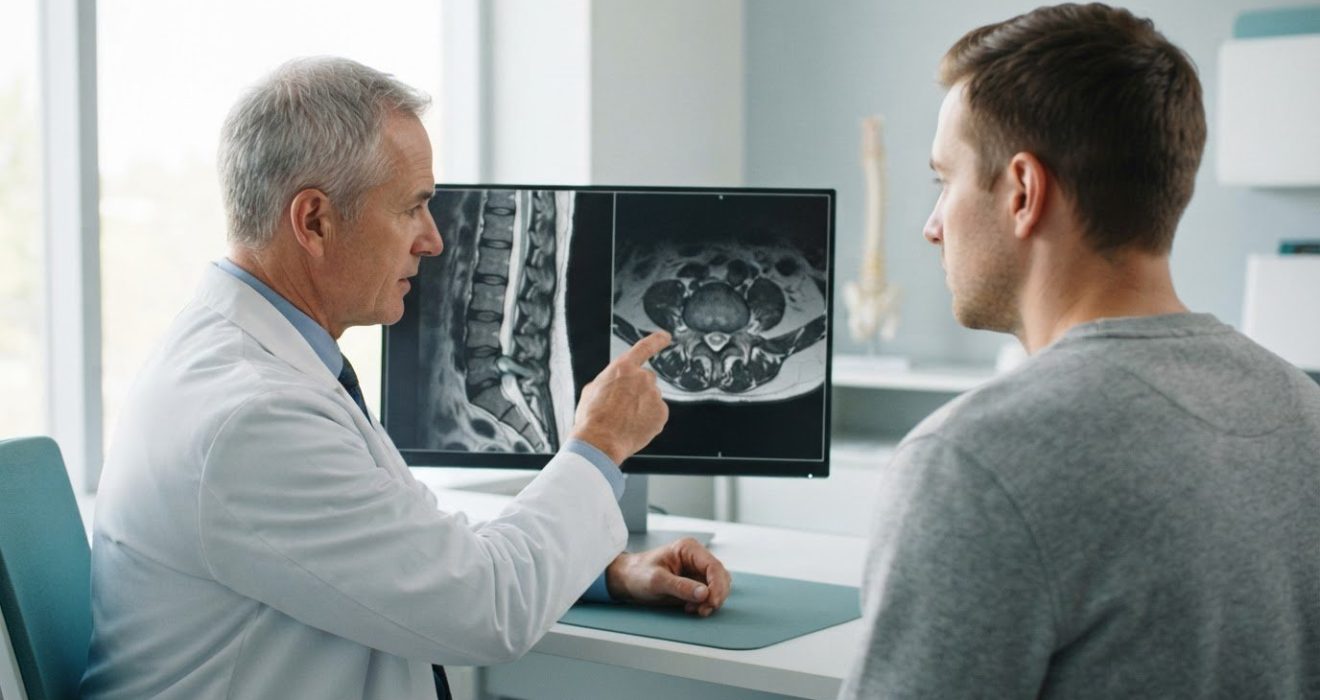
Minimally Invasive Neurosurgery of Texas provides minimally invasive spine surgery in Lewisville and Plano, Texas. Dr. Scott Kutz, a board-certified neurosurgeon and Fellow of the AANS and ACS, leads the practice.
A second opinion from a Lewisville neurosurgeon can help clarify whether a proposed spine operation fits your diagnosis, imaging, symptoms, and goals.
It’s reasonable to want a clear explanation before deciding on surgery. This article explains how a neurosurgeon reviews a second-opinion request, which records can help, and how to compare treatment approaches and hospital affiliations. You’ll also learn how to prepare for a focused discussion about your care.
Key Takeaways
- Learn how referral and insurance requirements can shape the steps for arranging a second-opinion evaluation.
- See which medical records and imaging can help a neurosurgeon assess a proposed spine treatment.
- Understand how hospital affiliations and treatment locations factor into choosing where to receive care.
- Explore how specialists evaluate spinal stenosis and herniated discs when considering care options.
- Discover what to consider when comparing a proposed procedure with minimally invasive spine surgery approaches.
Choosing a provider and location for treatment
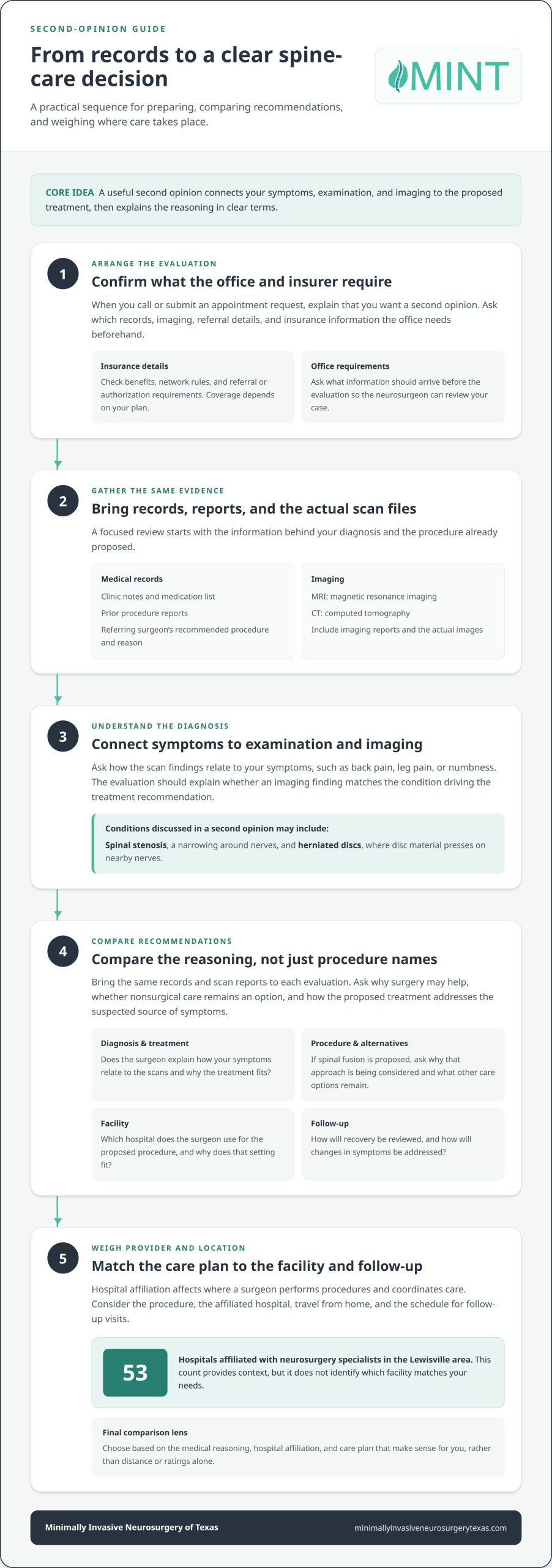
After a second opinion, you can choose the provider and facility where you receive treatment. In Lewisville, compare each neurosurgeon’s assessment with your diagnosis, proposed procedure, and goals for daily activity. A useful second opinion explains whether the recommended operation addresses the source of your symptoms, not just what appears on a scan. Ask how the surgeon connects your symptoms, examination, and imaging before recommending a treatment path.
Hospital affiliation matters because the location affects where a surgeon performs procedures and coordinates care. The Lewisville area has 53 hospitals affiliated with neurosurgery specialists. That count gives context, but it doesn’t show which facility matches your needs. Compare the hospital where the recommended surgeon performs procedures, the procedure under consideration, and the location that works for follow-up visits. A nearby facility may make appointments easier, while another location may better fit the proposed treatment plan.
Use consistent criteria when weighing providers in Lewisville, Plano, or nearby Flower Mound:
- Diagnosis: Does the neurosurgeon explain how your symptoms relate to the findings on your scans?
- Treatment options: Does the evaluation explain why surgery may help, and whether nonsurgical care remains an option?
- Procedure and facility: Which hospital does the surgeon use for the proposed operation, and why does that setting fit?
- Follow-up: How will the surgeon review your recovery and address changes in symptoms?
Bring the same medical records and scan reports to each evaluation. If one recommendation involves spinal fusion, which joins bones in the spine, ask the second neurosurgeon to explain why that approach is being considered. Compare the reasoning, not just the procedure names. A clear discussion connects the treatment choice to your diagnosis, symptoms, and priorities.
Location also affects practical decisions. Consider travel from your home in Lewisville, the route to the affiliated hospital, and the schedule for follow-up appointments. If providers recommend different facilities, compare how each plan addresses your condition and what care takes place there. You may choose your preferred provider and facility after getting a second opinion. Your decision can reflect the medical reasoning, hospital affiliation, and care plan that make sense for you.
Neurosurgeons near Lewisville, Texas
Compare local neurosurgeons by board certification, spine specialty, experience, and how clearly they explain your diagnosis and surgical options. Coverage for a second opinion depends on your health plan’s benefits, network rules, and referral or authorization requirements.
Comparing Credentials, Specialties, and Ratings
Review each surgeon’s board certification, fellowship training, and focus within neurosurgery. A specialist who regularly evaluates spine conditions can explain how your diagnosis relates to a proposed operation. During the appointment, note whether the surgeon discusses alternatives and answers your questions directly. These details help you assess the clinical discussion alongside credentials and patient ratings.
Local listings show an overall average rating of 4.3 stars for neurosurgery specialists in Lewisville. Dr. Saeid Aryan receives a 4.2-star rating from 45 ratings and 21 written reviews for minimally invasive neurological spine surgery near Lewisville. Treat ratings as one comparison point, not proof that a surgeon’s approach matches your diagnosis. Look for comments that describe communication and explanations of treatment choices.
Location can help narrow the search. The local listing places Dr. Justin Dowdy in Flower Mound, 3.3 miles from Lewisville. Compare each surgeon’s specialty and the reasoning behind the treatment plan, rather than choosing by distance or rating alone. A clear evaluation should connect symptoms, examination findings, and imaging to the diagnosis.
Conditions Neurosurgeons Evaluate for a Second Opinion
Neurosurgeons near Lewisville may assess conditions such as spinal stenosis, a narrowing around nerves, and herniated discs, where disc material presses on nearby nerves. A second opinion can clarify whether imaging findings match symptoms such as back pain, leg pain, or numbness. Your diagnosis and symptoms guide discussion of possible treatments, including whether surgery fits your situation.
Two evaluations may interpret a disc finding differently or recommend different next steps. Ask the neurosurgeon to explain what the scan shows, how it relates to your symptoms, and why the proposed treatment addresses the suspected cause. This can help distinguish an imaging finding from the condition driving the treatment recommendation.
Insurance benefits vary by plan. Review your plan’s terms for specialist visits, network participation, referrals, and prior authorization, meaning your insurer must approve certain care beforehand. These details determine whether a second-opinion visit is covered and what steps apply. Your plan documents explain the relevant benefits, and the neurosurgeon’s office can provide visit information needed for the insurance process.
How do neurosurgeons schedule a second-opinion evaluation?
To schedule, call or submit an appointment request to a neurosurgery practice and explain that you want a second opinion. Ask which records, imaging, referral details, and insurance information the office needs before the evaluation.
Records and imaging a neurosurgeon reviews
Gather records related to your diagnosis and proposed treatment. These may include clinic notes, a medication list, prior procedure reports, and imaging reports. Imaging files matter too: MRI means magnetic resonance imaging, and CT means computed tomography. The actual images help the neurosurgeon assess what the reports describe.
Include the referring surgeon’s recommended procedure and the reason for it. If the plan involves surgery for a herniated disc, for example, the second-opinion neurosurgeon can compare the scan findings with your symptoms and examination. The office can explain how to submit records securely and whether it needs anything else before the appointment.
Virtual Second Opinion Availability
A virtual second-opinion visit can support a review of your medical history, imaging, diagnosis, and proposed treatment. It may help you discuss surgical options with neurosurgery experts without traveling for that conversation. However, a virtual visit cannot provide hands-on checks of strength, sensation, or movement. The surgeon may need an in-person examination to assess those findings.
When scheduling, ask whether the appointment format suits your records and clinical question. Complete imaging files and reports help the neurosurgeon prepare for a remote discussion. If new examination findings could change the assessment, an in-person visit may provide useful information.
Topics to discuss during a second-opinion appointment
Bring questions about your diagnosis, the reason for the proposed surgery, and the goal of treatment. Ask how the neurosurgeon connects your symptoms and examination findings to the imaging. You can also discuss nonsurgical options, the procedure’s intended benefits, potential risks, and how the treatment plan relates to your daily activities.
Describe any changes in pain, weakness, numbness, or walking ability since the first evaluation. These details help the neurosurgeon understand whether your condition has changed. Delaying recommended surgery can carry risks if symptoms worsen or neurological function declines. Ask the surgeon how your symptoms affect timing and which changes need prompt medical attention.
How to find a neurosurgeon for a second opinion
Start with the decision you need help making. If a surgeon has recommended an operation, look for a neurosurgeon whose clinical focus includes the affected part of the spine. A second opinion should address your diagnosis, the proposed procedure, and reasonable alternatives. For a Lewisville neurosurgeon second opinion, choose an evaluator who can explain how the recommendation relates to your symptoms and goals.
Use your health plan’s provider directory to identify in-network neurosurgeons near Lewisville, then review each specialist’s areas of practice. A provider who evaluates spine conditions can discuss a proposed spine operation directly. If a surgeon has advised you to consider spinal fusion, for example, choose an evaluator prepared to explain why it may fit your diagnosis and what other approaches could apply.
Before booking, describe the purpose of the visit clearly. Tell the scheduling team that you want another opinion about a diagnosis or proposed surgery, and ask how the neurosurgeon will review your case. Find out how the office handles medical records and imaging, whether it needs referral information, and what insurance details support the appointment. These steps help the specialist prepare for your medical question.
Use a short checklist to assess whether the evaluation fits your needs:
- Clinical focus: Does the neurosurgeon evaluate the condition and procedure involved in your case?
- Review process: Can the specialist consider your medical history, examination, imaging, and prior recommendation together?
- Coverage: Does your plan include the specialist, and does it require a referral or authorization?
- Decision support: Will the appointment explain the reasoning behind each treatment option?
During the appointment, listen for a clear connection between your diagnosis and the treatment recommendation. A useful explanation identifies what the surgeon sees in your imaging, how it relates to your symptoms, and why a particular procedure may help. Ask the neurosurgeon to explain unfamiliar terms in plain language. A Lewisville neurosurgeon second opinion should help you understand the main choices and prepare focused follow-up questions.
A second opinion can inform your decision without requiring an automatic change in treatment. Use the evaluation to clarify a surgical recommendation, understand alternatives, or feel better prepared to decide where to receive care. Choose a specialist whose expertise matches your question and whose explanation helps you make an informed choice.
What conditions do Lewisville-area neurosurgeons evaluate for a second opinion?
A second opinion can review a diagnosis involving spinal stenosis or a herniated disc. Spinal stenosis means narrowing around the spinal nerves. A herniated disc occurs when disc material extends beyond its usual boundary and may irritate nearby nerves. The neurosurgeon compares these findings with your symptoms and examination, then explains whether they support the proposed treatment.
For spinal stenosis, the evaluation considers where the narrowing appears and how it relates to your symptoms. Lower back narrowing, for example, may be discussed alongside pain, tingling, or weakness in the legs. A scan alone cannot explain how you feel. A useful review connects the location shown in imaging with your reported symptoms and physical examination findings.
For a herniated disc, the neurosurgeon considers its location and whether it could explain symptoms such as lower back pain that travels into a leg. The evaluation also considers when symptoms began, which activities affect them, and whether they have changed. This helps clarify whether the scan finding matches the problem behind the original recommendation.
- Diagnosis: Does the imaging show stenosis, a herniated disc, or another spinal finding?
- Symptom match: Does the affected area correspond with where pain, tingling, or weakness occurs?
- Treatment rationale: What finding supports the recommended procedure, and what goal does it address?
- Other options: What nonsurgical approaches may be appropriate for the symptoms and diagnosis?
Bring a clear timeline to the evaluation. Describe when your lower back pain started, whether it travels, and which movements make it better or worse. Mention any changes in walking, strength, or sensation. A specific example, such as leg discomfort while walking, gives the neurosurgeon useful context for interpreting the scan and discussing how the diagnosis affects daily activities.
The second opinion should explain how your diagnosis, symptoms, and proposed treatment fit together. If the first recommendation calls for surgery, ask what the surgeon aims to address and how the findings support that approach. A separate review can clarify differences in interpretation or treatment reasoning, giving you a clearer basis for discussing next steps and understanding options for your spinal condition.
Minimally Invasive Neurosurgery of Texas
Minimally Invasive Neurosurgery of Texas provides minimally invasive spine care for patients considering another opinion about a spine diagnosis or proposed operation. Dr. Scott Kutz, a board-certified neurosurgeon and Fellow of the AANS and ACS, evaluates how a patient’s symptoms, examination, and imaging relate to the recommended treatment. This review can help clarify the reasoning behind a surgical plan and the options relevant to the patient’s condition.
Dr. Kutz considers whether imaging findings match a patient’s symptoms before discussing a procedure. A scan may show a disc change, for example, but the evaluation also considers whether it corresponds with the patient’s pain or other concerns. This connection frames a useful discussion about what the proposed treatment aims to address. Patients can discuss their diagnosis, treatment goals, and questions about the recommendation.
The practice focuses on spine care, including minimally invasive spine surgery, which uses smaller incisions than traditional open surgery. Depending on the diagnosis, a discussion may include minimally invasive spine techniques, endoscopic spine surgery, or artificial disc replacement. Each approach serves a distinct role. The neurosurgeon relates the options to the patient’s findings rather than treating procedures as interchangeable.
A second-opinion discussion can help you understand whether a proposed operation fits your diagnosis and goals. It can clarify the purpose of a procedure and alternatives relevant to your clinical picture. You can use that perspective to prepare for a decision about care without assuming you must change providers or proceed with surgery.
If you have lower back pain, the discussion can include how symptoms affect movement and daily activities. The neurosurgeon can review the available information and explain how it informs the treatment discussion. Understanding the recommendation can help you take your next steps with greater confidence.
To discuss a second opinion, contact Minimally Invasive Neurosurgery of Texas.
Frequently Asked Questions
Do I need a referral for a second opinion?
Referral requirements depend on your health plan. Call the number on your insurance card and ask whether a specialist referral or prior authorization applies to the visit. Confirm whether the neurosurgeon participates in your plan’s network and what paperwork the plan requires. For a Lewisville neurosurgeon second opinion, checking these details first can clarify the steps your plan expects before scheduling.
Which neurosurgeons in or near Lewisville, Texas offer second opinions?
Patients seeking a Lewisville neurosurgeon second opinion can consider Dr. Scott Kutz, a board-certified neurosurgeon specializing in spinal disorders. Local listings also include Dr. Saeid Aryan for minimally invasive neurological spine surgery near Lewisville and Dr. Justin Dowdy in Flower Mound. Compare each specialist’s clinical focus with your diagnosis, such as a disc concern or spinal narrowing, and consider which evaluation addresses your treatment question.
How does a neurosurgery practice schedule a second opinion in Lewisville, Texas?
Minimally Invasive Neurosurgery of Texas lets patients request an appointment through its “Book Now” button or by calling (972) 244-3491. Explain that you want another opinion about a spine diagnosis or proposed procedure. Ask how to send imaging and medical records. Submitting the New Patient Form doesn’t establish a doctor-patient relationship; the evaluation remains a separate clinical step.
How long does it take to get a neurosurgical second-opinion appointment near Lewisville?
Appointment timing depends on the practice’s calendar and how soon it receives the records needed for review. Referral or insurance authorization steps may also affect scheduling. When requesting an appointment, mention whether a surgeon recommended an operation and describe any recent symptom changes. This context helps the practice understand your situation while arranging the visit. Ask about the next available appointment and how to submit your records.