Minimally Invasive Neurosurgery of Texas (MINT) provides specialized care under Dr. Scott Kutz, a board-certified neurosurgeon, Fellow of the American Association of Neurological Surgeons, and Fellow of the American College of Surgeons. Located in Lewisville and Plano, the practice offers advanced back surgery options for patients throughout North Texas. Dr. Kutz utilizes motion-preserving techniques to resolve chronic pain and accelerate recovery for those suffering from debilitating spinal conditions.
What if the solution to your chronic pain required only a tiny incision and a significantly shorter hospital stay? Many people living in North Texas delay necessary care because they fear the complications often associated with traditional open procedures. You might worry about failed back surgery syndrome; you may also feel confused by the various surgical types available today. Dr. Scott Kutz uses modern, minimally invasive techniques to ensure you experience long-term pain relief. This 2026 guide details how our specialized approach in Lewisville and Plano simplifies your path to wellness through clinical innovation and surgical precision.
Key Takeaways
- Learn when clinical intervention becomes necessary, typically after conservative treatments like physical therapy fail to relieve symptoms for six to twelve weeks.
- Understand how modern back surgery techniques at MINT utilize small incisions and tubular retractors to minimize muscle damage and reduce hospital stays.
- Discover the benefits of motion-preserving procedures like artificial disc replacement that maintain spinal flexibility and improve long-term comfort.
- Gain clarity on recovery timelines, including why many patients return home within 24 hours and begin early mobilization to speed up their healing.
- Explore the credentials of Dr. Scott Kutz, a board-certified neurosurgeon who brings over 20 years of experience to his practices in Lewisville and Plano.
Understanding Back Surgery: When is Intervention Necessary?
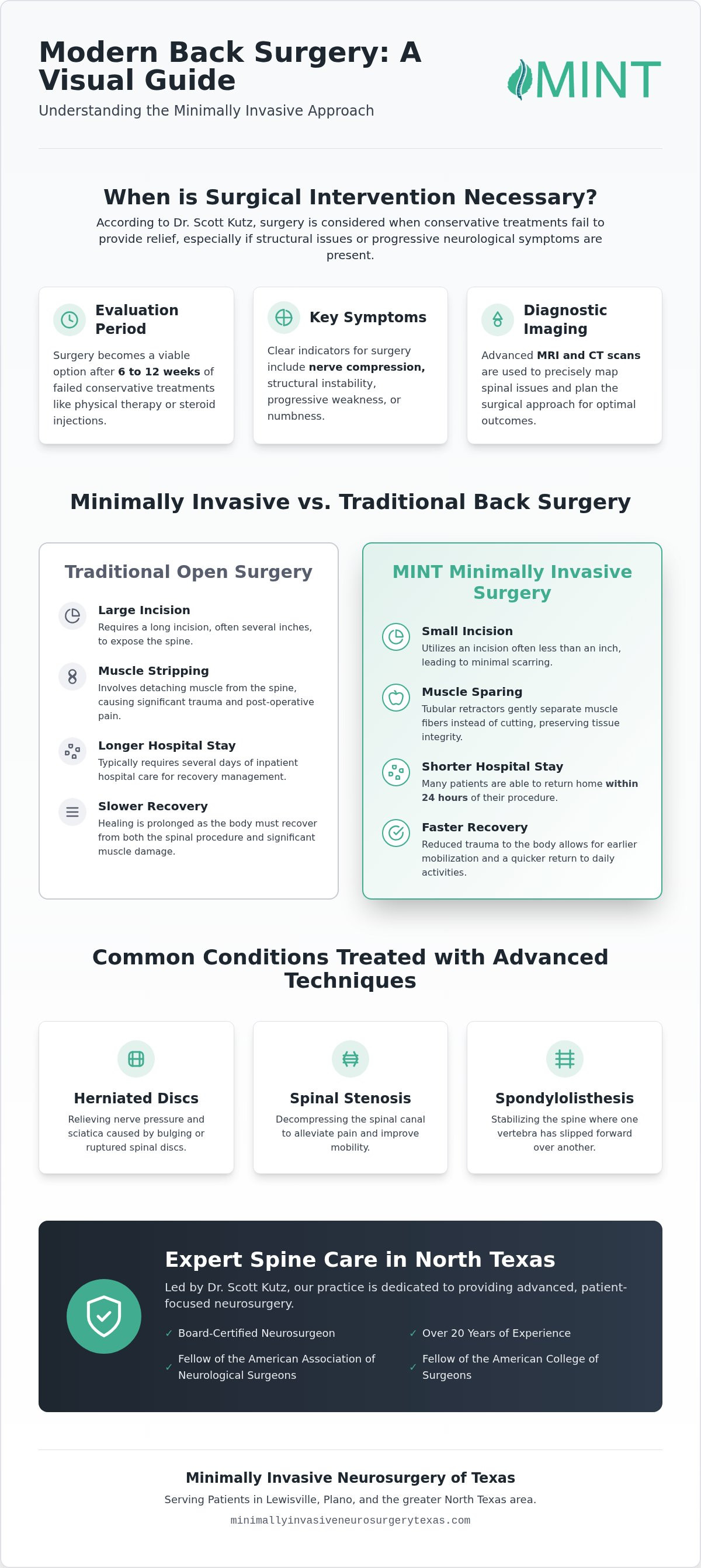
Minimally Invasive Neurosurgery of Texas (MINT) provides specialized back surgery in Lewisville and Plano under the leadership of Dr. Scott Kutz. Many patients wonder exactly when they should transition from conservative management to surgical intervention. Dr. Scott Kutz, a board-certified neurosurgeon, Fellow of the American Association of Neurological Surgeons, and Fellow of the American College of Surgeons, explains that surgery becomes a viable option when treatments like physical therapy or steroid injections fail to provide relief after six to twelve weeks. While some general practitioners suggest waiting longer, Dr. Kutz emphasizes that persistent pain often indicates a structural issue that requires more than just rest.
Dr. Kutz identifies surgical candidates by looking for clear evidence of nerve compression or structural instability. He prioritizes early intervention in cases where progressive weakness or numbness appears. Waiting too long to address these symptoms can lead to permanent nerve damage. The field of Orthopedic surgery and neurosurgery has evolved to favor early, precise corrections over prolonged, ineffective conservative care. Our clinics in Lewisville and Plano focus on restoring your quality of life before chronic conditions cause irreversible physical decline.
Common Conditions Requiring Surgical Attention
Several specific spinal pathologies frequently necessitate the expertise available at MINT. Herniated discs are a primary concern, often causing sciatica, which is sharp pain that radiates down the leg. Another condition is spinal stenosis, where the narrowing of the spinal canal limits a patient’s walking distance and standing time. Dr. Kutz also treats spondylolisthesis, a condition where a vertebra slips forward over another. These structural failures often require minimally invasive spine surgery to stabilize the spine and decompress affected nerves effectively.
The Role of Diagnostic Imaging in Surgical Planning
Dr. Kutz utilizes advanced MRI and CT scans to map the precise location of spinal issues. This diagnostic phase is critical for determining if a patient is a candidate for motion-preserving procedures. Precise planning at our Lewisville headquarters, which serves as our primary hub in 2026, allows Dr. Kutz to visualize the spinal anatomy before the procedure begins. This foresight ensures smaller incisions and better clinical outcomes. By using imaging to guide the surgical path, Dr. Kutz avoids unnecessary disruption to surrounding tissues, facilitating a much faster recovery for patients in the North Texas region.
Minimally Invasive vs. Traditional Back Surgery
Traditional back surgery often requires a large incision, sometimes measuring several inches in length. This “open” approach necessitates muscle stripping, where the surgeon must detach soft tissue from the spine to gain visibility. This process causes significant trauma to the surrounding area and leads to intense post-operative pain. Dr. Scott Kutz, a board-certified neurosurgeon and Fellow of the American Association of Neurological Surgeons, prioritizes minimally invasive techniques to avoid this unnecessary damage. By using tubular retractors, he creates a narrow corridor to the spine without tearing the muscle fibers. This precision-guided path allows for a much cleaner procedure with significantly less blood loss compared to traditional methods.
The difference in recovery is often stark. Traditional surgery requires the body to heal both the spinal correction and the damaged muscle tissue. In contrast, the muscle-sparing approaches used at MINT allow patients in Lewisville and Plano to begin their recovery from a much stronger baseline. Deciding when back surgery is a good idea depends on your specific diagnosis and how much the condition impacts your daily life. Dr. Kutz, who is also a Fellow of the American College of Surgeons, uses his 20 years of experience to ensure every patient understands the technical advantages of a smaller, more focused intervention.
The Benefits of Smaller Incisions
Smaller incisions offer more than just a better cosmetic result. They significantly reduce the risk of infection because less internal tissue is exposed to the environment. The skin and underlying soft tissues heal much faster because their blood supply remains intact. For many patients, the scar is no larger than a postage stamp, which reflects the high-tech nature of modern neurosurgery. This approach ensures you spend less time in the hospital and more time returning to your normal activities.
Technological Integration in Modern Surgery
Dr. Kutz integrates the Globus Excelsius GPS system to bring robotic-assisted precision to every operation. This system provides a sub-millimeter level of accuracy that traditional hand-guided surgery cannot match. He also utilizes Augmedics AR technology, which functions like an x-ray vision headset. This allows Dr. Kutz to see the 3D spinal structure directly through the patient’s anatomy in real-time. These proprietary technological systems act as a hallmark of our practice, ensuring that patients in the North Texas region receive the most advanced care available. If you’re ready to explore these options, you can request a consultation at our Lewisville or Plano offices today.
Advanced Surgical Options: Motion Preservation and Decompression
Dr. Scott Kutz, a board-certified neurosurgeon, Fellow of the American Association of Neurological Surgeons, and Fellow of the American College of Surgeons, specializes in advanced motion-preserving techniques. While traditional methods often rely on stabilizing the spine by stopping movement, modern back surgery at MINT focuses on maintaining your natural range of motion. Dr. Kutz frequently performs Artificial Disc Replacement as a sophisticated alternative to fusion. This procedure involves removing a damaged spinal disc and replacing it with a prosthetic device that mimics the function of a healthy joint. By choosing Minimally Invasive Spine Surgery, patients in Lewisville and Plano benefit from a precision-guided approach that preserves the integrity of the spinal column.
Another hallmark of our practice is endoscopic spine surgery. This technique allows Dr. Kutz to treat herniated discs through an incision smaller than a fingernail. He uses an endoscope, which is a thin tube with a camera and light, to visualize the spinal canal with extreme clarity. This high-tech decompression method removes pressure from the nerves while leaving the majority of the spinal structure untouched. These specialized methodologies ensure that patients experience less physical impact during the procedure and a much smoother transition back to their daily lives.
Artificial Disc Replacement vs. Spinal Fusion
Spinal fusion has long served as the standard for treating instability; however, it permanently joins two or more vertebrae together. This lack of movement often leads to adjacent segment disease, a condition where the discs above and below the fusion site wear out faster due to increased stress. Dr. Kutz evaluates each patient at our Plano office to determine if they are a candidate for disc replacement. Maintaining flexibility is essential for active patients who wish to return to sports or demanding daily activities without the restrictions of a fused spine.
Correcting Failed Back Surgery Syndrome
Many patients come to MINT after a previous surgery failed to resolve their symptoms. This condition, known as Failed Back Surgery Syndrome, affects a significant number of individuals who underwent traditional open procedures elsewhere. Dr. Scott Kutz uses advanced neurosurgical techniques to address underlying issues like scar tissue or missed disc fragments. At our Lewisville headquarters, we develop personalized revision plans that utilize robotic navigation to correct these complex problems. We provide a sense of optimism for those who thought their pain was permanent, guiding them toward a successful clinical outcome through specialized, boutique surgical care.
For individuals who have suffered from neurological complications that extend beyond surgical outcomes, such as birth-related or traumatic brain injuries, you can discover The Dedric Brown Law Firm to find specialized legal support.
Recovery Timeline and Post-Operative Expectations
Modern medical advancements have transformed the recovery process for back surgery, shifting the focus from prolonged bed rest to active healing. In 2024, industry data showed that 41% of spine procedures were performed in outpatient settings. This trend continues in 2026 at MINT, where Dr. Scott Kutz, a board-certified neurosurgeon, Fellow of the American Association of Neurological Surgeons, and Fellow of the American College of Surgeons, utilizes techniques that allow most patients to return home the same day or within 24 hours. Dr. Kutz emphasizes early mobilization, which means getting patients on their feet shortly after the procedure. This proactive approach helps prevent blood clots and reduces post-operative stiffness, leading to a more comfortable transition back to daily life.
Safe recovery also depends on effective pain management. MINT prioritizes non-opioid options to manage discomfort, focusing on medications and methods that minimize the risk of dependency. By reducing the physical trauma to the muscles during the operation, Dr. Kutz ensures that the pain you experience is manageable and temporary. Our clinical team provides a supportive environment where your comfort and safety remain the top priorities. You can read more about our patient-centered approach on our about us page.
The First Week After Surgery
The initial seven days after your procedure focus on gentle movement and protecting the surgical site. Dr. Kutz instructs patients to engage in light walking around their homes to maintain healthy circulation. You must avoid heavy lifting of anything over ten pounds during this period to ensure the spinal tissues heal correctly. The MINT clinical team provides comprehensive wound care instructions to prevent infection and promote skin healing. Patients in Plano receive a follow-up call within the first 48 hours to ensure their recovery remains on track and to answer any immediate questions about their progress.
Long-Term Outcomes and Physical Activity
As the weeks progress, the focus shifts toward restoring strength and flexibility. Most patients report a significant reduction in their pre-operative pain within the first month. Between six and twelve weeks, you can typically expect a full return to more strenuous activities. Dr. Kutz recommends a gradual reintroduction of stretching and core strengthening exercises to stabilize the spine. These exercises are vital for protecting the surgical site and preventing future issues. Dr. Kutz monitors your recovery through scheduled visits at our Lewisville headquarters, where he evaluates your mobility and clinical progress. If you want to experience a faster recovery and return to your favorite activities, schedule your consultation with our team today.
Expert Spine Care at Minimally Invasive Neurosurgery of Texas
Minimally Invasive Neurosurgery of Texas (MINT) represents the intersection of high-tech innovation and local accessibility. Dr. Scott Kutz, a board-certified neurosurgeon, brings over 20 years of clinical experience to the Dallas-Fort Worth metroplex. Unlike large, impersonal hospital networks, MINT operates as a boutique surgical center. This specialized structure allows Dr. Kutz to provide personalized care for every patient requiring back surgery in Lewisville or Plano. By focusing exclusively on spinal health and advanced neurosurgical techniques, our team ensures that you receive the attention and precision necessary for a successful outcome. We treat your health as our top priority, moving you from a state of concern to a state of informed confidence.
What makes Dr. Scott Kutz a specialist in minimally invasive spine surgery?
Dr. Scott Kutz is a board-certified neurosurgeon with over 20 years of experience who specializes in motion-preserving techniques at MINT in Lewisville and Plano. He holds fellowships in the American Association of Neurological Surgeons and the American College of Surgeons, which certify his expertise in complex spinal disorders. Dr. Kutz utilizes advanced robotic navigation and endoscopic tools to perform procedures through small incisions. This approach allows patients to recover faster and experience less post-operative pain than with traditional open methods.
Why Choose Dr. Scott Kutz in Lewisville and Plano?
Dr. Kutz holds prestigious designations as a Fellow of the American Association of Neurological Surgeons (FAANS) and a Fellow of the American College of Surgeons (FACS). These credentials reflect a career dedicated to professional excellence and certified authority. He possesses extensive training in functional neurosurgery and the management of complex spinal disorders. His approach prioritizes patient-first communication; he ensures you understand every step of your diagnostic journey. Dr. Kutz relies on evidence-based care to recommend the most effective, least invasive path to recovery. His role as a high-tech healer ensures that patients benefit from the latest robotic navigation systems while receiving the warmth of a dedicated local physician.
Scheduling Your Consultation at MINT
Our practice offers two convenient locations to serve the growing North Texas population. Our Lewisville headquarters, opened in 2026, serves as the primary hub for comprehensive diagnostic evaluations and advanced procedures. This location is ideally situated for residents in Flower Mound, Southlake, and Denton. Our satellite office in Plano provides easy access for patients living in Frisco, Allen, and McKinney. This regional focus avoids the coldness of a large hospital system, projecting instead an image of specialized care that prioritizes personal attention. You can visit our Testimonials page to hear from local patients who have successfully returned to their normal activities after treatment. We invite you to begin your narrative arc of recovery by contacting our staff to schedule your initial evaluation.
Restore Your Mobility and Quality of Life
Choosing the right path for your spinal health doesn’t have to be a source of anxiety. Modern back surgery at MINT focuses on precision and patient comfort through the use of state-of-the-art robotic navigation and AR technology. By prioritizing motion-preserving techniques like artificial disc replacement, Dr. Scott Kutz helps you maintain flexibility while resolving chronic pain. You don’t have to settle for long hospital stays or significant muscle trauma. Our specialized methodologies ensure that your recovery remains the top priority from the moment you enter our clinic.
Dr. Scott Kutz is a board-certified neurosurgeon, Fellow of the American Association of Neurological Surgeons, and Fellow of the American College of Surgeons with over 20 years of experience. He provides the clinical authority you need to feel confident in your healthcare journey. Whether you visit our Lewisville headquarters or our Plano office, you receive a personalized treatment plan designed to accelerate your healing. It’s time to move toward a successful clinical outcome. Schedule your consultation with Dr. Scott Kutz at MINT today and take the first step toward a return to your normal activity. We are ready to help you rediscover a life without the burden of persistent spinal pain.
Frequently Asked Questions
Is back surgery a last resort for chronic pain?
Dr. Scott Kutz typically recommends surgery when conservative treatments like physical therapy or injections fail to provide relief after six to twelve weeks. He views back surgery as a precise solution for structural issues that non-operative care cannot fix. If you experience progressive weakness or loss of bowel control, surgery may become an urgent priority rather than a final option. Early intervention often prevents permanent nerve damage.
How long does a minimally invasive back procedure take?
Most minimally invasive spine procedures take between one and three hours to complete. The exact duration depends on the complexity of the spinal condition and the specific technique Dr. Scott Kutz selects. He utilizes advanced robotic navigation to streamline the process and enhance precision. Because these methods involve smaller incisions, the overall time spent in the operating room is often shorter than traditional open surgeries.
Will I need physical therapy after my surgery?
Most patients benefit from a structured physical therapy program to optimize their recovery and restore full mobility. While Dr. Kutz emphasizes early mobilization, professional guidance helps you safely reintroduce stretching and core strengthening exercises. This rehabilitation phase typically begins a few weeks after the procedure. It ensures that the muscles supporting your spine remain strong and flexible as you return to your normal daily activities.
What are the risks associated with minimally invasive spine surgery?
Minimally invasive techniques carry lower risks than traditional open procedures; however, potential complications include infection, bleeding, or nerve irritation. Dr. Scott Kutz uses real-time imaging and robotic guidance to minimize these possibilities. While no back surgery is entirely without risk, the smaller incisions and reduced tissue disruption significantly decrease the likelihood of post-operative complications and hospital-acquired infections compared to open methods.
Can Dr. Scott Kutz perform surgery if I have had a previous fusion?
Dr. Scott Kutz frequently treats patients who require revision surgery or treatment for adjacent segment disease following a previous fusion. Advanced neurosurgical techniques allow him to address new issues that develop above or below the original surgical site. At our Lewisville and Plano offices, we use specialized diagnostic tools to determine if a minimally invasive approach can resolve the pain caused by a previous traditional operation.
Do I need a referral to see a neurosurgeon in Lewisville or Plano?
You don’t always need a formal referral to schedule an initial consultation at our Lewisville or Plano locations. While some insurance plans require a primary care physician to authorize a specialist visit, many patients contact MINT directly for an evaluation. Our administrative team helps you verify your insurance coverage and determine the necessary steps to see Dr. Scott Kutz for your specific spinal health needs.
How soon can I return to work after a microdiscectomy?
Most patients can return to sedentary or desk-based work within one to two weeks following a microdiscectomy. If your job involves heavy lifting or significant physical exertion, you may need six weeks or more to recover fully. Dr. Kutz provides specific guidelines based on your healing progress and the physical demands of your occupation. We prioritize a safe, gradual return to work to prevent re-injury.
Does insurance typically cover artificial disc replacement?
Many major insurance providers cover artificial disc replacement when it is medically necessary and conservative treatments have failed. Because coverage policies vary, our office staff works closely with insurance companies to obtain the required pre-authorizations. Dr. Scott Kutz provides the clinical documentation needed to demonstrate the benefits of motion preservation for your specific condition. We help you understand your benefits before proceeding with any treatment.