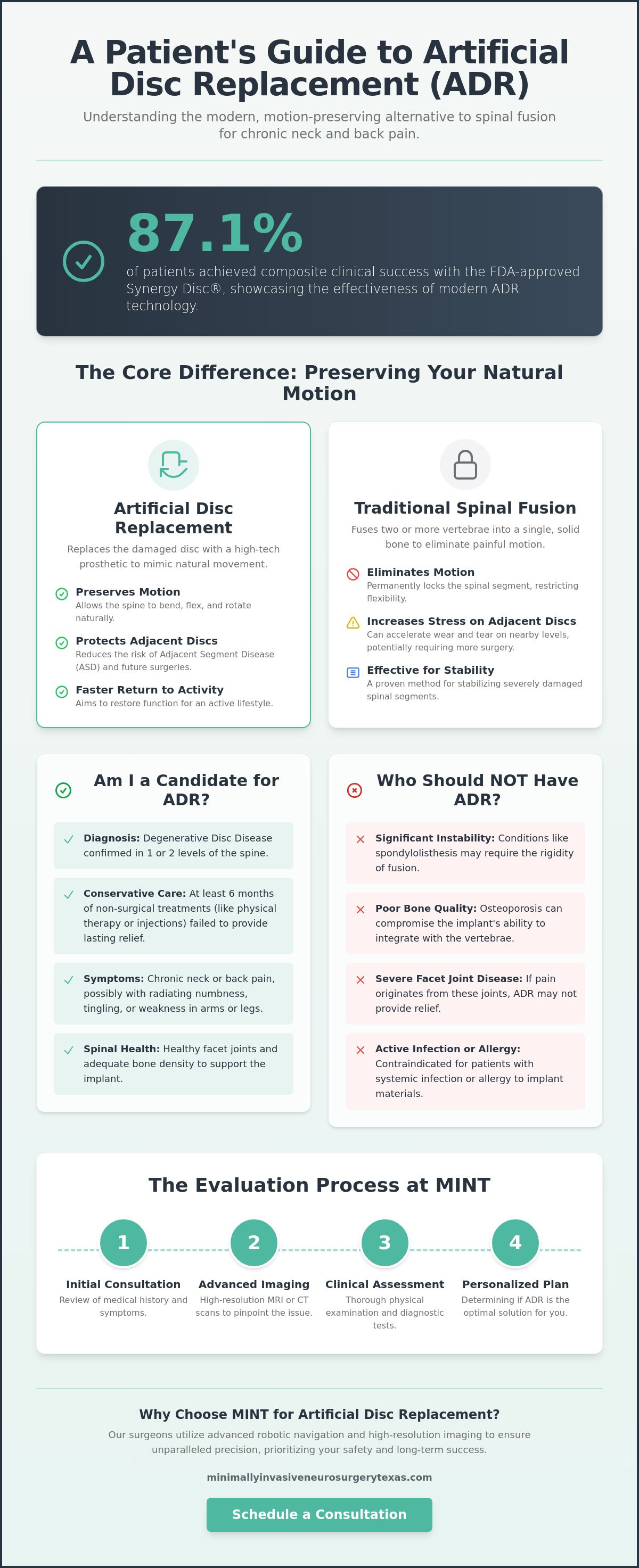
Recent clinical data shows that 87.1% of patients receiving the newly FDA-approved Synergy Disc® achieved composite clinical success, signaling a major shift in how we treat degenerative disc disease. If you’re struggling with chronic neck or back pain, you’re likely asking, “am I a candidate for artificial disc replacement?” while fearing the restrictive nature of a traditional spinal fusion. You don’t have to settle for a procedure that limits your mobility or increases the risk of Adjacent Segment Disease in the years to come.
It’s frustrating to feel that your active lifestyle in Plano or Lewisville is on hold because physical therapy and injections haven’t provided lasting relief. We understand that your goal isn’t just to stop the pain; it’s to reclaim the full range of motion that makes your daily life possible. This 2026 guide clarifies the specific medical criteria and bone health requirements necessary for this advanced motion-preserving technology. You’ll discover the local evaluation process we use to determine if you can bypass fusion for a more sophisticated, high-tech solution. We will examine the latest FDA-approved implants and the clinical milestones that define a successful recovery.
Key Takeaways
- Understand why artificial disc replacement is the modern, motion-preserving alternative to traditional spinal fusion for maintaining your natural range of motion.
- Determine “am I a candidate for artificial disc replacement” by reviewing the specific medical criteria, including bone density and the state of your facet joints.
- Learn why failing to find relief from at least six months of conservative treatments is a primary indicator that you may be ready for surgical intervention.
- Discover how advanced robotic navigation and high-resolution imaging at our Plano and Lewisville clinics ensure unparalleled precision during your procedure.
- Explore the long-term benefits of motion-preserving technology, including its role in preventing secondary surgeries like adjacent segment disease.
What is Artificial Disc Replacement (ADR) and How Does it Work?
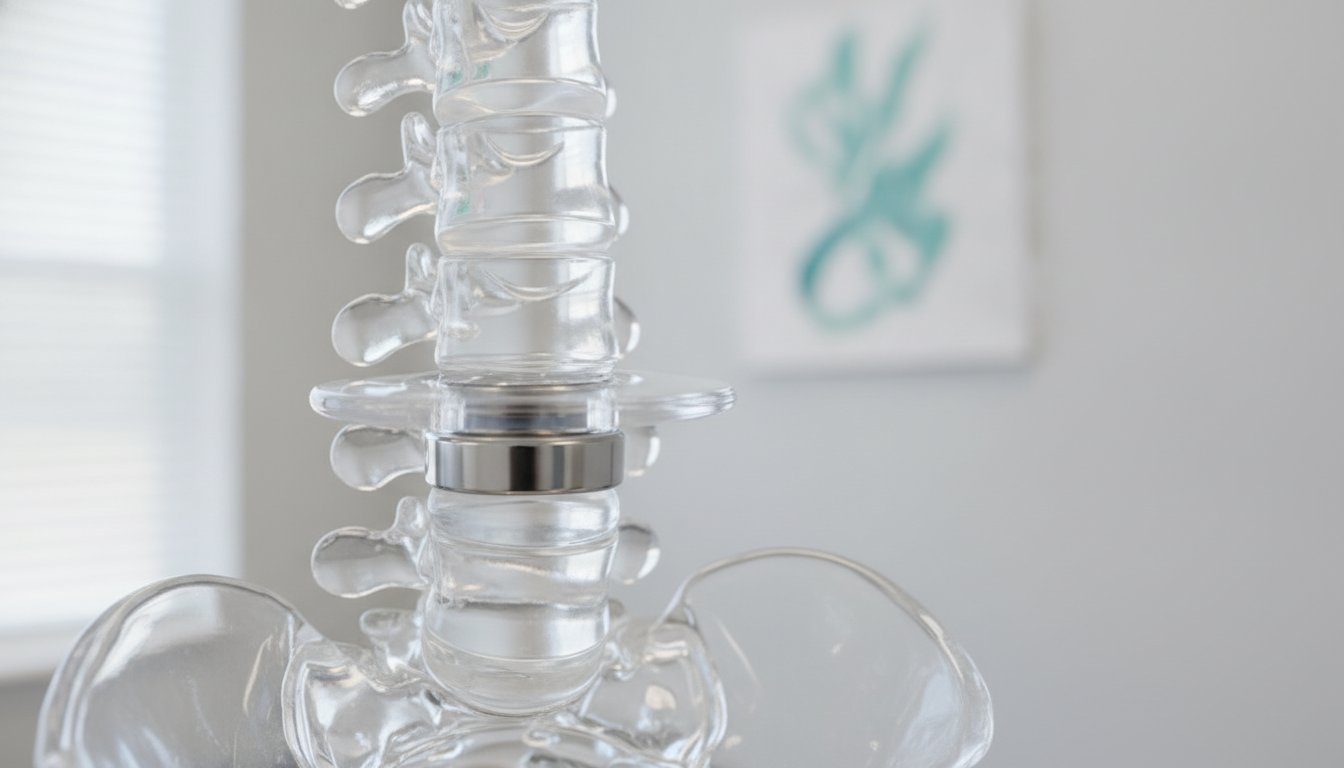
Artificial Disc Replacement, technically known as Total Disc Replacement, is a sophisticated, motion-preserving alternative to traditional spinal fusion. While fusion aims to stop pain by eliminating movement between vertebrae, ADR replaces a degenerated or painful disc with a high-tech prosthetic designed to move with you. These devices are typically engineered from medical-grade metals like titanium or cobalt-chrome and a specialized polymer core that mimics the natural cushion of a healthy disc. The primary objective is to restore disc height and spinal stability while allowing the vertebrae to bend and rotate naturally. This precision-engineered approach is a cornerstone of modern minimally invasive neurosurgery.
When you begin to wonder, “am I a candidate for artificial disc replacement,” you’re likely looking for a solution that addresses the root cause of your pain without the permanent stiffness associated with older surgical methods. This procedure doesn’t just remove the source of the agony; it restores the mechanical integrity of your spine using technology that has been refined over decades of clinical use.
ADR vs. Spinal Fusion: The Mobility Difference
Traditional spinal fusion works by locking two or more vertebrae together into a single, solid bone. While effective for stability, it permanently eliminates motion at that specific level. ADR takes the opposite approach by keeping the vertebrae moving independently. This preservation of motion is critical for preventing Adjacent Segment Disease (ASD). When one level of the spine is fused, the discs above and below are forced to compensate for the lost flexibility, often leading to accelerated wear and the need for secondary surgeries. For active individuals in Plano who want to return to sports or demanding careers, maintaining this natural biomechanical flow is a top priority. It’s about protecting the rest of your spine while fixing the immediate problem.
Cervical vs. Lumbar Disc Replacement
The application of ADR depends on where the disc degeneration occurs. Cervical ADR focuses on the seven vertebrae in the neck. It’s frequently recommended for patients experiencing radiating arm pain, weakness, or numbness caused by nerve compression. Lumbar ADR targets the lower back, specifically addressing chronic, localized discogenic pain that makes sitting or standing for long periods unbearable. Determining “am I a candidate for artificial disc replacement” in the lumbar spine involves a careful assessment of your specific pain patterns and bone quality. While both procedures utilize minimally invasive techniques, the surgical pathways differ. Cervical procedures typically involve a small incision in the front of the neck, often leading to a faster initial recovery. Lumbar procedures require a different specialized approach but offer the same promise of long-term relief and a return to normal activity.
The Ideal Candidate: Are You a Match for ADR?
Determining “am I a candidate for artificial disc replacement” involves more than just identifying the source of your pain. It’s a precise clinical calculation of your spine’s structural integrity and long-term health. The primary diagnosis we look for is Degenerative Disc Disease (DDD) localized to one or two levels of the spine. Unlike spinal fusion, which can sometimes address more extensive instability, ADR is most effective when the surrounding spinal architecture is still robust and capable of supporting motion.
Clinical necessity for this procedure is often defined by your history of conservative care. Most insurance providers and surgical protocols require at least six months of documented non-surgical treatment without significant improvement. This isn’t a passive waiting period. It’s a rigorous attempt to heal through specialized methods. If you’ve reached this six-month milestone without relief, your diagnostic journey may lead to a motion-preserving surgical solution.
Symptoms That Signal You Might Be a Candidate
Chronic neck or back pain that intensifies during prolonged sitting or specific movements is a hallmark of disc-related issues. You might also experience radiculopathy, which manifests as numbness, tingling, or weakness that travels into your arms or legs. These symptoms often indicate that a degenerated disc is compressing vital neural structures. If you’ve already completed the following without success, you’re likely ready for a specialized surgical consultation:
- Structured physical therapy focusing on spinal stabilization.
- Epidural steroid injections or selective nerve root blocks.
- Consistent use of prescription anti-inflammatory medications.
Age and Lifestyle Considerations
While the typical age range for artificial disc replacement is 18 to 60, biological health often outweighs chronological age. We prioritize patients with excellent bone density. The medical-grade metal of the prosthetic needs a strong, healthy foundation to integrate securely. If osteoporosis has weakened your vertebrae, the implant may not remain stable over time. Additionally, your lifestyle choices significantly impact your recovery. Being a non-smoker is a critical requirement. Nicotine constricts blood vessels and severely impairs the body’s ability to bond with the implant and heal the surrounding tissues.
Athletes and high-performance professionals in North Texas frequently seek out ADR because it preserves the natural biomechanics of the spine. This allows for a more fluid return to demanding physical activities compared to the rigid nature of a fusion. If you’re ready to see if your diagnostic profile matches this high-tech approach, you can schedule an evaluation with our specialized team to review your imaging and medical history.
Facet Joint Health and Spinal Stability
Another vital factor in determining “am I a candidate for artificial disc replacement” is the health of your facet joints. These are the small joints at the back of your spine that facilitate movement. If these joints show signs of advanced arthritis or significant disease, ADR may not be the right choice. The prosthetic is designed to move, and if the “hinges” of your spine are already damaged, that movement could cause further pain. We also look for signs of spinal instability, such as spondylolisthesis, which might require the rigid support of a fusion instead of the flexibility of a replacement.
Red Flags: Who Should NOT Have Artificial Disc Replacement?
While motion-preserving technology represents a pinnacle of modern neurosurgery, it’s not a universal solution for every patient. When asking, “am I a candidate for artificial disc replacement,” it’s vital to identify specific medical red flags that might compromise your safety or the implant’s longevity. Clinical excellence requires us to be as selective about when not to operate as we are about the procedures we perform. If your spinal architecture has moved beyond a certain point of degeneration, the flexibility provided by an artificial disc could actually be counterproductive.
Bone health is a primary, non-negotiable factor. The medical-grade metal of the prosthetic, often a combination of titanium and cobalt-chrome, requires a dense, healthy vertebral foundation to anchor itself. If you have severe osteoporosis, your bone may not be strong enough to support the implant, leading to a risk of the device shifting or subsiding into the vertebrae. Additionally, active spinal infections or documented severe allergies to these specific implant materials are absolute contraindications. We also look for signs of significant spinal instability, such as high-grade spondylolisthesis. If your vertebrae are already slipping over one another, the spine requires the rigid, locking power of a fusion rather than the fluid movement of a replacement.
Understanding Facet Joint Integrity
The spine functions as a balanced mechanical unit where the disc in the front and the facet joints in the back work in tandem. For an artificial disc to function correctly, the back of the spinal joint must be healthy. If you have advanced facet joint disease or severe arthritis in these rear structures, moving the front of the spine will only increase the friction and pain in the back. Dr. Scott Kutz meticulously evaluates facet health during your diagnostic phase using high-resolution imaging. For patients where facet arthritis is the primary pain driver, we often recommend Minimally Invasive Spinal Fusion to provide the necessary stability and pain relief.
The Impact of Spinal Deformity
Significant structural deformities change the mechanical load on your entire skeletal system. If you have severe scoliosis or kyphosis, your spine is not aligned in a way that allows an artificial disc to balance your body weight effectively. In these cases, the prosthetic would likely wear out prematurely or fail to resolve your symptoms. Multi-level degeneration also changes the candidacy equation. While 2026 advancements like the Synergy Disc® have expanded our ability to treat single-level issues with high success, complex cases involving three or more degenerated discs often still require the structural correction that only fusion can provide. We prioritize your long-term outcome, ensuring that the technology we choose aligns perfectly with your specific spinal geometry.
The Evaluation Process at MINT in Plano & Lewisville
At MINT, we provide a localized North Texas diagnostic pathway that replaces generic advice with clinical precision. The question “am I a candidate for artificial disc replacement” is answered through a rigorous four-pillar evaluation designed to ensure your long-term success. This journey begins with a comprehensive review of your medical history and pain journey. We don’t just look at where it hurts; we analyze how your symptoms have evolved and which specific activities have become impossible. This clinical deep dive allows us to move beyond the surface and understand the unique biomechanics of your spine.
A physical assessment follows, where our team evaluates your neurological function and current range of motion. We test for muscle weakness, reflex changes, and sensory deficits that indicate nerve root compression. To ensure your vertebrae can support a high-tech prosthetic, we often require bone density testing via a DEXA scan. This is a critical safety step that many general practices overlook. By confirming your bone strength before surgery, we significantly reduce the risk of implant subsidence and ensure the device integrates perfectly with your natural anatomy.
Diagnostic Imaging: Seeing the Disc in Detail
High-resolution imaging is the cornerstone of an accurate Plano evaluation. We require imaging studies performed within the last six months to ensure we are viewing the current state of your spinal health. While an MRI is essential for visualizing soft tissues like spinal nerves and the discs themselves, we may also utilize CT scans to get a clearer picture of your bony architecture. A vital component of our process is the use of “flexion-extension” X-rays. These standing images capture your spine in motion, allowing us to detect hidden instabilities that aren’t visible when you’re lying flat in an MRI machine. This level of detail is necessary to confirm that ADR is the safest path forward for your specific condition.
What to Expect During Your MINT Consultation
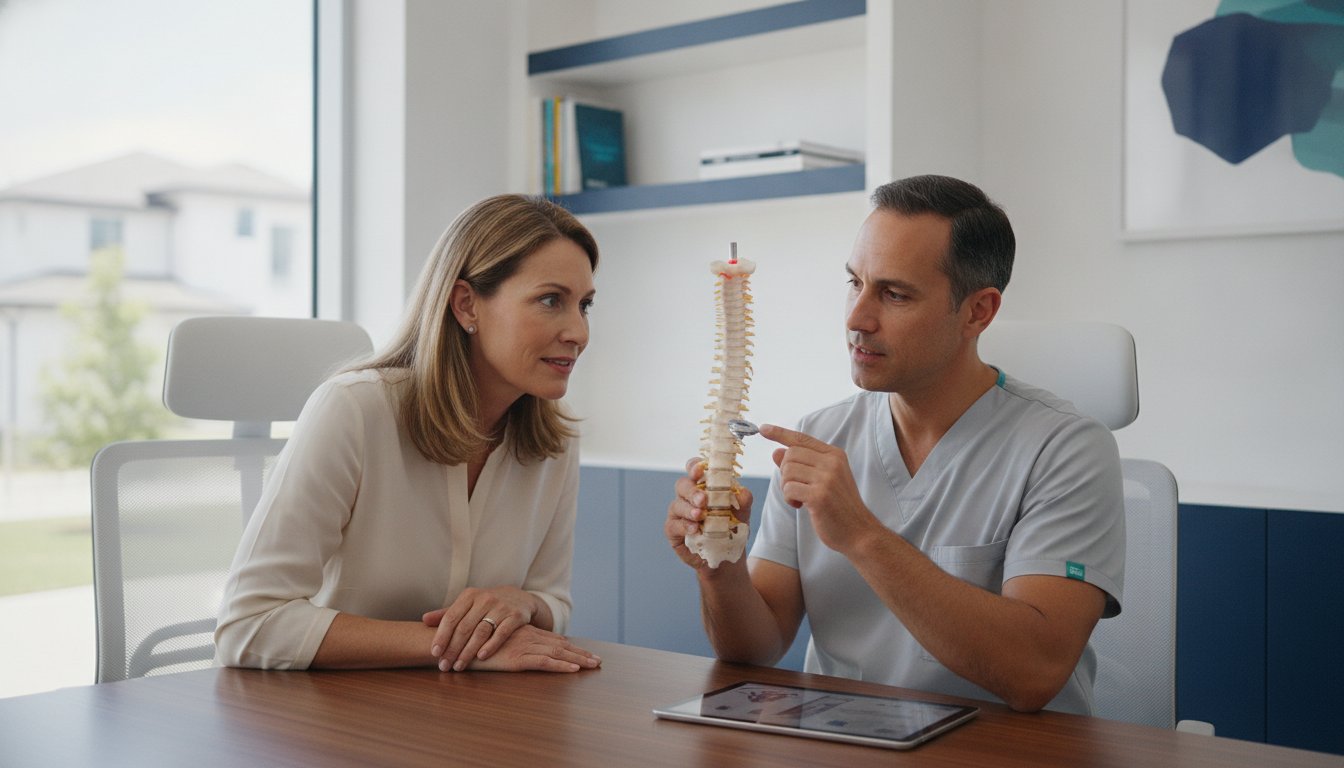
During your consultation, you’ll meet with Dr. Scott Kutz to discuss your motion-preservation goals. This is a collaborative session where we review your previous failed conservative treatments, such as physical therapy or injections, to build a robust case for insurance approval. We then develop a customized surgical plan using minimally invasive neurosurgery techniques. These methods are designed to minimize tissue disruption and accelerate your timeline for a return to normal activity. To begin your diagnostic journey in Plano or Lewisville, schedule your diagnostic evaluation with our specialized team today.
Why Choose MINT for Artificial Disc Replacement in North Texas?
Selecting the right surgical partner is the most critical step in your journey toward motion preservation. At MINT, we combine world-class technical expertise with a boutique, patient-centered approach that larger hospital systems often lack. Dr. Scott Kutz is a board-certified neurosurgeon who has spent years specializing in the nuances of artificial disc replacement. His clinical authority ensures that when you ask, “am I a candidate for artificial disc replacement,” you receive an answer grounded in deep specialization and verified clinical outcomes. We don’t just perform surgery; we engineer a path back to your active lifestyle using the most advanced tools available in modern medicine.
Our commitment to excellence is reflected in our investment in high-tech surgical infrastructure. By focusing exclusively on minimally invasive neurosurgery, we provide a level of precision that reduces tissue trauma and accelerates the healing process. Patients in Plano, Lewisville, and the greater North Texas area choose MINT because we bridge the gap between complex robotic technology and compassionate, local care. We prioritize your long-term spinal health, ensuring that every intervention is designed to prevent future complications like adjacent segment disease.
Robotic Precision with Globus Excelsius
The success of a motion-preserving implant depends entirely on the accuracy of its placement. MINT utilizes the Globus Excelsius robotic navigation system to achieve unparalleled precision during every procedure. This high-tech hallmark allows Dr. Kutz to map your spinal anatomy in three dimensions before the first incision is made. Robotic-assisted navigation eliminates the margin for human error, ensuring that the prosthetic is aligned perfectly with your natural biomechanics. This perfect alignment is the primary factor in long-term joint survival. When an implant is positioned with sub-millimeter accuracy, it functions more naturally and experiences less wear over time. We invest in this proprietary technology because our patients deserve the absolute forefront of surgical innovation.
A Patient-Centered Recovery Philosophy
Our clinical philosophy is built on the ultimate value proposition: a return to normal activity. We recognize that chronic pain has likely sidelined you from the hobbies and professional responsibilities that define your life. Our post-operative care and pain management protocols are designed to move you through the recovery phase with confidence and clarity. We provide a logical, results-oriented rhythm of care that starts at our conveniently located clinics in Plano and Lewisville and continues until you’ve reached your mobility goals. If you’re ready to stop managing pain and start reclaiming your range of motion, schedule your ADR evaluation at MINT today.
Reclaiming Your Mobility in 2026
The decision to choose motion preservation over traditional fusion is a pivotal moment in your spinal health journey. You now understand that determining am I a candidate for artificial disc replacement requires a sophisticated analysis of your bone density, joint health, and long-term lifestyle goals. By prioritizing advanced technology like the Globus Excelsius robotic navigation system, we ensure that your path to recovery is defined by surgical precision and clinical excellence. This high-tech approach is designed to protect your natural biomechanics and prevent the complications often associated with more invasive methods.
If you’re ready to move beyond the limitations of chronic pain, our specialized team is here to guide your diagnostic journey. Board-certified neurosurgeon Dr. Scott Kutz provides the expert authority and personal attention necessary to navigate these complex surgical choices. We are proud to serve the Plano, Lewisville, and greater DFW communities with a boutique care model that prioritizes your unique recovery timeline. Your return to normal activity is our ultimate objective.
Take the First Step: Book Your Artificial Disc Replacement Consultation
Reclaiming your life without the restrictions of spinal pain is possible. We look forward to providing the clarity and care you need to move forward with confidence.
Frequently Asked Questions
Is artificial disc replacement better than spinal fusion?
Artificial disc replacement is often superior for patients who prioritize maintaining their natural range of motion and want to minimize the risk of Adjacent Segment Disease. While spinal fusion is highly effective for addressing severe instability, it permanently locks the vertebrae together. ADR preserves the biomechanical flow of the spine, allowing for a more fluid return to normal activity without putting excessive stress on the surrounding discs.
How long does an artificial disc implant last?
Modern prosthetics are engineered for extreme durability, with many designs intended to last for 40 to 50 years. Laboratory wear testing and long-term clinical studies indicate that medical-grade metals and specialized polymers can withstand decades of daily movement. Most patients will never require a revision surgery, provided the initial implant placement was precise and their underlying bone health remains stable throughout their life.
What is the recovery time for artificial disc replacement?
Most patients return to light daily activities and office work within two to four weeks. Because we utilize minimally invasive techniques, the initial healing phase is typically faster than traditional open surgeries. You can generally expect to resume more demanding physical activities and high-impact sports between three and six months post-op, once the implant has fully integrated with your vertebral bone.
Does insurance cover artificial disc replacement in 2026?
Yes, major insurance providers, including Medicare and UnitedHealthcare, currently provide coverage for total artificial disc replacement when specific medical necessity criteria are met. New policies effective in early 2026 have clarified these requirements, making the procedure more accessible. When determining “am I a candidate for artificial disc replacement,” our team helps document your failed conservative treatments to streamline the prior authorization process with your carrier.
Can I have disc replacement at multiple levels of my spine?
Multi-level ADR is now a viable option for many patients thanks to recent technological advancements. In late 2025, the FDA approved devices like the prodisc® C Vivo and prodisc® C SK for two-level cervical procedures. While single-level disease is the most common indication, we can evaluate your specific spinal alignment to see if a multi-level motion-preservation strategy is appropriate for your condition.
What are the risks associated with ADR surgery?
Standard surgical risks include infection, blood loss, or adverse reactions to anesthesia. Specific to ADR, there is a minor risk of implant migration or subsidence if the bone foundation is weak. We mitigate these risks by using advanced robotic navigation to ensure sub-millimeter precision. This high-tech approach ensures the device is perfectly centered, which is vital for the long-term success and stability of the prosthetic.
Will I be able to return to sports after disc replacement?
Reclaiming an active lifestyle is one of the primary benefits of this procedure. Many patients successfully return to golf, tennis, swimming, and cycling once their recovery is complete. Because ADR mimics natural spinal movement, you don’t face the same mechanical restrictions as patients with fused vertebrae. We will provide a customized physical therapy plan to help you safely transition back to your favorite sports.
How do I know if my bone density is high enough for ADR?
We assess your structural foundation using a DEXA scan, which is the gold standard for measuring bone mineral density. This test is a critical component in answering “am I a candidate for artificial disc replacement” because the vertebrae must be robust enough to support the metal implant. If the scan shows significant bone thinning or osteoporosis, we may recommend alternative stabilization methods to ensure your safety.