Minimally Invasive Neurosurgery of Texas, led by board-certified neurosurgeon Dr. Scott Kutz (AANS and ACS Fellow), provides advanced options for getting a second opinion for spinal stenosis Lewisville and Plano, TX. The practice specializes in minimally invasive spine surgery (MISS) and endoscopic techniques to help patients avoid traditional open surgery and return to normal activity faster.
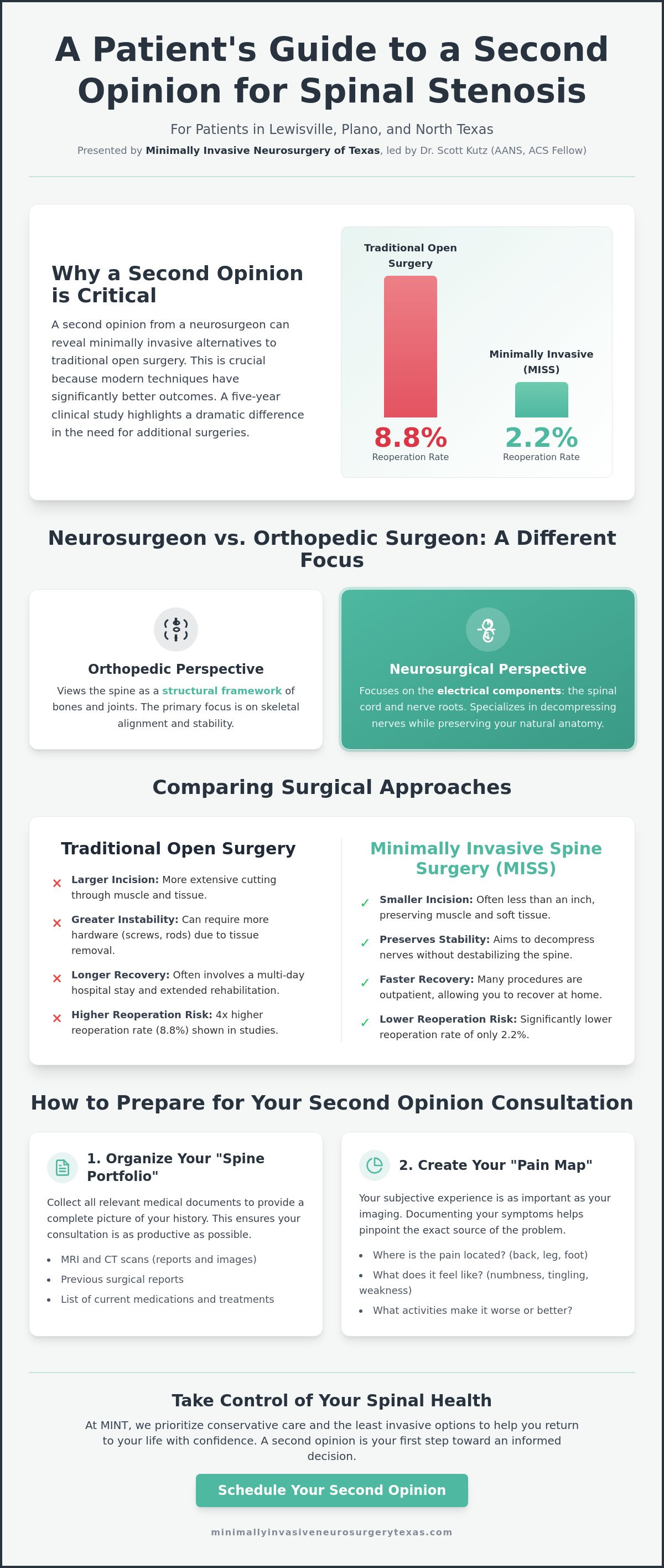
A five year study reveals that the reoperation rate for minimally invasive transforaminal lumbar interbody fusion (MIS-TLIF) is a mere 2.2 percent, compared to 8.8 percent for traditional open surgery. If you struggle with chronic leg pain or the heavy burden of back pain, these statistics represent your future mobility. You likely feel that invasive surgery is your only option, but modern advancements have changed the diagnostic landscape. This guide promises to show you how a specialized second opinion at Minimally Invasive Neurosurgery of Texas can help you discover minimally invasive spine surgery alternatives. We will preview 2026 Medicare updates and the specific MISS techniques that offer a confident path to recovery.
Key Takeaways
- Learn how a neurosurgical review of your imaging can reveal alternatives to major surgery that general orthopedic assessments might overlook.
- Discover the essential steps for getting a second opinion for spinal stenosis Lewisville to ensure your diagnosis accurately reflects the cause of your leg and back pain.
- Compare traditional open laminectomy with advanced minimally invasive decompression techniques that prioritize spinal stability and faster recovery.
- Find out how to organize your “Spine Portfolio” and “Pain Map” to maximize the clinical value of your consultation with Dr. Scott Kutz.
- Understand the MINT philosophy of prioritizing conservative care and minimally invasive options to help you return to normal activity with confidence.
Why Seeking a Second Opinion for Spinal Stenosis in Lewisville is a Critical Step
A second opinion for spinal stenosis is not just a repeat of your first visit. It is a rigorous, top-down audit of your imaging, such as MRI and CT scans, performed by a board-certified specialist like Dr. Scott Kutz at Minimally Invasive Neurosurgery of Texas. For patients in North Texas, getting a second opinion for spinal stenosis Lewisville ensures that your treatment plan aligns with the most current 2026 clinical standards. Many patients initially consult general orthopedic surgeons for back issues. However, a neurosurgical review offers a higher level of precision regarding the delicate nerves within the spinal canal.
Seeking this additional input provides essential peace of mind. It reduces the psychological weight of deciding on surgery. In 2026, patients are more empowered to question traditional open surgical recommendations. With CMS phasing out the Inpatient Only list, more procedures now occur in specialized outpatient settings. This shift highlights the importance of choosing a surgeon who utilizes advanced, localized techniques rather than outdated, highly invasive methods. Patients in Lewisville and Plano deserve access to the most modern care available.
The Difference Between an Orthopedic and Neurosurgical Perspective
While both specialties treat the back, their focus differs significantly. An orthopedic surgeon often looks at the spine as a structural framework of bones and joints. A neurosurgeon focuses on the electrical components: the spinal cord and nerve roots. Spinal Stenosis specifically involves the narrowing of the spaces where these nerves live. Dr. Kutz, an AANS and ACS Fellow, specializes in nerve decompression. This approach aims to relieve pressure on the nerves while preserving as much of your natural anatomy as possible. At MINT, we use minimally invasive spine surgery to achieve these goals. These techniques result in smaller incisions and less tissue disruption than traditional methods. Research supports this approach; a five year study showed a 2.2 percent reoperation rate for minimally invasive transforaminal lumbar interbody fusion compared to an 8.8 percent rate for open surgery.
Overcoming the Fear of “Offending” Your Current Doctor
Some patients hesitate to seek another perspective because they don’t want to seem disrespectful. In reality, second opinions are a standard part of modern healthcare. Most professional surgeons encourage them because they want you to feel certain about your path to recovery. You can simply tell your current provider, “I’d like to explore all available minimally invasive options before moving forward.” This request is professional. It focuses on your desire for the best clinical outcome. A confident surgeon will support your choice to be fully informed. This transparency builds trust and ensures you are the primary driver of your healthcare journey.
Understanding Spinal Stenosis: Why One Diagnosis Isn’t Always the Full Story
Spinal stenosis is a structural narrowing of the spinal canal that compresses delicate nerve roots. This pressure causes symptoms like numbness, tingling, and neurogenic claudication, which is leg pain that worsens with walking. These symptoms are notoriously intermittent. You might feel fine while sitting but experience significant pain after walking just one block. This variability often leads to confusion during the initial diagnosis. getting a second opinion for spinal stenosis Lewisville is essential because an MRI alone does not always tell the full story. A picture of a narrow canal doesn’t always mean that specific area causes your pain.
A second opinion also protects you from the risk of Failed Back Surgery Syndrome. This occurs when a procedure fails to achieve the desired outcome, often because the surgery addressed the wrong spinal level. By consulting with a board-certified neurosurgeon like Dr. Scott Kutz (AANS and ACS Fellow), you receive a more nuanced look at the Spinal Stenosis diagnosis and treatment options available to you. Dr. Kutz correlates your imaging with a physical exam to ensure any proposed intervention targets the true generator of your discomfort. While conservative care like physical therapy and epidural injections can manage mild cases, they sometimes only mask symptoms while the underlying condition progresses.
The “Copycat” Conditions: Is it Really Stenosis?
Leg pain doesn’t always originate in the spine. Conditions like Sacroiliac (SI) joint dysfunction or vascular issues can mimic the symptoms of stenosis. This leads some patients in Plano and McKinney to undergo unnecessary back surgery when the problem lies elsewhere. Minimally Invasive Neurosurgery of Texas uses diagnostic blocks to confirm the exact source of pain by temporarily numbing specific nerves or joints. A physical exam that matches your MRI findings is the only way to ensure a successful surgical outcome.
When a Second Opinion is Non-Negotiable
Certain situations demand a second look from a specialist. If your leg pain or weakness worsens despite months of dedicated physical therapy, your current plan isn’t working. You should also seek a second opinion if a surgeon recommends a multi-level fusion for what seems like a straightforward case of stenosis. Fusions are permanent and change your spinal mechanics. Finally, if you have had previous back surgery and your pain has returned, you need a specialist who understands complex revisions. If you find yourself in these categories, consider scheduling a consultation at MINT to explore more precise alternatives.
Comparing Surgical Approaches: Traditional Open Surgery vs. Minimally Invasive Techniques
Traditional open laminectomy requires a large incision and significant muscle stripping to access the spine. This process often disrupts the natural support structures and ligaments that keep your back stable. In contrast, getting a second opinion for spinal stenosis Lewisville allows you to explore minimally invasive decompression. This technique uses smaller incisions and specialized tools to reach the spinal canal without causing extensive tissue damage. When Comparing Surgical Approaches, the preservation of spinal stability is a primary concern. Traditional methods can sometimes destabilize the vertebrae, which may necessitate a future fusion surgery to restore balance. Minimally invasive methods focus on targeted relief, leaving the surrounding bone and muscle intact.
Recovery timelines differ drastically between these two methods. Patients undergoing traditional open surgery often face weeks of restricted activity and significant postoperative pain. Those choosing minimally invasive options at Minimally Invasive Neurosurgery of Texas frequently return to light Lewisville activities within days. Dr. Scott Kutz, an AANS and ACS Fellow, utilizes specialized tubular retractors that gently push muscle tissue aside rather than cutting through it. This “MINT Advantage” minimizes blood loss and reduces the risk of infection. It provides a smoother, faster path to recovery for patients in Dallas and Fort Worth who want to return to their daily routines quickly.
The Role of Endoscopic Spine Surgery
Endoscopic techniques represent the ultra-minimally invasive frontier of back care. This procedure involves a sub-centimeter incision and the use of a tiny camera to provide direct visualization of the compressed nerve. This level of precision allows Dr. Kutz to remove bone spurs or thickened ligaments with minimal impact on surrounding structures. You can learn more about how this technology is changing patient outcomes in our guide on Endoscopic Spine Surgery: The Future of Back Care.
Artificial Disc Replacement as an Alternative
For some patients, a second opinion reveals that motion-preserving Artificial Disc Replacement (ADR) is a viable alternative to spinal fusion. While fusion locks two vertebrae together, ADR maintains natural flexibility and reduces the stress on adjacent spinal levels. Dr. Kutz evaluates each patient to determine if they are a candidate for this advanced technology. Seeking a second opinion ensures you don’t receive a fusion recommendation when a motion-preserving option could provide a better long-term quality of life. This specialized evaluation is a cornerstone of the patient-centered care provided at MINT.
How to Prepare for Your Second Opinion Consultation in Lewisville
Preparation turns your consultation into a decisive step toward recovery. When getting a second opinion for spinal stenosis Lewisville, you must arrive with a complete “Spine Portfolio.” This collection includes your recent MRI discs, CT scans, and any previous operative reports if you have had prior back surgery. Providing these original images allows Dr. Scott Kutz to review the raw data himself rather than relying solely on a radiologist’s written report. You should also document a detailed “Pain Map.” Note the specific times of day your pain peaks and identify whether leaning forward or sitting down provides relief. This clinical detail helps distinguish stenosis from other conditions like vascular claudication.
Insurance logistics also require early attention. Many plans, including Medicare Part B, cover second opinions, but you should verify if your specific policy requires a referral or has out-of-network stipulations. In 2026, the new WISeR model for Medicare involves stricter prior authorization for certain spine procedures. A comprehensive second opinion from a board-certified neurosurgeon can provide the necessary clinical documentation to satisfy these requirements and avoid delays in your care. Set realistic expectations for your visit; the goal is to gain clarity and explore every available path to relief.
5 Essential Questions to Ask During Your Consultation
- Is there a minimally invasive or endoscopic alternative to the surgery I was offered?
- What is the risk of spinal instability if we perform this decompression?
- How many of these specific procedures do you perform annually?
- Ask the surgeon to explain the specific vertebrae numbers involved in your stenosis to ensure precise targeting.
Local Lewisville Logistics
If your current imaging is more than six months old, you may need updated scans. Lewisville and Plano offer several high-quality imaging centers that coordinate directly with our office. Seeing a local specialist like Dr. Kutz, an AANS and ACS Fellow, simplifies your journey. Local care means your post-operative follow-up appointments are just a short drive away in Lewisville. You will experience a “high-tech healer” environment where we use advanced diagnostic tools to confirm your path to recovery. If you are ready to organize your records and move toward a pain-free life, contact Minimally Invasive Neurosurgery of Texas to schedule your review.
Why MINT is the Premier Choice for Spinal Stenosis Second Opinions
Minimally Invasive Neurosurgery of Texas stands out as a specialized, boutique surgical center that prioritizes personal attention over the high volume of large hospital systems. When getting a second opinion for spinal stenosis Lewisville, you benefit from the direct expertise of Dr. Scott Kutz. As a board-certified neurosurgeon and an AANS and ACS Fellow, Dr. Kutz brings a high level of clinical authority to every diagnostic review. Our practice focuses on the relief of suffering through a logical, tiered philosophy. We prioritize conservative care first, explore minimally invasive options second, and only consider traditional surgery as a final resort. This results-oriented approach ensures that you never undergo a procedure that is more invasive than necessary for your specific condition.
Our commitment to the Lewisville and Plano communities drives us to maintain the highest standards of professional excellence. We understand that chronic physical conditions create a state of concern for patients and their families. By positioning our practice as a source of optimism, we move you from a state of uncertainty to one of informed confidence. We provide the specialized care you need right here in North Texas, avoiding the coldness often found in massive healthcare networks. At MINT, your health is our top priority, and we design every treatment plan to reflect your unique lifestyle goals.
Cutting-Edge Technology: Globus Excelsius and Augmedics
We utilize the absolute forefront of modern surgical innovation to provide the most precise outcomes possible. The Globus Excelsius robotic navigation system allows Dr. Kutz to plan and execute your procedure with incredible accuracy. This technology acts as a GPS for the spine, ensuring that every instrument placement is perfect. Additionally, we use Augmedics, an Augmented Reality (AR) system that allows the surgeon to “see through” the skin and soft tissues. This high-tech hallmark signals a shift away from traditional methods. These systems allow for smaller incisions, reduced physical impact, and significantly improved recovery timelines for our patients.
A Path Back to Your Life
The ultimate value proposition at MINT is our signature promise: a return to normal activity. We have helped numerous Lewisville residents find relief from debilitating pain through targeted, minimally invasive decompression. Many of our success stories involve patients who were told they needed complex fusions elsewhere but found a less invasive path at our center. We invite you to experience the difference that specialized, high-tech healing can make in your recovery journey. Schedule your second opinion consultation with Dr. Kutz today.
Your Path to a Confident Recovery
Choosing the right treatment for spinal stenosis is a decision that impacts your daily quality of life. getting a second opinion for spinal stenosis Lewisville moves you from a state of uncertainty to a state of informed confidence. You now understand that traditional open surgery is not your only option. Board-certified neurosurgeon Dr. Scott Kutz (AANS and ACS Fellow) specializes in identifying the least invasive path to relief. Minimally Invasive Neurosurgery of Texas has served the Lewisville and Plano communities for over a decade; we provide the specialized care that large hospital systems often lack.
Our team utilizes the most advanced tools available, including Globus Excelsius Robotic Navigation, to ensure surgical precision and faster recovery times. This technology allows for smaller incisions and a quicker return to the activities you love. Don’t let chronic pain dictate your future when modern, specialized alternatives are within reach. You deserve a clear, authoritative perspective on your spinal health.
Request Your Second Opinion Consultation with Dr. Scott Kutz today. We look forward to helping you reclaim your mobility and live without limits.
Frequently Asked Questions
Is it worth getting a second opinion for spinal stenosis if I already have an MRI?
Yes, a second opinion is highly valuable because an MRI only provides a static image of your anatomy. Dr. Scott Kutz, a board-certified neurosurgeon, interprets these images through the lens of specialized nerve decompression. He ensures that the narrowing shown on the scan actually matches the location of your pain. This expert review often prevents unnecessary surgery on spinal levels that are not the true source of your symptoms.
Will my insurance cover a second opinion for spine surgery in Lewisville?
Most major insurance providers and Medicare Part B cover second opinions for elective surgeries. In 2026, the WISeR model for Medicare requires specific clinical documentation for procedures like percutaneous image-guided lumbar decompression. A second opinion provides the detailed neurosurgical evaluation necessary to satisfy these new requirements. You should always contact your provider to confirm if your second-opinion physician must remain in-network to minimize your out-of-pocket costs.
How do I tell my current surgeon I want a second opinion?
You can simply inform your current doctor that you want to be fully informed about all available surgical methodologies. Professional surgeons view second opinions as a standard part of the patient’s journey and do not take offense. You might say, “I want to explore minimally invasive or endoscopic alternatives before I commit to a procedure.” This approach keeps the focus on your health goals and your desire for a faster return to normal activity.
Can a second opinion help me avoid a spinal fusion?
A second opinion often reveals that you are a candidate for motion-preserving alternatives like artificial disc replacement or simple decompression. Many patients receive recommendations for multi-level fusion when a less invasive approach could achieve the same results. Dr. Scott Kutz (AANS and ACS Fellow) evaluates whether your spinal stability can be maintained without permanent fusion. This specialized perspective is a core benefit of getting a second opinion for spinal stenosis Lewisville.
What happens if the second opinion contradicts the first diagnosis?
A contradictory opinion is a signal to pause and gather more data. It allows you to ask deeper questions about why the two specialists disagree on the source of your pain. You might choose to share the second report with your first doctor or seek a third opinion to find a consensus. The priority is to ensure your surgical plan targets the exact vertebrae causing your leg and back pain before proceeding.
How long does a second opinion consultation at MINT typically take?
A comprehensive second opinion consultation at Minimally Invasive Neurosurgery of Texas generally takes 30 to 45 minutes. During this time, Dr. Kutz reviews your “Spine Portfolio” of imaging and performs a physical exam to correlate your symptoms. This time allows for a detailed discussion of advanced technologies like the Globus Excelsius robotic system. We prioritize a thorough evaluation to give you a clear, confident path to recovery.
Do I need to repeat my MRI or CT scans for a second opinion?
You do not need new scans if your existing imaging is recent and of high diagnostic quality. Most specialists consider scans from the last six months to be current. However, if your symptoms have worsened significantly since your last MRI, Dr. Kutz may recommend updated imaging at a local Lewisville or Plano facility. Having the most current data ensures that your treatment plan addresses the present state of your spinal canal.
What is the most common reason a second opinion changes a treatment plan for stenosis?
The most common reason for a change is the discovery of a less invasive surgical technique. Many patients in North Texas are initially offered traditional open surgery with long recovery times. getting a second opinion for spinal stenosis Lewisville often identifies that an endoscopic or robotic-assisted decompression is a viable option. These advanced methods use smaller incisions and preserve muscle tissue, which leads to high patient satisfaction and a faster path to recovery.