Minimally Invasive Neurosurgery of Texas (MINT) is a specialized surgical practice led by Dr. Scott Kutz, a board-certified neurosurgeon. From our clinics in Lewisville and Plano, Texas, we provide advanced treatments including minimally invasive spine surgery and artificial disc replacement.
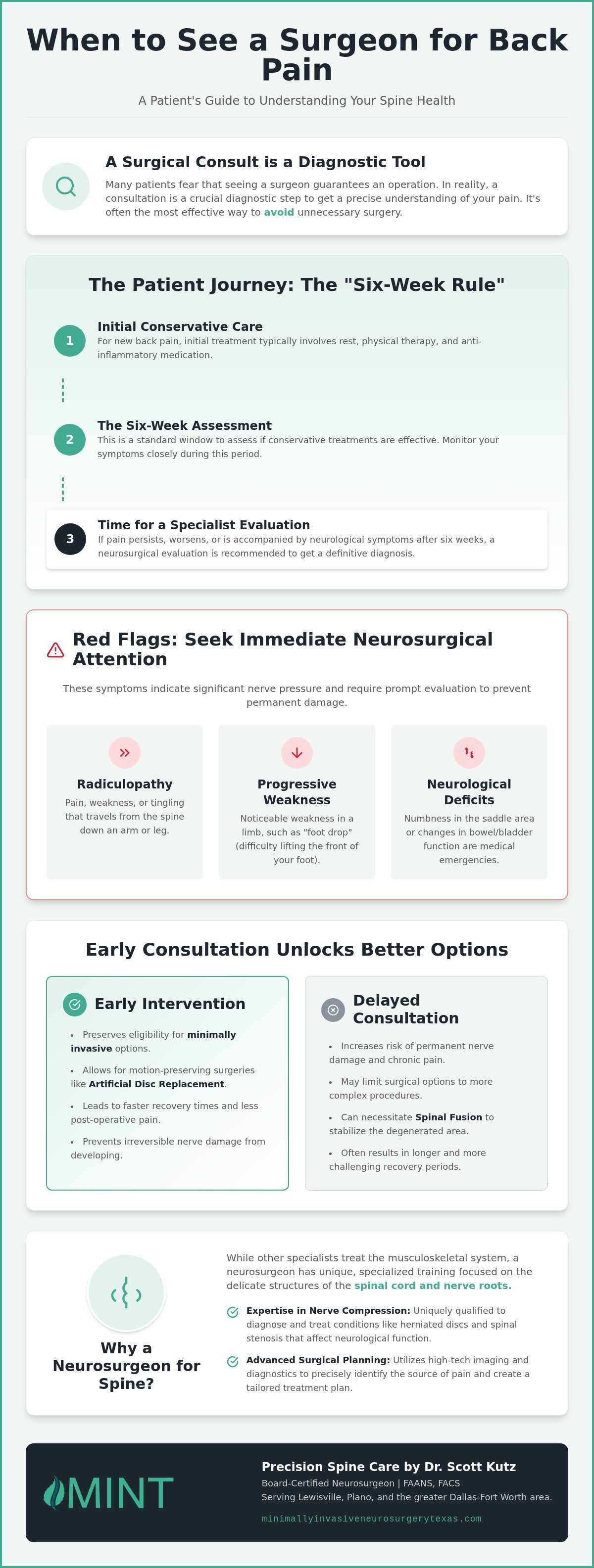
Consulting a spine surgeon is often the most effective way to avoid unnecessary surgery rather than a guaranteed path to the operating room. You’ve likely spent months managing persistent pain that interrupts your sleep and makes every movement a challenge. It’s natural to feel hesitant about seeking a surgical opinion because you fear a long recovery or a complex procedure. However, understanding when to see a surgeon for back pain is a vital diagnostic step that prioritizes your long term mobility. Dr. Scott Kutz, a board-certified neurosurgeon, Fellow of the American Association of Neurological Surgeons, and Fellow of the American College of Surgeons, believes that informed patients achieve the best clinical outcomes.
In this 2026 guide, you’ll learn about the specific clinical red flags, such as progressive neurologic deficits, that require professional intervention. We’ll preview the diagnostic milestones and high-tech options available at our Lewisville and Plano facilities to help you return to normal activity with confidence.
Key Takeaways
- Identify clinical red flags like radiculopathy and progressive neurological deficits that require immediate evaluation by a specialist to prevent permanent nerve damage.
- Understand the “Six-Week Rule” and how to transition from conservative treatments to advanced surgical options if your symptoms don’t improve within a standard recovery window.
- Learn when to see a surgeon for back pain as a critical diagnostic milestone to ensure you receive a precise treatment plan tailored to your specific spinal health.
- Discover why the specialized training of Dr. Scott Kutz, a board-certified neurosurgeon and Fellow of the American Association of Neurological Surgeons, is essential for managing complex conditions of the spinal cord.
- Explore how modern technologies like robotic navigation and minimally invasive techniques in Lewisville and Plano facilitate a faster return to normal activity.
Understanding When to See a Surgeon for Back Pain
Minimally Invasive Neurosurgery of Texas (MINT) provides specialized spine care in Lewisville and Plano under the leadership of Dr. Scott Kutz. Many patients assume that visiting a surgical center means they’ve already committed to an operation. This is a common misconception. In reality, knowing when to see a surgeon for back pain is about accessing a higher level of diagnostic precision. Dr. Scott Kutz is a board-certified neurosurgeon who specializes in treating complex spinal disorders through advanced surgical planning. He uses a consultation to distinguish between simple muscle fatigue and significant structural issues that require specialized intervention. A surgical evaluation serves as a powerful diagnostic tool. It identifies the precise cause of pain through advanced imaging and clinical testing that goes beyond the scope of general medicine.
The Role of a Neurosurgeon in Spine Health
Neurosurgeons specialize in the delicate structures of the spinal cord and nerve roots. While many specialists focus on the musculoskeletal system, Dr. Scott Kutz utilizes his fellowship training in functional neurosurgery to address complex nerve compression syndromes. This specific background allows him to provide a more definitive diagnosis for conditions like herniated discs or spinal stenosis than a general practitioner can offer. At our clinics in Lewisville and Plano, we analyze how structural shifts in the vertebrae affect your neurological function. This focus is essential because untreated pressure on the spinal cord can lead to long term mobility issues. Dr. Kutz, a Fellow of the American Association of Neurological Surgeons and a Fellow of the American College of Surgeons, applies his decades of experience to ensure your diagnosis is accurate before discussing any treatment path.
Why Early Consultation Matters for Minimally Invasive Options
Early intervention often allows for smaller incisions and less tissue disruption. If you wait until your symptoms are debilitating, your surgical options might become more limited. Delaying a specialist visit can lead to permanent nerve damage or the need for a more complex Spinal fusion procedure to stabilize the column. Dr. Kutz prioritizes motion-preserving approaches like artificial disc replacement when patients seek help before significant degeneration occurs. Seeking an opinion early ensures you remain a candidate for minimally invasive spine techniques. These modern methods offer faster recovery times and significantly less post-operative discomfort than traditional open surgeries. By visiting our Lewisville or Plano offices at the first sign of radiating pain or weakness, you take a proactive step toward preserving your quality of life.
Recognizing Red Flags That Require Immediate Neurosurgical Attention
Recognizing red flags is the most critical part of deciding when to see a surgeon for back pain. While many minor aches resolve with rest, neurological deficits signal that a nerve is under significant pressure and requires decompression. Dr. Scott Kutz, a board-certified neurosurgeon, Fellow of the American Association of Neurological Surgeons, and Fellow of the American College of Surgeons, evaluates these symptoms to determine if endoscopic spine surgery can relieve pressure. This advanced technique often avoids the trauma associated with traditional open methods. Prompt evaluation in our Lewisville or Plano offices can prevent long term mobility loss by addressing the root cause before nerve damage becomes permanent.
Neurological Symptoms You Should Not Ignore
Radiculopathy is a primary reason to seek a specialist. It presents as pain, weakness, or tingling that travels from the spine into your arms or legs. If you notice a “foot drop,” where you struggle to lift the front part of your foot while walking, you’re likely experiencing advanced nerve impingement. Certain conditions that may require surgery involve even more urgent markers. Numbness in the “saddle area,” which includes the inner thighs and groin, or sudden changes in bowel and bladder control are surgical emergencies. These symptoms suggest Cauda Equina Syndrome. This is a severe compression of the spinal nerve roots that requires immediate neurosurgical intervention to prevent lasting paralysis.
Structural Changes and Physical Misalignment
You might also notice visible shifts in your physical alignment that indicate a deeper problem. If one shoulder sits higher than the other or your posture has shifted significantly to one side, your spine may be losing its stability. Spondylolisthesis occurs when one vertebra slips over the one below it, often causing mechanical pain and nerve irritation. Dr. Kutz uses precision imaging at MINT to map these structural changes with absolute certainty. By identifying these misalignments early, he develops a plan that preserves your motion and prevents further degradation. If you recognize any of these warning signs, scheduling a clinical evaluation at our Lewisville or Plano headquarters is the safest next step for your spinal health.
The Six Week Rule: Assessing Failed Conservative Care
Most episodes of acute back pain are mechanical. They typically resolve within four to six weeks with basic rest, gentle stretching, and over-the-counter anti-inflammatory medications. This window is the standard waiting period for most primary care physicians. However, if your symptoms persist or intensify despite these efforts, it’s a clear indicator of when to see a surgeon for back pain. Dr. Scott Kutz, a board-certified neurosurgeon, Fellow of the American Association of Neurological Surgeons, and Fellow of the American College of Surgeons, emphasizes that lingering pain often points to an underlying structural pathology that physical therapy alone cannot resolve. A specialized consultation at MINT in Lewisville or Plano helps determine if your condition requires a more direct intervention to restore your mobility.
Defining Failed Conservative Treatment
Conservative care is the first line of defense. It usually involves a combination of physical therapy, non-steroidal anti-inflammatory drugs (NSAIDs), and occasionally epidural steroid injections to reduce localized inflammation. While these methods are effective for minor strains, they often provide only temporary relief for structural defects like a herniated disc or severe spinal stenosis. Dr. Scott Kutz carefully reviews your previous treatment history to identify exactly where conservative measures fell short. If you’ve completed a full course of therapy without significant functional improvement, the underlying issue is likely mechanical. Understanding When is back surgery a good idea? depends on identifying these specific gaps in your recovery progress during a clinical evaluation.
When Pain Impacts Your Quality of Life
Surgery becomes a viable and often necessary option when chronic pain prevents you from working, sleeping, or enjoying family activities. Living in a state of constant physical limitation isn’t a requirement of injury or spinal wear. Dr. Kutz focuses on returning patients to their normal activities as quickly as possible by utilizing advanced diagnostic tools and motion-preserving strategies. Modern medical advancements mean that a surgical recommendation isn’t the daunting prospect it once was. By choosing minimally invasive spine techniques, patients at MINT experience faster recovery timelines and reduced post-operative discomfort. This precision-focused approach ensures that we address the root cause of your suffering while minimizing the impact on your healthy surrounding tissues. If your daily life feels like a series of compromises due to spinal pain, a neurosurgical evaluation is the next logical step in your healthcare journey.
Beyond medical intervention, many individuals find that non-surgical aesthetic care helps them feel more like themselves again; for those interested, you can explore Botox and other wellness treatments at Davam Aesthetics to support your confidence during recovery.
Choosing the Right Specialist for Your Spinal Health
Patients often feel overwhelmed by the variety of practitioners offering back care, ranging from chiropractors to general orthopedic physicians. Knowing when to see a surgeon for back pain is a decision that typically follows months of seeking answers without finding a permanent solution. Neurosurgeons like Dr. Scott Kutz undergo extensive training specifically focused on the brain and spinal cord. The American Board of Neurological Surgery certifies doctors who have mastered the most complex spinal procedures, ensuring they can navigate the delicate pathways of the central nervous system. This certification represents a commitment to technical excellence and patient safety that is essential for successful outcomes.
Neurosurgeon vs Orthopedic Surgeon
Both specialists perform spine surgery, but their clinical perspectives vary significantly. Orthopedic training centers on the bones and joints of the entire body, whereas neurosurgery focuses on the nerves and the protective structures around them. Dr. Scott Kutz uses his background as a Fellow of the American Association of Neurological Surgeons to perform intricate nerve decompressions that require microscopic accuracy. Choosing a neurosurgeon is particularly important when nerve compression or spinal cord issues are present. Minimally Invasive Neurosurgery of Texas (MINT) focuses exclusively on spinal health to provide a level of specialized care that general surgical practices cannot match. Our team understands the high stakes of spinal health and applies decades of specialized experience to every case.
The Benefits of a Boutique Surgical Practice
Our practice operates as a specialized, boutique surgical center in Lewisville and Plano. This model allows us to avoid the coldness and bureaucracy often found in large hospital systems. Patients receive personal attention and direct communication from Dr. Scott Kutz and his dedicated clinical team. We prioritize patient education so that you fully understand your diagnosis and the mechanics of your recovery before proceeding with any treatment. This transparency empowers you to make informed decisions about your spinal health. By highlighting Dr. Kutz’s specific background and our regional service areas, we ensure our patients feel seen and heard throughout their diagnostic journey. Learn more about our patient-centered approach and how we prioritize your return to normal activity.
Dr. Scott Kutz, a board-certified neurosurgeon and Fellow of the American College of Surgeons, believes that a successful recovery starts with a foundation of trust. We maintain the professional distance necessary for clinical excellence while projecting a warm, patient-centered style. Our offices in Lewisville and Plano utilize the latest diagnostic technology to provide a clear path forward for those dealing with chronic physical conditions. If you are ready to move beyond temporary relief and seek a definitive solution for your spinal health, contact our team to schedule a comprehensive evaluation.
Precision Spine Care at MINT in Lewisville and Plano
Deciding when to see a surgeon for back pain is a pivotal moment in your health journey. Once you recognize that conservative treatments haven’t restored your quality of life, the next step involves finding a practice that utilizes modern surgical innovation. Minimally Invasive Neurosurgery of Texas (MINT) operates at the forefront of spinal care by integrating advanced technology with personalized treatment plans. Dr. Scott Kutz, a board-certified neurosurgeon and Fellow of the American College of Surgeons, leads our team in providing precision-based solutions. Our new headquarters in Lewisville, TX, serves the entire Dallas-Fort Worth Metroplex with modern clinical facilities designed for patient comfort and surgical excellence.
Advanced Technology for Better Outcomes
Dr. Scott Kutz employs the Globus Excelsius system to ensure unmatched precision during complex procedures. This robotic navigation platform allows for the highly accurate placement of spinal implants by combining a rigid robotic arm with specialized navigation software. It functions much like a GPS for the spine, reducing the margin for error and minimizing the impact on surrounding healthy tissues. Additionally, we utilize Augmedics AR (Augmented Reality) technology. This system provides the surgeon with a “transparent” view of the patient’s anatomy, effectively granting x-ray vision during the procedure. You can explore these technologies in detail on the MINT homepage to understand how they contribute to faster recovery timelines and improved clinical results.
Your Path to Recovery in North Texas
The transition from chronic suffering to a return to normal activity requires more than just a successful procedure. Dr. Scott Kutz and his clinical team provide comprehensive support from your initial diagnostic consultation through every stage of post-operative recovery. We prioritize motion-preserving options like artificial disc replacement to help you maintain flexibility rather than relying on traditional fusion methods that can limit movement. This philosophy ensures that your long term mobility remains our top priority. Our practice serves patients from Plano and Lewisville, as well as surrounding communities like Flower Mound and Southlake. We’ve designed our patient-centered flow to move you from a state of concern to a state of informed confidence. If you’re ready to explore whether you’re a candidate for endoscopic spine surgery or other minimally invasive techniques, scheduling an evaluation at one of our North Texas offices is the definitive next step toward a pain-free life.
Take Control of Your Spinal Health Journey
Understanding when to see a surgeon for back pain is the first step toward reclaiming your daily quality of life. As this guide has detailed, persistent neurological deficits and structural misalignments require the specialized attention that only a dedicated neurosurgical practice can provide. If you’ve exhausted conservative treatments for more than six weeks without functional improvement, a diagnostic consultation becomes essential. Dr. Scott Kutz utilizes his deep expertise to distinguish between conditions that require continued observation and those that benefit from high-tech, motion-preserving interventions.
Your recovery deserves the precision of a specialist who understands the delicate relationship between the spine and the nervous system. Dr. Scott Kutz is a board-certified neurosurgeon, a Fellow of the American Association of Neurological Surgeons, and a Fellow of the American College of Surgeons with over 20 years of clinical experience. He prioritizes minimally invasive techniques that minimize tissue disruption and accelerate your return to normal activity. You don’t have to navigate chronic pain alone. Schedule your consultation with Dr. Scott Kutz at MINT today to begin your path toward lasting relief. We look forward to helping you move with confidence again.
Frequently Asked Questions
Is back surgery always the last resort for chronic pain?
Surgery isn’t always the last resort. While Dr. Scott Kutz usually recommends conservative care first, certain structural issues require early surgical intervention to prevent permanent nerve damage. If you experience progressive neurological decline, waiting too long can lead to irreversible disability. Dr. Kutz evaluates your specific pathology in Lewisville or Plano to determine if surgery is the safest first-line option for your recovery.
What is the difference between a neurosurgeon and an orthopedic spine surgeon?
Neurosurgeons undergo specific training focused on the brain, spinal cord, and delicate nerve roots. While both specialists perform spine surgery, neurosurgeons prioritize the protection of the nervous system during every procedure. Dr. Scott Kutz, a board-certified neurosurgeon, uses his specialized fellowship training to address complex nerve compression. This focus is vital when your condition involves the neural pathways rather than just the bone structure.
How long is the recovery time for minimally invasive spine surgery?
Most patients return to light activities within one to two weeks of their procedure. Minimally invasive techniques involve smaller incisions and significantly less muscle disruption than traditional open surgery. This approach reduces post-operative pain and speeds up the healing process. Patients at our Plano and Lewisville clinics often find they can return to their normal activity levels much faster than they initially expected.
Can a herniated disc heal on its own without seeing a surgeon?
Many herniated discs do heal on their own through a natural process called resorption. However, it’s important to know when to see a surgeon for back pain if your symptoms persist beyond six weeks. If you experience radiating leg pain or muscle weakness, the disc may require surgical decompression. Dr. Scott Kutz recommends an evaluation if conservative measures fail to provide functional relief within a standard recovery window.
What are the emergency signs that mean I need spine surgery immediately?
Emergency signs include a sudden loss of bowel or bladder control and numbness in the groin or inner thighs. These symptoms suggest Cauda Equina Syndrome, which is a rare but severe compression of the spinal nerve roots. Rapidly progressing muscle weakness or a “foot drop” also requires immediate neurosurgical attention. If you experience these red flags, seek emergency care immediately to prevent permanent paralysis or long term loss of function.
Do I need a referral to see Dr. Scott Kutz at MINT?
Referral requirements vary based on your specific insurance plan and provider network. Many PPO plans allow patients to schedule directly with a specialist like Dr. Scott Kutz without a primary care referral. However, HMO plans usually require a formal referral to cover the cost of the consultation. Our staff in Lewisville and Plano can assist you in verifying your insurance requirements before you visit our clinical facilities.
What should I bring to my first consultation with a spine surgeon?
You should bring your most recent imaging studies, such as MRI or CT scans, on a physical disc or accessible digital link. Dr. Kutz also needs a detailed history of your previous treatments, including physical therapy reports and any injection records. Providing these documents allows for a more efficient diagnostic process. This preparation ensures that your first visit focuses on developing a precise treatment plan for your spinal health.
Does insurance typically cover minimally invasive neurosurgery?
Most major insurance providers cover minimally invasive procedures when they are clinically necessary to treat a diagnosed spinal condition. Because these advanced methods often result in fewer complications and shorter recovery times, they are standard covered services. Dr. Scott Kutz and the MINT team work with various providers in the Dallas-Fort Worth area. We recommend contacting our Lewisville or Plano offices to confirm your specific coverage details before your procedure.