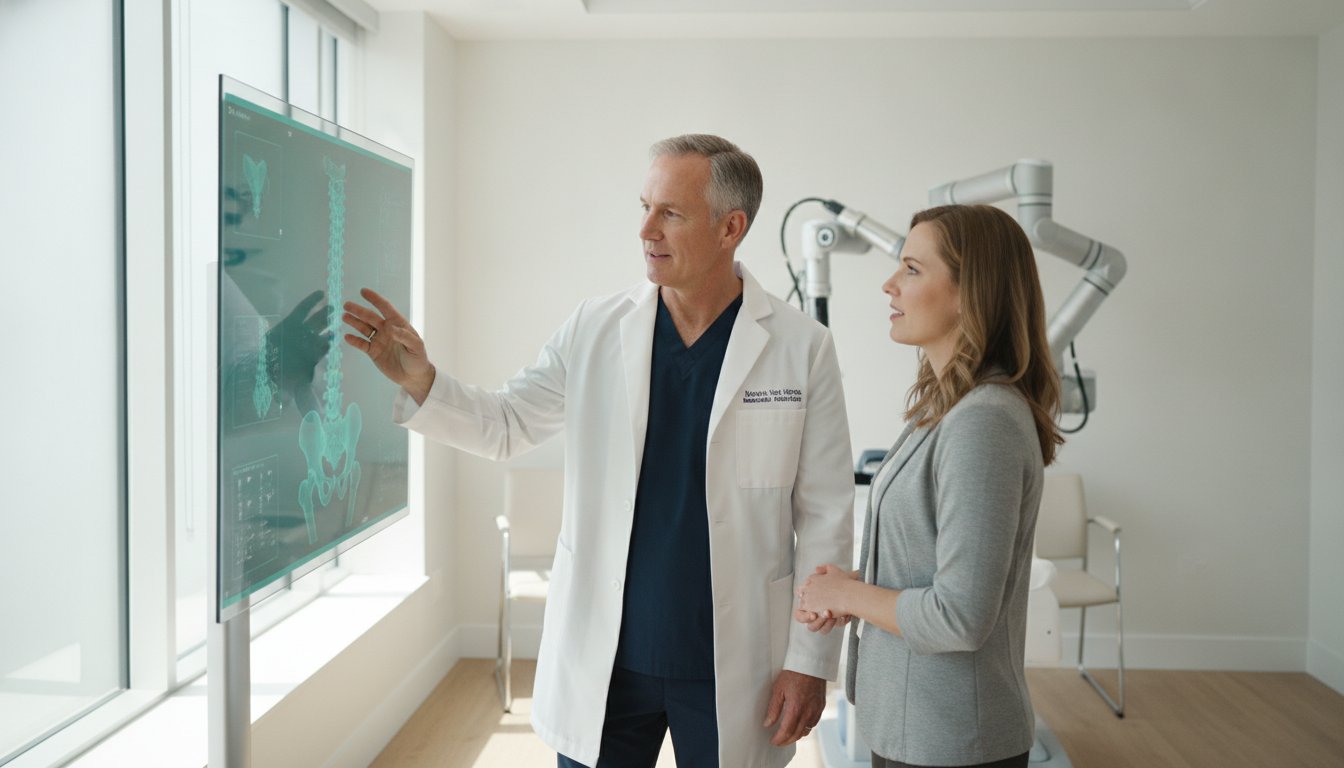
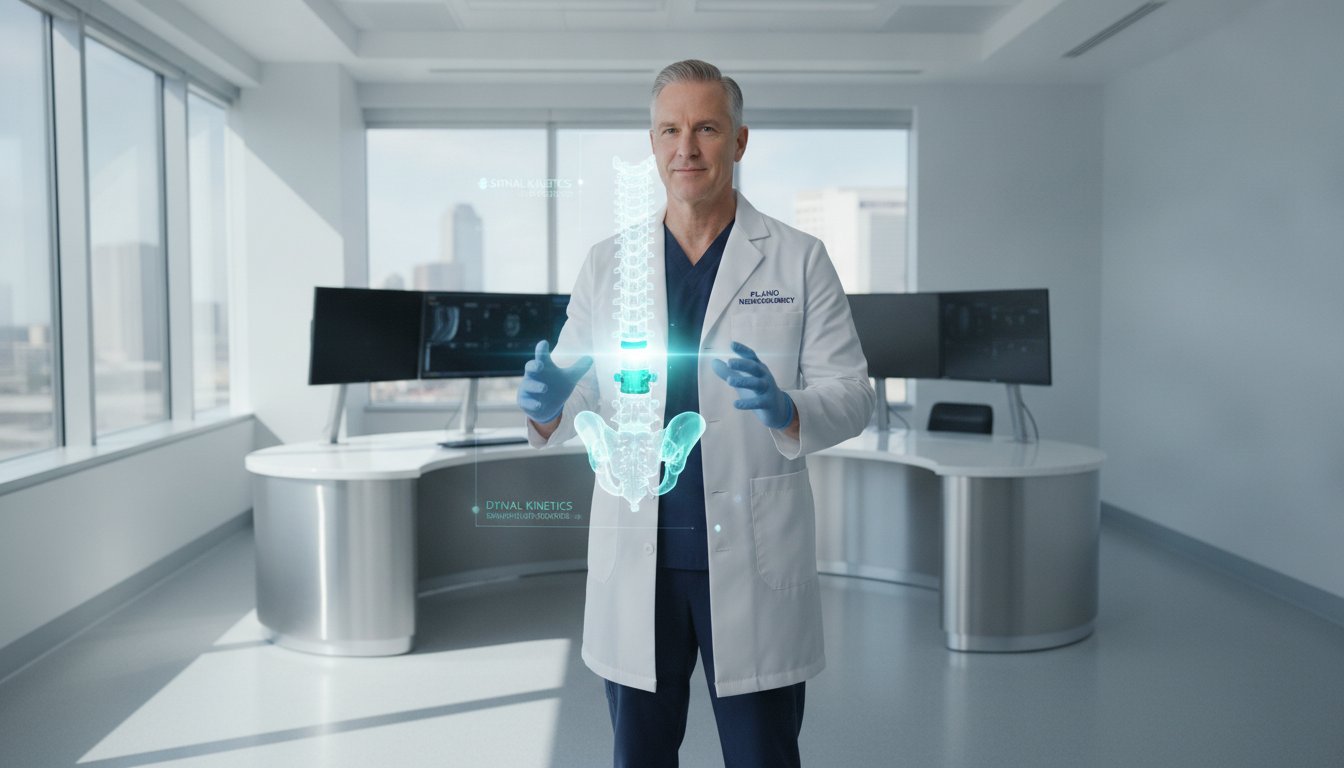
A quarter-inch incision. That’s all it takes for Dr. Scott Kutz, board-certified neurosurgeon and Fellow of the American Association of Neurological Surgeons, to access the source of your debilitating back pain. If you’ve been told you need spine surgery and you’re picturing long hospital stays, large scars, and months of recovery, the reality of endoscopic surgery for spine conditions at Minimally Invasive Neurosurgery of Texas (MINT) looks nothing like that.
You’re right to have questions. Spine surgery is a significant decision, and the fear of trading chronic pain for a grueling recovery is completely understandable. Most patients arrive at MINT having lived with herniated disc pain or spinal stenosis for months, sometimes years, wondering if there’s a better path forward.
There is. This article walks you through exactly what happens during an endoscopic spine procedure at MINT’s Lewisville and Plano locations, from your pre-operative preparation to walking out the same day, so you can approach your consultation with clarity and confidence rather than anxiety.
Key Takeaways
- Endoscopic surgery for spine conditions at MINT requires only a quarter-inch incision, allowing most patients to go home the same day rather than facing a lengthy hospital stay.
- Dr. Scott Kutz, a board-certified neurosurgeon with over 20 years of experience, uses advanced imaging review and precise surgical planning to tailor each procedure to the individual patient at MINT’s Lewisville and Plano locations.
- Because the technique preserves surrounding muscle tissue instead of cutting through it, post-operative pain is typically far less intense than patients expect from traditional spine surgery.
- MINT incorporates cutting-edge navigation technology, including Augmedics augmented reality, to give Dr. Kutz real-time surgical precision that improves safety and outcomes.
- This article walks you through every stage of the process, from your first consultation to your recovery timeline, so you can arrive at your appointment informed and confident.
What is Endoscopic Spine Surgery at MINT?
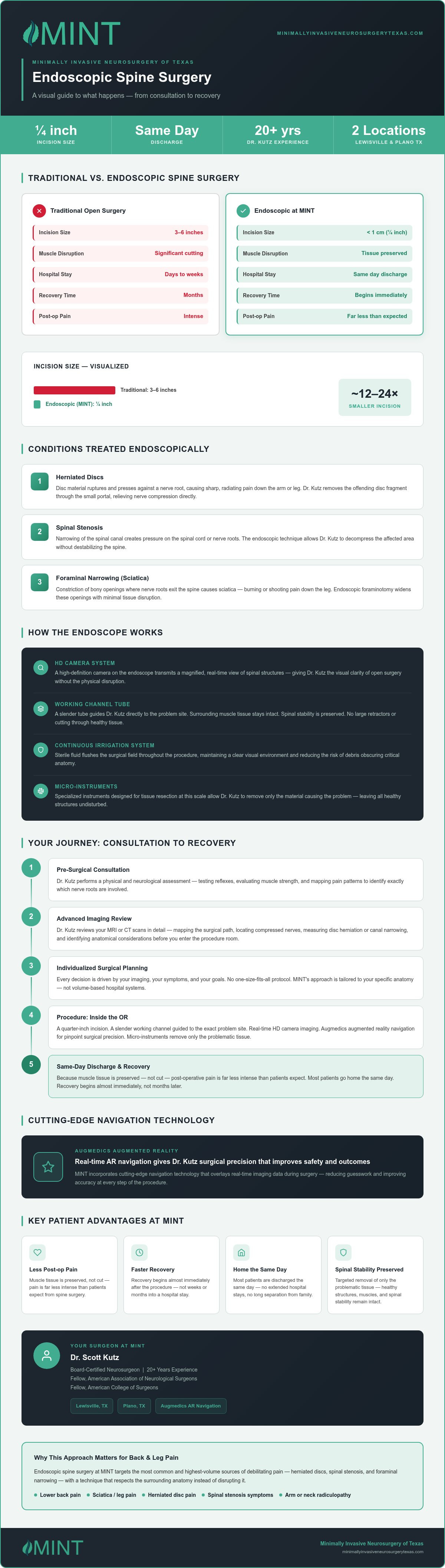
At Minimally Invasive Neurosurgery of Texas (MINT), endoscopic surgery for spine conditions represents the most precise, tissue-preserving approach to spinal care available in North Texas. Serving patients at locations in Lewisville and Plano, Dr. Scott Kutz, board-certified neurosurgeon and Fellow of the American Association of Neurological Surgeons, performs these procedures through an incision smaller than one centimeter. That’s not a rounding error. It’s the foundation of a fundamentally different surgical philosophy.
Traditional open spine surgery requires cutting through layers of muscle to reach the affected area. The endoscopic approach takes a different path entirely. Dr. Kutz guides a slender tube, called a working channel, directly to the problem site. A high-definition camera mounted on the endoscope transmits a magnified, real-time view of the spinal structures, giving him the visual clarity of open surgery without the physical disruption. The surrounding muscle tissue stays intact. Spinal stability is preserved. Recovery begins almost immediately.
The Technology Behind the Endoscope
The endoscope itself is engineered for precision in a confined space. Its camera system delivers a magnified view of the spinal canal, allowing Dr. Kutz to identify and address compressed nerves, disc material, and bone spurs with accuracy that simply isn’t possible through a larger incision. A continuous irrigation system runs throughout the procedure, flushing the surgical field with sterile fluid to maintain a clear visual environment and reduce the risk of debris obscuring critical anatomy. Specialized micro-instruments, designed specifically for tissue resection at this scale, allow Dr. Kutz to remove only the material causing the problem while leaving healthy structures undisturbed.
Conditions Treated with Endoscopic Techniques
This approach addresses several of the most common sources of debilitating spinal pain:
- Herniated discs: When disc material ruptures and presses against a nerve root, the result is sharp, radiating pain that can travel down the arm or leg. Dr. Kutz removes the offending disc fragment through the small portal, relieving nerve compression directly.
- Spinal stenosis: Narrowing of the spinal canal creates pressure on the spinal cord or nerve roots. The endoscopic technique allows Dr. Kutz to decompress the affected area without destabilizing the spine.
- Foraminal narrowing: When the bony openings through which nerve roots exit the spine become constricted, patients often experience sciatica, a burning or shooting pain down the leg. Endoscopic foraminotomy widens these openings with minimal tissue disruption.
To learn more about how MINT approaches these conditions, visit the endoscopic spine surgery service page or explore the MINT practice overview to understand Dr. Kutz’s clinical background and philosophy.
Preparing for Your Procedure in Lewisville and Plano
Your path to relief doesn’t begin in the operating room. It begins with a conversation. Before Dr. Scott Kutz, board-certified neurosurgeon and Fellow of the American Association of Neurological Surgeons, ever considers a surgical approach, he conducts a thorough evaluation designed to confirm that endoscopic surgery is the right solution for your specific anatomy and symptoms. That level of individualized preparation is what separates a boutique surgical practice from a high-volume hospital system.
The Pre-Surgical Consultation
During your initial consultation, Dr. Kutz performs both a physical examination and a neurological assessment. He tests your reflexes, evaluates muscle strength, and maps your pain patterns to identify precisely which nerve roots are involved. This isn’t a checkbox exercise. It’s the clinical foundation on which your entire surgical plan is built.
Advanced imaging plays a central role. Dr. Kutz reviews your MRI or CT scans in detail, using them to map the surgical path before you ever enter the procedure room. He identifies the exact location of the compressed nerve, the degree of disc herniation or canal narrowing, and any anatomical considerations that might influence his approach. This evidence-based planning reflects the MINT philosophy: every decision is driven by your imaging, your symptoms, and your goals, not a one-size-fits-all protocol. Learn more about that patient-first approach on the MINT about us page.
Before your procedure date, you’ll receive clear, specific pre-operative instructions. These typically include guidance on which medications to pause, fasting requirements for the evening before surgery, and what to arrange for your ride home. Because most patients undergoing endoscopic surgery for spine conditions at MINT are discharged the same day, having a trusted person available to drive you is essential. The MINT team walks you through every detail so there are no surprises on procedure day.
Logistics for North Texas Patients
MINT’s headquarters is located in Lewisville, positioned conveniently within the Dallas-Fort Worth Metroplex and easily accessible for patients traveling from Flower Mound, Southlake, and surrounding communities. The Plano satellite office serves patients in the northern corridor of the Metroplex, streamlining access for those coming from Allen, McKinney, and nearby areas. Both locations offer outpatient surgical services, meaning you check in, complete your procedure, and return home the same day without an overnight hospital admission.
Check-in at MINT’s outpatient centers is designed to be straightforward. Arrive at your scheduled time with your identification, insurance information, and your pre-operative paperwork completed. The clinical team confirms your vitals, reviews your medication history one final time, and prepares you for the procedure in a calm, organized environment. If you’re ready to take that first step, reach out to the MINT team to schedule your consultation at the location most convenient for you.
Inside the Operating Room: The Surgical Process
What happens once you’re on the table is where the endoscopic approach truly distinguishes itself. The entire procedure is built around the principle of doing more with less: less disruption, less tissue damage, less time under anesthesia. Dr. Scott Kutz, board-certified neurosurgeon and Fellow of the American Association of Neurological Surgeons, performs each procedure with a level of precision that traditional open surgery simply cannot replicate at this scale.
Depending on your specific anatomy and the complexity of the compression, Dr. Kutz will use either local anesthesia with sedation or general anesthesia. Both options are calibrated to keep you comfortable while allowing the surgical team to monitor your neurological responses throughout the procedure.
Step-by-Step Surgical Execution
The procedure begins with the placement of a guide wire, positioned under live fluoroscopic guidance. Fluoroscopy is a real-time X-ray imaging system that allows Dr. Kutz to confirm the wire’s trajectory before advancing any instruments. This step eliminates guesswork entirely. Once the guide wire is confirmed at the correct spinal level, a series of progressively wider dilators gently separate the muscle fibers along their natural grain rather than cutting through them. The working channel is established without disturbing the surrounding musculature.
The endoscope then travels down this channel, and the HD camera transmits a magnified, high-resolution view of the surgical field directly to a monitor. Dr. Kutz identifies the exact site of nerve compression or disc herniation in real time, using this live feed to navigate with the kind of clarity that makes endoscopic surgery for spine conditions fundamentally different from conventional approaches. Specialized micro-instruments remove only the offending tissue, whether that’s a fragment of herniated disc or a bone spur narrowing the spinal canal, while leaving the healthy disc material and adjacent structures completely intact.
Closure is straightforward. In most cases, the small portal requires only a single absorbable suture or a strip of surgical tape. There’s no large incision to close in layers, no extensive wound management, and no drain placement.
Precision and Safety Measures
Safety during endoscopic surgery for spine procedures at MINT is layered and active, not passive. Dr. Kutz incorporates the Globus Excelsius robotic-assisted planning system into the surgical workflow, which allows for pre-operative trajectory mapping that guides instrument placement with sub-millimeter accuracy. Real-time imaging throughout the procedure continuously confirms that instruments remain within the planned corridor, significantly reducing the risk of inadvertent nerve contact.
The clinical team monitors your vital signs continuously from the moment anesthesia is administered to the moment you’re moved to recovery. Heart rate, blood pressure, oxygen saturation, and neurological indicators are tracked throughout. Because the procedure typically runs under an hour for straightforward decompressions, your exposure time is minimal and your physiological stress is kept low. That combination of speed, precision, and active monitoring is what makes same-day discharge not just possible, but routine for most MINT patients.
Recovery Timelines and Post-Operative Care
The procedure is finished. You’re awake, oriented, and the nerve pain that brought you to MINT is already beginning to lift. For most patients undergoing endoscopic surgery for spine conditions at MINT’s Lewisville and Plano locations, the next step isn’t a hospital room. It’s the recovery suite, then home, all within the same day.
That’s not an exaggeration. Because the endoscopic technique spares the surrounding musculature entirely, your body isn’t recovering from the surgery itself the way it would after a traditional open procedure. The tissue wasn’t cut. It was gently moved aside and allowed to return to its natural position. That distinction drives everything about what your recovery looks and feels like.
Dr. Scott Kutz, board-certified neurosurgeon and Fellow of the American Association of Neurological Surgeons, builds a personalized recovery plan for each patient based on the specific procedure performed, the patient’s baseline health, and their activity goals. There’s no generic handout. There’s a plan built around you.
The First 48 Hours
Walking is encouraged almost immediately after you’re cleared from the recovery suite. This isn’t incidental. Early ambulation, meaning controlled movement shortly after surgery, promotes circulation, reduces the risk of blood clots, and signals to your neuromuscular system that normal function is expected. Short, gentle walks around your home are appropriate on the first day. You’re not pushing through pain. You’re preventing the stiffness and deconditioning that prolonged bed rest creates.
Incision care during this window is straightforward. Keep the site dry for the first several days. Avoid submerging it in water, meaning no baths, pools, or hot tubs until Dr. Kutz confirms the site has closed properly. Showering with the incision covered is typically permitted after 24 to 48 hours, but follow the specific guidance your MINT care team provides at discharge.
Minor soreness around the incision site and some residual muscle fatigue are normal in the first 48 hours. Most patients manage this comfortably with over-the-counter anti-inflammatory medications or a short course of prescribed pain relief. Nerve-related discomfort, if present, often resolves progressively over the first few weeks as the affected nerve root recovers from compression.
Long-Term Outcomes and Mobility
The week-by-week trajectory for most MINT patients looks like this:
- Days 1 to 3: Rest at home with gentle walking. Avoid bending, lifting, or twisting.
- Days 4 to 7: Gradual increase in daily movement. Many patients with sedentary or light office roles return to work within this window.
- Weeks 2 to 4: Activity expands progressively. Light household tasks and short walks become comfortable for most patients.
- Weeks 6 to 12: Return to more demanding physical activity, including exercise and job-related physical tasks, is evaluated individually. Dr. Kutz clears each patient based on their healing progress rather than a fixed calendar date.
Return to strenuous activity or sport follows a similar individualized path. Patients who have undergone decompression procedures without fusion retain full spinal motion from the outset. There’s no fused segment to compensate around, no adjacent-level stress to monitor in the early months. The spine moves the way it was designed to move. That’s the clinical advantage of a motion-preserving approach over traditional fusion, and it’s one of the most significant long-term benefits MINT patients report. Learn more about the full clinical picture at the MINT endoscopic spine surgery page.
Recovery doesn’t have to be a long, uncertain process. If you’re ready to understand what your personal timeline might look like, contact the MINT team to schedule your consultation at the Lewisville or Plano location.
Why Choose Dr. Scott Kutz for Endoscopic Spine Surgery?
Credentials matter. So does experience. But what separates a genuinely exceptional surgical practice from a technically qualified one is the combination of both, applied consistently, within a care environment built around the patient rather than the institution. At MINT, that combination is the standard, not the exception.
A Legacy of Clinical Excellence
Dr. Scott Kutz brings more than 20 years of experience treating complex spinal disorders to every procedure he performs. As a board-certified neurosurgeon, Fellow of the American Association of Neurological Surgeons, and Fellow of the American College of Surgeons, his credentials reflect a sustained commitment to clinical rigor that goes well beyond general surgical training. His fellowship in functional neurosurgery deepened his understanding of how the nervous system responds to compression and decompression, knowledge that directly informs how he approaches each patient’s anatomy and symptom profile.
That depth of training shapes how MINT communicates with patients too. You won’t encounter fear-based language or pressure tactics here. Dr. Kutz explains diagnoses clearly, grounds every recommendation in imaging evidence, and ensures you understand exactly what’s happening in your spine before any surgical decision is made. That’s not just good bedside manner. It’s a clinical philosophy.
MINT also incorporates the Augmedics augmented reality surgical navigation system, a technology that overlays real-time spinal anatomy onto Dr. Kutz’s field of view during endoscopic surgery for spine procedures. This allows him to navigate with a level of spatial precision that conventional imaging alone can’t provide, reducing procedural variability and improving safety margins for every patient.
Patient Success in North Texas
The measure of any surgical practice isn’t the technology it uses. It’s the outcomes patients experience after they go home. MINT’s patient testimonials from across the Dallas-Fort Worth area reflect what happens when surgical precision meets a genuinely patient-first environment: people return to their lives.
MINT’s new Lewisville headquarters positions the practice at the heart of the DFW Metroplex, making it accessible for residents across Flower Mound, Southlake, and the broader North Texas region without the impersonal experience of a large hospital system. The Plano location extends that same boutique, focused care to patients in Allen, McKinney, and surrounding communities.
If you’re ready to understand what your path forward looks like, learn more about Dr. Kutz and the MINT practice, then take the next step toward a consultation at the location closest to you.
Your Next Step Toward a Life Without Chronic Back Pain
Chronic spine pain doesn’t have to define your daily life. As this article has shown, endoscopic surgery for spine conditions at MINT offers a genuinely different path: a quarter-inch incision, muscle-preserving technique, same-day discharge, and a recovery timeline measured in days rather than months. That’s not a promise built on marketing language. It’s the clinical reality of a procedure performed by a board-certified neurosurgeon with over 20 years of experience in motion-preserving spinal care.
Dr. Scott Kutz and the MINT team serve patients across North Texas from convenient locations in Lewisville and Plano, bringing boutique, precision-focused surgical care to communities that deserve better than a crowded hospital system. Whether you’re living with a herniated disc, spinal stenosis, or persistent sciatica, your situation deserves a thorough, individualized evaluation.
You’ve done the research. The next step is a conversation. Schedule your consultation with Dr. Kutz at MINT and take the first real step toward getting your life back.
Frequently Asked Questions About Endoscopic Spine Surgery at MINT
Is endoscopic spine surgery considered a major surgery?
Endoscopic spine surgery is classified as a minimally invasive procedure, not a major surgery in the traditional sense. Unlike open spine surgery, which requires large incisions and significant muscle disruption, the endoscopic approach accesses the spine through a portal smaller than one centimeter. There’s no general hospital admission required for most patients, and the physiological stress on your body is considerably lower than what conventional spinal procedures involve.
How long does the endoscopic surgery for spine procedure take?
For straightforward decompressions, endoscopic surgery for spine conditions at MINT typically runs under an hour. The exact duration depends on the complexity of your anatomy, the number of spinal levels being addressed, and whether additional steps are needed based on intraoperative findings. Dr. Scott Kutz reviews your imaging thoroughly before your procedure date, so the surgical plan is already optimized before you enter the room, keeping procedure time efficient and predictable.
Will I have a large scar after endoscopic surgery?
No. The incision used in endoscopic spine surgery at MINT measures less than one centimeter, roughly the size of a small fingernail. Most patients are left with a minimal mark that fades significantly over the months following their procedure. There are no layered wound closures or drains involved. In most cases, a single absorbable suture or a strip of surgical tape is all that’s needed to close the portal site.
Can I drive myself home after the procedure in Plano or Lewisville?
No. Because endoscopic spine procedures at MINT involve sedation or general anesthesia, you’re not cleared to drive yourself home on procedure day. You’ll need a trusted adult to pick you up from either the Lewisville or Plano location and stay with you for the initial hours of recovery. The MINT care team confirms this requirement during your pre-operative consultation so you can arrange transportation well in advance without any last-minute stress.
What is the success rate of endoscopic surgery for herniated discs?
Published clinical literature on endoscopic discectomy consistently reports favorable outcomes for appropriately selected patients, with many studies documenting meaningful reductions in leg and back pain following nerve decompression. Outcomes vary based on individual anatomy, symptom duration, and the degree of nerve compression present before surgery. Dr. Scott Kutz evaluates each patient’s imaging and symptom profile carefully to confirm they’re a strong candidate before recommending this approach, which directly influences the likelihood of a positive result.
How soon can I return to work after an endoscopic procedure?
Return-to-work timelines depend on the physical demands of your job. Patients with sedentary or light office roles often return within four to seven days following their procedure. Those with physically demanding jobs, including roles that involve lifting, prolonged standing, or repetitive bending, typically require a longer recovery window. Dr. Kutz evaluates each patient’s healing progress individually rather than applying a fixed calendar date, so your clearance is based on your actual recovery, not a generic timeline.
Does Dr. Scott Kutz accept insurance for endoscopic spine surgery?
Insurance coverage for endoscopic spine surgery varies by plan, carrier, and the specific procedure being performed. MINT’s administrative team works with patients to clarify coverage details prior to scheduling. The most reliable way to confirm your benefits is to contact the MINT office directly so the team can review your specific plan and help you understand what to expect before your consultation date.
What happens if endoscopic surgery is not right for my condition?
Not every spinal condition is best addressed through an endoscopic approach, and Dr. Kutz is direct about that. If your imaging or symptom profile indicates that a different surgical method would produce better outcomes, he’ll explain why and walk you through the alternatives. MINT’s patient-first philosophy means the recommendation you receive is always grounded in your clinical picture, not a preference for any single technique. Your long-term outcome takes priority over any procedural preference.