What if the most critical factor in your recovery isn’t the size of the incision, but the navigation system used to guide it? You’ve likely heard the horror stories of “failed back surgery syndrome” or felt the anxiety of losing months to a grueling recovery. It’s natural to feel overwhelmed by a sea of acronyms while researching lumbar spine surgery, especially when you just want to return to your daily life without pain. You deserve a solution that blends clinical excellence with the precision of 2026 technology.
This guide will help you understand the modern surgical landscape in Plano and Lewisville. You’ll learn how to evaluate advanced options and find a specialist who prioritizes your return to normal activity. We’ll compare the latest robotic-assisted systems that offer up to 98% accuracy, explain how the new Medicare WISeR regulations in Texas impact your surgical timeline, and clarify why the choice between manual and tech-navigated precision now defines patient outcomes.
Key Takeaways
- Learn to differentiate between decompression and stabilization procedures to understand the specific goals of your treatment plan.
- Discover how minimally invasive neurosurgery techniques minimize muscle trauma to support a more efficient return to normal activity.
- Compare traditional open methods with modern robotic-assisted lumbar spine surgery to prioritize precision and safety in your recovery.
- Identify the key credentials and training markers necessary when selecting a specialized spine surgeon in the Plano and Lewisville areas.
- Understand how to interpret your diagnostic reports to better advocate for yourself during surgical consultations.
Understanding Lumbar Spine Surgery: When is it Time for a Surgical Solution?
Lumbar spine surgery refers to specialized procedures addressing the vertebrae numbers L1 through S1 segments of the lower back. These five vertebrae bear the majority of your body weight and are the most common sites for degenerative changes that lead to chronic pain. The primary clinical objective of any intervention is either decompressing pinched nerves or stabilizing the spinal architecture to prevent painful, irregular movement. In 2026, the standard of care has shifted decisively toward motion preservation. While Spinal fusion remains a reliable method for stabilization, modern techniques often prioritize maintaining your natural range of motion to protect the health of adjacent spinal levels.
Recognizing the “window of opportunity” for surgery is vital for long-term recovery. While many patients manage symptoms for years, certain red flags indicate that waiting may lead to permanent neurological deficits. Progressive leg weakness, a “drop foot” where you cannot lift your toes, or sudden changes in bowel or bladder control are critical indicators. If you experience these symptoms, the risk of “waiting and seeing” far outweighs the risks of a surgical intervention. Delaying care when nerves are severely compressed can result in permanent numbness or loss of function that even the most advanced surgery cannot fully reverse.
Common Conditions Requiring Lumbar Intervention
Most patients suffer from three primary conditions that may eventually require a surgical solution. Herniated discs occur when the soft inner material of a disc leaks out, chemically irritating or physically compressing a nerve. Lumbar spinal stenosis is a narrowing of the spinal canal that makes walking or standing difficult; it’s the reason many patients find themselves leaning on a grocery cart for relief. Finally, spondylolisthesis occurs when one vertebra slips over the one below it. This creates a structural instability that often requires a specialized stabilization plan to help you achieve a return to normal activity.
The “Non-Surgical First” Philosophy
We believe surgery should be the final step in your journey, not the first. Most patients explore physical therapy, targeted lifestyle modifications, and conservative pain management before consulting a neurosurgeon. When these measures fail to provide lasting relief, it serves as a clear diagnostic signal. It tells us the underlying problem is likely a mechanical obstruction or structural instability rather than simple inflammation. Our practice focuses exclusively on spinal health. This high level of specialization allows us to provide exceptional diagnostic accuracy, ensuring that if we recommend lumbar spine surgery, it’s because we’ve identified the specific mechanical cause of your suffering.
The Lumbar Surgery Buying Guide: Comparing Your Procedural Options
Choosing the right path for lumbar spine surgery requires understanding the specific mechanical issue your body is facing. When you review your MRI report, look for keywords like “foraminal narrowing,” “central stenosis,” or “spondylolisthesis.” These terms dictate whether you need a decompression procedure to remove tissue or a stabilization procedure to add support. If you’re unfamiliar with how spinal levels are labeled, our guide to understanding vertebrae numbers and spinal anatomy can help you decode your diagnostic report before your consultation. In 2026, surgical philosophy has moved beyond simply stopping pain; it focuses on preserving as much natural movement as possible. Modern patients shouldn’t just ask about the procedure itself. You must evaluate the total cost of recovery, which includes time away from work, the length of your hospital stay, and the speed of returning to normal activity.
Decompression Procedures: Discectomy and Laminectomy
Decompression is about creating space for your nerves to function. A microdiscectomy is often considered the gold standard for localized herniations where a small piece of disc material presses on a nerve root. For patients with more extensive narrowing, a laminectomy removes part of the vertebral bone to relieve pressure on the cauda equina. While these are common types of back surgery, the technology has evolved. Endoscopic spine surgery now allows surgeons to perform these decompressions through incisions smaller than a fingernail. This approach significantly reduces postoperative discomfort and allows for a faster transition back to your daily routine.
Stabilization Procedures: Fusion and Disc Replacement
If your spine has lost its structural integrity, stabilization becomes necessary. Traditional spinal fusion joins two vertebrae to eliminate painful motion. However, we often prefer a Minimally Invasive TLIF (Transforaminal Lumbar Interbody Fusion). This technique achieves the same stability while minimizing muscle trauma and blood loss. For many younger or more active patients, Artificial Disc Replacement is a superior “buying” choice. Unlike fusion, ADR replaces the damaged disc with a prosthetic that mimics natural movement. This helps prevent the “adjacent level disease” often seen with traditional fusions. If you’re exploring these options, you may want to consult with a specialist who performs both fusion and motion-sparing alternatives. This ensures your treatment plan is tailored to your long-term mobility goals rather than just a one-size-fits-all solution.
Precision Tech: Comparing Open, MIS, and Robotic-Assisted Surgery
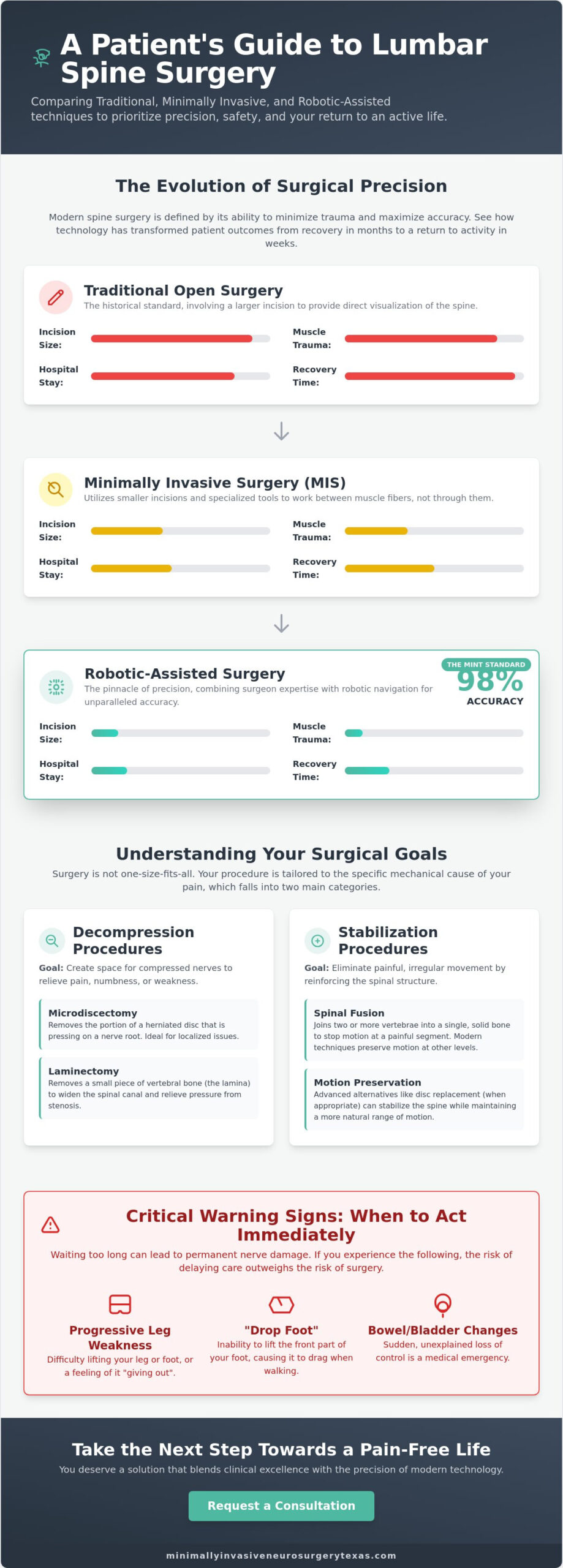
Modern lumbar spine surgery has evolved far beyond the simple choice between a large or small incision. In 2026, the real distinction lies in the level of technological guidance used to protect your anatomy. Traditional open surgery involves significant muscle retraction to provide the surgeon with a direct line of sight. While effective, this method often results in more postoperative pain and a slower recovery. Minimally Invasive Surgery (MIS) changed this by using tubular retractors to tunnel through muscle fibers rather than cutting them. This tissue-sparing approach is a hallmark of boutique surgical centers that prioritize a rapid return to normal activity.
The 2026 standard for excellence is defined by robotic-assisted navigation. This technology provides a digital roadmap of your unique spinal anatomy before the first incision is even made. Robotic navigation is a specialized tool that allows for sub-millimeter accuracy when placing stabilization hardware. Recent advancements, such as the FDA clearance of the Medtronic Stealth AXiS™ system on February 13, 2026, have further integrated navigation and robotics to refine these outcomes. These systems ensure that hardware placement accuracy often exceeds 98%, providing a level of safety that was previously unattainable with manual techniques alone.
The Benefits of Robotic-Assisted Spine Surgery
Systems like the Globus Excelsius represent the pinnacle of modern surgical safety. One of the most significant advantages for patients is the reduction in radiation exposure. Because the robot uses pre-operative imaging to guide the surgeon, there’s less need for repetitive X-rays during the procedure itself. This precision placement also minimizes the risk of malpositioned hardware, which is a common concern for those worried about “failed back surgery syndrome.” By ensuring every screw is placed with absolute certainty, we provide a more predictable path toward long-term relief and stability.
Augmented Reality (AR) in the Operating Room
Augmented Reality is the newest frontier in North Texas spine care. Using headsets like those from Augmedics, surgeons gain “X-ray vision” that overlays a 3D model of your spine directly onto their field of view. This allows the specialist to maintain their focus entirely on the patient rather than glancing back and forth at a monitor. This streamlined workflow provides comprehensive spine care by reducing total surgical time. Faster procedures mean you spend less time under anesthesia, which is a critical factor in a safer, more efficient recovery. Patients in Plano and Lewisville should prioritize facilities that utilize these AR and robotic combinations to ensure they receive the most precise care available today.
How to Choose a Lumbar Spine Specialist in Plano and Lewisville
Selecting a provider for lumbar spine surgery requires a structured evaluation of both clinical expertise and technological investment. In the North Texas market, patients often face a choice between high-volume hospital systems and specialized boutique practices. To secure the best outcome, you must look beyond general reputation and analyze specific performance benchmarks. This buying guide framework provides five essential steps to ensure you partner with a “high-tech healer” rather than a standard surgical factory. Your goal is to find a specialist who views surgery as a precise, tech-navigated intervention designed to facilitate a rapid return to normal activity.
- Step 1: Verify Board Certification and Fellowship training specifically in minimally invasive neurosurgery.
- Step 2: Assess the “Neurosurgery vs. Orthopedic” distinction; neurosurgeons possess specialized training for delicate nerve decompression.
- Step 3: Review the facility’s technology stack, ensuring they utilize modern robotics, augmented reality, and endoscopy.
- Step 4: Analyze patient outcomes and specific “return to activity” benchmarks rather than just “pain reduction” scores.
- Step 5: Evaluate the boutique clinic experience, which often provides more personalized post-operative care than large hospital systems.
Evaluating Surgical Credentials and Experience
While many surgeons perform spine procedures, a board-certified neurosurgeon is uniquely qualified for lumbar nerve care. Their residency and fellowship training focus intensely on the brain and spinal cord, making them masters of the neural structures within the lumbar canal. When interviewing a specialist, don’t hesitate to ask specific questions about their volume. Ask, “How many of these procedures do you perform robotically?” In 2026, experience with navigation systems is just as critical as manual dexterity. Choosing a provider with a local Lewisville presence is also a practical necessity. It ensures that your post-operative follow-ups are convenient, allowing your surgeon to monitor your progress closely without the stress of a long commute during your recovery.
Facility Standards and Recovery Support
The setting where your surgery takes place significantly impacts your experience. Many modern procedures have shifted to Ambulatory Surgery Centers (ASCs). These facilities are designed for efficiency and lower infection rates compared to traditional hospitals. Understanding the minimally invasive spinal fusion Texas recovery protocol is essential for setting realistic expectations. At MINT, we prioritize a boutique approach that treats every patient as an individual rather than a number in an assembly line. We combine absolute clinical authority with compassionate reassurance to move you from a state of chronic pain to a state of informed confidence. If you are ready to explore your options with a local expert, schedule a consultation at our Plano or Lewisville office to begin your journey back to an active lifestyle.
The MINT Advantage: Leading Lumbar Spine Care in North Texas
Dr. Scott Kutz has built a legacy of innovation in lumbar spine surgery by prioritizing precision over volume. Unlike large hospital systems that manage a wide array of conditions from cranial tumors to vascular issues, MINT focuses exclusively on spinal health. This boutique specialization ensures that every resource, from our surgical staff to our advanced imaging technology, is optimized for the complex L1-S1 segments. Our Lewisville and Plano locations offer a streamlined journey for North Texas patients. We provide access to world-class neurosurgical precision without the impersonal atmosphere of a massive medical complex. We believe that your health is the top priority, and our results-oriented rhythm reflects that commitment from your first visit.
Our practice operates at the absolute forefront of modern surgical innovation. By integrating proprietary technological systems like robotic navigation and augmented reality, we offer a level of accuracy that was once impossible. These tools are not just for show; they are essential for minimizing physical impact and reducing recovery timelines. Every procedure we perform is designed with your daily quality of life in mind. We don’t just aim to stop your pain. We aim to restore your function so you can reclaim the activities you love most.
Minimally Invasive Excellence at MINT
Success in spine surgery begins long before the first incision. We utilize advanced diagnostic mapping to identify the precise pain generator in your lower back. This meticulous approach helps patients avoid the symptoms of failed si joint fusion that often occur when diagnostic accuracy is overlooked. We believe an informed patient is a confident patient. Our clinical team takes the time to explain what is back fusion surgery and how modern stabilization differs from traditional, more invasive methods. Our ultimate value proposition is a return to normal activity. This promise is the emotional core of our brand, serving as the benchmark for every clinical outcome we achieve.
Ready for a Consultation?
Taking the next step toward a pain-free life should be a simple and efficient process. We’ve optimized our intake at both our Plano and Lewisville clinics to respect your time and your health journey. When you arrive for your evaluation, please bring recent imaging such as MRI or CT scans on a disc, along with your complete medical history. Dr. Kutz will review these diagnostic tools with you, often using our high-tech navigation models to show you exactly what is occurring within your spinal structure. We’re here to move you from a state of concern to a state of informed confidence. Schedule Your Lumbar Evaluation with Dr. Kutz today and discover the difference that specialized, tech-navigated care can make in your recovery.
Secure Your Future Mobility with Precision Care
Modern medicine has transformed lumbar spine surgery from a daunting prospect into a highly predictable, tech-navigated journey toward relief. You’ve learned that the 2026 standard of care prioritizes motion preservation and sub-millimeter accuracy through robotic and augmented reality systems. By choosing a specialized boutique practice over a high-volume hospital, you ensure that your recovery is managed with personal attention and clinical excellence. Your path back to an active lifestyle depends on combining the right diagnostic mapping with the most advanced surgical tools available today.
Led by Dr. Scott Kutz, a board-certified neurosurgeon, our practice is equipped with the Globus Excelsius robotic navigation system and specializes in endoscopic and AR-guided spine surgery. We’re dedicated to helping you achieve a return to normal activity with absolute confidence. Don’t let chronic back pain dictate your future when precise, minimally invasive solutions are available right here in Plano and Lewisville. Schedule Your Consultation at Minimally Invasive Neurosurgery of Texas to begin your diagnostic journey. We’re ready to help you rediscover the life you’ve been missing.
Frequently Asked Questions
Is lumbar spine surgery considered a major surgery in 2026?
Lumbar spine surgery remains a significant medical intervention because it involves the structural support of your body and delicate neural pathways. However, the definition of “major” has evolved with modern technology. Many procedures that once required week-long hospital stays are now performed in ambulatory surgery centers using minimally invasive techniques. While the clinical stakes remain high, the physical impact on your body is substantially lower than traditional open methods used in previous decades.
How long is the recovery time for minimally invasive lumbar fusion?
Most patients begin walking within hours of their procedure and return home the same day or after a single overnight stay. You can typically return to sedentary office work within two to four weeks. Achieving a full return to normal activity involving strenuous exercise or heavy lifting usually requires three to six months. This timeline is significantly shorter than traditional fusion recovery, which often sidelined patients for twice as long.
What is the success rate of robotic-assisted lumbar surgery?
Success rates for appropriate surgical candidates typically range from 70% to 90% depending on the specific diagnosis. Robotic-assisted systems have further refined these outcomes by providing screw placement accuracy that often exceeds 98%. This high level of precision reduces the risk of hardware-related complications and “failed back surgery syndrome.” Your individual success depends heavily on an accurate initial diagnosis and following your specific post-operative rehabilitation plan.
Can I avoid fusion with artificial disc replacement in the lumbar spine?
Artificial disc replacement is a viable alternative to fusion for patients who meet specific clinical criteria. This procedure is designed to preserve natural motion at the treated spinal level rather than locking it in place. It is often an ideal choice for younger or more active patients with degenerative disc disease who do not have significant facet joint arthritis or spinal instability. Your surgeon will determine if motion preservation is a safe option based on your imaging and mechanical stability.
What are the risks of delaying lumbar surgery when symptoms are present?
Delaying necessary intervention can lead to permanent neurological deficits that surgery may not be able to reverse later. If you are experiencing progressive leg weakness, “drop foot,” or loss of sensation, these are signs of active nerve damage. Waiting too long allows the nerve to remain compressed, which can result in chronic pain or permanent muscle atrophy. We recommend a consultation as soon as neurological symptoms appear to protect your long-term mobility.
How do I know if my back pain requires a neurosurgeon or a chiropractor?
You should consult a board-certified neurosurgeon if your back pain is accompanied by shooting leg pain, numbness, or weakness. While chiropractors focus on spinal alignment through manual manipulation, neurosurgeons are medical doctors specialized in the neural structures and structural repairs of the spine. If your condition involves a herniated disc, stenosis, or structural slippage, a surgical evaluation is necessary to determine if mechanical decompression is required to protect your nerves.
Will I need physical therapy after my lumbar procedure?
Rehabilitation is a critical component of a successful recovery and long-term spinal health. Most patients begin a structured physical therapy program several weeks after surgery to rebuild core strength and flexibility. While we do not provide in-house therapy, we coordinate closely with local specialists to ensure your exercise protocol aligns with your surgical goals. Following your post-operative instructions is essential for achieving the best possible clinical outcome and a permanent return to normal activity.
Does insurance typically cover robotic-assisted spine surgery?
Most insurance providers cover the underlying surgical procedure, such as a fusion or decompression, regardless of the tools used to perform it. As of January 1, 2026, the WISeR Model in Texas requires prior authorization for certain Medicare fee-for-service procedures, including percutaneous image-guided lumbar decompression. Our team works directly with your insurance carrier to secure the necessary authorizations. We recommend verifying your specific plan’s requirements for robotic-assisted navigation during your initial surgical consultation.