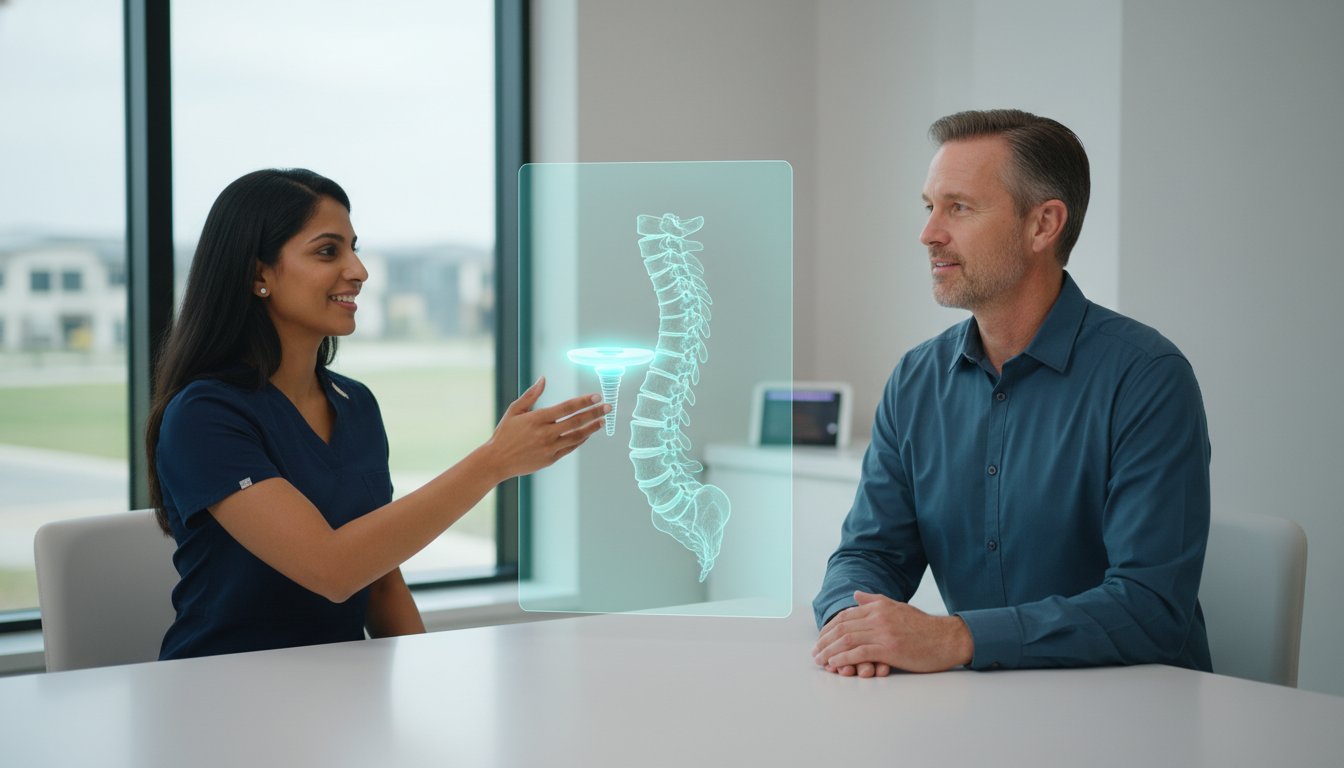
Did you know that 90% of patients undergoing artificial disc replacement return to work within just 14 days? If you’re struggling with chronic neck pain, the fear of a long, disabling recovery often feels as heavy as the physical symptoms themselves. You likely want to know the exact cervical disc replacement recovery time 2026 standards before committing to a procedure. It’s normal to feel anxious about post-operative pain or to worry that you’ll be sidelined from your life in North Texas for months on end.
This guide explains how our specialized approach to minimally invasive neurosurgery prioritizes your rapid return to activity. You’ll learn exactly when you can expect to drive, work, and resume your favorite hobbies with confidence. We’ll preview the latest clinical data, including the 91.7% meaningful improvement rate seen in modern motion-preserving devices, so you can stop feeling confused and start planning your journey toward lasting relief. Our goal is to move you from a state of concern to a state of informed confidence using the most advanced technology available today.
Key Takeaways
- Understand the accelerated cervical disc replacement recovery time 2026 standards that allow 90% of patients to return to work within just 14 days.
- Discover how robotic navigation and augmented reality provide precision that minimizes tissue trauma and speeds up your return to normal activity.
- Learn the critical 12-week milestone timeline, from early mobilization in the first 72 hours to resuming full physical tasks.
- Identify the specific lifestyle factors and “pre-hab” strategies that directly influence your body’s ability to heal after surgery.
- Explore why motion-preserving artificial disc replacement offers a modern, high-tech alternative to traditional spinal fusion.
Understanding Cervical Disc Replacement Recovery in 2026
Cervical disc replacement represents a paradigm shift in spinal care. Unlike traditional methods that prioritize stabilization through immobilization, this procedure aims to replicate the natural movement of your neck. Often referred to by clinicians as Total Disc Replacement (TDR), ADR replaces a diseased or damaged disc with a high-tech prosthetic that mimics organic biomechanics. The primary goal is to alleviate debilitating nerve pressure and radiating pain while preserving the flexibility you need for daily life. When we discuss the cervical disc replacement recovery time 2026 standards, we are looking at a timeline that is significantly shorter than in previous decades. This progress is largely due to advancements in surgical precision and the use of smaller, more focused access points.
It’s helpful to view your healing journey in two distinct phases. First is surgical healing, where the incision closes and initial inflammation subsides. Second is functional restoration, where your muscles and nerves adapt to the new implant and regained range of motion. In 2026, the clinical focus has shifted toward guided reactivation. This means we encourage gentle, controlled movement almost immediately after the procedure to prevent stiffness and promote blood flow to the surgical site.
Motion Preservation vs. Spinal Fusion Recovery
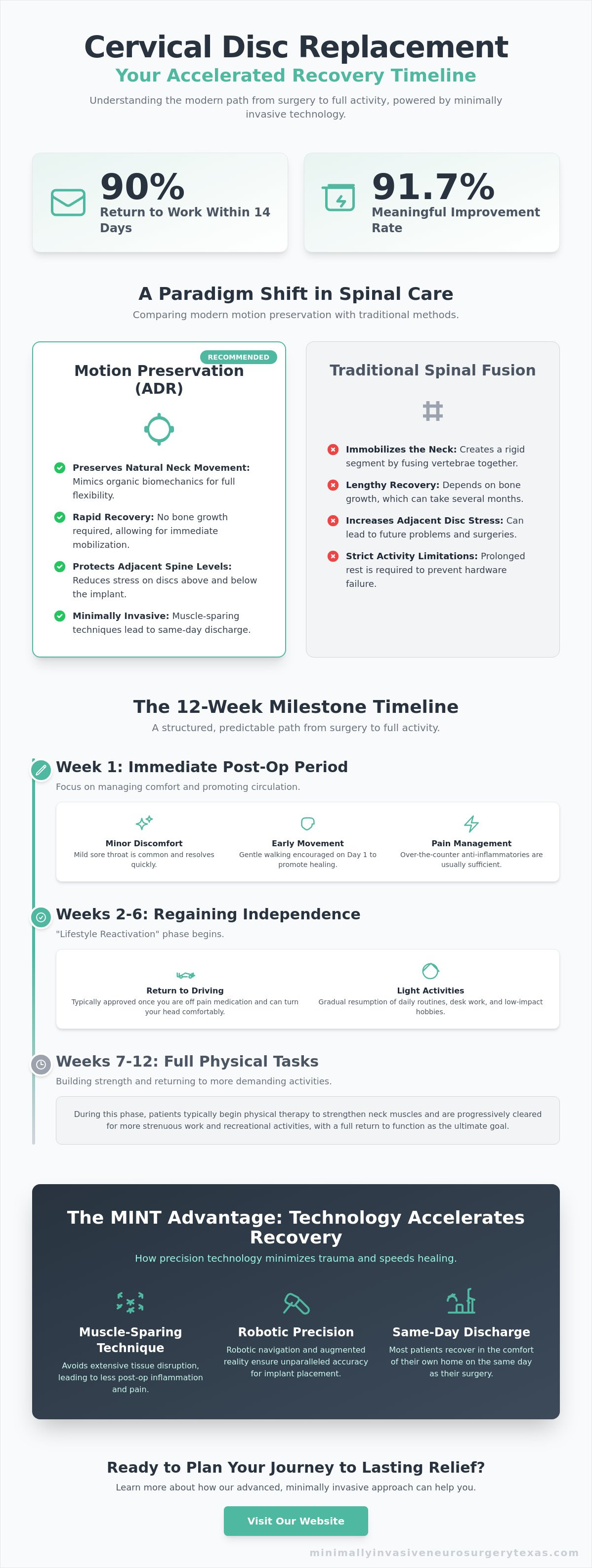
Fusion patients often face a lengthy waiting game because their recovery depends on bone growing across a graft to create a solid bridge. This biological process can take several months, during which activity is strictly limited to prevent the hardware from failing. ADR patients don’t have this constraint. Because there’s no bone growth required for stability, you can often move your neck within days of the procedure. Maintaining these natural biomechanics also protects the rest of your spine. By preserving motion at the treated level, we reduce the stress on the discs above and below, which helps prevent a complication known as adjacent segment disease.
The Role of Minimally Invasive Neurosurgery
At MINT, we utilize muscle-sparing techniques that avoid the extensive tissue disruption common in older surgical models. By working through smaller corridors, we significantly reduce post-operative inflammation and the need for heavy pain medication. This precision technology is a major reason why the cervical disc replacement recovery time 2026 experience often includes a same-day discharge. Most of our patients in Plano and Lewisville return home the afternoon of their surgery. This allows them to begin their recovery in a comfortable, familiar environment. Faster mobilization isn’t just a convenience; it’s a clinical strategy that accelerates the overall healing process and gets you back to your normal routine faster.
The 12-Week Milestone Timeline: From Surgery to Full Activity
Your journey back to health follows a structured, predictable path. In 2026, the clinical standard for cervical disc replacement recovery time 2026 emphasizes early mobilization rather than prolonged rest. Research indicates that 90% of patients return to work within just 14 days, a statistic that reflects the efficiency of modern motion preservation. While the prosthetic provides immediate structural stability, your body requires a specific sequence of healing to ensure long-term success. Understanding these milestones helps transform anxiety into a proactive recovery plan.
Detailed clinical data from Cervical Disk Replacement Surgery studies confirms that early movement prevents scar tissue from restricting your new range of motion. We categorize this progression into four distinct phases. Each phase moves you closer to your ultimate goal: a life free from chronic nerve pain and physical limitations.
Week 1: Navigating the Immediate Post-Op Period
The first 72 hours focus on managing minor surgical discomfort. Because we typically use an anterior approach, you might experience a mild sore throat or temporary difficulty swallowing. These symptoms usually resolve within a few days. We view movement as medicine. You’ll be encouraged to walk on day one to promote circulation. Your incision, though small due to our muscle-sparing techniques, requires basic care. Keep the area clean and dry, following the specific protocols provided by our surgical team in Plano. Most patients find that over-the-counter anti-inflammatories are sufficient for managing discomfort during this initial window.
Weeks 2-6: Regaining Your Independence
This period marks your return to “lifestyle reactivation.” You can typically return to driving once you’ve stopped taking narcotic pain medications and can rotate your head comfortably to check blind spots. For those with desk-based careers in North Texas, returning to work is often possible by the second week. We introduce gentle range-of-motion exercises during this phase to help your neck muscles adapt to the restored disc height. If you have questions about your specific timeline, you can schedule a consultation with our specialized team to discuss your unique healing progress.
Month 3 and Beyond: Long-term Outlook
By the third month, most patients have achieved their final surgical result. Nerve sensations, which may have tingled or felt “electric” during the early healing weeks, typically stabilize as the inflammatory response vanishes. Long-term maintenance involves staying active and maintaining core neck strength. We recommend annual check-ups to monitor the hardware and ensure the artificial disc continues to function perfectly within your spinal column. This high-tech healer approach ensures that your return to normal activity remains permanent and pain-free.
Why 2026 Technology Accelerates Your Recovery Time
The surgical precision of 2026 isn’t just about high-tech hardware; it’s about the biological response to that precision. By utilizing advanced visualization and robotic assistance, we can target the specific source of your pain with unprecedented accuracy. This level of detail directly influences the cervical disc replacement recovery time 2026 patients experience. When an implant is placed with sub-millimeter exactness, your body encounters less trauma, which translates to a faster, more comfortable healing process. High-tech tools allow us to move away from the “one-size-fits-all” approach of the past, tailoring every movement to your unique spinal anatomy.
Our commitment to innovation means your procedure is guided by real-time data. This reduces the need for extensive post-operative pharmaceutical intervention. Because the surrounding nerves and muscles are rarely disturbed, the inflammatory response is significantly muted. For more details on the evolution of these devices, the American Academy of Orthopaedic Surgeons provides a thorough breakdown of Cervical Disk Replacement designs and their clinical benefits. In 2026, we don’t just aim for a successful surgery; we aim for a recovery that feels like a seamless transition back to your normal life.
Robotic Precision in North Texas
At MINT, Dr. Scott Kutz utilizes the Globus Excelsius robotic navigation system to ensure absolute accuracy during your procedure. This system provides a rigid, GPS-like roadmap of your spine, allowing for sub-millimeter disc placement. Why does this matter for your recovery? When the artificial disc is positioned perfectly, it interacts with your vertebrae exactly as a natural disc would. This leads to more natural neck movement immediately following the surgery. You won’t have to wait for your body to “adjust” to a poorly aligned implant, which is a common cause of lingering discomfort in traditional surgeries.
We also integrate Augmented Reality (AR) through the Augmedics system. This provides our surgical team with “X-ray vision,” allowing us to see through the skin and tissue to visualize the underlying bone structure in 3D. This eliminates the guesswork and reduces the time you spend under anesthesia, which is a critical factor in how quickly you wake up and feel ready to mobilize.
Minimizing the “Surgical Footprint”
The difference between modern 2026 techniques and traditional open surgery is visible in the “surgical footprint” left behind. We define minimally invasive as the intentional reduction of collateral tissue damage during the surgical process. Instead of large, disruptive incisions, we typically use a 1-inch corridor to access the cervical spine. This muscle-sparing approach leads to several clinical advantages:
- Faster Skin Healing: Smaller incisions close more quickly and with minimal scarring.
- Lower Infection Rates: Reduced exposure of internal tissues significantly lowers the risk of post-op complications.
- Reduced Blood Loss: Endoscopic assistance allows us to maintain a clear surgical field with minimal fluid disruption.
By prioritizing these muscle-sparing methods, we ensure that the most difficult part of your recovery isn’t the healing of the surgical site, but simply waiting for your body to regain its full strength. Most of our patients find that this precision-first approach makes their recovery feel predictable and manageable.
Critical Factors That Influence Your Personal Healing Speed
While our high-tech surgical approach provides the foundation for success, your biological environment determines the final pace of your progress. The cervical disc replacement recovery time 2026 standards assume a baseline of healthy tissue integration. However, several modifiable factors can either accelerate or stall your journey back to normal activity. We view recovery as a partnership between our surgical precision and your commitment to a healing-focused lifestyle. By optimizing your physical health before you even enter the operating room, you create a “high-performance” environment for your new implant.
Nutrition plays a vital role in tissue repair and collagen synthesis. We recommend increasing your lean protein intake and maintaining strict hydration levels in the weeks surrounding your procedure. Protein provides the building blocks for muscle repair, while proper hydration ensures that your remaining natural discs stay cushioned and healthy. Adhering to post-operative lifting restrictions is equally critical. During the first six weeks, we typically limit lifting to ten pounds or less. This protection allows the prosthetic to settle perfectly into the vertebral architecture without the interference of excessive mechanical stress.
The “Non-Smoker” Advantage
Nicotine is perhaps the single greatest obstacle to a rapid recovery. It’s a powerful vasoconstrictor that narrows your blood vessels and starves the surgical site of the oxygen and nutrients required for cellular repair. This delay in blood flow can lead to sub-optimal wound healing and increased risks of hardware complications. At MINT, we strongly recommend that patients cease all nicotine use at least four to six weeks before and after surgery. Patients who remain nicotine-free consistently report lower pain levels and faster integration of the artificial disc compared to those who continue the habit.
Physical Therapy and Active Recovery
In 2026, we no longer prescribe total bed rest. Instead, we advocate for “active recovery” that balances resting the neck with moving the body. We refer our patients to the most skilled physical therapists in Plano and Lewisville to guide this transition. These specialists help you regain core stability and postural awareness without overtaxing the surgical site. You’ll learn to recognize the signs of pushing too hard, such as increased localized swelling or sharp nerve twinges, versus the normal “good” soreness associated with reactivation. If you are ready to optimize your health for a motion-preserving procedure, contact our team at MINT today to begin your personalized surgical assessment.
Pre-operative preparation, often called “pre-hab,” can also give you a head start. Strengthening your deep neck flexors and upper back muscles before surgery makes the post-operative transition feel much more natural. When your body is strong and well-nourished, the transition from chronic pain to a life of movement becomes a predictable, efficient process rather than a source of anxiety.
The MINT Advantage: Specialized Cervical Care in Plano & Lewisville
Dr. Scott Kutz leads our practice with a singular focus: restoring your mobility through advanced motion-preservation techniques. We operate as a boutique surgical center, avoiding the bureaucratic coldness of large hospital systems. This specialized environment is designed to streamline your care and optimize your cervical disc replacement recovery time 2026 experience. Our clinics in Plano and Lewisville provide convenient access to world-class spinal innovation right in your neighborhood. We believe that every patient deserves a personalized path to healing that combines clinical authority with compassionate reassurance.
Our results-oriented rhythm mirrors your own journey from diagnostic concern to informed confidence. By focusing exclusively on the most modern surgical methodologies, we maintain a level of proficiency that general surgical practices cannot match. This specialization directly contributes to the high clinical success rates associated with modern disc devices. We don’t just treat symptoms; we engineer a return to your normal activity level. Our commitment to North Texas residents is built on trust and the relief of suffering, positioning MINT as a source of optimism for those dealing with chronic physical conditions.
Why Choose a Neurosurgeon for Disc Replacement?
Choosing the right specialist is the most critical decision in your surgical journey. While many types of surgeons perform spine work, a board-certified neurosurgeon possesses unique expertise in managing the delicate neural structures that reside within the cervical canal. Dr. Kutz applies this specialized training to every minimally invasive neurosurgery he performs. This precision is essential for achieving the rapid recovery outcomes we discussed earlier, as it ensures the spinal cord and exiting nerves remain protected throughout the procedure. Our high-tech healer approach minimizes tissue disruption, which is the primary driver of post-operative comfort.
Your Recovery Starts with a Consultation
Your first visit to MINT is more than a simple appointment. It’s a comprehensive evaluation where we analyze your imaging, lifestyle goals, and clinical history to determine if you are a candidate for neck disk replacement. We believe that a successful cervical disc replacement recovery time 2026 begins with patient education and precise planning. You’ll leave our clinic with a clear understanding of your diagnosis and a realistic roadmap for your return to health. We take the time to answer your questions about driving, working, and long-term hardware maintenance.
Don’t let chronic neck pain dictate your future. Our team is dedicated to providing the relief of suffering through high-tech precision and compassionate care. If you’re ready to reclaim your mobility and leave the anxiety of spinal pain behind, Schedule your consultation with MINT today. We’re here to guide you through every step of your recovery, from the initial diagnosis to your final milestone of full activity.
Reclaim Your Active Lifestyle with Precision Care
Navigating your health journey requires a partner who combines technical mastery with a commitment to your daily quality of life. We’ve explored how motion-preserving technology and robotic precision can drastically reduce your cervical disc replacement recovery time 2026. By choosing a specialized minimally invasive spine center, you aren’t just treating a condition; you’re investing in a faster return to normal activity. Our use of the Globus Excelsius Robotic Navigation system ensures every movement is guided by sub-millimeter accuracy, minimizing tissue trauma and accelerating your healing process.
Board-Certified Neurosurgeon Dr. Scott Kutz and the MINT team prioritize your relief from suffering through innovation and personalized attention. You don’t have to settle for the limitations of chronic neck pain or the long wait times of traditional fusion. If you’re ready to move from a state of concern to a state of informed confidence, it’s time to speak with a specialist. Schedule Your Evaluation at our Plano or Lewisville Clinic today. We’re here to help you rediscover the freedom of movement without the burden of pain. Your journey back to a vibrant, active life is closer than you think.
Frequently Asked Questions
How long after cervical disc replacement can I drive?
You can typically return to driving within one to two weeks after your procedure. The primary requirements are that you must no longer be taking narcotic pain medications and you must have sufficient neck rotation to check your blind spots safely. Most patients find that their mobility returns quickly enough to meet these criteria by their first post-operative follow-up appointment.
When can I return to work after neck surgery in 2026?
Most patients with desk-based occupations return to work within 14 days. Clinical data shows a 90% return-to-work rate within this timeframe due to the motion-preserving nature of the implant and our muscle-sparing techniques. If your job involves heavy lifting or manual labor, your timeline may extend to six weeks or longer to ensure the prosthetic is fully integrated and stable.
Will I need to wear a neck brace after the procedure?
You generally won’t need a rigid neck brace after an artificial disc replacement. Unlike fusion surgery, which requires strict immobilization for bone growth, ADR thrives on early, controlled movement to maintain flexibility. We may provide a soft cervical collar for comfort during the first few days, particularly while sleeping or traveling, but we encourage active mobilization to prevent post-operative stiffness.
How soon can I start exercising or lifting weights?
Walking is encouraged starting on the day of your surgery to promote healthy circulation. You can usually transition to light aerobic exercise like stationary cycling by week two. However, you should avoid heavy weightlifting or high-impact sports for at least three months. This protection period is essential for the cervical disc replacement recovery time 2026 standards to ensure the implant remains perfectly aligned during tissue integration.
Is cervical disc replacement recovery more painful than fusion?
Recovery from disc replacement is typically less painful than traditional spinal fusion. Because ADR does not require bone grafting or the biological process of fusion, there is significantly less internal inflammation. Our minimally invasive neurosurgery techniques further reduce post-operative discomfort by sparing the surrounding muscles, allowing most patients to manage their recovery with simple over-the-counter anti-inflammatories after the first few days.
What are the red flags I should watch for during recovery?
Watch for warning signs such as a fever over 101 degrees, significant new weakness in your arms, or redness and drainage at the incision site. While minor throat soreness is common after an anterior approach, any severe difficulty breathing or swallowing should be reported immediately. These occurrences are rare with modern precision technology, but prompt communication with our clinics ensures your safety remains the top priority.
How long does the artificial disc last after surgery?
Modern artificial discs are engineered to last for several decades, with many designs intended to function for the remainder of a patient’s life. Laboratory testing simulates 40 to 50 years of typical neck movement without significant wear. This longevity is a hallmark of the motion-preserving approach, as it maintains the natural biomechanics of your spine and reduces the likelihood of needing future surgeries.
Can I travel or fly shortly after my disc replacement?
You can typically manage short car trips or domestic flights within one to two weeks of your procedure. For international travel or flights longer than four hours, we recommend waiting at least four weeks to minimize the risk of blood clots. Always stay hydrated and move your legs frequently during travel to maintain healthy circulation while your body continues its initial healing phase.