Minimally Invasive Neurosurgery of Texas (MINT), led by Dr. Scott Kutz, a board-certified neurosurgeon, Fellow of the American Association of Neurological Surgeons, and Fellow of the American College of Surgeons, specializes in motion-preserving spinal care in Lewisville and Plano, Texas. A core focus of the practice is providing advanced minimally invasive surgery for lumbar stenosis to help patients regain their independence and mobility.
What if the heavy, aching pain in your legs that stops you from walking through the grocery store could be resolved through an incision smaller than one inch? You likely feel that your world is shrinking as lumbar stenosis limits your activity and forces you to sit down just to find temporary relief. Dr. Scott Kutz understands that the fear of a long hospital stay or spinal instability often keeps patients from seeking the help they need. This 2026 guide reveals how advanced, motion-preserving techniques provide rapid relief from leg pain and numbness. We will examine how these outpatient procedures allow you to return to your daily activities within weeks and walk without the constant burden of chronic pain. By prioritizing precision over traditional open surgery, Dr. Scott Kutz helps you achieve lasting results with minimal physical impact.
Key Takeaways
- Learn how minimally invasive surgery for lumbar stenosis utilizes incisions smaller than one inch to decompress the spinal canal while preserving spinal stability.
- Discover how Dr. Scott Kutz uses high-definition visualization tools to provide precise relief from leg pain and numbness through outpatient procedures.
- Understand the differences between motion-preserving techniques like the MILD procedure and endoscopic decompression to find the right fit for your specific condition.
- Identify the clinical symptoms that qualify you for surgery and explore recovery timelines that often see patients walking unassisted within hours.
- Explore the benefits of choosing a specialized boutique practice in Lewisville or Plano for personalized care that prioritizes your return to a normal, active life.
Understanding Minimally Invasive Surgery for Lumbar Stenosis
Minimally Invasive Neurosurgery of Texas (MINT) operates as a specialized boutique surgical center under the leadership of Dr. Scott Kutz. As a board-certified neurosurgeon, Fellow of the American Association of Neurological Surgeons, and Fellow of the American College of Surgeons, Dr. Kutz focuses on motion-preserving care for patients in Lewisville and Plano, TX. His practice provides minimally invasive surgery for lumbar stenosis to address the chronic pain caused by a narrowing spinal canal. This condition, known as lumbar stenosis, restricts the space available for spinal nerves in the lower back. To resolve this, Dr. Kutz uses advanced Minimally invasive spine surgery techniques. These methods employ specialized instruments and high-definition visualization to relieve pressure on the nerves. These surgical approaches require incisions under one inch, which allows for a more precise and less traumatic intervention compared to traditional methods.
The Clinical Causes of Spinal Narrowing
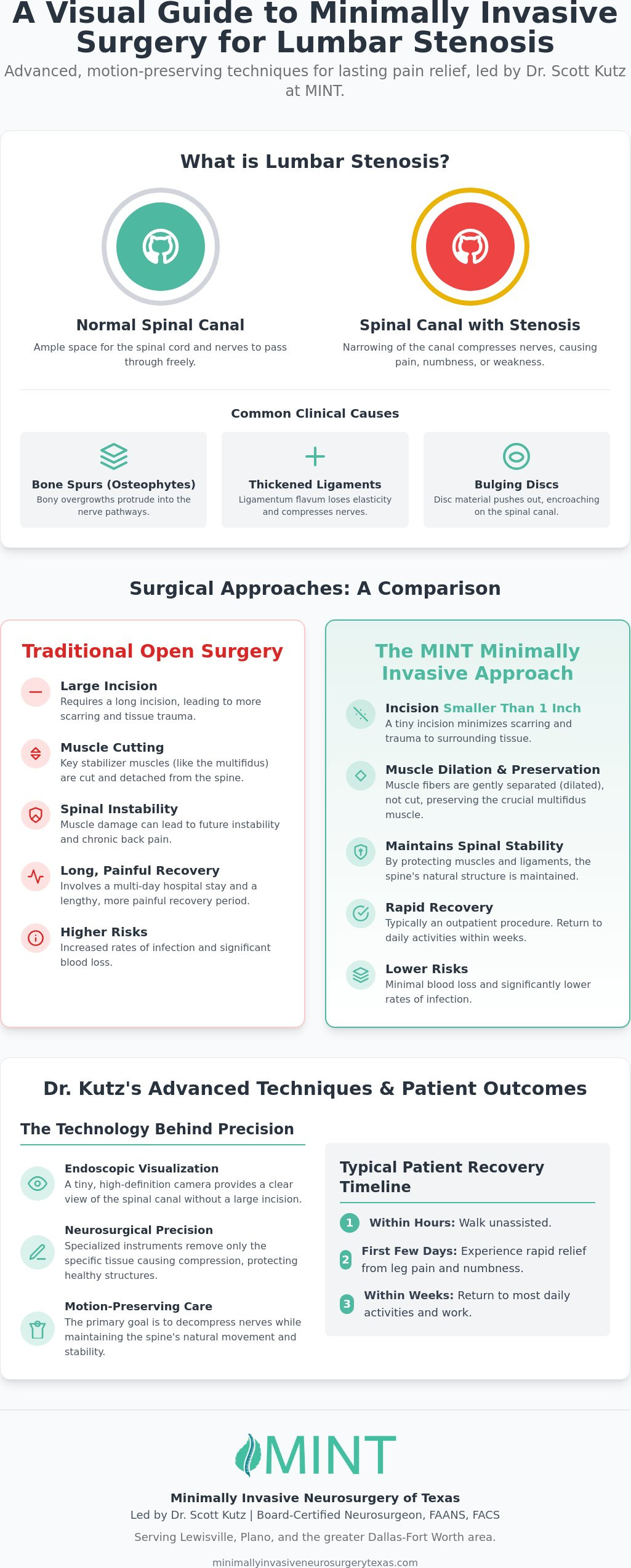
Several anatomical changes typically cause the spinal canal to narrow. Bone spurs, also called osteophytes, are common culprits. These are smooth, hard bumps of extra bone that grow on the vertebrae and protrude into the nerve pathways. Another significant factor is the thickening of the ligamentum flavum. This ligament runs along the inside of the spinal canal and can lose its elasticity, eventually compressing the nerves from behind. Additionally, bulging discs often contribute to the loss of space. When the soft inner material of a spinal disc pushes against its outer layer, it creates a bulge that encroaches on the spinal canal. Dr. Scott Kutz evaluates these specific causes to determine the most effective decompression strategy for each patient at our Lewisville or Plano offices.
Why Tissue Preservation Matters for Recovery
The primary benefit of a minimally invasive approach is the preservation of healthy tissue. Traditional open back surgery usually involves long incisions and the detachment of the multifidus muscle. This muscle serves as the primary stabilizer for the spine. When surgeons cut or detach it, the patient often faces a longer, more painful recovery. Dr. Kutz utilizes minimally invasive spine techniques that dilate the muscle fibers instead of cutting them. This preservation of the multifidus muscle significantly reduces post-operative pain and helps prevent future spinal instability. Smaller incisions also lead to lower infection rates and minimal blood loss. By protecting the structural integrity of the back, MINT ensures that patients can return to their daily routines much faster than those undergoing traditional surgery.
How Dr. Scott Kutz Performs Advanced Lumbar Decompression
Dr. Scott Kutz approach to minimally invasive surgery for lumbar stenosis begins with a meticulous neurosurgical plan. As a board-certified neurosurgeon and Fellow of the American Association of Neurological Surgeons, Dr. Kutz brings a specialized understanding of neural anatomy to every procedure. This expertise is vital because the goal of decompression isn’t just to remove bone; it’s to protect the delicate nerve roots that are being crowded. At Minimally Invasive Neurosurgery of Texas (MINT), he utilizes high-definition visualization tools that provide a crystal-clear view of the spinal canal. By focusing on surgical precision, he removes only the specific tissue causing the compression. This targeted approach ensures that the surrounding healthy bone and ligaments remain intact, which maintains the natural stability of your spine. If you’re struggling with leg pain or mobility issues, you can schedule a consultation at our Lewisville or Plano offices to discuss these advanced options.
The Role of Endoscopic Visualization
Modern endoscopic spine surgery has revolutionized how surgeons access the lower back. A spinal endoscope acts as a tiny camera that Dr. Kutz inserts through a small tube. This tool allows him to see around corners within the spinal canal without the need for large, traumatic incisions. The endoscope provides intense lighting and magnification, making it easier to distinguish between a compressed nerve and the thickened ligamentum flavum. Because the camera provides such a detailed view from the inside, the external surgical footprint remains as small as possible. This technology is a cornerstone of the precision care provided at our Lewisville headquarters.
Precision Microsurgical Tools
The tools used during these procedures are just as advanced as the cameras. Dr. Kutz often employs ultrasonic bone-cutting tools. These instruments use high-frequency vibrations to precisely shave away bone spurs while leaving soft tissues, like nerves and blood vessels, completely unharmed. These micro-instruments allow for a highly targeted foraminotomy, which widens the pathways where nerves exit the spine, or a laminectomy to relieve central pressure. By using these specialized tools, Dr. Kutz minimizes blood loss and reduces the physical impact on the body. This level of precision is why many MINT patients experience a much faster return to their daily activities compared to those undergoing traditional open surgery.
Comparing Minimally Invasive Procedures for Spinal Narrowing
Choosing the correct minimally invasive surgery for lumbar stenosis depends entirely on the specific anatomical cause of your symptoms. Dr. Scott Kutz performs a comprehensive evaluation to determine if your pain stems from bone spurs, a thickened ligament, or a bulging disc. For patients with a thickened ligamentum flavum, the MILD procedure (Percutaneous Image-guided Lumbar Decompression) offers a specialized solution. This technique removes small portions of the ligament through a tiny portal without the need for general anesthesia or stitches. In contrast, endoscopic decompression utilizes a high-definition camera to address more complex narrowing or specific nerve root compression. For broader decompression needs, a micro-laminectomy allows Dr. Kutz to remove bone and ligament through a small tubular retractor. Each of these procedures prioritizes the preservation of spinal stability while effectively opening the spinal canal to relieve nerve pressure.
Decompression vs. Spinal Fusion
Decompression focus on removing only the specific tissue causing nerve impingement. This approach is ideal when the spine remains structurally sound and stable. However, some patients exhibit spinal instability, such as spondylolisthesis, where one vertebra has slipped forward over another. In these instances, removing bone for decompression might further weaken the spinal structure. Dr. Scott Kutz may then recommend a fusion to stabilize the affected segment and prevent future nerve damage. You can find detailed information on these stabilization techniques in our Minimally Invasive Spinal Fusion Texas guide. While fusion provides necessary support for unstable spines, MINT always explores decompression-only options first to maintain your natural anatomy.
Motion-Preserving Alternatives
Dr. Kutz prioritizes motion-preserving strategies whenever clinically possible. Preserving the natural movement of your vertebrae reduces the physical stress placed on the levels above and below the surgical site. This focus helps prevent adjacent segment disease, a condition where fusion leads to accelerated wear on neighboring spinal joints. When the spinal structure is stable, avoiding hardware like rods or screws allows for a more natural range of motion during your recovery. For cases involving significant disc degeneration, artificial disc replacement serves as another advanced motion-preserving technology. This procedure replaces a damaged disc with a device that mimics natural movement, providing an alternative to traditional fusion. By utilizing these high-tech systems, MINT ensures you can return to your active lifestyle with a spine that remains flexible and functional.
Candidacy and Recovery Timelines for MIS Lumbar Procedures
Dr. Scott Kutz, a board-certified neurosurgeon and Fellow of the American Association of Neurological Surgeons, typically recommends surgery only after conservative treatments fail to provide relief. You can learn more about his background and our patient-first philosophy on our about us page. Most candidates for minimally invasive surgery for lumbar stenosis have spent at least six months attempting physical therapy, activity modification, or epidural steroid injections. When these methods no longer manage the pain, a surgical intervention becomes the most effective way to prevent permanent nerve damage. Because Dr. Kutz performs these procedures using muscle-sparing techniques, he often completes them in an outpatient setting. This allows you to recover in the comfort of your own home and avoid the risks associated with an extended hospital stay.
Who is a Candidate for MIS?
Candidates for these procedures usually struggle with neurogenic claudication, which is leg pain or heaviness that intensifies when standing or walking. A classic sign of candidacy is the shopping cart sign, where your pain improves significantly when you lean forward. To confirm your candidacy, Dr. Kutz utilizes high-resolution MRI or CT scans to identify the exact location of the narrowing. These diagnostic tools allow for meticulous surgical planning and ensure that the decompression targets only the problematic tissue. Age is rarely a barrier for these advanced techniques. Because the physical impact is so much lower than traditional open surgery, older patients can often safely undergo these procedures to restore their mobility and independence.
The First 48 Hours to Two Weeks
The recovery timeline for a minimally invasive decompression is remarkably fast. Most patients at our Lewisville and Plano offices walk unassisted within a few hours of their procedure. During the first 48 hours, you will focus on light movement and resting at home. Many patients report that the sharp, radiating leg pain they felt before surgery disappears almost instantly. You can typically return to light office work or sedentary activities within one week. However, you must adhere to specific restrictions during the initial healing phase. Dr. Kutz advises against heavy lifting, twisting, or strenuous exercise for the first two to four weeks to allow the internal tissues to heal properly. Most patients achieve a full return to normal activity levels within six weeks. If you are ready to find lasting relief from chronic leg pain, schedule a consultation at our Lewisville or Plano office today.
Choosing MINT for Lumbar Stenosis Treatment in Lewisville and Plano
Dr. Scott Kutz offers a level of specialized expertise that large, multi-disciplinary hospital systems often cannot match. As a board-certified neurosurgeon, Fellow of the American Association of Neurological Surgeons, and Fellow of the American College of Surgeons, he has dedicated his career to the advancement of motion-preserving spinal care. At Minimally Invasive Neurosurgery of Texas (MINT), the entire clinical team focuses exclusively on spinal health. This specialization ensures that every patient seeking minimally invasive surgery for lumbar stenosis receives care from professionals who understand the intricate nuances of spinal canal decompression. Dr. Kutz utilizes advanced technological systems, such as robotic navigation and endoscopic tools, to ensure the highest degree of surgical precision. By choosing a boutique practice, you benefit from a high-tech healer who combines cutting-edge innovation with a compassionate, local approach.
A Boutique Patient Experience
The journey toward recovery at MINT differs significantly from the experience at a large, impersonal hospital system. We prioritize personal attention and clear communication at every stage of your diagnostic journey. Dr. Kutz and his staff ensure that you understand your diagnosis and your surgical options without feeling like just another number in a system. Our patient-first communication philosophy fosters a state of informed confidence, moving you from concern to a clear path for recovery. For the convenience of our patients, we offer care at our primary Lewisville headquarters and our satellite office in Plano. This dual-location approach allows us to serve the North Texas community with the personal touch of a specialized surgical center while maintaining the highest clinical standards.
Schedule Your Evaluation
Patients from surrounding areas such as Southlake, McKinney, and Flower Mound often travel to our Lewisville office for precision spinal care. We encourage you to take the next step in your healthcare journey by scheduling a comprehensive evaluation. During your visit, Dr. Kutz will review your imaging and discuss how minimally invasive surgery for lumbar stenosis can address your specific symptoms. You can learn more about our philosophy and surgical outcomes by visiting the Minimally Invasive Neurosurgery of Texas about page. If you are ready to reclaim your mobility and live without the burden of chronic leg pain, call our office directly at (972) 244-3491. Our team is ready to help you return to normal activity with confidence and informed optimism.
Reclaiming Your Independence and Active Lifestyle
Living with the chronic leg pain and restricted movement of spinal narrowing doesn’t have to be your permanent reality. Advanced medical technology now allows for targeted relief through minimally invasive surgery for lumbar stenosis, which prioritizes the preservation of your natural spinal motion and structural stability. By choosing a specialized boutique practice like MINT, you receive personalized care that avoids the coldness and complexity of large hospital systems. Dr. Scott Kutz, a board-certified neurosurgeon with over 20 years of experience and a Fellow of the American College of Surgeons, utilizes precision-driven systems to ensure your recovery is both rapid and lasting. These motion-preserving techniques help you avoid the significant downtime of traditional open surgery while protecting the long-term health of your spine. Most patients walk within hours of their procedure and return to their favorite activities within weeks. You deserve a clear path back to a life without physical limitations. Take the first step toward relief and request a consultation with Dr. Scott Kutz at our Lewisville or Plano office. We look forward to helping you achieve a pain-free future.
Frequently Asked Questions
Is minimally invasive surgery for lumbar stenosis safe for elderly patients?
Minimally invasive surgery for lumbar stenosis is often a safer alternative for elderly patients compared to traditional open procedures. Dr. Scott Kutz utilizes incisions smaller than one inch, which significantly reduces blood loss and the risk of post-operative infection. Because these techniques are less traumatic to the body, older individuals can often undergo decompression with lower anesthesia risks and a much faster return to their daily routines.
How long does the actual MIS decompression procedure take?
A typical minimally invasive decompression procedure takes between 45 and 90 minutes to complete. The exact time depends on the number of spinal levels requiring treatment and the specific anatomical complexity of the narrowing. Dr. Scott Kutz uses high-definition visualization and specialized micro-instruments to ensure the procedure remains efficient and precise. This targeted approach minimizes the time you spend under anesthesia compared to traditional back surgery.
Will I need to stay in the hospital overnight after surgery?
Most patients do not require an overnight hospital stay after a procedure at MINT. Dr. Scott Kutz performs minimally invasive surgery for lumbar stenosis as an outpatient procedure, allowing you to return home the same day. This same-day discharge is possible because the muscle-sparing techniques result in less physical trauma. Recovering in your own home environment often leads to higher patient satisfaction and a lower risk of hospital-related complications.
What is the success rate of minimally invasive surgery for lumbar stenosis?
Clinical data indicates that for appropriately selected patients, the success rate for this surgery is as high as 90%. Dr. Scott Kutz focuses on precise nerve decompression to resolve symptoms like leg pain and numbness. Most patients experience immediate relief from radiating pain and a significant improvement in their walking distance. The high success rate stems from the ability to target the specific cause of stenosis without compromising spinal stability.
How soon can I start physical therapy after my procedure?
You can typically begin a structured physical therapy program two to four weeks after your surgery. While Dr. Scott Kutz encourages you to start walking within hours of the procedure, the initial weeks focus on natural healing. Physical therapy then plays a vital role in strengthening the muscles that support your spine. This gradual reintroduction of activity ensures you regain full mobility while protecting the surgical site during the early recovery phase.
Can lumbar stenosis return after a minimally invasive surgery?
The specific bone or ligament that Dr. Kutz removes during surgery does not grow back, so stenosis rarely recurs at the exact same site. However, degenerative changes can occasionally cause narrowing at a different level of the spine over time. Dr. Scott Kutz utilizes motion-preserving techniques to reduce the stress on neighboring vertebrae. Maintaining a healthy lifestyle and core strength helps minimize the risk of developing new issues at adjacent levels.
Does insurance typically cover minimally invasive spinal decompression?
Most private insurance providers and Medicare cover minimally invasive spinal decompression when conservative treatments fail to provide relief. Medicare generally covers 80% of the approved cost after you meet the Part B deductible. Because every plan has different requirements, our staff in Lewisville and Plano helps you navigate the prior authorization process. We work to ensure you understand your coverage and out of pocket responsibilities before your scheduled procedure.