Minimally Invasive Neurosurgery of Texas (MINT), led by board-certified neurosurgeon Dr. Scott Kutz, provides specialized care in Lewisville and Plano, TX. Dr. Kutz, a Fellow of the AANS and ACS, utilizes advanced technologies like robotic navigation to perform minimally invasive spine surgery and complex revision procedures for patients across North Texas, including McKinney and Flower Mound.
A successful surgery should mark the end of your pain; it shouldn’t start a new chapter of physical limitation. You likely chose surgery to escape the stabbing pain in your buttocks, yet you still struggle to sit through a dinner or stand without discomfort. It’s frustrating when you feel like your hardware is moving or loose after you’ve already committed to a long recovery. This guide helps you identify the specific symptoms of failed si joint fusion and explains how modern revision techniques can finally restore your mobility. We’ll examine why some fusions result in pseudarthrosis, a condition where the bone fails to fuse properly, and how Dr. Scott Kutz uses precision tools to correct these mechanical failures. You’ll discover how a targeted second opinion can move you from a state of constant concern to a state of informed confidence in your recovery.
Key Takeaways
- Learn to identify the warning signs, such as localized stabbing pain and a feeling of instability, which are primary symptoms of failed si joint fusion.
- Understand the difference between biological failure, like pseudarthrosis (bone failing to fuse), and mechanical issues involving hardware malpositioning.
- Discover why Dr. Scott Kutz uses a multi-modal diagnostic approach in Lewisville and Plano to find subtle issues that standard X-rays often miss.
- Explore how revision surgery using the Globus Excelsius robotic navigation system offers a precise, minimally invasive way to correct previous surgical errors.
- Gain a clear path toward a return to normal activity through specialized second opinions and advanced surgical methodologies at MINT.
Symptoms of Failed SI Joint Fusion: Identifying the Red Flags
Minimally Invasive Neurosurgery of Texas (MINT) is a specialized surgical practice led by Dr. Scott Kutz, a board-certified neurosurgeon and Fellow of the AANS and ACS. From our primary facilities in Lewisville and Plano, TX, Dr. Kutz treats patients from across the region, including McKinney and Southlake, who still suffer after a previous surgery. When a sacroiliac fusion fails to provide relief, it often leaves the patient feeling discouraged and physically limited. Identifying the symptoms of failed si joint fusion is the first step toward finding a corrective solution.
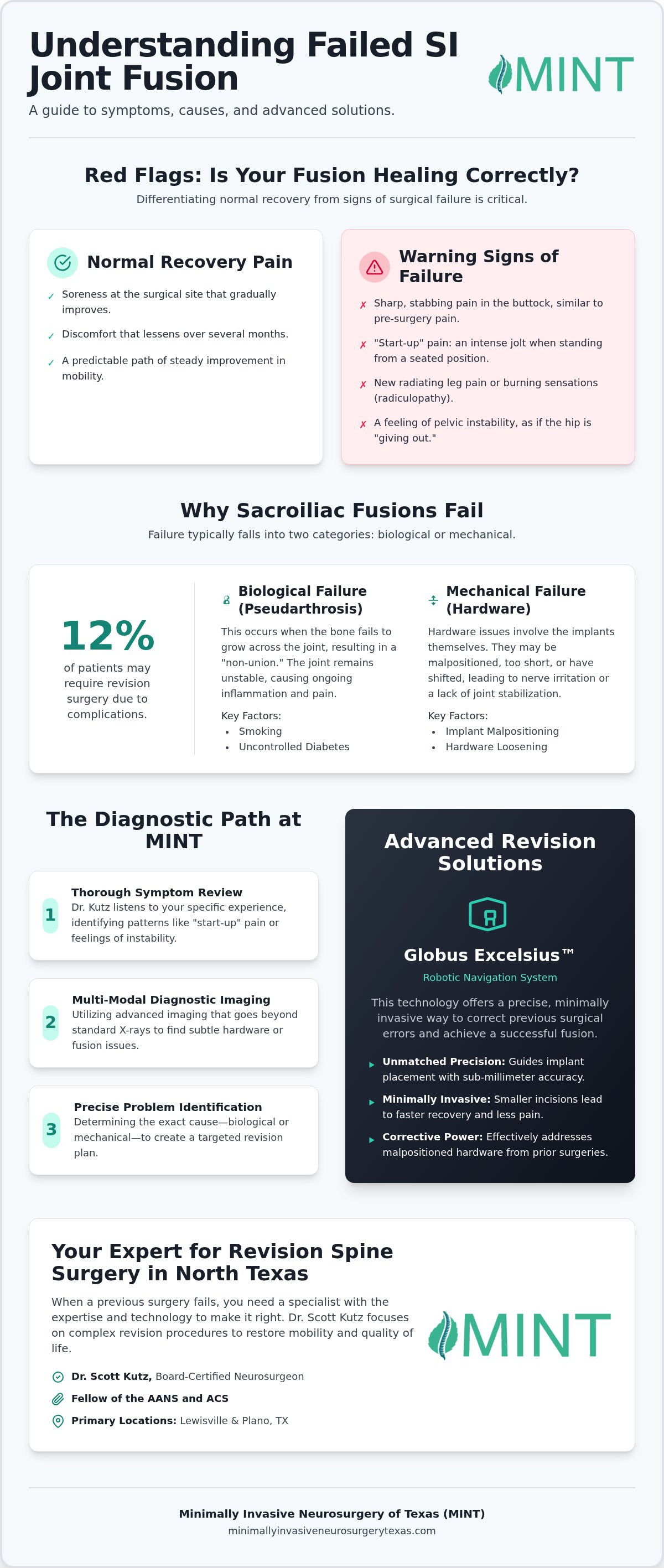
For many patients, the most frustrating aspect of a failed surgery is that the pain feels exactly like the original sacroiliac joint dysfunction. You may experience a sharp, stabbing sensation deep in the buttock that persists long after the initial healing phase. A hallmark sign of failure is “start-up” pain. This occurs when you transition from a seated or lying position to a standing one. If you feel a sudden, intense jolt in your lower back or hip the moment you rise from a chair, the fusion may not have stabilized the joint as intended.
Normal Recovery Pain vs. Surgical Failure
It’s normal to feel some soreness or surgical site discomfort for several months following minimally invasive spine surgery. However, a successful fusion follows a predictable path of improvement. In contrast, surgical failure often involves pain that remains stagnant or actually worsens over time. If you notice a new burning sensation or pain radiating down your leg, this may indicate radiculopathy, which is nerve irritation. In a failed fusion, this often happens because the surgical hardware is too close to the sacral nerves or has shifted since the procedure.
The Sensation of Pelvic Instability
A failed fusion often creates a distinct feeling of mechanical instability. Patients frequently describe a sensation that their hip is “giving out” or that the internal hardware feels loose. This lack of structural integrity forces you to change your gait, which is your natural walking pattern. You might find yourself limping or avoiding certain movements to protect the joint. This instability makes daily tasks difficult, such as:
- Climbing stairs or stepping over curbs
- Standing for more than ten or fifteen minutes
- Rolling over in bed at night
- Walking on uneven surfaces like grass or gravel
Dr. Scott Kutz emphasizes that these symptoms suggest the bones did not successfully grow together to create a solid bridge. When the joint continues to move despite the presence of implants, it causes ongoing inflammation and pain. At our Lewisville and Plano clinics, we prioritize a thorough diagnostic review to determine if your hardware is positioned correctly or if a biological failure has occurred.
Why Sacroiliac Fusions Fail: Biological and Mechanical Causes
Minimally Invasive Neurosurgery of Texas (MINT) provides expert revision spine surgery under the leadership of Dr. Scott Kutz, a board-certified neurosurgeon. Located in Lewisville and Plano, TX, our practice focuses on restoring mobility through advanced surgical techniques. Dr. Kutz, a Fellow of the AANS and ACS, specializes in identifying the biological and mechanical reasons why some procedures do not achieve the intended results. While primary SI joint fusion has a high success rate, approximately 12% of patients may require a revision due to underlying complications. Dr. Kutz analyzes the symptoms of failed si joint fusion to determine if the issue is structural or biological.
Biological Failure and Pseudarthrosis
Pseudarthrosis occurs when the body fails to grow new bone across the joint space. This results in a non-union, which is the clinical term for a fusion that never solidifies into a single bone. Research into the causes of SI joint pain shows that biological factors often hinder this process. Smoking significantly reduces blood flow to the bone, while uncontrolled diabetes interferes with the natural healing response. When the bone doesn’t bridge the gap, the joint continues to move, causing persistent inflammation and stabbing pain in the buttocks.
Mechanical Failure and Hardware Issues
Mechanical failure involves the implants themselves. Micro-motions within the pelvis can cause titanium implants to back out, meaning they slowly unscrew or shift out of position. In some cases, hardware malpositioning occurs during the initial surgery. This happens when a surgeon places an implant too close to the sacral nerves, causing sharp shooting pains down the leg. Dr. Kutz utilizes the Globus Excelsius robotic navigation system to address these mechanical issues with sub-millimeter precision. Hardware can also lose its grip on the bone, a process called loosening, or even fracture the surrounding bone if the patient has low bone density.
Sometimes, the original surgery failed because of an incorrect initial diagnosis. If the pain actually originated from a herniated disc or hip pathology rather than the SI joint, the fusion would not provide relief. This is why Dr. Kutz performs a thorough diagnostic review for patients from Flower Mound, Southlake, and the surrounding North Texas area. If you suspect your previous surgery did not address the true source of your pain, we invite you to reach out for a second opinion at our Lewisville or Plano offices.
The Diagnostic Path: How Dr. Kutz Identifies a Failed Fusion
Minimally Invasive Neurosurgery of Texas (MINT), led by board-certified neurosurgeon Dr. Scott Kutz, specializes in identifying and correcting complex surgical failures. Dr. Kutz, a Fellow of the AANS and ACS, operates primarily from facilities in Lewisville and Plano, TX. He treats patients from across North Texas, including Allen and Frisco, who continue to experience debilitating pain after a sacroiliac procedure. Diagnosis requires more than a simple review of past surgical notes. Dr. Kutz uses a multi-modal approach to confirm whether the symptoms of failed si joint fusion stem from a mechanical issue or a biological failure to heal.
Standard X-rays often provide an incomplete picture of a patient’s condition. While they can show major hardware displacement, they frequently fail to reveal subtle hardware loosening or early-stage bone resorption. At our Plano office, Dr. Kutz prioritizes a detailed patient history and physical examination. He looks for specific pain patterns, such as localized tenderness over the surgical site or pain that intensifies during specific pelvic rotations. High-resolution CT scans are essential in this process. These scans allow the surgeon to view the bone-to-implant interface with extreme clarity, identifying where the titanium has failed to integrate with the surrounding pelvic bone.
The Role of Diagnostic Injections
If imaging remains inconclusive, Dr. Kutz may recommend a diagnostic injection. This procedure involves injecting a numbing medication directly into the previously fused joint under live X-ray guidance. If the patient experiences immediate, significant pain relief, it confirms that the sacroiliac joint remains the primary source of the pain. This suggests the fusion is not solid. Conversely, if the injection provides no relief, the pain likely originates from a different spinal issue, such as a herniated disc or spinal stenosis, rather than a failure of the SI joint hardware.
Advanced Imaging Protocols in Lewisville
At our Lewisville headquarters, we utilize 3D CT reconstructions to visualize the entire fusion mass. This advanced technology helps Dr. Kutz identify “halos” around the surgical screws. A halo is a thin, radiolucent line on an image that indicates the screw is moving within the bone rather than staying fixed. These findings are critical for planning a revision procedure. You can find more detail on these diagnostic standards in our Minimally Invasive Spinal Fusion Texas guide. By combining physical testing with sub-millimeter imaging, Dr. Kutz ensures that any subsequent surgery addresses the exact cause of the failure, moving the patient closer to a return to normal activity.
Revision Options: Minimally Invasive Solutions at MINT
Revision surgery is a corrective procedure designed to fix a previous surgery that did not heal or stabilize correctly. At Minimally Invasive Neurosurgery of Texas, Dr. Scott Kutz uses advanced methodologies to help patients who still suffer from the symptoms of failed si joint fusion. If your initial implants have loosened or shifted, a revision allows the surgeon to remove the compromised hardware. Dr. Kutz then cleans the joint space and applies a bone graft to prepare the site for a more successful second fusion. He utilizes minimally invasive spine surgery techniques to minimize muscle and tissue damage. This approach typically leads to a much faster recovery than traditional open revision surgeries.
Robotic Navigation for Precision Revision
The Globus Excelsius robotic navigation system provides a level of accuracy that was once impossible. During a revision, Dr. Kutz uses 3D mapping to see the exact position of existing hardware and the surrounding pelvic anatomy. The robotic arm guides the placement of new implants with sub-millimeter precision. This ensures the new screws avoid the sacral nerves and achieve the best possible grip on the bone. This technology is particularly useful for navigating around dense surgical scars from your first procedure. By using this high-tech hallmark of our practice, we significantly reduce the risk of nerve irritation. This precision is why radiographic fusion rates for robotic revision can reach 100% by 18 months according to clinical data from early 2026.
Recovery and Expectations After Revision
Patients at our Plano and Lewisville clinics often return to light walking and daily tasks within a few weeks. However, full biological fusion, where the bone completely bridges the joint, can take several months. Dr. Kutz often recommends a bone growth stimulator. This is a portable device that uses electrical or ultrasonic signals to encourage the body to create new bone cells. This step is vital for overcoming the biological hurdles, like poor blood flow, that caused the first surgery to fail. A successful revision restores the structural integrity of the pelvis. This allows you to return to normal activity without the constant fear of your hip giving out. If you are ready to explore a permanent solution for your persistent pain, you can schedule a consultation with Dr. Kutz today at our Lewisville or Plano offices.
Finding Relief in North Texas: Why Choose Dr. Scott Kutz
Minimally Invasive Neurosurgery of Texas (MINT), led by board-certified neurosurgeon Dr. Scott Kutz, provides a dedicated path forward for patients whose initial surgeries did not deliver the promised relief. Dr. Kutz is a Fellow of the AANS and ACS with over 20 years of surgical experience. He operates from our primary facilities in Lewisville and Plano, TX, where he focuses on complex revision cases. We understand that a failed surgery carries a heavy emotional burden. If you still struggle with the symptoms of failed si joint fusion, you deserve a clinical team that listens to your concerns and offers concrete, high-tech solutions. Our practice maintains a patient-centered communication style that prioritizes your quality of life over simple diagnostic data. We encourage you to read testimonials from other North Texas residents who successfully regained their mobility after seeking care at MINT.
A Specialized Second Opinion
Seeking a second opinion is a vital step for anyone dealing with failed back or pelvic surgery. A new perspective often reveals subtle mechanical issues that the original surgeon might overlook. During a comprehensive consultation at our Lewisville office, Dr. Kutz reviews your previous surgical records and current imaging with a focus on motion-preserving options. He explains every medical finding in plain English, ensuring you understand why the first procedure did not achieve a solid fusion. Our goal is to move you from a state of physical limitation to a state of informed confidence. We specialize in minimally invasive spine surgery, which allows us to correct hardware issues with less trauma to the surrounding muscles and tissues.
Next Steps for Patients in Dallas and Fort Worth
Regaining your quality of life starts with a thorough diagnostic evaluation. MINT serves the entire Dallas and Fort Worth metroplex, including surrounding communities like Frisco, Allen, and McKinney. We relocated our headquarters to Lewisville in January 2026 to better serve our growing patient base, while our Plano office continues to provide convenient access for those in the northern suburbs. To schedule an appointment, you can call our office directly or use our online contact form. Our staff will guide you through the process of transferring your previous imaging and records for Dr. Kutz to review. You do not have to live with persistent pelvic pain or the feeling that your mobility is permanently lost. Reach out to MINT today to discover how advanced robotic revision can help you return to the activities you love.
Take the Next Step Toward Lasting Pelvic Stability
Identifying the biological and mechanical reasons behind a failed surgery is the only way to move past chronic pain. You’ve learned that persistent stabbing sensations and a feeling of pelvic instability are key symptoms of failed si joint fusion that require professional evaluation. Modern diagnostic tools like 3D CT reconstructions now allow Dr. Kutz to see hardware loosening and pseudarthrosis that standard imaging often misses. By choosing a specialized revision, you address these issues through minimally invasive techniques that prioritize your recovery timeline and long-term joint health.
Dr. Scott Kutz is board-certified by the American Board of Neurological Surgery and brings over 20 years of surgical experience to his patients in Lewisville and Plano. As a specialist in robotic-guided revision surgery, he uses the Globus Excelsius system to ensure your new implants achieve perfect placement and stability. You don’t have to accept a life of limited mobility or the frustration of a failed procedure. We invite you to schedule a consultation with Dr. Scott Kutz at MINT today to explore your options for a successful recovery. Your journey back to a normal, active life starts with a precise diagnosis and a surgeon you can trust.
Frequently Asked Questions
How do I know if my SI joint fusion has failed?
You know your surgery failed if the original stabbing pain returns or if you feel new instability in your hip. These symptoms of failed si joint fusion often become clear after the initial six-month healing window passes. If you struggle to stand from a seated position or feel a sharp jolt during pelvic rotation, your joint likely remains unstable.
Can a failed SI joint fusion be corrected with another surgery?
Yes, revision surgery can correct a failed fusion by removing loose hardware and achieving a solid biological bridge. Dr. Scott Kutz uses the Globus Excelsius robotic navigation system to ensure the second procedure achieves sub-millimeter precision. This high-tech approach allows the surgeon to place new implants in healthy bone while avoiding previous surgical scars.
What is the most common reason for SI joint fusion failure?
Pseudarthrosis, which is the failure of the bone to grow together across the joint space, is the most common reason for surgical failure. This biological non-union often occurs due to poor blood flow or patient risk factors like smoking. Mechanical issues, such as hardware malpositioning or loosening, also contribute to failure in a small percentage of traditional fusion cases.
How long after surgery do symptoms of a failed fusion appear?
Symptoms typically appear between six and twelve months after the initial procedure. This is the period when the bone should have solidified into a solid unit. If the pain persists or worsens after this timeframe, it suggests the joint did not fuse correctly. Some patients notice mechanical symptoms, like clicking or snapping, much sooner if the hardware shifts.
What does hardware loosening feel like in the sacroiliac joint?
Hardware loosening often feels like a deep, localized ache that turns into a sharp, stabbing sensation when you move. You might experience “start-up” pain, which is an intense jolt when you first stand up or roll over in bed. Some patients describe a sensation of the joint “slipping” because the titanium implants no longer have a firm grip on the bone.
Does Dr. Scott Kutz offer second opinions for failed spine surgeries?
Dr. Scott Kutz provides comprehensive second opinions for patients who have undergone unsuccessful spine or SI joint surgeries. During your consultation in Lewisville or Plano, TX, Dr. Kutz reviews your high-resolution CT scans to identify subtle hardware issues. He focuses on finding a minimally invasive path to restore your mobility and stop the cycle of chronic pain.
Is revision SI joint fusion more painful than the first surgery?
Revision surgery is not necessarily more painful than the first procedure because Dr. Kutz utilizes minimally invasive spine surgery techniques. These methods involve smaller incisions and less muscle disruption than traditional open surgery. Modern robotic-guided revisions allow for greater precision, which reduces the risk of nerve irritation and post-operative discomfort.
What is the recovery time for a revision SI fusion in Lewisville?
Most patients in Lewisville return to light daily activity within two to four weeks following a revision procedure. Full biological fusion, where the bone completely bridges the joint, usually requires six to twelve months. Dr. Kutz often prescribes a bone growth stimulator, which is a device that uses electrical signals to encourage bone growth, to ensure the joint solidifies correctly.