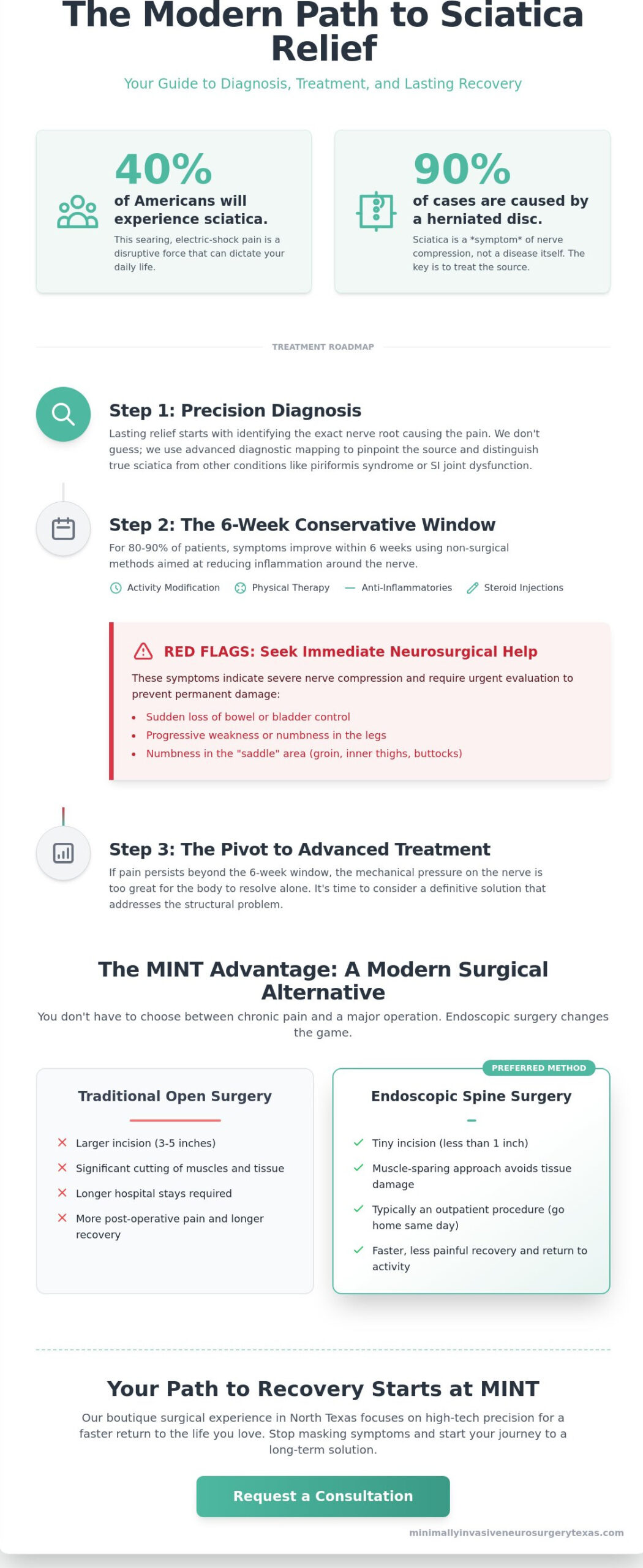
Did you know that up to 40% of Americans will experience the searing, electric-shock sensation of sciatica at some point in their lives? If you’re currently struggling to sit through a dinner or stand for more than a few minutes, you know that this condition is far more than just back pain. It’s a disruptive force that dictates your entire daily schedule. Many patients in Plano and Lewisville feel caught in a cycle of temporary fixes, wondering if they simply need more rest or if surgery is inevitable. Finding the right sciatica treatment starts with understanding that this pain is a symptom of an underlying issue, such as a herniated disc, which accounts for 90% of cases.
You deserve a path back to your normal activity that relies on precision rather than guesswork. We’re here to help you move beyond masking symptoms to achieving a long-term recovery through advanced diagnostic mapping and modern technology. This guide explores how specialized sciatica treatment in Lewisville and Plano can provide a faster recovery with less physical impact. We will look at how minimally invasive neurosurgery and endoscopic techniques offer a sophisticated alternative to traditional methods, ensuring you receive a diagnosis that targets the exact source of your nerve compression.
Key Takeaways
- Understand why sciatica is actually a symptom of lumbar radiculopathy and how precision diagnostics identify the exact nerve root involved.
- Learn to identify the right moment to pivot from conservative management to advanced sciatica treatment for long-term relief.
- Discover the clinical advantages of Endoscopic Spine Surgery, including smaller incisions and significantly less muscle trauma than traditional methods.
- Explore how diagnostic injections provide a roadmap for your recovery by confirming the pain source before any surgical intervention occurs.
- Gain insight into the boutique surgical experience in North Texas that focuses on your return to normal activity through high-tech precision.
Understanding Sciatica Treatment: More Than Just Masking the Pain
Sciatica is often misunderstood as a simple backache. It’s actually a clinical condition known as lumbar radiculopathy, which occurs when the nerve roots in the lower spine become compressed or irritated. Realizing that sciatica is a symptom rather than a standalone disease is the first step toward Understanding Sciatica and its underlying causes. Lasting sciatica treatment requires addressing the structural source of the compression. We don’t just focus on suppressing pain signals; we aim to resolve the mechanical issue at its origin.
Most cases of nerve impingement stem from specific structural changes in the spine. A herniated lumbar disc is the culprit in approximately 90% of sciatica instances. Other common triggers include bone spurs, also known as osteophytes, or spinal stenosis, which is a narrowing of the spinal canal that puts pressure on neural pathways. Identifying these triggers through precise imaging is essential for developing an effective recovery plan.
While many patients begin their journey with conservative care, certain “Red Flag” symptoms demand an immediate neurosurgical consultation. Seek professional medical attention right away if you experience a sudden loss of bowel or bladder control. Progressive leg weakness or numbness in the “saddle” area also requires urgent evaluation. These signs indicate severe nerve compromise that may lead to permanent damage if left untreated. Our team prioritizes these cases to ensure rapid intervention and nerve preservation.
The Anatomy of the Sciatic Nerve
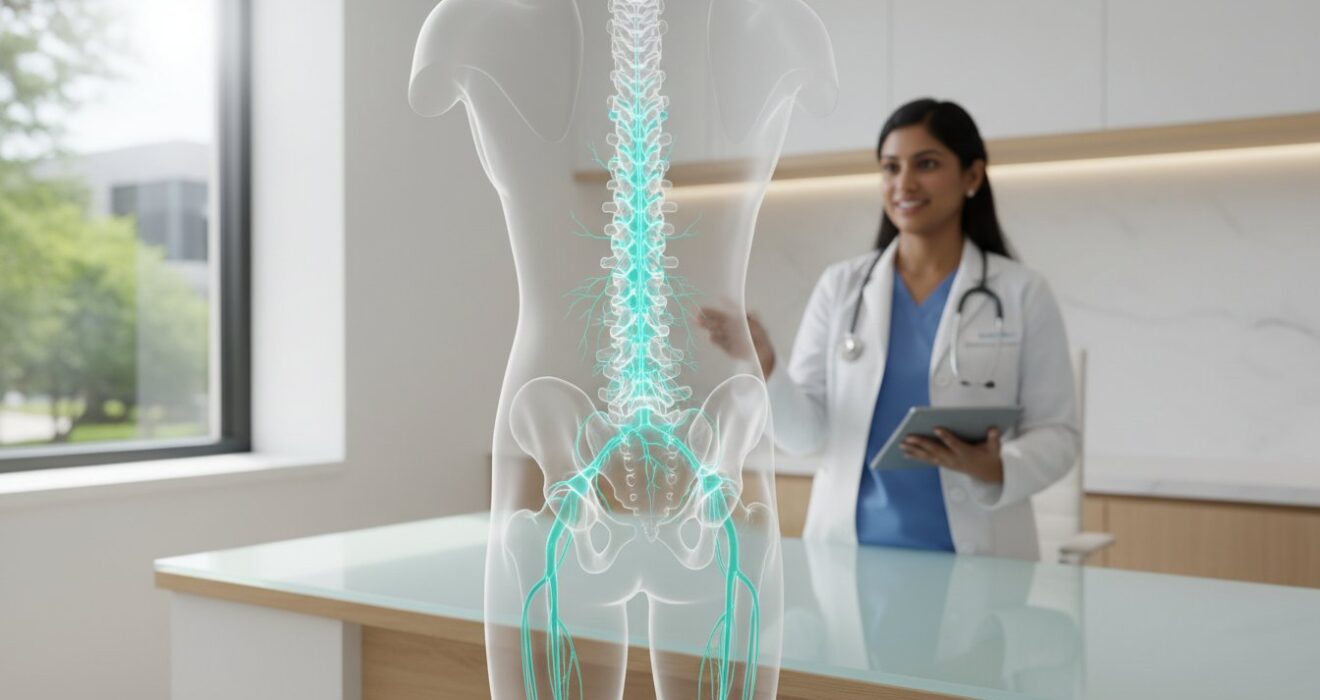
The sciatic nerve originates from the L4 through S3 vertebrae in the lumbar and sacral spine. It travels deep through the gluteal muscles and extends down the back of each leg, branching out to the feet. Sensory symptoms often manifest as tingling, burning, or “pins and needles” sensations along this specific path. Motor symptoms are more serious, appearing as muscle weakness that makes walking or standing difficult. The sciatic nerve is the longest and thickest nerve in the human body.
True Sciatica vs. Sciatica-Like Conditions
Not all radiating leg pain is true sciatica. “Pseudo-sciatica” can occur when the piriformis muscle in the buttock tightens and compresses the nerve, mimicking a spinal issue. Similarly, SI joint dysfunction can create referred pain that travels down the thigh. Because these conditions require vastly different clinical approaches, a precise diagnosis is vital. A board-certified neurosurgeon uses advanced neural mapping and high-resolution imaging to distinguish between muscular issues and actual nerve root compression. This ensures your sciatica treatment targets the correct anatomical level from the start.
Conservative vs. Surgical Sciatica Treatment: When to Pivot Your Strategy
Most patients start their recovery journey with conservative measures. This is a logical and often effective first step. Standard sciatica treatment options typically include non-steroidal anti-inflammatory drugs (NSAIDs), activity modification, and the alternating use of heat and ice. These methods aim to reduce the chemical inflammation surrounding the nerve. When oral medications aren’t enough, epidural steroid injections can provide a more concentrated dose of anti-inflammatories directly to the affected area. This can be highly effective for managing acute flare-ups, though it’s important to remember that injections don’t change the underlying spinal structure.
Clinical experts generally observe a six-week window for conservative management. Statistics show that roughly 80% to 90% of cases improve without the need for an operation. However, if your symptoms persist or worsen beyond this timeframe, it’s a clear signal that the mechanical compression is too significant for the body to resolve on its own. Many people endure years of pain because they fear a “major back surgery” with a long, difficult recovery. Modern medicine has changed this reality. You don’t have to choose between chronic suffering and a highly invasive procedure. If your current sciatica treatment isn’t delivering results, it may be time to consult with a spine specialist to explore advanced alternatives.
The Limitations of Non-Surgical Care
Non-surgical care has its limits, especially when dealing with structural abnormalities. If a herniated disc is physically impinging on a nerve root, physical therapy cannot move the disc material away from the nerve. Prolonged compression isn’t just painful; it’s dangerous. It can lead to permanent neurological deficits and muscle wasting. At MINT, we specialize in helping patients who have “graduated” from physical therapy but still haven’t found the relief they need to return to their normal activity.
The “Pivot Point” for Specialist Intervention
Identifying the pivot point is critical for a full neurological recovery. You should seek a specialist immediately if you notice “foot drop,” which is an inability to lift the front of your foot, or progressive weakness in your leg. Intractable pain that prevents sleep or work is another clear indicator for a change in strategy. In 2026, minimally invasive neurosurgery has redefined this transition point. By offering procedures with minimal downtime and reduced muscle trauma, we can intervene earlier. This early intervention often leads to better long-term outcomes because it prevents the nerve from being crushed for extended periods.
Why Your ‘Sciatica’ Might Not Be Sciatica: Precision Diagnosis in Plano
Many patients arrive at our Plano and Lewisville clinics after months of attempting home remedies for sciatica with little to show for it. The primary reason for persistent pain is often a lack of diagnostic precision. While a standard MRI can reveal a bulging disc, it doesn’t always tell the whole story. Many adults have asymptomatic disc bulges that appear on scans but cause no pain. A generalist may see an abnormality on an image and assume it’s the source of suffering, but our neurosurgeons take a more analytical approach. We ensure that your physical symptoms align perfectly with the radiological findings. This level of scrutiny is what prevents the dreaded “failed back surgery syndrome” and ensures that your sciatica treatment is targeted at the actual culprit.
Diagnostic injections serve as a vital tool in our assessment process. By injecting a small amount of numbing agent near a specific nerve root, we can “confirm” the pain source before moving forward. If your pain vanishes temporarily after the injection, we’ve found the exact target. This clinical confirmation provides a definitive roadmap for our surgical team. We believe that a precise diagnosis is the only way to move from temporary relief to a long-term recovery.
Advanced Imaging and Neural Mapping
High-resolution MRI is just the beginning of our diagnostic journey. In complex cases, we utilize CT myelograms to visualize the exact space around the spinal nerves with incredible clarity. We also employ Electromyography (EMG) and Nerve Conduction Studies to measure the electrical activity of your muscles and the speed of nerve signals. These tests help us determine if a nerve is actively being damaged or is simply irritated. It’s a fundamental truth in our practice that imaging must correlate perfectly with clinical symptoms for surgical success.
Evaluating the SI Joint and Piriformis
It’s common for patients to be told they have sciatica when the issue actually lies in the sacroiliac (SI) joint or the piriformis muscle. The SI joint, located where the spine meets the pelvis, can mimic the sharp, radiating pain of a herniated disc. Our differential diagnosis process in Plano involves specific physical maneuvers to isolate these joints and rule out “pseudo-sciatica.” If the SI joint is identified as the source of chronic instability, we may recommend minimally invasive spinal fusion Texas to stabilize the area. By distinguishing between nerve root compression and joint dysfunction, we ensure you receive the most effective sciatica treatment for your specific anatomy.
Minimally Invasive Sciatica Surgery: Advanced Options in North Texas
When conservative options fail to provide relief, the next step in your sciatica treatment involves modern surgical intervention. At MINT, we specialize in advanced methodologies that prioritize the preservation of healthy tissue. Endoscopic Spine Surgery represents the pinnacle of this “ultra-minimally invasive” approach. By utilizing specialized micro-instruments, we can address nerve compression through an incision no larger than a standard pencil eraser. This technique significantly reduces muscle trauma and blood loss compared to traditional “open” back surgery. Our use of robotic navigation systems allows for sub-millimeter precision, ensuring that the source of your pain is addressed with absolute accuracy. The ultimate goal of these high-tech interventions is a rapid return to normal activity.
Choosing a specialized surgical center means you’re not just another number in a large hospital system. We focus on boutique care that combines clinical authority with a compassionate, patient-centered style. This efficiency is a hallmark of our boutique surgical center’s approach to sciatica treatment. By focusing on the least invasive path possible, we minimize your time in the operating room and maximize your potential for a full, uncomplicated recovery.
Endoscopic Discectomy: The Gold Standard for Herniated Discs
An endoscopic discectomy is the most precise way to treat a herniated disc causing sciatic pain. We use a tiny camera, called an endoscope, to view the spinal canal in high definition. This allows the surgeon to remove only the portion of the disc that is pressing on the nerve without disturbing the surrounding bone or muscle. Because the procedure is so focused, it’s typically performed as an outpatient experience. Most patients return home the same day, avoiding the lengthy hospital stays associated with traditional methods. This approach is the modern standard for patients who want to resolve their pain without the baggage of a long recovery.
Artificial Disc Replacement vs. Fusion
For many patients in Plano and Lewisville, Artificial Disc Replacement (ADR) offers a superior alternative to traditional spinal fusion. While fusion locks two vertebrae together to stop movement, ADR preserves the natural motion of the lumbar spine. This motion preservation reduces the risk of “adjacent segment disease,” where the discs above and below the surgical site begin to wear out prematurely due to increased stress. Whether you’re seeking neck disk replacement or a lumbar solution, our robotic guidance systems ensure perfect implant placement every time. This technology removes the margin for human error and provides a stable, long-lasting result. If you’re ready to explore these advanced options, schedule a consultation with our neurosurgical team to discuss your path to recovery.
Choosing Your Sciatica Specialist at MINT: Relief Starts Here
Your path to recovery should not feel like navigating a complex maze. Choosing the right specialist for your sciatica treatment is the most critical decision you’ll make in your journey toward a pain-free life. At Minimally Invasive Neurosurgery of Texas (MINT), we provide a sophisticated alternative to the impersonal nature of large hospital systems. Our boutique surgical centers in Lewisville and Plano are designed to offer a personalized, patient-centered experience where your health is our absolute priority. We combine clinical excellence with a warm, welcoming environment to ensure you feel confident and informed at every stage of your care.
Dr. Scott Kutz leads our practice with a philosophy he calls High-Tech, High-Touch. This approach merges the absolute forefront of modern surgical innovation with the compassionate, dedicated attention of a local physician. We understand that chronic nerve pain affects more than just your body; it impacts your career, your family life, and your emotional well-being. Our goal is to provide a definitive solution that allows North Texas residents to reclaim their independence and return to their active lives without the burden of persistent suffering.
What to Expect During Your Consultation
Precision begins with your very first visit. When you arrive for a consultation, we don’t just look at a radiologist’s report. Dr. Kutz and our neurosurgical team perform a comprehensive review of your previous imaging, including MRIs and CT scans, through a specialized neurosurgical lens. This fresh perspective often uncovers subtle structural issues that may have been overlooked during earlier evaluations. Our process includes:
- A detailed physical examination to correlate your sensory and motor symptoms with imaging findings.
- A transparent discussion regarding the full spectrum of your options, ranging from conservative management to advanced sciatica treatment.
- A clear and honest assessment of your candidacy for surgery, ensuring that intervention is only recommended when it offers the highest probability of success.
- A personalized recovery roadmap tailored to your specific anatomical needs and lifestyle goals.
The MINT Difference: Innovation and Compassion
What distinguishes MINT from other practices is our singular focus on spinal health and minimally invasive neurosurgery. Unlike general surgeons, our specialists are dedicated to the intricate structures of the spine. We utilize the Globus Excelsius robotic navigation system to achieve a level of precision that was once impossible. This technology allows for sub-millimeter accuracy during procedures, which translates to smaller incisions, less muscle disruption, and a significantly faster recovery timeline for our patients. We believe that by staying at the absolute forefront of surgical technology, we can offer our community the safest and most effective outcomes available in 2026.
Relief is within reach. If you’re tired of temporary fixes and are ready for a long-term recovery, it’s time to take the next step. Schedule your sciatica evaluation at Minimally Invasive Neurosurgery of Texas today and discover how our high-tech approach can help you return to normal activity.
Reclaim Your Active Lifestyle with Precision Care
Living with radiating nerve pain doesn’t have to be your permanent reality. You’ve learned how a precision diagnosis distinguishes true nerve root compression from other conditions, ensuring your sciatica treatment targets the correct anatomical source. By leveraging specialized technology like Globus Excelsius robotic navigation, we offer surgical solutions that prioritize your safety and a rapid return to normal activity. Board-Certified Neurosurgeon Dr. Scott Kutz and the team at MINT focus exclusively on minimally invasive spine surgery, providing a boutique experience that larger hospital systems often lack.
We combine high-tech clinical authority with the compassionate care you deserve. Whether you’re exploring endoscopic spine surgery or artificial disc replacement, our goal is to resolve your pain through the least invasive means possible. You don’t have to settle for temporary relief when long-term recovery is within reach. Take the first step toward a pain-free future today.
Request an Appointment with Dr. Scott Kutz in Plano or Lewisville
Frequently Asked Questions
Is sciatica surgery considered a major operation?
Modern minimally invasive neurosurgery has transformed these procedures into targeted, low-impact interventions. Unlike traditional “open” back surgery that requires large incisions and significant muscle retraction, we use specialized instruments to address nerve compression through tiny openings. This approach preserves the integrity of your spinal support structures and typically allows for an outpatient experience. While any surgery requires careful consideration, these advanced techniques are designed to be far less taxing on the body than older methodologies.
How long is the recovery time after minimally invasive sciatica treatment?
Most patients return to light daily activities within a few days and resume their normal routines within two to four weeks. Because our techniques involve minimal muscle disruption, the initial healing phase is significantly shorter than traditional surgery. Your specific timeline depends on the complexity of the nerve compression and your overall health. We prioritize a rapid return to normal activity and provide a detailed recovery roadmap to ensure you heal safely and efficiently.
Can sciatica come back after I have surgery?
While the specific structural issue we resolve is corrected, it’s possible to develop a new herniation at a different level of the spine. The procedure successfully removes the existing pressure on the nerve root, but it doesn’t prevent future age-related changes in other discs. Maintaining a healthy weight and practicing proper lifting techniques are essential steps to protect your long-term spinal health. We focus on providing a definitive solution for your current pain while educating you on how to prevent future issues.
Will I need physical therapy after a minimally invasive procedure?
We typically recommend a structured rehabilitation program with an external specialist to help you regain core strength and flexibility. While the surgery corrects the mechanical source of your pain, physical therapy is vital for restoring the supportive muscles that protect your spine. This collaborative approach ensures that your sciatica treatment results in long-term stability. We coordinate with various providers in Plano and Lewisville to find a rehabilitation plan that fits your lifestyle.
How do I know if my leg pain is actually sciatica?
True sciatica is characterized by a sharp, searing, or electric-shock sensation that travels from the lower back through the buttock and down the back of the leg. This pain often extends below the knee and into the foot. If your discomfort is localized only in the hip or stops at the mid-thigh, it may be related to joint dysfunction rather than nerve root compression. A precise neurosurgical evaluation is the only way to confirm the source of the pain and rule out conditions like piriformis syndrome.
Does insurance typically cover minimally invasive spine surgery in Texas?
Most major insurance providers in Texas cover minimally invasive procedures when they are deemed medically necessary and conservative treatments have failed. Our administrative team works diligently to verify your benefits and obtain the required authorizations before your procedure. Because coverage varies between different plans and carriers, we recommend reviewing your specific policy regarding specialist care and surgical facility fees in the North Texas region.
What happens if I leave my sciatica untreated for too long?
Delaying necessary sciatica treatment can lead to permanent neurological deficits, such as chronic numbness or significant muscle weakness. If a nerve is compressed for an extended period, it may lose the ability to transmit signals properly even after the pressure is eventually removed. In severe cases, untreated compression can result in “foot drop” or a permanent loss of bowel and bladder control. Early intervention is critical to preserving nerve function and ensuring a full recovery.
Can Dr. Kutz help if I have already had a failed back surgery elsewhere?
Dr. Kutz frequently performs revision spine surgery for patients who did not achieve the desired results from previous operations. We use high-resolution imaging and diagnostic mapping to identify why the initial surgery failed, whether it was due to a missed fragment or recurrent herniation. Our specialized focus on minimally invasive techniques allows us to navigate through existing scar tissue with high precision. We offer a fresh perspective and advanced technological options for those still seeking relief after a previous surgical experience.