The pain that shoots from your lower back down through your leg isn’t something you should keep managing with rest and over-the-counter medication alone. If weeks of conservative treatment haven’t brought real relief, it’s a clear signal that your sciatic nerve needs more than a temporary fix. It needs precision care from sciatica specialists who understand the underlying structural cause, not just the symptom.
You already know how relentless this pain can be. The burning, the numbness, the way it steals simple pleasures like walking to the mailbox or sitting through dinner. And if you’ve tried physical therapy, epidural injections, or chiropractic care without lasting results, the frustration is completely understandable. The question most patients reach at this stage is exactly the right one: when is it time to see a neurosurgeon?
This article gives you a clear, honest answer. You’ll learn how to identify the right specialist for persistent sciatica, what a board-certified neurosurgeon evaluates that other providers often miss, and what advanced minimally invasive treatment options are available to patients in Lewisville and Plano through Minimally Invasive Neurosurgery of Texas (MINT). Relief and a return to normal daily activity are closer than you may think.
Key Takeaways
- Not all providers who treat back pain are equally equipped to address sciatica at its structural source, and understanding the difference between provider types helps you find the right level of care faster.
- Consulting sciatica specialists with neurosurgical training becomes critical when conservative treatments like physical therapy or injections fail to deliver lasting relief after six to twelve weeks.
- Waiting too long to seek specialized evaluation carries real clinical risk, including the possibility of permanent nerve damage that timely intervention could have prevented.
- Advanced minimally invasive techniques available in Lewisville and Plano offer meaningful advantages over traditional open surgery, including smaller incisions, less tissue disruption, and faster return to normal daily activity.
- Dr. Scott Kutz brings more than 20 years of experience in complex spinal disorders to patients across North Texas, combining board-certified expertise with motion-preserving surgical approaches designed to protect long-term spinal health.
Understanding Sciatica and the Role of a Specialist
Minimally Invasive Neurosurgery of Texas (MINT) is a specialized spine surgery practice led by Dr. Scott Kutz, a board-certified neurosurgeon, Fellow of the American Association of Neurological Surgeons, and Fellow of the American College of Surgeons. With offices in Lewisville, TX and Plano, TX, MINT focuses exclusively on minimally invasive and motion-preserving spinal procedures, including endoscopic spine surgery and artificial disc replacement. The practice’s clinical mission centers on identifying the precise structural source of nerve compression to deliver targeted, lasting relief rather than temporary symptom management.
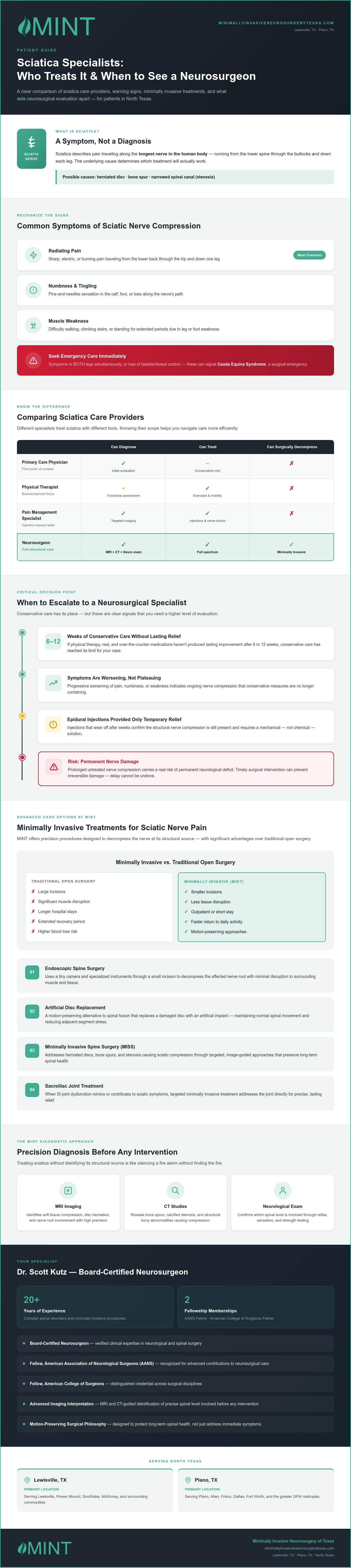
Sciatica describes pain that travels along the path of the sciatic nerve, the longest nerve in the human body, which runs from the lower spine through the buttocks and down each leg. The condition itself isn’t a diagnosis. It’s a symptom, and that distinction matters enormously when choosing who treats it. The underlying cause, whether a herniated disc, bone spur, or narrowed spinal canal, determines which treatment approach will actually work.
This is precisely where the sciatica specialists at MINT separate themselves from generalist providers. Dr. Scott Kutz brings over 20 years of experience in complex spinal disorders to every patient evaluation, applying advanced imaging interpretation and detailed clinical assessment to identify exactly which nerve root is compressed and why. That structural precision shapes every treatment decision that follows.
Common Symptoms of Sciatic Nerve Compression
Recognizing these symptoms helps patients seek the right level of care sooner:
- Radiating pain that travels from the lower back through the hip and down one leg, often described as sharp, electric, or burning
- Numbness and tingling along the nerve’s path, frequently felt as a pins-and-needles sensation in the calf, foot, or toes
- Muscle weakness in the affected leg or foot that makes walking, climbing stairs, or standing for extended periods noticeably harder
Symptoms that affect both legs simultaneously, or that accompany loss of bladder or bowel control, require immediate evaluation. These patterns can signal a more serious condition called cauda equina syndrome, which constitutes a surgical emergency.
Why a Precise Diagnosis Matters
Treating sciatica without identifying its structural source is like silencing a fire alarm without finding the fire. Misdiagnosis leads to weeks or months of ineffective treatment while nerve compression continues. Dr. Kutz uses advanced imaging, including MRI and CT studies, alongside a thorough neurological examination to confirm which spinal level is involved before any intervention is recommended. That diagnostic accuracy is the foundation of every successful outcome at MINT.
Comparing Different Types of Sciatica Specialists
Most patients don’t start their journey with a neurosurgeon. They begin with a primary care physician who orders imaging and recommends rest, then progress to a physical therapist working on core strengthening and mobility, and eventually land in a pain management clinic for epidural steroid injections. This progression makes sense for many patients. But when symptoms persist or worsen, understanding exactly who treats what, and why the distinction matters, becomes essential to getting the right care.
The landscape of sciatica specialists spans several disciplines, each with a different scope of practice and a different set of tools. Primary care physicians are skilled at initial evaluation and conservative management. Physical therapists address biomechanical dysfunction and muscular imbalance. Pain management specialists focus on reducing inflammation and interrupting pain signals through targeted injections and nerve blocks. Each plays a legitimate role in the care continuum. None of them, however, are trained to surgically decompress a nerve root that won’t respond to anything else.
The Difference Between Pain Management and Neurosurgery
Pain management is designed to reduce the experience of sciatic nerve pain, not to eliminate its structural cause. An epidural steroid injection can calm inflammation around a compressed nerve root and provide meaningful short-term relief, but it doesn’t remove the herniated disc material or bone spur creating the compression in the first place. When the inflammation returns, the pain returns with it.
Neurosurgery operates at a different level entirely. Dr. Scott Kutz and the team at MINT are trained in the precise anatomy of the spinal cord, nerve roots, and surrounding structures, the same structures that, when compressed, generate the burning and radiating pain that travels down your leg. That anatomical expertise allows a neurosurgeon to identify exactly where decompression is needed and perform it with a level of specificity that general pain management simply cannot replicate. MINT always prioritizes conservative care first, but when that approach has been exhausted, surgical decompression becomes the most direct path to lasting recovery.
When to Choose a Board-Certified Neurosurgeon
Certain clinical presentations move the decision toward neurosurgical evaluation without delay. Progressive neurological deficits are the clearest signal. Foot drop, the inability to lift the front of your foot while walking, indicates active nerve damage that conservative measures cannot reverse. Conditions requiring spinal decompression or stabilization, such as severe disc herniation, lateral recess stenosis, or spondylolisthesis, fall squarely within neurosurgical territory.
Dr. Scott Kutz is a board-certified neurosurgeon and Fellow of the American Association of Neurological Surgeons, a designation that reflects the highest level of peer-recognized achievement in the field. That credential isn’t ceremonial. It signals that Dr. Kutz has met rigorous standards in surgical training, clinical outcomes, and ongoing professional development. For patients in Lewisville and Plano who have exhausted other options, that level of expertise is exactly what the next step requires. If you’re unsure whether your symptoms have crossed that threshold, schedule a consultation with MINT to get a clear, expert answer.
Recognizing When to Consult a Neurosurgical Specialist
Waiting is the most common mistake patients make. Not because they’re careless, but because they’re hopeful. Another round of physical therapy, one more injection, a few more weeks of rest. That hope is understandable, but it carries a clinical cost. Prolonged nerve compression can cause damage that becomes permanent, and no surgical technique, however precise, can fully restore a nerve that has been compromised too long. The window for optimal recovery is real, and it closes.
Dr. Scott Kutz recommends a neurosurgical consultation when conservative treatments haven’t produced meaningful, lasting relief after six to twelve weeks. That timeline isn’t arbitrary. It reflects the clinical reality that most cases of acute nerve compression respond to conservative care within that window. When they don’t, the underlying structural problem is unlikely to resolve on its own. Early evaluation by sciatica specialists with neurosurgical training allows for targeted intervention before nerve damage progresses, and it often allows for less complex procedures than would be needed if treatment is delayed further. You can review Dr. Kutz’s clinical background and approach at the MINT about us page.
Red Flags That Require Immediate Attention
Some symptoms don’t allow for a wait-and-see approach. These presentations require emergency evaluation, not a scheduled appointment:
- Sudden loss of bowel or bladder control is the hallmark sign of cauda equina syndrome, a compression of the nerve bundle at the base of the spine that constitutes a surgical emergency. Hours matter.
- Rapidly worsening leg weakness that progresses to the point of difficulty standing or bearing weight signals active, accelerating nerve damage.
- Numbness in the saddle area or inner thighs, the region that would contact a saddle while riding, indicates involvement of the sacral nerve roots and demands immediate imaging.
The Mayo Clinic’s overview of sciatica symptoms and causes confirms that these neurological warning signs distinguish routine sciatica from emergent spinal conditions requiring urgent care. If any of these symptoms appear, go directly to an emergency room or call 911.
The Limitations of Conservative Therapy
Conservative care works well for many patients. It simply can’t do what it isn’t designed to do. Physical therapy corrects muscular imbalances, improves posture, and builds the core stability that protects the spine long-term. It cannot reabsorb a severely herniated disc or widen a spinal canal narrowed by bone spurs. Epidural steroid injections reduce inflammation around a compressed nerve root and can provide weeks of meaningful relief, but the disc material or bony structure creating the compression remains exactly where it was.
When Dr. Scott Kutz evaluates a patient who has completed a course of conservative care without lasting results, he reviews the full treatment history with specific clinical questions in mind: What imaging was done and when? Which nerve levels were targeted by injections? Did physical therapy address the correct structural problem? That review determines whether conservative care was truly exhausted or simply incomplete. It also identifies the most precise, least invasive surgical path forward for patients who genuinely need it, protecting both their recovery timeline and their long-term spinal health.
Advanced Minimally Invasive Treatments for Sciatic Nerve Pain
When conservative care has run its course and the structural source of your sciatic nerve pain is clearly identified, the next question becomes which surgical approach delivers the best outcome with the least disruption to your body. At MINT, the answer is always rooted in the same principle: use the smallest intervention necessary to achieve the most precise, lasting result. Dr. Scott Kutz designs every surgical plan around motion preservation and minimal tissue disruption, protecting your spinal health not just today but for the decades ahead. Explore our minimally invasive spine techniques to understand the full range of approaches available to patients in Lewisville and Plano.
Endoscopic Spine Surgery and Microdiscectomy
Endoscopic spine surgery uses a thin tube equipped with a miniature camera, allowing Dr. Kutz to visualize the compressed nerve root and the offending disc material through an opening that’s a fraction of the size used in traditional open surgery. The surrounding muscles and soft tissue remain largely undisturbed, which translates directly into less post-operative pain and a significantly shorter recovery timeline. Microdiscectomy, one of the most precise tools available to sciatica specialists, removes only the specific portion of the herniated disc pressing against the nerve root, leaving the rest of the disc structure intact. Both procedures are typically performed on an outpatient basis, meaning most patients return home the same day rather than spending nights in a hospital.
Artificial Disc Replacement as an Alternative to Fusion
Traditional spinal fusion eliminates movement at the treated level by permanently joining two vertebrae together. That stability comes at a cost: the segments above and below the fusion absorb additional stress, which can accelerate degeneration over time, a phenomenon known as adjacent segment disease. Artificial disc replacement (ADR) addresses this directly. By replacing the damaged disc with a precision-engineered implant that replicates the spine’s natural range of motion, ADR preserves flexibility at the treated level and reduces the mechanical burden on neighboring segments. Dr. Scott Kutz is an expert in ADR for patients who qualify, making it a compelling option for those who want lasting relief without sacrificing long-term spinal mobility. Learn more about this approach at the MINT artificial disc replacement page.
Addressing Sacroiliac Joint Dysfunction
One of the most frequently missed diagnoses in patients with leg pain is sacroiliac (SI) joint dysfunction. The SI joint connects the base of the spine to the pelvis, and when it becomes inflamed or unstable, it generates pain patterns that travel into the buttock and down the leg in a way that closely mimics sciatic nerve compression. Generalist providers often overlook this distinction entirely, directing patients toward spinal treatments that don’t address the actual source of their pain.
Dr. Kutz evaluates SI joint involvement as a routine part of every diagnostic workup at MINT. That step matters. Proceeding with spine surgery on a patient whose leg pain originates from the SI joint doesn’t resolve the problem; it simply adds an unnecessary procedure. For patients whose symptoms are confirmed to originate at the sacroiliac joint, MINT provides minimally invasive SI joint fusion, a targeted procedure that stabilizes the joint and eliminates the dysfunction driving the pain.
Patients across North Texas, including those in Lewisville, Plano, Allen, and McKinney, now have access to this level of diagnostic precision and surgical expertise without traveling out of state. If you’re ready to find out which approach fits your specific condition, schedule a consultation with Dr. Kutz at MINT and take the first step toward a real return to normal daily activity.
Why Patients in Plano and Lewisville Trust Dr. Scott Kutz
Choosing a surgeon is one of the most consequential decisions a patient makes. It’s not a choice that should rest on proximity alone, or on a referral made without context. Patients across the Dallas-Fort Worth Metroplex, from McKinney and Allen to Southlake and beyond, consistently choose MINT because Dr. Scott Kutz offers something that large hospital systems and generalist practices rarely can: deep subspecialty expertise delivered with genuine personal attention.
More than 20 years of experience treating complex spinal disorders shapes every consultation Dr. Kutz conducts. That depth of clinical history means he has encountered the full spectrum of presentations that sciatica specialists face, including the atypical cases that confound providers with narrower experience. Patients who arrive at MINT after years of misdiagnosis or failed treatments often describe their first consultation as the first time someone actually explained what was happening in their spine and why previous treatments hadn’t worked.
MINT’s 2026 relocation to a state-of-the-art headquarters in Lewisville, TX, reflects the practice’s commitment to delivering advanced surgical care in a facility designed specifically for minimally invasive procedures. The new location serves patients throughout North Texas with the same clinical rigor that has defined MINT’s reputation, now in a purpose-built environment that supports the precision these procedures demand.
Board-Certified Expertise in North Texas
Dr. Scott C. Kutz is board-certified by the American Board of Neurological Surgery and completed a fellowship in functional neurosurgery at Rush University Medical Center, one of the country’s most respected academic medical institutions. That training foundation, combined with his ongoing commitment to surgical innovation, means patients in Lewisville and Plano receive care that reflects the most current evidence and technique available in 2026. Credentials like these aren’t background details. They’re the clinical basis for trusting someone with your spine. You can review Dr. Kutz’s full background at the MINT about us page.
Patient-Centered Care and Recovery
No procedure is recommended at MINT until the patient fully understands their diagnosis, the structural source of their pain, and every available treatment path. That commitment to informed decision-making isn’t a formality. It’s the foundation of a care philosophy built on trust. The goal is always a return to normal daily activity through the least invasive method that will achieve a lasting result. For patients who want to hear directly from others who’ve walked this path, read patient stories from the Plano and Lewisville community and see what recovery actually looks like when the right specialist finds the right solution.
Your Path to Lasting Relief Starts Here
Persistent sciatic nerve pain isn’t something you have to keep living with. This article has walked you through the critical distinctions between provider types, the warning signs that demand urgent evaluation, and the advanced minimally invasive procedures that address the structural source of your pain rather than masking its symptoms. The clearest takeaway is this: when conservative care hasn’t delivered lasting results, the right sciatica specialists make all the difference.
Dr. Scott Kutz brings more than 20 years of board-certified neurosurgical expertise to patients in Lewisville and Plano, combining precise diagnostic evaluation with motion-preserving techniques designed to protect your spinal health for the long term. The goal at MINT is always the same: a real return to normal daily activity through the least invasive approach that achieves a lasting result.
You don’t have to keep waiting for relief that never comes. Schedule your consultation with Dr. Scott Kutz today and take the first concrete step toward understanding exactly what’s causing your pain and what it will take to resolve it for good.
Frequently Asked Questions About Sciatica Specialists
What type of doctor is a sciatica specialist?
Sciatica specialists can come from several disciplines, including primary care physicians, physiatrists, pain management doctors, orthopedic surgeons, and neurosurgeons. The right type depends on the severity and duration of your symptoms. For cases involving structural compression of a nerve root, a board-certified neurosurgeon like Dr. Scott Kutz offers the deepest anatomical expertise and the widest range of treatment options, from conservative management through advanced minimally invasive surgical intervention.
When should I see a neurosurgeon for my sciatica pain?
A neurosurgical consultation becomes appropriate when conservative treatments haven’t produced lasting relief after six to twelve weeks, when you’re experiencing progressive leg weakness, or when foot drop develops. These signs indicate that the nerve compression is causing active damage rather than temporary irritation. Waiting beyond this point risks permanent neurological deficit that even precise surgical decompression may not fully reverse. Early evaluation gives you the best possible outcome.
Is minimally invasive spine surgery better than traditional open surgery?
For most patients with sciatic nerve compression, minimally invasive approaches offer meaningful clinical advantages over traditional open surgery. Smaller incisions mean less disruption to surrounding muscles and soft tissue, which directly reduces post-operative pain and shortens recovery time. Not every patient is a candidate, however. Dr. Scott Kutz evaluates each case individually to determine whether an endoscopic approach, microdiscectomy, or another technique best matches the specific structural problem identified on imaging.
How long is the recovery time after a minimally invasive sciatica procedure?
Recovery timelines vary depending on the specific procedure and the patient’s overall health, but many patients who undergo minimally invasive decompression procedures at MINT return home the same day and resume light daily activities within one to two weeks. More involved procedures like artificial disc replacement typically require a longer structured recovery. Dr. Kutz provides each patient with a personalized recovery plan designed around their specific procedure and their goal of returning to normal daily activity as efficiently as possible.
Can a herniated disc heal on its own without surgery?
Yes, some herniated discs do improve without surgical intervention, particularly in the early weeks following onset. The body can gradually reabsorb disc material, and inflammation around the nerve root often diminishes with time and conservative care. However, this natural resolution doesn’t occur in every case. When symptoms persist beyond twelve weeks, worsen progressively, or include neurological deficits like weakness or numbness, the disc is unlikely to resolve on its own and a structural solution becomes necessary.
Does Dr. Scott Kutz treat patients from Frisco and McKinney?
Yes. Dr. Kutz and the MINT team serve patients from across the North Texas region, including McKinney, Allen, Frisco, Southlake, and Flower Mound. Following MINT’s 2026 relocation to its new Lewisville headquarters, the practice is well-positioned to serve communities throughout the Dallas-Fort Worth Metroplex. Patients from McKinney and surrounding areas regularly make the drive to access Dr. Kutz’s subspecialty expertise in minimally invasive neurosurgery.
What is the difference between a bulging disc and a herniated disc?
A bulging disc occurs when the outer wall of the disc extends beyond its normal boundary but remains intact, often producing mild to moderate nerve irritation. A herniated disc involves a rupture of that outer wall, allowing the inner gel-like material to leak out and press directly against nearby nerve roots. Herniated discs typically produce more intense, radiating symptoms. Dr. Kutz uses MRI and CT imaging to distinguish between these presentations precisely, since the structural difference directly influences which treatment approach is most appropriate.
Are there non-surgical options available at MINT for sciatica?
MINT’s clinical philosophy always prioritizes the least invasive approach that can achieve a lasting result. Dr. Kutz reviews each patient’s full conservative treatment history before any surgical recommendation is made, and he will direct patients back to appropriate non-surgical care when the clinical picture supports it. What MINT does not offer in-house includes physical therapy or chiropractic services. When surgery isn’t the right next step, Dr. Kutz provides clear guidance on which non-surgical path gives each patient the best chance at meaningful, durable relief.