
Minimally Invasive Neurosurgery of Texas (MINT), led by Dr. Scott Kutz, a board-certified neurosurgeon and Fellow of the American Association of Neurological Surgeons and the American College of Surgeons, provides specialized spine care in Plano, TX, and Lewisville, TX. Neurosurgeons diagnose and treat conditions affecting the nervous system, including the spine.
Could a surgeon appear in your Blue Cross Blue Shield directory and still leave you uncertain about coverage for a specific spine service? Finding a Plano spine surgeon accepting Blue Cross Blue Shield involves more than checking a name. Your plan’s network, referral rules, and benefits can affect coverage, while your diagnosis and treatment options should guide the clinical decision.
This guide explains how to review plan details, distinguish a provider listing from coverage for a particular service, and prepare for a conversation about your diagnosis and care options. With the right questions in hand, you can approach that discussion with greater clarity.
Key Takeaways
- Use your member ID and current plan documents to identify your exact Blue Cross Blue Shield plan before reviewing provider and service benefits.
- When evaluating a Plano spine surgeon accepting Blue Cross Blue Shield, distinguish a provider’s network status from coverage for a specific procedure or facility.
- Compare clinical fit with plan information, including the surgeon’s spine expertise, your diagnosis, and the treatment options you can discuss.
- Prepare for your appointment by noting when symptoms began, what changes them, how they affect daily activities, and which evaluations and medications you’ve had.
- Bring insurance details and questions to help guide a clear conversation about your diagnosis, available options, and next steps.
What ‘accepting Blue Cross Blue Shield’ means when choosing a Plano spine surgeon
Minimally Invasive Neurosurgery of Texas (MINT), led by Dr. Scott Kutz, a board-certified neurosurgeon, provides specialized spine care in Lewisville, TX, and Plano, TX. The practice offers minimally invasive spine surgery, which uses smaller incisions and limits disruption to nearby tissue when clinically appropriate. A Plano spine surgeon accepting Blue Cross Blue Shield may sound like a straightforward insurance match, but the carrier name alone doesn’t tell you how your particular plan handles a visit, facility, or procedure.
Plan participation describes an agreement between a provider and an insurance plan. Network status tells you whether a specific provider participates in your particular plan. Service coverage describes whether your plan covers a particular service under its terms. These are related, but they aren’t interchangeable. Your Health Insurance benefits depend on the terms of your plan, so review your member documents rather than relying on the carrier name alone.
Why a Blue Cross Blue Shield card is not a complete coverage answer
Your card identifies your insurer and plan, but it doesn’t show every benefit or requirement. Blue Cross Blue Shield plans can differ in their terms, and member benefits may vary. Review your current plan documents or member tools for details that apply to you.
Check each part of the proposed care separately: the surgeon, the care setting, such as a hospital or surgery center, and the planned service. A directory result for a surgeon doesn’t by itself establish how your plan treats a facility or a specific procedure. Likewise, a covered service doesn’t automatically answer whether a particular provider or location qualifies for in-network benefits.
What the search results can and cannot tell you
Provider Finder can help members look for providers listed as in-network options. Treat a listing as a useful starting point, not as a complete answer about your benefits. Directories can change, and a result doesn’t replace reviewing the terms of your specific plan for the care you’re considering.
For a more useful search, use your member account and identify the full plan name on your card or plan documents. Then check the exact provider and location, and compare the result with your benefits information. If the directory or plan documents leave a detail unclear, use the member support contact listed on your card to ask about that specific plan and service. Keep a note of what you learn, including the date and any reference details, so you can use the information when planning your care.
How to check Blue Cross Blue Shield coverage for spine care in Plano
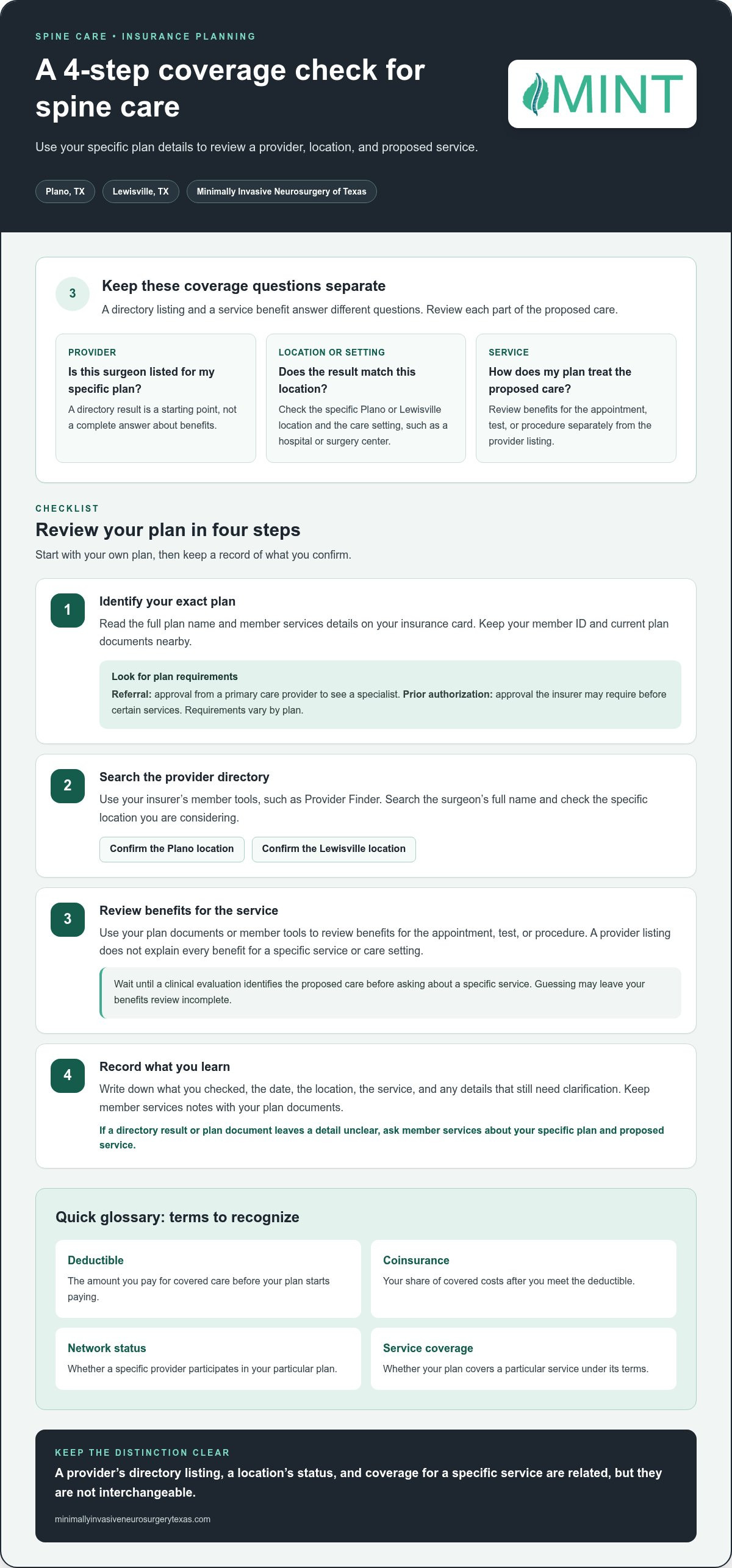
A focused coverage review starts with the details of your own plan, not just the carrier name. Keep your member ID and current plan documents nearby, and follow these four steps to organize your questions before scheduling spine care in Plano.
- Identify your plan. Read the full plan name and member services details on your insurance card. Note whether your plan requires a referral, which is approval from a primary care provider to see a specialist, or prior authorization, which is approval the insurer may require before certain services.
- Search the provider directory. Use the insurer’s member tools, such as Provider Finder, to look for the surgeon by full name and the specific location you’re considering. Check the Plano or Lewisville location that relates to your appointment.
- Review service benefits. Use your plan documents or member tools to understand benefits for the planned appointment, test, or procedure. A directory result concerns a provider listing; it doesn’t explain every benefit for a particular service or care setting. The Health Insurance Terminology glossary can help clarify terms such as deductible, the amount you pay for covered care before your plan starts paying, and coinsurance, your share of covered costs after you meet the deductible.
- Record questions and answers. Write down what you find, the date you checked, and any details that still need clarification. Keep notes from member services with your plan documents so you can refer to them when planning care.
Information to gather before using the member directory
Start with your insurance card. Copy the exact plan name and member services phone number, then have your member ID available when you sign in to the insurer’s tools. Search using the surgeon’s full name, and distinguish between the Plano and Lewisville locations rather than assuming one location’s directory result applies to another.
Record the service or procedure only after a clinical evaluation identifies what your care may involve. Before that discussion, you may not know which service to ask about, and guessing can lead to an incomplete benefits review. Referral and prior authorization requirements vary by plan, so look for the applicable policy or ask the insurer about your specific plan and proposed care.
How to interpret network and benefit information
An in-network result indicates how the directory classifies a provider for the plan you searched. Benefit information addresses how that plan handles a specific service. Keep these details separate in your notes, and record the location, service, date checked, and any guidance you receive. Plan documents and insurer guidance control individual benefit details.
For a spine-care discussion at MINT, bring your plan questions alongside your health concerns so the conversation can focus on both the diagnosis and the options under consideration. You can use the MINT contact page to connect with the practice about arranging a conversation.
How to compare a Plano surgeon’s clinical fit with insurance information
A directory result can help you review plan information, but it can’t tell you whether a treatment fits your condition. Compare the clinical discussion and insurance details as two separate parts of your decision. A surgeon’s spine specialization, your diagnosis, the options available, and the clarity of the conversation all matter. Insurance status doesn’t determine whether a procedure suits your diagnosis.
Use this table to organize what you learn during a consultation and when reviewing your plan:
| Clinical fit | Plan information | Questions to resolve |
|---|---|---|
| Does the surgeon focus on spine conditions relevant to your symptoms? | What does your plan say about this provider and location? | Does the directory result match the specific appointment location? |
| How does the diagnosis explain your symptoms and affect treatment choices? | What benefits apply to the appointment, test, or proposed procedure? | Does your plan require a referral or prior authorization for the service? |
| Which nonoperative options, meaning treatments that don’t involve surgery, or surgical approaches may fit your case? | What plan-specific terms or requirements apply to the planned care? | What information should you gather after the clinician identifies a treatment option? |
| Can the surgeon explain the reasoning, alternatives, and expected goals clearly? | Have you reviewed the applicable benefit details in current plan materials? | Which clinical and plan questions still need an answer before you decide? |
Clinical questions to discuss with a spine surgeon
Ask how the diagnosis connects to your symptoms and what treatment options make sense for your situation. For example, spinal stenosis means narrowing around the spinal canal, the passage that protects the spinal cord, or the nerves. Ask whether nonoperative care or surgery may address the problem, and why a minimally invasive approach, which uses smaller incisions and aims to reduce disruption to nearby tissue, may or may not suit your case.
A useful discussion explains the reasoning in plain language. You should understand how the diagnosis guides the options, what each option aims to address, and what other factors shape the recommendation.
When a procedure-specific discussion matters
Once a clinical evaluation identifies a possible procedure, ask what it involves and why the surgeon considers it relevant to your diagnosis. Endoscopic spine surgery is a minimally invasive procedure that uses a small camera to guide work in the spine. MINT’s endoscopic spine surgery approach is one option to discuss when it fits the clinical evaluation.
Artificial disc replacement removes a damaged spinal disc and places an artificial one in its place, with the aim of preserving motion. It isn’t the right choice for every patient. A Plano spine surgeon accepting Blue Cross Blue Shield may appear to match a plan directory, but that information doesn’t establish whether endoscopic surgery, artificial disc replacement, or another option fits your diagnosis. Discuss the clinical rationale first, then review the plan details for the specific service under consideration.
What to prepare before a spine appointment in Plano or Lewisville
A little preparation can help you use your appointment time well. Bring a clear account of your symptoms, relevant records you already have, a current medication list, and your insurance information. These details help the specialist understand your concerns and discuss what evaluation or next steps may make sense.
Bring a clear summary of symptoms and prior care
Before your visit, write down when symptoms began, where you feel them, and what changes them. Note how they affect everyday activities, such as walking, sleeping, working, or getting dressed. Include any numbness, which means reduced feeling, tingling, or weakness, and describe when those symptoms occur. These details can help guide the discussion, but symptoms alone don’t establish a diagnosis or mean that surgery is necessary.
Gather records you already have. Imaging, such as an MRI (magnetic resonance imaging scan that creates detailed pictures inside the body) or X-ray, can help the surgeon understand your clinical picture alongside your symptoms and examination. You don’t need to interpret the images yourself. Bring available reports and records from prior evaluations or treatments, and note when you received them.
- A short timeline of symptoms, including what makes them better or worse
- Details about how symptoms affect daily activities
- Names or records from prior evaluations and treatments
- Available imaging reports or other relevant medical records
- A list of current medications, including how you take them
- Your insurance card and any plan information or questions you’ve collected
Prepare questions about care and plan details
Write down questions you want to discuss with the surgeon. You might ask what diagnosis the evaluation supports, how it relates to your symptoms, and which treatment options fit that diagnosis. Ask what further evaluation may help clarify the clinical picture, if any. Keep these clinical questions separate from plan questions about benefits, referrals, or authorization. The surgeon can discuss your care; your insurer’s guidance and plan documents address individual benefit terms.
For a Plano spine surgeon accepting Blue Cross Blue Shield, an insurance directory can help you organize plan research, but it can’t replace a clinical conversation about your symptoms and treatment options. Bring the exact plan information you have, and note any insurer guidance you want to clarify. That way, you can keep coverage questions connected to the actual care being discussed without assuming that a symptom or plan listing determines the recommended treatment.
MINT provides specialized spine care in Plano and Lewisville, with its main office in Lewisville. Discuss your spine-care next steps and prepare for a focused conversation about your evaluation and options.
Meet with a Plano-area spine specialist and understand your options
A treatment decision starts with understanding your spine condition. At Minimally Invasive Neurosurgery of Texas, Dr. Scott Kutz evaluates the diagnosis and discusses appropriate options before moving forward. MINT provides specialized spine care in Plano and Lewisville, Texas, with its main office in Lewisville.
What a patient-centered spine evaluation should clarify
A useful evaluation connects your symptoms with examination findings and available medical records. Dr. Kutz considers how the information fits together, explains the diagnosis in clear language, and discusses which treatment options may address your specific condition. You can ask what each option aims to do, what factors shape the recommendation, and whether you need additional evaluation before deciding.
MINT’s patient-first approach gives you space to understand your choices before proceeding. If surgery may help, Dr. Kutz can explain why he recommends a particular approach and how it relates to your clinical findings. The practice offers minimally invasive spine surgery when clinically appropriate. These procedures use smaller incisions and aim to reduce disruption to nearby tissue, but the right approach depends on your diagnosis and circumstances. No technique guarantees a particular result.
Clear communication matters. You should leave the discussion with a practical understanding of the problem, available paths, and the reasoning behind each recommendation. Ask for plain-language explanations whenever a medical term or part of the plan feels unclear.
Where to learn more about the practice and treatment approaches
You can learn about Dr. Scott Kutz’s neurosurgical background and explore minimally invasive spine techniques that may suit a patient’s condition. Educational information can help you prepare questions, but your evaluation guides which options fit your needs.
Keep clinical questions distinct from insurance questions. The surgeon can explain the diagnosis and treatment rationale; your plan documents and insurer guidance address plan-specific benefits. Bring your questions and records to a focused conversation about care in Plano or Lewisville. Contact the MINT team to discuss your spine-care next steps.
Take the next step with confidence
You don’t need to decide on a procedure before you speak with a spine specialist. Start with a conversation about what you’re experiencing, what the evaluation may clarify, and which options could fit your needs. Keep your insurance questions in view, but give the clinical discussion room to focus on your health and daily activities.
If you’re considering a Plano spine surgeon accepting Blue Cross Blue Shield, use the appointment to understand your diagnosis and how the care team approaches treatment planning. MINT’s patient-centered spine care gives you space to discuss the reasoning behind possible options and make decisions with relevant clinical information.
Contact the MINT team to discuss your spine-care next steps. A clear conversation can help you move forward with greater understanding and confidence.
Frequently Asked Questions
Does Blue Cross Blue Shield cover spine surgery in Texas?
Your plan’s terms determine whether a spine surgery service qualifies for benefits. Once a clinician identifies a procedure for consideration, use its name and the proposed care setting when reviewing your plan’s surgical benefits. Ask which policy applies and whether your plan lists clinical criteria or steps that affect eligibility. This helps you get information relevant to the proposed care instead of relying on a general answer about spine surgery.
How can I find an in-network spine surgeon near Plano with Blue Cross Blue Shield?
Use the member directory connected to your plan and search the surgeon’s full name, specialty, and Plano office location. If you’re comparing results, save each listing with the plan name and date you viewed it. The exact phrase Plano spine surgeon accepting Blue Cross Blue Shield doesn’t identify which plan or office a result covers, so match the listing to your own member information.
Is an in-network spine surgeon the same as an in-network surgery facility?
No. A surgeon and a surgical facility have separate directory entries, so review each one for the proposed location. If your treatment plan involves other clinicians, such as an anesthesiologist, include them in your coverage questions too. Keep a short record naming each provider or facility and its directory result. That gives you a clearer list of details to resolve before care takes place.
What should I ask Blue Cross Blue Shield before a spine appointment?
Ask the insurer: “Does my plan list a referral or authorization requirement for this appointment or proposed service?” Also ask which provider name and location appear in the directory and what plan document explains the relevant benefit. Note the representative’s guidance and when you received it. If your clinician hasn’t identified a procedure, explain that; you can revisit service-specific questions after your evaluation.
Can I see a spine surgeon before knowing whether I need surgery?
Yes. You can seek an evaluation to understand what may explain your symptoms without deciding in advance to have surgery. Bring a symptom timeline and ask what the examination suggests, whether you need additional testing, and what choices make sense at that stage. The discussion may clarify that you need more information before considering treatment. An appointment starts a clinical conversation, not a commitment to a procedure.
What spine conditions does a neurosurgeon treat?
A spine-focused neurosurgeon may evaluate spinal disorders such as herniated discs, spinal stenosis, and degenerative disc disease, which involves changes in the discs between vertebrae. MINT treats these conditions. Sciatica, pain that travels along the path of the sciatic nerve, can also prompt a spine evaluation. Similar symptoms can have different causes, so the clinician considers your history and examination before discussing which condition may explain them.
Does minimally invasive spine surgery guarantee a faster recovery?
No. Minimally invasive techniques use smaller incisions and aim to limit tissue disruption, but they can’t guarantee a faster recovery for an individual. Ask the surgeon which activities you may need to modify after the specific procedure, what recovery milestones the care team will monitor, and when you should report a concern. Those details can help you plan realistically without treating a general recovery estimate as a promise.