What if the most helpful support while considering spine surgery comes from two different places? It’s understandable to want to hear from people who’ve faced similar decisions, while also needing answers that fit your own diagnosis. If you’re exploring minimally invasive spine surgery Plano TX, this guide explains how peer support and a specialist consultation can serve different needs, and how to approach each thoughtfully.
Minimally Invasive Neurosurgery of Texas (MINT) provides minimally invasive spine care in Plano and Lewisville, TX. Dr. Scott Kutz, a board-certified neurosurgeon and Fellow of the AANS and ACS, helps patients understand spinal diagnoses and treatment options.
Peer communities can offer connection, practical perspectives, and support for caregivers. But another person’s experience can’t predict what surgery or recovery will look like for you. A clinical consultation helps you discuss your diagnosis, goals, and options, including procedures such as endoscopic spine surgery, which uses a small camera to guide treatment, and artificial disc replacement, which replaces a damaged spinal disc with an implant. The sections ahead explore ways to find relevant peer support, prepare questions for a consultation, and keep personal stories in perspective.
Key Takeaways
- Use peer and caregiver resources for shared perspectives, and treat personal stories as individual experiences rather than predictions about your care.
- When comparing support groups, consider their purpose and whether they protect privacy, welcome questions, and avoid pressure or guaranteed claims.
- Prepare for a spine consultation by gathering records, listing concerns, clarifying your goals, and bringing someone for support if helpful.
- Ask which diagnosis may explain your symptoms and which nonsurgical or surgical options fit your situation when considering minimally invasive spine surgery Plano TX.
- MINT’s Dr. Scott C. Kutz, MD, is a board-certified neurosurgeon who helps patients understand their spinal diagnosis and treatment options before making decisions.
Considering minimally invasive spine surgery in Plano? Start with the support you need
Minimally Invasive Neurosurgery of Texas (MINT), led by Dr. Scott C. Kutz, MD, a board-certified neurosurgeon, provides spine surgery care in Plano and Lewisville, TX. If you’re considering minimally invasive spine surgery Plano TX, you may have medical questions about your diagnosis alongside practical concerns about daily routines, caregiving, and what a procedure could involve. You don’t have to sort through every question in the same way or with the same person.
What support can look like before a spine-surgery decision
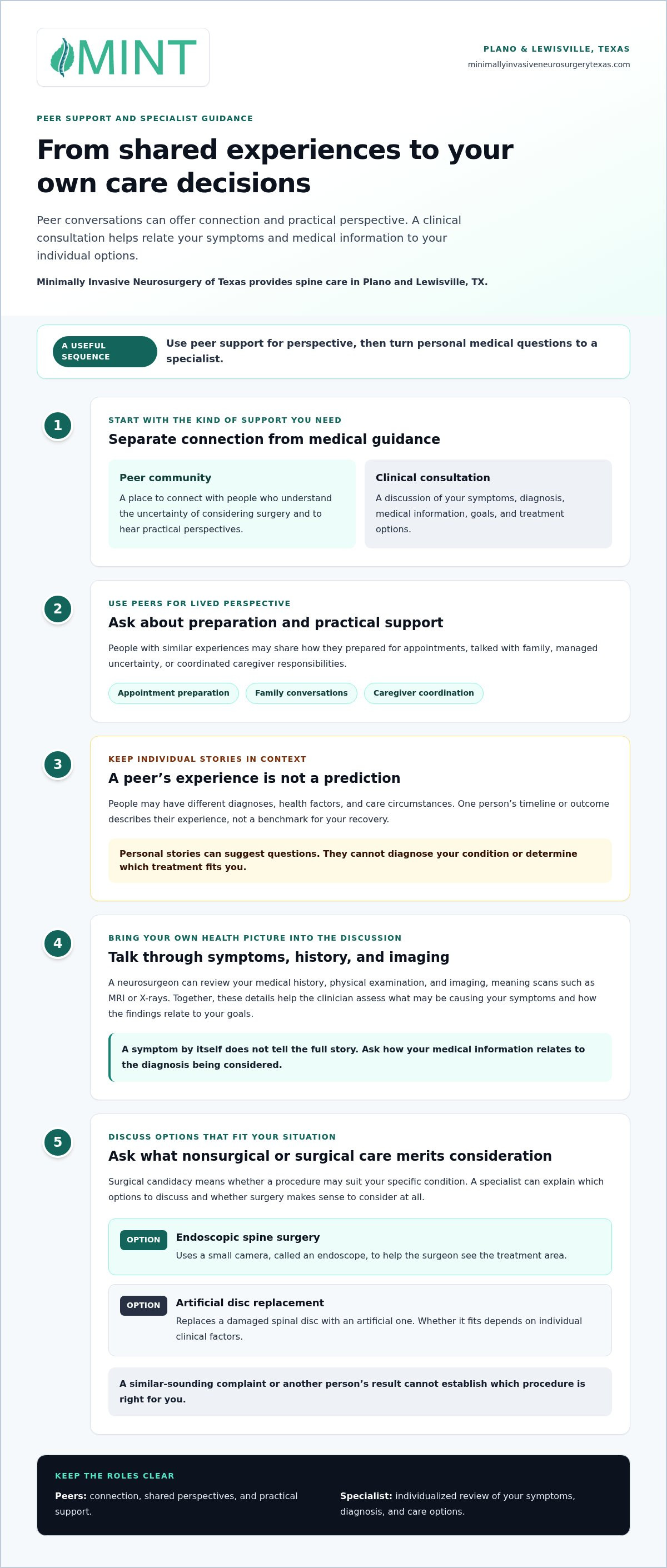
Different kinds of support serve different purposes. A peer group can connect you with people who understand the uncertainty of weighing surgery. Members may share how they prepared for appointments or managed conversations with family. Their experiences can help you feel less alone, but they can’t diagnose your condition or tell you what treatment fits your health.
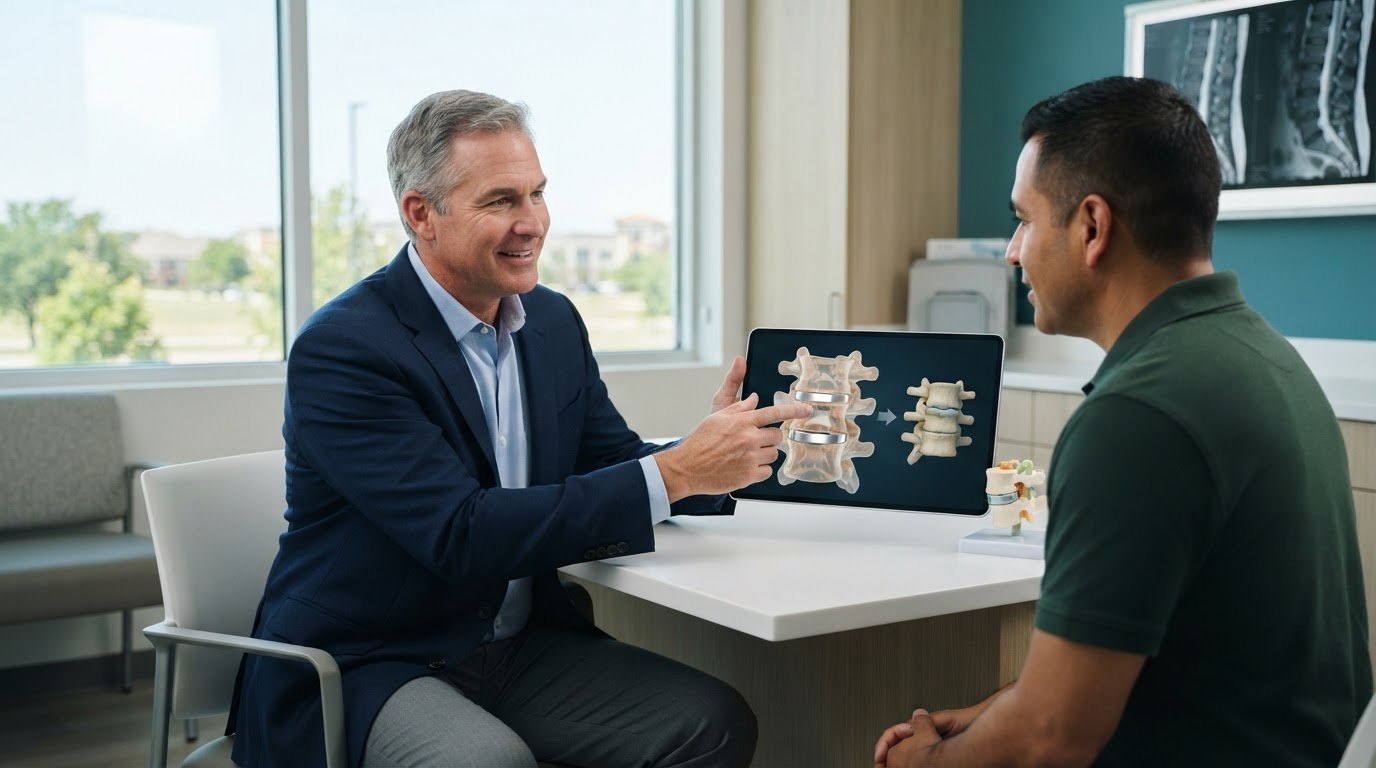
Caregiver conversations focus on the practical side: who can help with meals, transportation, or household tasks if you need support. A one-to-one clinical discussion addresses your individual symptoms, diagnosis, and treatment options. A neurosurgeon can review your medical information and explain how it relates to your goals. Patients in Plano, Lewisville, and the wider North Texas community can draw on peer connection while turning to clinical guidance for personal medical decisions.
What minimally invasive spine surgery means
Minimally invasive spine surgery describes an approach that aims to limit disruption to muscles and other tissue while a surgeon treats a spinal problem. It can involve different techniques, and the details depend on the procedure and a patient’s condition. The general overview of Minimally Invasive Spine Surgery describes the field and its range of approaches.
Endoscopic spine surgery uses a small camera, called an endoscope, to help the surgeon see the treatment area. The surgeon works through a small access point and uses specialized instruments to address the targeted problem. That differs from treating a peer’s story as a template: even when two people describe similar symptoms, their diagnoses and care needs may differ. MINT’s endoscopic spine surgery approach is one example of a minimally invasive technique.
A less disruptive approach doesn’t automatically suit every patient or every spinal condition. A surgeon considers the diagnosis, symptoms, imaging, health factors, and treatment goals before recommending an approach. Use peer conversations to gather perspective and support. Use a clinical consultation to understand which options apply to you, including whether surgery makes sense to discuss at all.
How clinical guidance and peer support help in different ways
People who have considered spine surgery can offer something valuable: the perspective of someone who understands the uncertainty and practical questions. They can describe how they prepared for appointments, what helped them communicate with family, or how a caregiver coordinated daily tasks. A treating neurosurgeon offers a different kind of help by assessing your symptoms, reviewing your medical information, and discussing treatment options in light of your individual health and goals.
Peer experience cannot determine whether you’re a candidate for spine surgery. Surgical candidacy means whether a procedure may suit your specific condition. A peer’s story can help you think of questions, but it can’t establish your diagnosis or predict how your care will unfold.
Questions peer groups can help patients explore
Use peer conversations to learn about preparation and support, not to decide which procedure you need. You might ask members how they organized questions before an appointment, kept track of information from their care team, or arranged help from family. You can also discuss how they handled worry, explained their concerns to loved ones, or coordinated caregiver responsibilities.
Keep personal timelines and outcomes in context. One person may describe returning to a routine at a certain point, while another may have a different experience. Their stories reflect their own diagnoses, health, and care circumstances. Treat them as perspectives to consider, not benchmarks for your own recovery.
Questions that need an individualized clinical discussion
Your symptoms alone don’t tell the full story. A neurosurgeon considers your medical history, physical examination, and imaging, meaning scans such as MRI or X-rays, to assess what may be causing your symptoms. The clinician can explain how those findings relate to your diagnosis and which nonsurgical or surgical options merit discussion. That assessment matters when comparing procedures such as endoscopic spine surgery, which uses a small camera to help the surgeon see the treatment area, with other approaches.
Artificial disc replacement replaces a damaged spinal disc with an artificial one. Whether that procedure fits depends on individual clinical factors, not on whether it helped someone with a similar-sounding complaint. MINT’s artificial disc replacement overview explains the procedure, while the American Association of Neurological Surgeons provides general information about the benefits, risks, and techniques of minimally invasive spine surgery.
If you’re exploring minimally invasive spine surgery in Plano, TX, bring questions prompted by peer conversations to a clinical discussion. Dr. Scott C. Kutz, MD, a board-certified neurosurgeon specializing in spinal disorders, can help connect your diagnosis, options, and goals. A spine consultation with MINT can give you a place to discuss those individual factors while peer support offers connection alongside your care.
How to compare spine-surgery support groups and patient resources
A useful support resource should match the questions you want to explore. Some resources focus on living with a spine condition, others discuss surgery or recovery experiences, and caregiver-focused resources help family members think through their role. For people considering minimally invasive spine surgery Plano TX, the right fit may depend on whether you want shared experience, practical caregiving ideas, or a place to ask questions without pressure.
A practical checklist for assessing a support resource
Before joining a group or relying on an online resource, consider its purpose and how it handles discussion. Does it focus on spine conditions, surgery, recovery experiences, or caregiving? Does a moderator guide conversations and address unsupported medical claims? Review privacy expectations, including who can see posts or attend meetings, and consider whether the format feels accessible and comfortable for you.
- Look for a clear focus that matches the questions you want to discuss.
- Check whether the resource explains privacy expectations and how moderators guide conversations.
- Notice whether members can ask questions without pressure to share personal details or follow a particular treatment path.
- Be cautious of strong medical claims or promises that everyone will have the same outcome. Bring those claims to a clinician for context.
For a local group, contact the organization that runs it to verify current meeting details, eligibility, format, and accessibility. Schedules and participation guidelines can change, so confirm them directly rather than relying on an old post or directory entry. This approach helps you assess available resources without assuming a particular group operates in Plano or elsewhere nearby.
When an online community may help, and when it may not
Online discussions can make it easier to read about others’ experiences, reflect on questions, and feel connected when an in-person conversation doesn’t suit you. They can also expose you to conflicting accounts. A post can’t review your records, interpret your imaging, or provide medical advice tailored to your diagnosis. Use online input to shape questions, then discuss personal treatment decisions with your clinical team.
This comparison can help you choose where to take different questions:
| Resource | Purpose and strengths | Limits | Questions it may suit |
|---|---|---|---|
| In-person peer group | Shared conversation and connection with people who choose to attend | Experiences may not match your diagnosis or circumstances | “How did you prepare for a difficult appointment?” |
| Moderated online community | Flexible discussion and access to different perspectives | Posts can’t assess your personal health or verify every claim | “What questions did you bring to your consultation?” |
| Caregiver-focused resource | Ideas for communication, coordination, and practical support | Advice may need adapting to your household and care plan | “How can we organize support around appointments?” |
Choose a resource that respects your boundaries and leaves room for uncertainty. Support should help you think clearly, not push you toward a decision or promise a specific result.
Prepare for a Plano spine consultation with practical questions
A little preparation can help you use a spine consultation to understand your diagnosis, discuss options, and identify what matters most to you. You don’t need to arrive with a treatment decision already made. Bring the information and questions that will help your clinician connect your symptoms with your goals.
A simple sequence to prepare
- Gather relevant records. Bring available imaging reports, test results, medication information, and notes from clinicians who have evaluated your symptoms. Imaging means scans, such as MRI or X-rays, that help clinicians examine the spine. If you have the images themselves, ask how the office prefers to receive them.
- List your concerns. Write down what you want to understand, including how symptoms affect sleep, movement, work, or daily activities. Note when symptoms began and what changes them, if you know.
- Identify your goals. Consider what you hope to address through care. You might want to manage a particular activity more comfortably or understand whether a procedure makes sense. Clear goals can help focus the treatment conversation.
- Bring a support person if helpful. A trusted person can listen, take notes, and help you remember questions. You can also ask them to wait outside for part of the visit if you prefer a private conversation.
Questions to bring to a spine-surgery appointment
Ask direct questions and request plain-language explanations. For example: “What diagnosis could explain my symptoms?” A diagnosis identifies the condition a clinician believes may be causing a health problem. You can also ask which findings from your examination or imaging support that assessment, and whether any uncertainty remains.
- Which nonsurgical and surgical options fit my condition, and what trade-offs should I understand?
- If you recommend a procedure, how does it address my diagnosis and support the goals we discussed?
- What should I understand about endoscopic spine surgery, a technique that uses a small camera to help the surgeon view the treatment area?
- How will the care team explain next steps and answer questions that come up after the appointment?
Patients considering minimally invasive spine surgery Plano TX can review MINT’s minimally invasive spine techniques as background for a discussion. Use that information to shape questions, not to decide which approach fits before a clinician evaluates your individual condition.
How caregivers and peer support can help you prepare
A caregiver or trusted companion can help organize your notes and capture the clinician’s explanations. Peer conversations can also suggest useful questions, such as what helped someone keep track of appointment details. Keep the distinction clear: another person’s experience can prompt questions, but your personal records and clinical answers belong in your care discussions.
For an individualized conversation about spine symptoms and treatment options, schedule a consultation with MINT.
Explore minimally invasive spine surgery options with MINT in Plano
Minimally Invasive Neurosurgery of Texas (MINT) serves patients in Plano and Lewisville, TX, and the wider North Texas area. Dr. Scott C. Kutz, MD, is a board-certified neurosurgeon who specializes in spinal disorders. A conversation with a spine specialist can help you understand what your diagnosis means and which treatment options may fit your health and goals. It doesn’t mean you’ve committed to surgery.
What to expect from a patient-centered spine-care discussion
A useful discussion starts with your concerns. Dr. Kutz and the care team can review your symptoms, relevant medical information, and what you hope to address. Together, you can discuss how the findings relate to your diagnosis and which next steps may make sense. You can ask for plain-language explanations and take time to consider the information.
Care depends on the individual. Some patients may discuss nonsurgical approaches, while others may explore a surgical option. A minimally invasive technique doesn’t suit every condition, and surgery may not be appropriate for every patient. The goal of the conversation is to understand the options, their relevance to your diagnosis, and the factors that shape a treatment decision.
Endoscopic spine surgery uses a small camera to help the surgeon see the treatment area. It represents one possible approach, not a universal recommendation. A surgeon assesses whether it fits the specific spinal problem and the patient’s circumstances. MINT’s endoscopic spine surgery service offers information about this procedure to help you prepare focused questions for a consultation.
You might ask how a proposed procedure addresses the condition identified in your evaluation, what alternatives merit discussion, and how each option relates to the activities or goals that matter to you. You can also ask what information the care team needs to explain next steps clearly. These questions help keep the discussion specific to you rather than to someone else’s experience.
Connect with the MINT team serving Plano and Lewisville
Patients exploring minimally invasive spine surgery Plano TX can bring questions about diagnosis, treatment choices, and personal goals to a discussion with MINT. The Minimally Invasive Neurosurgery of Texas website describes the practice’s spine-care focus for patients considering their next steps. A caregiver or support person may join if that helps you listen, take notes, or think through the information afterward.
If you’re ready to discuss your questions and how they relate to your care, contact MINT’s team when it feels right for you.
Take your next step with clarity and support
You don’t need to settle every question before moving forward. Let the concerns you’ve gathered guide a conversation about what matters to you and what you want to understand. If you’re considering minimally invasive spine surgery Plano TX, focus on getting information that helps you weigh your options at your own pace.
Peer perspectives may help you feel understood, while a clinical discussion can help you consider how your diagnosis and goals relate to possible care. Take time to reflect, write down any new questions, and decide what would help you feel more prepared for your next step.
When you’re ready to continue the conversation, reach out to MINT about your spine-care questions. You can move forward thoughtfully, one informed decision at a time.
Frequently Asked Questions
How can I find a spine surgery support group near Plano, TX?
Start with local hospital systems, community organizations, and established spine-health organizations that may maintain patient-resource directories. Search for groups focused on your diagnosis or on surgery-related experiences, then contact the organization that runs each group to confirm current meeting details and participation guidelines. If you don’t find a nearby in-person option, a moderated online group may offer connection without requiring local travel.
Are online support groups helpful for people considering spine surgery?
Yes, online support groups can help you compare perspectives, prepare questions, and feel less alone while weighing care options. For example, a discussion may remind you to ask about how a proposed treatment could affect a routine you value. Check whether moderators address questionable medical claims, and avoid sharing personal health details in spaces where you don’t understand the privacy settings. Use online posts as perspective, not personal medical advice.
Can a support group tell me whether I need minimally invasive spine surgery?
No. A support group can’t determine whether you need surgery or whether a minimally invasive approach fits your condition. That decision requires a clinician to consider your symptoms, examination, medical history, and relevant imaging. If you’re researching minimally invasive spine surgery Plano TX, use group discussions to identify concerns you want to raise, such as what a diagnosis means or which treatment options merit discussion.
What should I ask a spine surgeon during a Plano consultation?
Ask the surgeon to explain the suspected diagnosis, how it relates to your symptoms, and which findings inform the assessment. Then ask what nonsurgical and surgical options may fit, what trade-offs each involves, and how a proposed procedure connects to your priorities. If an explanation feels unclear, ask for simpler wording or a written summary. You can also ask whom to contact with follow-up questions after the visit.
Is minimally invasive spine surgery right for every patient?
No. A minimally invasive approach won’t fit every diagnosis or every patient. A neurosurgeon considers factors such as the spinal condition, symptoms, imaging, overall health, and treatment goals before discussing an approach. Minimally invasive spine surgery uses techniques designed to limit tissue disruption, but the specific method and its potential risks depend on the case. Ask your clinician to explain why an approach may or may not suit your circumstances.
Can a caregiver attend a spine-surgery consultation?
Often, patients find it helpful to bring a trusted caregiver or family member to listen, take notes, and help remember information afterward. Before the visit, agree on how that person can support you, such as keeping track of questions while you lead the conversation. You can also decide whether you want time to speak privately with the clinician. The patient should guide what personal information the companion hears.