
Minimally Invasive Neurosurgery of Texas (MINT), led by Dr. Scott C. Kutz, MD, a board-certified neurosurgeon, provides minimally invasive spine surgery in Lewisville, TX, and Plano, TX. Recognizing red flags when choosing a spine surgeon can help you spot pressure, unsupported promises, or explanations that leave you unsure. It does not mean every surgical recommendation is wrong.
A trustworthy spine surgeon explains how an operation relates to your diagnosis and goals before recommending it. If you’re weighing surgery, ask questions, compare options, or seek another opinion. Look for a clear explanation of your diagnosis, the purpose of a proposed procedure, and reasonable alternatives, including nonsurgical care when appropriate. This article will help you assess a surgeon’s experience and communication, recognize warning signs, and decide when to ask more questions or seek another opinion. You’ll also learn what a thorough consultation should cover, including discussions about endoscopic spine surgery and artificial disc replacement. A careful conversation can help you understand your choices and decide on your next step with greater confidence.
Key Takeaways
- Recognize red flags when choosing a spine surgeon, such as pressure to decide quickly or explanations that don’t address your concerns.
- Look beyond broad promotional claims. Consider board certification alongside experience with the specific procedure being discussed.
- A second opinion can help clarify your options without suggesting that the first surgeon’s advice was wrong.
- Compare recommendations by diagnosis, treatment goals, alternatives, proposed procedure, and meaningful risks, not by star ratings alone.
- Use five focused consultation questions to understand whether a treatment plan fits your condition and priorities.
Red Flags When Choosing a Spine Surgeon: Behaviors That Deserve a Closer Look
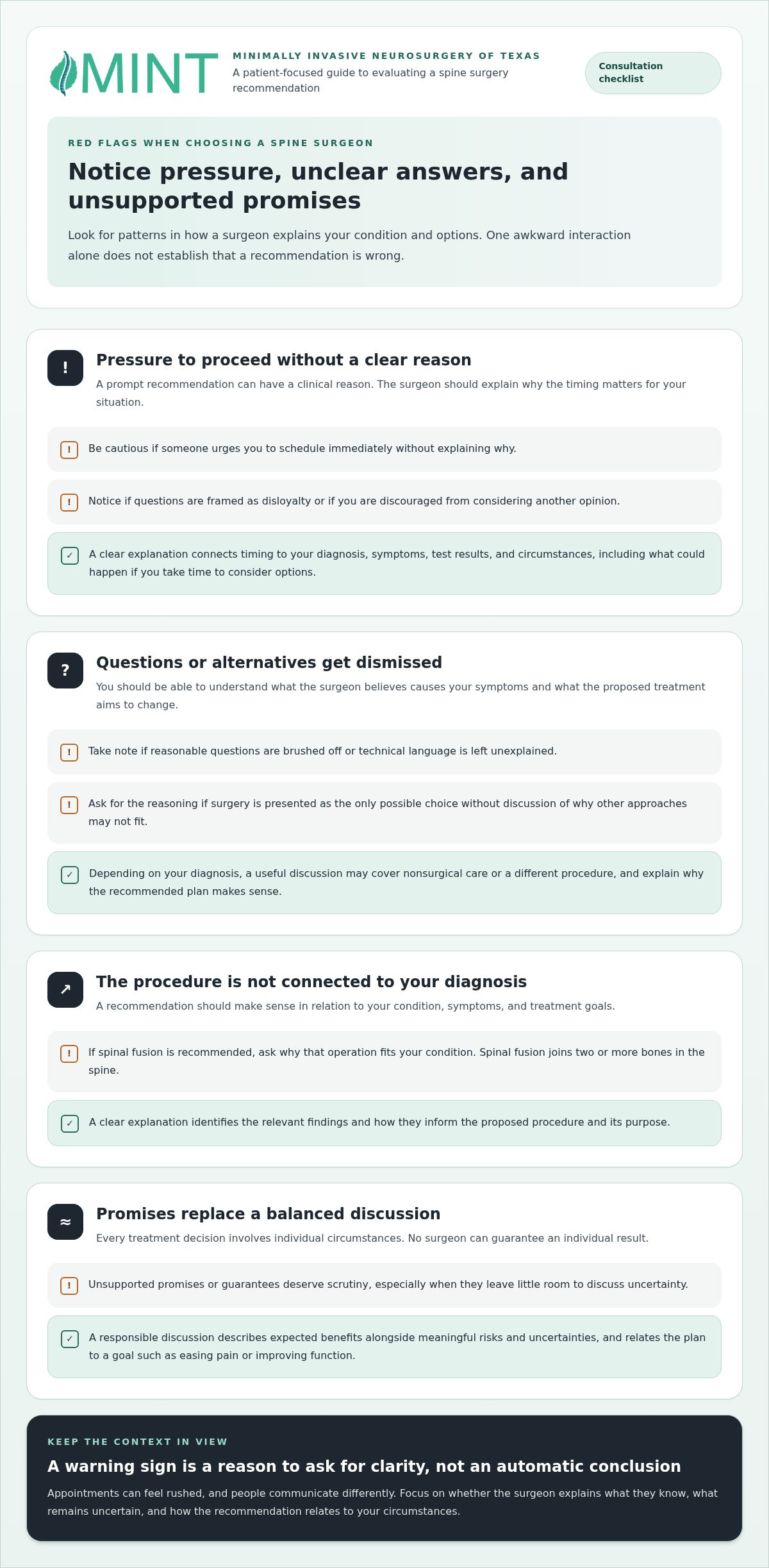
When you consider red flags when choosing a spine surgeon, look for patterns in how the surgeon explains your condition and options, not a single awkward moment. MINT, led by Dr. Scott C. Kutz, provides specialized spine care in Lewisville, TX, and Plano, TX.
One concerning interaction deserves context, not an automatic conclusion about a clinician. Appointments can feel rushed, and people communicate differently. Still, pressure to proceed, promises without a clear basis, or dismissive responses to reasonable questions warrant further discussion. Notice whether the surgeon clarifies what they know, what remains uncertain, and how their recommendation relates to your circumstances.
When a recommendation for surgery feels rushed
A surgeon may recommend prompt treatment for a specific clinical reason. That recommendation alone doesn’t signal misconduct. The surgeon should explain how the timing relates to your diagnosis, symptoms, test results, and overall circumstances. You should understand why acting now matters and what could happen if you take time to consider your options.
Pressure looks different. Be cautious if someone urges you to schedule immediately without explaining why, frames questions as disloyalty, or suggests that you can’t consider another opinion. A clear discussion gives you room to understand the proposed procedure and its purpose. For example, if a surgeon recommends spinal fusion, an operation that joins two or more bones in the spine, ask why that approach fits your condition. Spinal fusion offers general background, but your surgeon should explain how your diagnosis informs the recommendation. If the plan involves a less invasive technique, ask what that specific approach means for you, such as endoscopic spine surgery.
When questions, alternatives, or uncertainty get dismissed
You deserve understandable answers about what the surgeon believes causes your symptoms, what the treatment aims to change, and which reasonable options you can consider. Depending on your diagnosis, alternatives may include nonsurgical care or a different procedure. A surgeon doesn’t need to recommend every option, but should explain why a particular plan makes sense and why other approaches may not fit.
Be alert when a surgeon brushes off questions, uses technical language without explaining it, or presents surgery as the only possible choice without discussing the reasoning. Unsupported promises also deserve scrutiny. No surgeon can guarantee an individual result. A responsible discussion describes expected benefits alongside meaningful uncertainties and risks. Ask the surgeon to restate an explanation in plain language or connect it to a specific goal, such as easing pain or improving function.
Clear explanations help you understand the choices, weigh their trade-offs, and decide whether a treatment plan fits your goals.
Credentials and Procedure Experience: What a Spine Surgeon Should Explain
Credentials can help you understand a surgeon’s training, but they don’t establish by themselves whether a proposed operation fits your diagnosis. Board certification in neurosurgery means a surgeon has completed specialty training in the nervous system and passed certification assessments from the American Board of Neurological Surgery. This is a verifiable qualification, not a guarantee that a particular procedure suits every patient.
Dr. Scott C. Kutz, MD, holds board certification from the American Board of Neurological Surgery and Fellow status with the American Association of Neurological Surgeons (AANS) and the American College of Surgeons (ACS). These credentials provide context for his specialty background. A useful consultation should also connect a surgeon’s expertise to your condition and the treatment under consideration. Broad labels such as “the best” matter less than verifiable qualifications and specific explanations.
How credentials relate to your specific spine condition
Ask how a surgeon’s neurosurgical training relates to your diagnosis and proposed treatment. The surgeon should explain the relevant findings, such as which part of the spine may cause your symptoms, and how those findings inform the plan. Credentials establish a foundation of specialty preparation. They don’t replace an individualized explanation of your condition and options.
Fellowship training can provide additional specialization after residency, but its relevance depends on the training and the procedure under discussion. Focus on qualifications you can verify and explanations you can understand. The National Spine Health Foundation’s Questions to Ask Your Spine Surgeon offers prompts about qualifications and care approach that can help you prepare for a consultation.
Why procedure-specific experience and candid answers matter
General experience with spine care may not answer your questions about a particular operation. Ask how often the surgeon performs the proposed procedure, what makes it appropriate for your diagnosis, and what limitations could affect your situation. No single case-volume number guarantees a good fit. Look for a direct answer that gives useful context instead of a broad claim of extensive experience.
Endoscopic spine surgery uses a small camera and specialized instruments through a limited opening. Ask whether this approach fits the condition being treated and why another technique might suit it better. The diagnosis should guide technique selection, not a preference for a particular tool. MINT’s minimally invasive spine techniques provide examples of approaches to discuss in relation to your condition.
A candid surgeon discusses known risks, limitations, and factors that may affect recovery without promising an individual outcome. Verifiable qualifications carry more weight than unsupported claims about being “the best.” If you’d like to discuss questions about your spine care, contact MINT.
Second Opinions and Reviews: How to Compare Spine Surgery Advice
A second opinion can clarify your options. It doesn’t mean the first surgeon is wrong, and you don’t need to treat different recommendations as a contest where the majority wins. Another qualified clinician may interpret your diagnosis or weigh treatment options differently. The useful question is why each surgeon recommends a particular path and how that reasoning relates to your needs.
What a useful second opinion can clarify
Ask each surgeon to explain the reasoning behind the recommendation, not just name the procedure. If their advice differs, compare what each clinician believes causes your symptoms, what outcome they hope to achieve, and how they weigh alternatives. One may recommend surgery while another suggests more nonsurgical care. That difference can help you identify what information or clinical judgment drives each plan.
To compare written explanations, look for the same core details in each:
- Diagnosis: What condition or finding does the surgeon believe explains your symptoms?
- Goal: What change does the treatment aim to make in pain, movement, or daily function?
- Proposed treatment: Which procedure or care approach does the surgeon recommend, and why?
- Alternatives: What other reasonable options could address the problem?
- Risks: What meaningful risks, limitations, or uncertainties should inform your decision?
Then note where the explanations align and where they differ. A shared recommendation can offer reassurance, but agreement alone doesn’t prove that a treatment fits your situation. A clear explanation of the reasoning matters more than counting opinions. If a surgeon identifies a time-sensitive concern, ask what makes the timing important and follow the clinician’s guidance while you clarify your options. Don’t delay care when a clinician explains that prompt evaluation matters.
How to interpret online reviews and outcome claims
Online reviews can describe how a patient experienced communication, scheduling, or care. They can’t show whether that person had your diagnosis, goals, or medical circumstances. A positive review doesn’t establish that the same treatment will suit you, and a negative review doesn’t explain the clinical reasoning behind a recommendation.
Read reviews as personal accounts, not substitutes for evaluating medical advice. Treat broad success claims with care if they lack context about the condition, procedure, or outcome being measured. No star rating can answer how a surgeon weighs your diagnosis, explains alternatives, or discusses risks. Those questions require a direct conversation about your case.
If you’re considering the red flags when choosing a spine surgeon, compare clear clinical reasoning rather than relying on reviews or conflicting opinions. If you’d like to discuss your spine care questions with MINT, contact the practice.
A Spine Surgeon Consultation Checklist: Questions That Reveal the Quality of Care
Bring these questions to your appointment and write down the answers in plain language. The goal isn’t to test the surgeon. It’s to understand how the diagnosis, your priorities, and the proposed care fit together. Clear, individualized answers can help you assess red flags when choosing a spine surgeon and identify what you still need to discuss.
- What diagnosis explains my symptoms, and what findings support it?
A clear answer should name the suspected condition and connect it to your symptoms, examination, and imaging. Imaging means pictures of the inside of your body, such as an MRI or X-ray. Ask the surgeon to explain unfamiliar terms and how each finding supports, or does not support, the diagnosis.
- What should treatment help me do or feel better?
The surgeon should describe the treatment’s specific goal in terms that matter to you, such as easing pain or improving a daily activity. Ask how the proposed goal relates to your symptoms and diagnosis. An individualized answer should set realistic expectations rather than promise a particular result.
- What nonoperative options remain reasonable for me?
Nonoperative care means treatment without surgery. Ask which options may suit your condition, what each aims to address, and why the surgeon recommends or does not recommend them in your case. The explanation should reflect your symptoms and circumstances, not dismiss alternatives without discussing the reasoning.
- What procedure do you recommend, and why does it fit my diagnosis?
Ask what the operation involves and how it addresses the specific problem. For example, endoscopic spine surgery uses a small camera and specialized instruments to reach the treatment area. It may or may not fit a particular diagnosis. The surgeon should explain the factors behind that decision. MINT’s endoscopic spine surgery information can help you recognize the procedure name, while your consultation should address whether it suits your circumstances.
- What meaningful risks and recovery considerations should I weigh?
Ask the surgeon to explain relevant risks, possible limitations, and what recovery may involve for the proposed procedure. Recovery expectations can vary with the operation and individual factors, so ask what applies to you rather than relying on a general timeline. A responsible discussion avoids guarantees and welcomes follow-up questions.
Bring notes, ask the surgeon to clarify unfamiliar terms, and request time to consider the answers. If you’re ready to discuss your questions about spine care, contact MINT to discuss your care.
How MINT Supports an Informed Spine Surgery Decision in Lewisville and Plano
Choosing a spine surgeon means understanding more than a procedure name. MINT helps patients clarify their diagnosis, understand treatment choices, and discuss whether surgery fits their condition and goals. The conversation starts with your individual needs, not an assumption that every spinal problem requires an operation. MINT provides specialized spine care in Lewisville, TX, and Plano, TX.
A patient-centered discussion of spine treatment options
A useful consultation connects your symptoms and clinical findings to a clear explanation of the diagnosis. You should understand what a proposed treatment aims to address, which alternatives remain appropriate, and what questions you still need answered before deciding. The discussion can also consider how your symptoms affect daily activities and which changes matter most to you.
Minimally invasive approaches use techniques designed to limit disruption to the body, but they don’t suit every condition. Your diagnosis and clinical assessment guide the choice of technique. MINT’s minimally invasive spine techniques provide examples to discuss in the context of an individual treatment plan.
Artificial disc replacement replaces a damaged spinal disc with an artificial one. A surgeon should discuss this procedure when it relates to your diagnosis and treatment goals, and explain relevant alternatives, risks, and limitations. The procedure name alone cannot determine whether it fits your needs.
Plan a conversation with a North Texas spine specialist
As you consider your options, look for clear reasoning that links the diagnosis to the proposed plan. A thorough discussion should address alternatives, explain meaningful risks without guarantees, and leave room for follow-up questions. If an answer feels unclear, ask for a different explanation or ask the clinician to connect it to your specific findings. That can help you evaluate your choices with greater understanding.
Patients in Lewisville, Plano, and surrounding North Texas communities can bring their questions to a focused spine care discussion. Consider whether the clinician explains the reasoning behind the plan and gives you the information you need to weigh your options.
Contact MINT to discuss your spine care and ask questions about your diagnosis and treatment options.
Take Your Next Step With Confidence
You don’t have to decide about spine surgery before you understand the reasoning behind it. Use your next conversation to identify what remains unclear, then ask the clinician to connect each recommendation to your diagnosis, priorities, and daily needs. Focus on whether a plan makes sense for you, not on urgency, polished claims, or online opinions.
The purpose of recognizing red flags when choosing a spine surgeon isn’t to distrust every recommendation. It’s to notice when you need more context, clearer answers, or another perspective. Organize your questions and make a decision with a stronger understanding of your options. You deserve explanations that help you choose without pressure.
If you’d like to talk through your spine care questions and possible next steps, start a conversation with MINT. Take your next step by contacting MINT to discuss your diagnosis and treatment options.
Frequently Asked Questions
Is it a red flag if a spine surgeon recommends surgery at the first appointment?
Not by itself. A surgeon may have enough information from your history, examination, and imaging to discuss surgery at an initial visit. Focus on whether the surgeon explains the reasoning and gives you a chance to understand the plan. One of the red flags when choosing a spine surgeon is pressure to commit without a clear explanation, not simply hearing a surgical recommendation early.
Can I get a second opinion before deciding on spine surgery?
Yes. A second opinion can offer another clinical perspective before you decide. To make that discussion useful, bring relevant imaging, test reports, a medication list, and any written treatment recommendation you received. If a surgeon raises a time-sensitive concern, ask what makes the timing important and how quickly you should act. That helps you seek clarity without overlooking a clinical reason for prompt care.
How can I verify whether a spine surgeon is board-certified?
For a neurosurgeon, look up the physician through the American Board of Medical Specialties’ Certification Matters search tool or the American Board of Neurological Surgery’s verification resources. Match the physician’s full name and specialty, since similar names can cause confusion. If a search result leaves you uncertain, ask the surgeon’s office for the exact certifying board so you can check the credential against the right source.
What questions should I ask a spine surgeon before agreeing to surgery?
Ask what condition the surgeon plans to treat, how the proposed operation addresses it, and what alternatives remain. Also clarify who will perform the key parts of the procedure, what recovery may involve for your situation, and whom to contact with questions after the visit. Write down your main concerns and daily activities you hope to improve, so the discussion addresses what matters to you.
Should I choose a spine surgeon based on online reviews?
No. Reviews can help you understand how patients describe communication or their experience with a practice, but they can’t tell you whether a surgeon’s treatment recommendation fits your condition. Read them as individual accounts, and look for themes rather than treating a rating as a clinical measure. Use your consultation to assess how well the surgeon explains your case and responds to your questions.
What should I do if a surgeon guarantees a successful outcome?
Ask what the surgeon means by “successful” and what evidence supports the claim for your specific condition and proposed procedure. Individual results can vary, so a guarantee should prompt you to seek a more balanced explanation of likely benefits, possible risks, and factors that may affect your result. You can pause before making a decision and request clarification in writing if that would help you compare advice.
Does a spine surgeon need experience with the exact procedure being recommended?
Procedure-specific experience matters because different operations require different techniques and address different problems. Ask how the surgeon’s experience relates to the procedure proposed for you, what role the surgeon will have during the operation, and what limitations apply. A useful answer gives relevant context without relying on a broad claim or implying that one procedure suits every patient with similar symptoms.