Image sourced from Canva
Learning that disc replacement exists often raises the next question right away: could it work for me? At Minimally Invasive Neurosurgery of Texas, Dr. Scott Kutz, MD, a neurosurgeon board-certified by the American Board of Neurological Surgery (ABNS) serving patients in Lewisville, TX and Plano, TX, evaluates patients researching artificial disc replacement Lewisville TX options to determine whether their anatomy and symptoms support a motion-preserving approach.
This article explains the factors spine specialists typically review when considering disc replacement, the conditions most commonly evaluated, the situations where another option may fit better, and what to expect during an evaluation. It does not replace a personal medical assessment, but it can help you prepare for one.
If you are wondering whether you may be a candidate, contact Minimally Invasive Neurosurgery of Texas to discuss an evaluation.
Key Takeaways
- Candidacy for artificial disc replacement depends on your imaging, examination, bone quality, and spinal stability, not symptoms alone.
- Disc replacement is most often considered for disc problems at one or two levels that have not improved with conservative care.
- Osteoporosis, significant facet arthritis, instability, deformity, and multi-level disease may point toward another approach.
- An evaluation compares disc replacement, fusion, and non-surgical care so the plan fits your anatomy.
- Being evaluated does not mean committing to surgery, and results vary by patient.
Table of Contents
- What Makes Someone a Candidate for Artificial Disc Replacement?
- Conditions Commonly Evaluated for Disc Replacement
- Factors That May Point Toward Another Option
- How Artificial Disc Replacement Lewisville TX and Plano TX Evaluations Work
- Non-Surgical Alternatives and Surgical Risks
- Minimally Invasive Neurosurgery of Texas: Candidacy Evaluations
- Take the Next Step With a Clearer Plan
- Frequently Asked Questions
What Makes Someone a Candidate for Artificial Disc Replacement?
Artificial disc replacement removes a damaged disc and replaces it with an implant designed to allow controlled motion. For that implant to work as intended, the surrounding spine needs to be healthy enough to support movement. That is why candidacy depends on more than where it hurts.
The Symptoms and the Imaging Need to Match
A specialist looks for a clear connection between your symptoms and what your MRI or CT shows. For example, arm pain and numbness that follow a specific nerve pathway should correspond with a disc pressing on that nerve. When the clinical picture and the imaging line up, the surgeon can be more confident that treating that disc may help.
The Spine Around the Disc Matters
Disc replacement preserves motion, so the structures that share that motion must be in reasonable condition. The facet joints at the back of the spine, the strength of the bone, and the alignment of the spine all influence whether an implant is likely to function well.
Research Supports Careful Selection
Over the past two decades, multiple randomized trials have studied cervical disc arthroplasty for one- and two-level degenerative disc disease. In one 10-year randomized trial available through the National Library of Medicine’s PubMed Central, the risk of adjacent-level surgery was 3.1% after cervical disc arthroplasty compared with 20.5% after fusion in the patients studied. Those patients were selected using strict criteria, which is one reason careful evaluation matters so much.
Conditions Commonly Evaluated for Disc Replacement
Herniated Disc With Nerve Symptoms
A herniated disc occurs when the soft inner material pushes through the outer ring and presses on a nerve or the spinal cord. In the neck, this can cause pain, numbness, tingling, or weakness in the shoulder, arm, or hand. When symptoms persist despite conservative care, disc replacement may be one option a specialist reviews.
Degenerative Disc Disease
Degenerative disc disease describes age-related changes in a disc that can contribute to pain, nerve pressure, or reduced disc height. For patients exploring degenerative disc disease treatment Lewisville TX options, disc replacement may be considered when the degeneration is limited to one or two levels and other structures remain healthy.
Disc Problems at One or Two Levels
Disc replacement is most commonly considered when the problem involves one or two spinal levels. When many levels are affected, other approaches may be more suitable.
Factors That May Point Toward Another Option
Findings That May Favor Fusion or Another Procedure
Some findings suggest that fusion or another procedure may provide a more predictable result:
- Osteoporosis or low bone density, which can affect how well an implant integrates with bone
- Significant facet joint arthritis at the affected level, since those joints share motion with the disc
- Spinal instability, where vertebrae shift abnormally
- Deformity, such as significant curvature or alignment problems
- Disease at multiple levels that may need a broader approach
Comparing Disc Replacement and Fusion for Your Case
Understanding artificial disc replacement vs fusion in your specific case is part of a complete evaluation. A surgeon who performs both procedures can explain which one may fit better and why.
How Artificial Disc Replacement Lewisville TX and Plano TX Evaluations Work
Your History and Symptoms
The evaluation begins with your story: when symptoms started, how they have changed, what makes them better or worse, and which treatments you have tried. A timeline of physical therapy, medications, and injections is helpful.
Physical Examination
The specialist checks strength, reflexes, sensation, and range of motion to see how your nerves and spinal cord are functioning.
Imaging Review
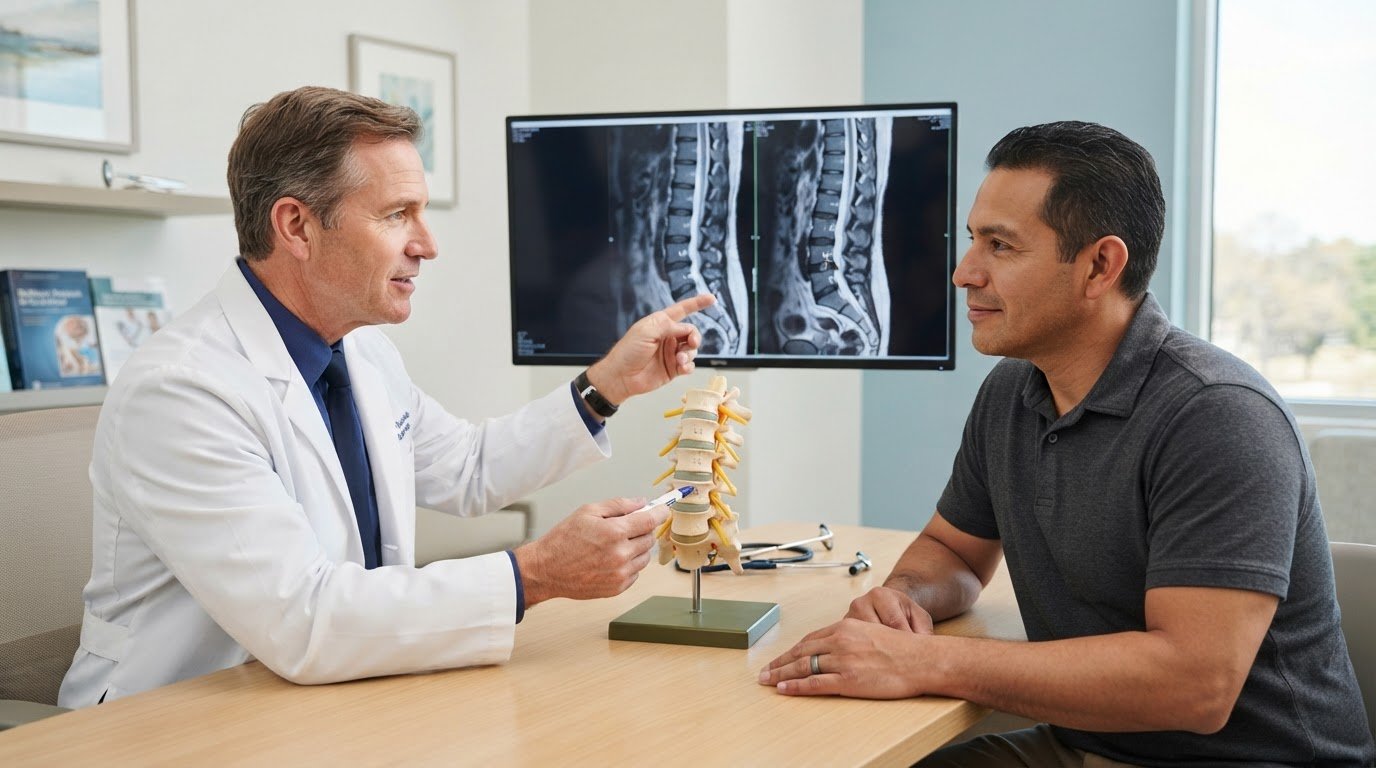
MRI shows discs, nerves, and the spinal cord, while CT and X-rays show alignment, bone structure, and arthritis, and a bone density scan may be ordered to check bone strength. Bring the actual images, not only the radiology report, so the specialist can review them directly.
A Plan That Fits Your Life
After reviewing everything, the specialist explains whether you may be a candidate for disc replacement, fusion, another procedure, or continued conservative care. Patients interested in motion-preserving spine surgery Plano TX options can be evaluated at either office.
Non-Surgical Alternatives and Surgical Risks
Non-Surgical Options
Many patients improve with physical therapy, anti-inflammatory or other medications, epidural steroid injections, and activity changes. Surgery is generally discussed when symptoms persist after a fair trial of these treatments or when nerve symptoms are significant.
Risks to Understand
Disc replacement carries general surgical risks, including infection, bleeding, nerve irritation, temporary hoarseness or difficulty swallowing after neck procedures, implant wear, movement or settling, bone forming around the implant that can limit its motion, and the possibility of further treatment later. Your surgeon should explain how these risks apply to you.
Minimally Invasive Neurosurgery of Texas: Candidacy Evaluations
Dr. Scott C. Kutz, MD is a neurosurgeon and spine surgeon, board-certified by the American Board of Neurological Surgery (ABNS), with more than 25 years of experience and more than 6,000 patients treated. He is the founder and head neurosurgeon of Minimally Invasive Neurosurgery of Texas, a private practice in Lewisville, TX and Plano, TX dedicated exclusively to minimally invasive and motion-preserving surgical techniques for spinal conditions. He has been a Fellow of the American Association of Neurological Surgeons (AANS) since 2011 and the American College of Surgeons (ACS) since 2010.
Dr. Kutz specializes in endoscopic spine surgery, artificial disc replacement, sacroiliac joint fusion, and complex revision spine surgery. His approach prioritizes the least invasive appropriate option first, using advanced surgical techniques designed to minimize tissue disruption, with the goal of long-term symptom improvement for patients across the Dallas-Fort Worth area and beyond. He evaluates candidates for both disc replacement and fusion, reviewing each patient’s MRI and CT imaging to match the procedure to their anatomy. Patients who have already received a surgical recommendation elsewhere can also request a spine surgery second opinion.
To review your options with Dr. Scott Kutz, MD, contact Minimally Invasive Neurosurgery of Texas.
Take the Next Step With a Clearer Plan
The only way to know whether you may be a candidate is a careful evaluation of your symptoms, examination, and imaging. If you are researching artificial disc replacement Lewisville TX options, preparing your imaging and treatment history ahead of time can make that visit more productive.
Patients from Lewisville, Plano, Flower Mound, Denton, and across the Dallas-Fort Worth area can learn more about artificial disc replacement at Minimally Invasive Neurosurgery of Texas before their appointment.
To find out whether disc replacement may be an option for you, contact Minimally Invasive Neurosurgery of Texas to discuss an evaluation.
Frequently Asked Questions
How do I know if I am a candidate for artificial disc replacement?
Only an evaluation can answer that. A specialist reviews your symptoms, examination, and MRI or CT imaging, then checks bone quality, facet joint health, and spinal stability. Candidates often have a disc problem at one or two levels that has not improved with conservative care, but each case is different.
Can older adults have artificial disc replacement?
Age alone does not decide candidacy. What matters more is bone quality, the condition of the facet joints, and overall health. Older adults are more likely to have osteoporosis or arthritis, which may point toward another option, so a specialist reviews each patient’s imaging and health before making a recommendation.
Can I have disc replacement if I have arthritis in my spine?
It depends on where the arthritis is and how advanced it is. Significant facet joint arthritis at the affected level may make disc replacement less suitable, because those joints share motion with the disc. A specialist can review your imaging and explain whether disc replacement, fusion, or another approach may fit.
What imaging do I need for a disc replacement evaluation?
Specialists typically review MRI to see discs, nerves, and the spinal cord, and may use CT or X-rays to assess bone quality, alignment, and arthritis. If you already have imaging, bring the actual images on a disc or through a patient portal along with the written radiology reports.
What are the risks of artificial disc replacement?
General risks include infection, bleeding, nerve irritation, temporary hoarseness or difficulty swallowing after neck surgery, implant wear, settling, or bone forming around it, and the possibility of further treatment later. The level of risk depends on your health and the level being treated. Your surgeon should review these risks before you decide on surgery.
What if I am not a candidate for disc replacement?
Not being a candidate does not mean you are out of options. Fusion, other decompression procedures, or continued non-surgical care such as physical therapy and injections may fit your situation. A specialist can explain the reasoning behind each recommendation so you can make an informed decision about next steps.
Medical Disclaimer: This article is for educational purposes only and is not medical advice. Individual results vary. Please consult a qualified physician about your specific condition. To discuss your options with Dr. Scott Kutz, MD, contact Minimally Invasive Neurosurgery of Texas.