Could spinal stenosis or a herniated disc explain back pain, tingling, or weakness? A focused evaluation of symptoms and imaging helps clarify whether these conditions affect nearby spinal structures. For people seeking a Lewisville neurosurgeon for lower back pain, Minimally Invasive Neurosurgery of Texas (MINT) provides minimally invasive spine surgery in Lewisville and Plano, Texas. Dr. Scott Kutz, a board-certified neurosurgeon and Fellow of the AANS and ACS, leads MINT.
It’s understandable to want clear answers before considering spine surgery. A diagnosis of spinal stenosis or a herniated disc does not automatically mean you need an operation. The first step is to understand how your symptoms and imaging relate.
This guide explains how neurosurgeons assess spinal stenosis and herniated discs, what can shape treatment decisions, and where minimally invasive spine surgery may fit. It also outlines what to prepare for a conversation with a local neurosurgeon, so you can discuss your options with greater confidence.
Key Takeaways
- Learn how symptoms and imaging help a neurosurgeon assess whether a spinal cyst may affect nearby nerves or other spinal structures.
- Understand how minimally invasive spine surgery uses smaller openings and specialized tools to reach targeted areas while aiming to protect surrounding tissue.
- See why treatment decisions depend on the cyst’s location, nerve effects, symptoms, and overall spinal condition.
- Get a clearer picture of local neurosurgical care options and the practical details to consider when planning an appointment in Lewisville.
- Explore when a discussion about specialized spine surgery may help clarify possible next steps for persistent or worsening symptoms.
Minimally Invasive Neurosurgery of Texas: Definition
Minimally Invasive Neurosurgery of Texas (MINT) is a spine-care practice that Dr. Scott Kutz leads. He is a board-certified neurosurgeon and Fellow of the AANS and ACS. The practice provides minimally invasive spine surgery in Lewisville and Plano, Texas. These techniques use smaller openings to reach targeted areas of the spine.
Smaller openings can limit disruption to nearby muscles and healthy tissue compared with approaches requiring wider access. Surgeons use specialized instruments to work around delicate spinal structures, aiming to address the problem while preserving surrounding tissue and spinal stability where possible. The approach depends on the condition’s location and nature, your symptoms, and the clinical findings.
For someone concerned about a herniated disc, the key question is whether it relates to symptoms or affects nearby spinal structures. A neurosurgical evaluation connects your concerns with the findings and clarifies whether surgery merits discussion. MINT focuses on spine care, and the evaluation helps determine whether surgery fits your situation.
Minimally invasive spine surgery describes an approach, not a single procedure. The surgeon selects a technique based on the treatment area and what needs to be done. MINT’s minimally invasive spine care offers a way to discuss how a surgeon may reach spinal structures while limiting disruption to surrounding tissue. Understanding the proposed approach can help you discuss next steps and how a procedure relates to your condition.
How Does a Neurosurgeon Evaluate a Herniated Disc?
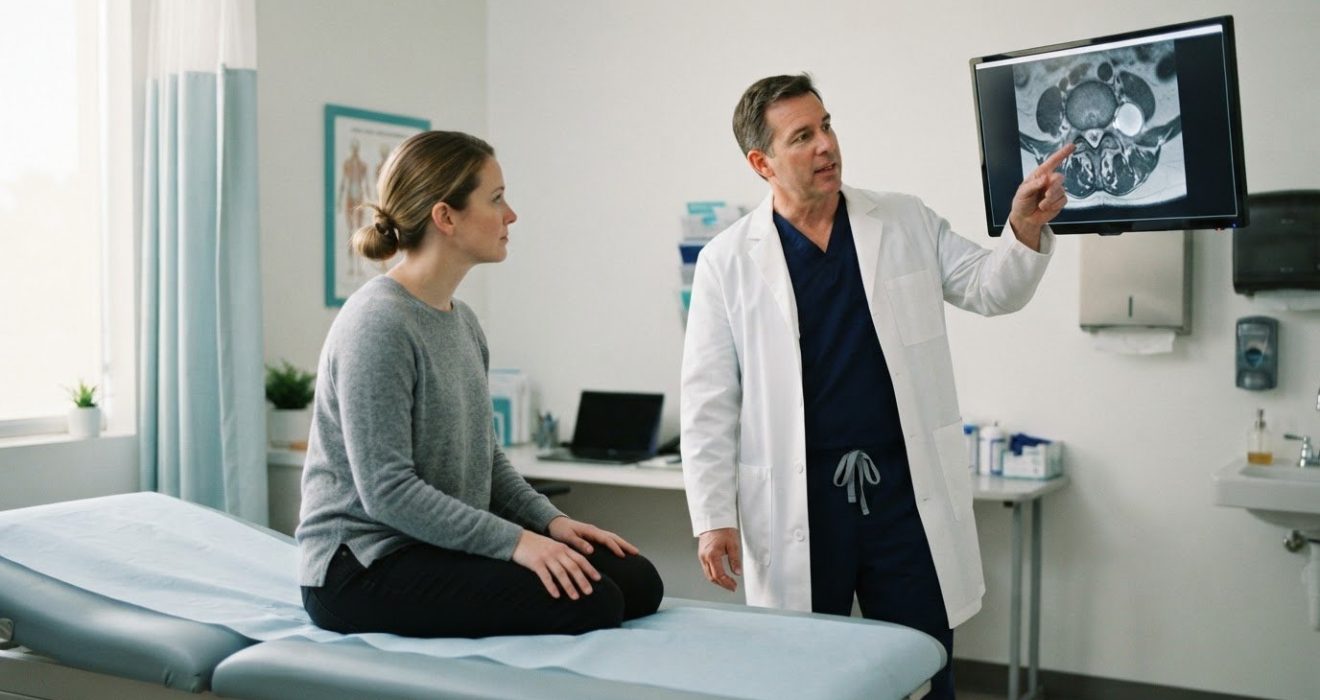
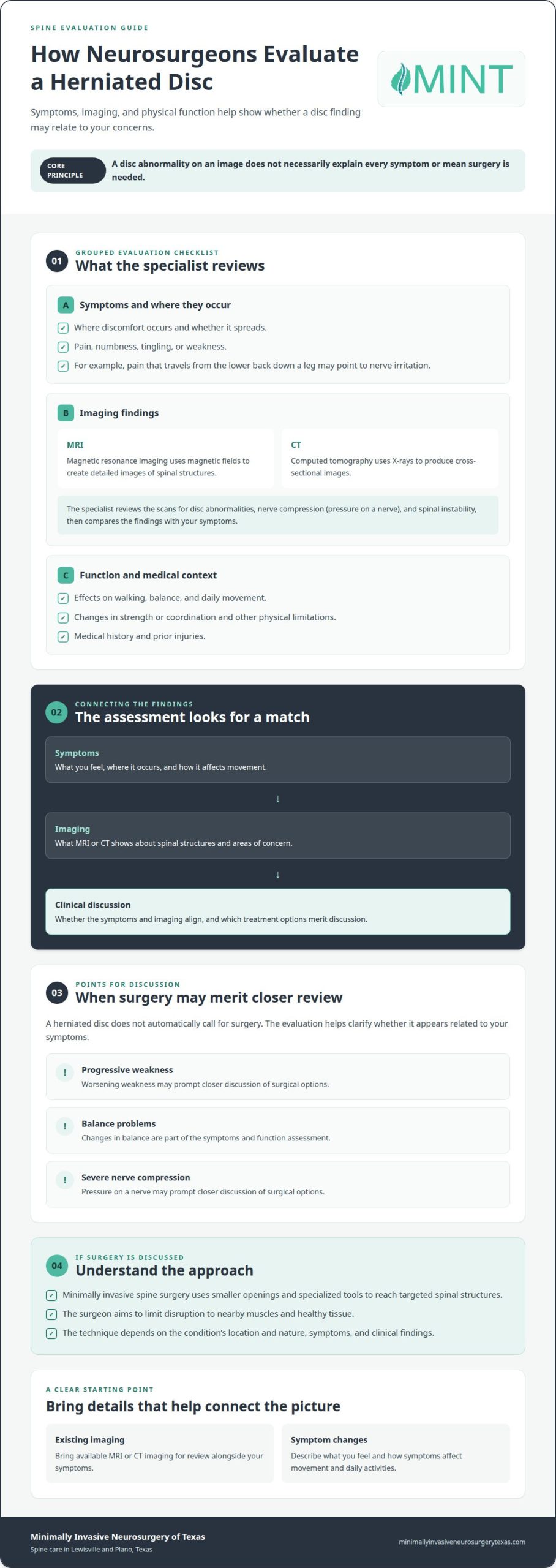
A neurosurgeon evaluates a herniated disc by comparing your symptoms with its location and imaging findings. The assessment also considers your medical history, prior injuries, and physical limitations. A disc abnormality on an image does not necessarily explain every symptom. The key question is whether it relates to nerve compression, or pressure on a nerve, or another spinal problem.
MRI, or magnetic resonance imaging, uses magnetic fields to create detailed images of spinal structures. CT, or computed tomography, uses X-rays to produce cross-sectional images. These scans can help identify nerve compression, spinal instability, and disc abnormalities. The neurosurgeon reviews the images alongside your account of pain, numbness, tingling, or weakness. For example, pain traveling from your lower back down a leg may point to nerve irritation.
- Symptoms: The specialist considers where discomfort occurs, whether it spreads, and how it affects walking, balance, or daily movement.
- Imaging: MRI and CT findings help show the relationship between spinal structures and areas of concern.
- Function: Physical limitations and changes in strength or coordination help clarify how the condition affects the patient.
A Lewisville neurosurgeon for herniated discs uses these findings to explain whether your symptoms and imaging align and which treatment options merit discussion. A disc finding does not automatically call for surgery. The evaluation helps clarify whether the herniated disc appears related to your symptoms. Progressive weakness, balance problems, or severe nerve compression may prompt closer discussion of surgical options.
Bring existing imaging and a clear account of symptom changes to the discussion. If you want to talk through spinal symptoms and evaluation options, contact Minimally Invasive Neurosurgery of Texas.
Minimally invasive spine surgery
Minimally invasive spine surgery uses smaller openings and specialized tools to reach spinal structures. The surgeon plans access around the target area and aims to protect nearby muscles and healthy tissue. For example, a procedure may relieve pressure on a nerve while limiting disruption around the spine. Imaging and navigation can help pinpoint compressed nerves and damaged structures.
Spine specialists assess symptoms, medical history, imaging, and physical limitations before recommending care. A herniated disc can press on nearby nerves and cause pain in an arm or leg. Spinal stenosis is a narrowing of the spinal canal that may affect walking, balance, or mobility. Orthopedic specialists also care for bones and joints, while neurosurgeons focus on the brain, spinal cord, and nerves. This discussion is about spinal care, not brain treatment.
At Medical City Lewisville, the hospital address is 500 West Main Street, Lewisville, Texas. Patients arriving for spine surgery go to the fourth floor. Follow posted signs when entering the hospital grounds to find visitor parking and the appropriate entrance. Confirm the appointment location before traveling, since a hospital surgery destination and an office consultation may differ.
For a referral or consultation, contact a Lewisville neurosurgery office directly, or ask your primary care clinician to coordinate a referral. Share the reason for the visit and mention any existing imaging. You can request a consultation to discuss spinal symptoms and local appointment options.
Dr. Scott Kutz, a board-certified neurosurgeon and Fellow of the AANS and ACS, uses minimally invasive surgical techniques to address back and neck pain. Spine specialists evaluate medical history, symptoms, prior injuries, imaging studies, and physical limitations when planning treatment. Advanced imaging and navigation systems can help surgeons target compressed nerves and damaged structures more accurately while preserving spinal stability. These details can guide discussion of whether a minimally invasive approach may suit a patient’s needs and circumstances.
Neurosurgery services in Lewisville, Texas
Dr. Scott Kutz provides spine care through Minimally Invasive Neurosurgery of Texas (MINT) in Lewisville. Patients asking about a herniated disc, which occurs when disc material pushes beyond its usual boundary, should discuss the specific finding with a neurosurgeon. General spine surgery expertise does not, by itself, establish a focus on a particular condition. The evaluation should connect the disc’s location and imaging with symptoms such as back pain or leg weakness.
Medical City Lewisville Hospital sits at 500 West Main Street in Lewisville, Texas. It provides a local hospital setting for spine surgery. A neurosurgical consultation and a hospital procedure may happen at different locations, so confirm the appointment address when scheduling. The hospital’s address identifies the surgical facility, not necessarily the clinic where a specialist sees patients.
MRI scans, which use magnetic fields to create detailed images, and CT imaging, which uses X-rays to show cross-sections, can help identify nerve compression, spinal instability, and disc abnormalities. A clinician can determine which imaging fits the concern and arrange imaging through a suitable facility near Lewisville. The neurosurgeon then compares the scan with symptoms and examination findings.
To prepare, describe where your pain travels, when it started, and whether weakness or numbness affects movement. Bring prior imaging reports and scans to the appointment if you have them. For example, leg pain alongside lower-back symptoms gives the specialist useful context when reviewing a spinal finding. This information helps connect the image with your day-to-day function.
Patients seeking a Lewisville-area neurosurgeon can contact MINT or ask their referring clinician to coordinate an appointment. Mention the suspected herniated disc, existing MRI or CT results, and any changes in walking or balance. These details help the office direct the inquiry appropriately and help the specialist prepare to review the case. Medical City Lewisville Hospital remains a local surgical destination, while consultation and imaging arrangements depend on the clinical pathway.
When comparing spine surgeons, distinguish general spine surgery experience from experience relevant to your specific condition and clinical question.
Surgeon experience and patient communication
Surgeon training and clear explanations help patients understand their treatment choices. For a spinal cyst, ask how the surgeon’s spine experience relates to your particular diagnosis and concerns.
Experience With Spinal Conditions
Michael Scott Turner, MD, practices in Lewisville and specializes in spine surgery. His listed experience includes more than 15 years, and his training includes neurological surgery residency at the University of Chicago from 2003 to 2010. Those details describe his spine background, but general experience alone does not establish specific experience operating on synovial or arachnoid cysts. Scoliosis and cysts also involve different treatment decisions.
The American Board of Neurological Surgery lists Turner as certified in neurological surgery. Certification and residency help describe a surgeon’s training, but patients also need a clear explanation of how imaging, symptoms, and physical findings shape a recommendation. For scoliosis, Medical City Lewisville Hospital information says doctors may recommend bracing and physical therapy for curves under 25 degrees, while surgery may be needed for curvatures between 40 and 50 degrees.
Patient Reviews
Patient reviews may describe how a neurosurgeon communicates, explains options, and supports follow-up. They cannot establish whether a surgeon has performed a particular spinal cyst operation or predict another patient’s outcome. Look for specific descriptions of the patient experience rather than treating general praise as proof of cyst-specific expertise. Your diagnosis, symptoms, and treatment discussion remain central.
Insurance coverage and in-network status depend on your plan and the care involved. Your insurer can explain how those terms apply to your policy and clinician. Care may involve observation or non-surgical options, such as medication management, injections, or activity modification. Surgery may be discussed when symptoms and findings warrant it. Progressive weakness, balance problems, or severe nerve compression may prompt an assessment of surgical options. Cyst type and location also shape the decision.
Practice location and office hours
Lewisville has a named hospital location for spine surgery: Medical City Lewisville Hospital, 500 West Main Street, Lewisville, Texas 75057. Patients arriving there for spine surgery go to the fourth floor. This address identifies the hospital, not necessarily the office for a neurosurgical consultation. Keep those destinations distinct when planning a visit.
Office consultations and hospital procedures can involve different locations. Use the address and hours on the appointment details for an office visit. For surgery at Medical City Lewisville Hospital, follow the hospital’s arrival instructions and proceed to the fourth floor. This distinction helps prevent arriving at the surgical facility for an office appointment, or vice versa.
Plan the route around the appointment’s specific destination. Enter “500 West Main Street, Lewisville, Texas 75057” for the hospital visit, then follow posted signs for parking and the hospital entrance. The available location details do not identify a particular parking lot or entrance, so use on-site directions rather than assuming a route. Allow time to reach the correct building area before checking in.
Office hours matter when arranging a consultation or returning a call. Use the hours provided with your appointment information to plan your arrival, and keep the clinic address separate from any hospital address. If your visit involves surgical care, review the arrival instructions as well. A consultation, imaging appointment, and hospital procedure may each have a different destination.
Before leaving, organize the appointment details in one place: the clinic or hospital address, the scheduled time, and any arrival instructions. For a hospital surgery at Medical City Lewisville, remember the fourth-floor destination. For an office visit, follow the office address and hours associated with that appointment. These steps keep local travel plans clear without confusing the consultation location with the surgical site.
Provider distances from Lewisville
Medical City Lewisville Hospital serves as a local reference point for comparing nearby hospital locations. Medical City Las Colinas Hospital sits 10.3 miles from Medical City Lewisville Hospital. Medical City Denton Hospital sits 10.4 miles away. These figures describe hospital-to-hospital distances, not travel times or distances from a specific clinic.
That distinction matters when planning an appointment. A neurosurgeon’s consultation office may sit somewhere different from the hospital where surgery takes place. Before traveling, use the appointment address to identify the correct destination. The hospital distances can help orient patients comparing facilities around Lewisville, but they don’t show which location provides a specific spinal cyst evaluation.
Distance alone also doesn’t indicate a neurosurgeon’s experience with spinal cysts. Patients should distinguish between a clinic visit, an imaging appointment, and a hospital procedure. For example, Medical City Denton Hospital’s 10.4-mile distance from Medical City Lewisville Hospital does not establish that a particular neurosurgeon practices there or treats cysts there. Confirm the destination shown for each appointment.
For a practical location check, compare the appointment address with the hospital name and note whether the visit involves consultation, imaging, or surgery. Keep the 10.3-mile Las Colinas and 10.4-mile Denton figures in context: they are reference distances between named hospitals. They cannot predict traffic, driving time, parking needs, or the route from a patient’s home.
Choosing a nearby location may make travel easier, but the clinical question remains central. The evaluation should address the cyst’s location, imaging findings, and symptoms. To discuss spinal symptoms and local care options, request a consultation.
Michael Turner’s Texas medical license is listed as valid: 2011 – 2028; his Illinois medical license: 2003 – 2011. Sciatica can cause burning pain, tingling, weakness, or numbness traveling from the lower back down the leg.
Minimally Invasive Neurosurgery of Texas
Minimally Invasive Neurosurgery of Texas provides a next step for people weighing spine-related symptoms and surgical options. Its Lewisville and Plano locations serve patients seeking specialized spine care. A consultation can connect your concerns, imaging findings, and physical limitations with a clearer discussion of possible care. A herniated disc finding alone does not determine whether surgery is appropriate.
Dr. Scott Kutz, a board-certified neurosurgeon and Fellow of the AANS and ACS, leads the practice’s spinal care. Minimally invasive spine surgery uses smaller openings and specialized tools to reach spinal structures while aiming to protect nearby tissue. Dr. Kutz may discuss this approach when a spinal condition causes symptoms and he considers surgery appropriate. Your diagnosis and clinical findings guide that decision.
If imaging shows a herniated disc, discuss how its location relates to your symptoms and daily function. A neurosurgeon can review relevant scans and explain what the findings mean for your spine. If surgery is considered, ask about the proposed approach and how it addresses the identified problem. Treatment choices depend on the full clinical picture, not the scan alone.
The practice also offers Endoscopic Spine Surgery, which uses specialized instruments and a small camera to access the spine, and Artificial Disc Replacement, which replaces a damaged disc with an artificial one. These procedures address different spinal conditions, so neither automatically applies to a herniated disc. The central goal is to understand the diagnosis, discuss appropriate options, and make an informed decision about care.
To discuss your spinal symptoms and care options, contact Minimally Invasive Neurosurgery of Texas.
Take the Next Step With Clear Questions
A herniated disc diagnosis can leave you wondering what the scan means and what to do next. Learning about spine care options can help you prepare for a focused conversation about your symptoms and concerns. You deserve an explanation that connects the medical details with your daily life.
As you consider a Lewisville neurosurgeon for herniated discs, use your next discussion to clarify the goals of care and the reasoning behind any recommendation. Ask how the specialist interprets the findings, which factors shape the decision, and how the proposed plan addresses your concerns. Clear answers can help you make a thoughtful choice without rushing into treatment.
When you’re ready to discuss your situation, contact Minimally Invasive Neurosurgery of Texas. A focused conversation can help you understand your options and consider your next steps.
Frequently Asked Questions
Looking for a location?
Minimally Invasive Neurosurgery of Texas lists its Lewisville office at 1850 Lakepointe Drive, Suite 500, Lewisville, Texas. Its Plano address is 5465 Legacy Drive, Suite 650, Plano, Texas 75024. Use the address associated with your appointment when planning your visit, since the Lewisville and Plano offices have different locations. The practice’s website provides general information, not a substitute for professional medical advice.
Which neurosurgeons near Lewisville, Texas treat herniated discs?
Dr. Scott Kutz is a board-certified neurosurgeon specializing in spinal disorders and minimally invasive spine surgery. If you’re seeking a Lewisville neurosurgeon for herniated discs, you can ask how your imaging and symptoms relate to the practice’s spine-care focus. A herniated disc alone does not mean surgery is appropriate. The clinical discussion should address the diagnosis, its effect on your symptoms, and possible treatment options.
What are the treatment options and risks for herniated discs, including surgery and observation?
A herniated disc does not automatically require surgery. A neurosurgeon considers symptoms, imaging, the disc’s location, and its effect on nearby nerves when discussing next steps. Progressive weakness, balance problems, or severe nerve compression may prompt a discussion of surgery.
Which Lewisville neurosurgeons are board-certified and have experience with herniated disc surgery?
Dr. Scott Kutz is a board-certified neurosurgeon whose practice evaluates herniated discs and offers minimally invasive spine surgery. Michael Scott Turner, MD, is also board-certified and specializes in spine surgery, but the article does not establish that he focuses on herniated disc surgery.