
Minimally Invasive Neurosurgery of Texas (MINT), led by Dr. Scott Kutz, a board-certified neurosurgeon and Fellow of the AANS and ACS, provides minimally invasive spine surgery in Lewisville and Plano, TX. For patients considering how to build trust with your surgeon, open dialogue helps make care decisions clearer.
A surgeon’s credentials matter, but trust also grows when you feel heard, understand the reasons behind recommendations, and can raise concerns openly. Help make the conversation productive by sharing your symptoms, medical history, priorities, and questions. Your surgeon should explain medical terms and discuss potential benefits and risks in language you understand.
This article covers practical ways to build understanding, from preparing for appointments and listening actively to reviewing credentials and seeking referrals. It also explains how empathy and clear communication can support shared decisions about spine care. These steps can help you approach a surgical consultation with greater clarity and decide whether the surgeon’s experience, communication style, and treatment plan fit your needs.
Key Takeaways
- Prepare for appointments by organizing your symptoms, medical history, medications, and top concerns so you can use the conversation well.
- Ask your surgeon to explain treatment options, expected outcomes, and unfamiliar medical terms in clear language.
- Use recommendations from friends and family as a starting point, then ask questions that help you assess whether a surgeon listens and communicates clearly.
- Notice whether your surgeon acknowledges your concerns, listens without rushing, and involves you in care decisions.
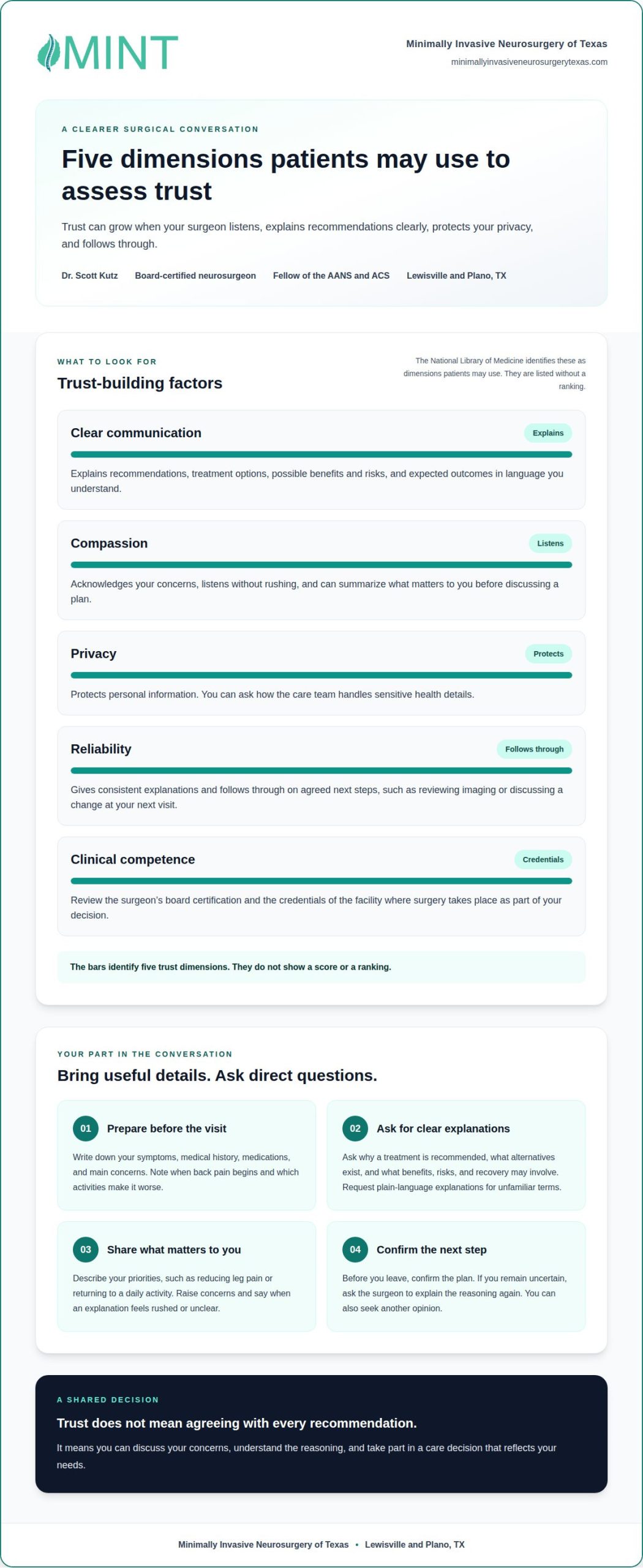
- Review a surgeon’s board certification and the credentials of the facility where surgery takes place as part of your decision.
Patient responsibilities in the surgeon-patient relationship
A productive relationship starts with sharing accurate health information and taking part in each discussion. Before an appointment, write down your symptoms, current medications, relevant medical history, and the concern that most affects daily life. For example, note when your back pain begins and which activities make it worse. Ask about unfamiliar terms and request plain-language explanations. These habits offer a practical starting point for how to build trust with your surgeon.
Use the surgeon’s educational materials to understand your diagnosis, proposed treatment, and care instructions. If a handout includes an unfamiliar term, mark it and ask about it at your next visit. Attend scheduled appointments, including tele-rechecks, which let patients review progress remotely. Describe specific changes, such as new numbness or difficulty with an activity, rather than saying only, “I feel different.”
Your surgeon should explain the reason for a recommendation, discuss possible surgical risks and complications, and describe the expected benefits. They should also explain follow-up care and how appointments can address changing needs during recovery. Ask what each option involves and how its potential benefits and risks relate to your goals. Then share your preferences so you can make the decision together.
Consistency helps your surgeon understand how your symptoms and priorities change over time. Keep follow-up appointments, report changes between visits, and say when a treatment plan feels difficult to follow. A respectful exchange works both ways: listen to the explanation, ask direct questions, and voice concerns without minimizing them. If you feel nervous or want help remembering the plan, a family member can join the appointment and take notes.
Trust doesn’t mean agreeing with every recommendation. If you’re uncertain, explain what remains unclear and ask your surgeon to review the reasoning. You can also seek another opinion and share your questions openly. An important step in how to build trust with your surgeon is confirming the next action before you leave, such as reviewing educational materials or attending a scheduled tele-recheck. This gives you and your doctor a clear plan to follow.
How can you build trust with your surgeon?
Trust can grow through clear communication, compassion, privacy, reliability, and clinical competence. The National Library of Medicine identifies these as dimensions patients may use to assess a physician’s trustworthiness. Notice whether your surgeon listens to your concerns, explains recommendations, protects personal information, and follows through on agreed next steps. Support open dialogue by saying what matters most to you, such as reducing leg pain or returning to a daily activity.
During informed consent, your surgeon should explain the proposed operation, why it may help, its possible risks and complications, and the expected outcomes. Informed consent means you understand this information and can make a considered choice. Ask about alternatives, what recovery may involve, and which warning signs need attention. Clear answers help you decide whether the plan fits your needs.
Honest communication works both ways. Share your symptoms, relevant medical history, and concerns about treatment, even if a detail feels difficult to mention. Then ask your surgeon to explain the reasoning behind a recommendation. For example, if an operation aims to address nerve pressure, ask what the surgeon expects it to improve and which symptoms may remain. Understanding the purpose helps you take part in the decision with confidence.
Compassion and body language also shape a consultation. A surgeon can show attention by setting aside distractions, facing you, and summarizing your concern before discussing a plan. Help by stating your main question first and saying when an explanation feels rushed. Privacy matters too: ask how the care team handles sensitive health details, and share information in a setting where you feel comfortable.
Reliability shows in consistent explanations and follow-through. If your surgeon says the team will review imaging or discuss a change at your next visit, note the plan and revisit it together. Clear communication before and after surgery can help you understand care instructions and raise recovery concerns promptly. Trust doesn’t mean avoiding difficult questions. It means discussing benefits, risks, and next steps openly with your surgeon.
Questions to ask friends and family about surgeon referrals
A referral from someone you trust can help you prepare for a medical consultation, but their experience may differ from yours. Ask which condition or procedure their surgeon treated and whether they felt heard during appointments. A friend’s experience with back surgery can offer context, but it can’t predict your treatment or outcome. Focus on details that show how the surgeon communicates and supports patients.
Ask your friend or family member for specific examples rather than a general rating. For instance, find out how the surgeon explained the diagnosis, answered questions, and discussed options. Ask whether the office kept them informed about appointments and follow-up. Their answers can help you identify topics to raise during your own consultation.
- What medical problem did the surgeon evaluate, and what treatment did they recommend?
- Did the surgeon explain the reasons for that recommendation in clear language?
- Could you express concerns or ask questions without feeling rushed?
- How did the surgeon and care team communicate before and after the procedure?
Use the referral as a starting point, then ask the surgeon about your diagnosis. You might say, “What findings in my examination or imaging support this treatment?” Ask what alternatives the surgeon considered and why they recommend one approach over another. If the surgeon discusses surgery, ask what the procedure aims to address, which risks or complications you should understand, and what follow-up care involves. These questions connect a personal recommendation to your specific medical needs.
How can you find and compare surgeon reviews and outcomes? Look for recurring details in reviews about listening, explanations, and follow-up, while treating individual stories as personal experiences. For outcomes, focus on the specific procedure and condition the surgeon is considering, then ask the surgeon how they define and discuss results for patients with similar needs.
During the consultation, notice whether the surgeon answers your questions directly and makes room for your priorities. If a term such as “nerve compression” comes up, ask what it means in your case and how it relates to your symptoms. Before you leave, summarize what you understood about the diagnosis, proposed treatment, and next step. This can show whether you and your surgeon share an understanding, which matters more than a referral alone.
Active listening and empathy
Active listening gives patients room to describe what a health problem means in their lives. A surgeon can invite that perspective by asking what feels hardest about the condition, then allowing time for an answer. For example, a patient may explain that uncertainty about returning to caregiving feels harder than the pain itself. That context can shape a more personally relevant discussion.
Empathy means more than recognizing a feeling. A surgeon can acknowledge it without dismissing it or rushing to reassure. If a patient feels overwhelmed by a possible operation, the surgeon can recognize the stress and explore what information or support would help make the decision clearer. This response respects the person behind the diagnosis while keeping the medical discussion grounded.
Patients can help by naming personal values that may affect care decisions. Preferences related to faith, modesty, family responsibilities, or cultural practices can matter during treatment planning. For example, explain whether involving a family member would help you consider a major decision. The surgeon can discuss how that preference fits the clinical situation and explain any limits that affect care.
Language and cultural differences also shape communication. Tell the care team which language you understand best and whether cultural beliefs affect your choices. A surgeon who respects these details can avoid assumptions and address your actual concerns. You can also say when a phrase feels uncomfortable or confusing. Respectful discussion makes room for different backgrounds without reducing anyone to a stereotype.
Empathy can strengthen collaboration by connecting clinical goals with outcomes that matter to the patient. A surgeon may focus on treating a spinal problem, while the patient may care most about maintaining independence or returning to a meaningful role. Discussing both perspectives helps define what progress means to that person. No conversation can guarantee a particular outcome, but shared understanding can make care decisions more personal and purposeful.
A doctor can help patients feel safe raising concerns by listening attentively, showing empathy, and acknowledging those concerns. Attentive listening may include setting aside distractions, listening carefully, and summarizing the patient’s concerns in the doctor’s own words. This gives the patient a chance to clarify whether the doctor understood what matters to them, rather than moving too quickly to a response.
The BATHE model prompts clinicians to ask about what is happening in a patient’s life, how the patient feels, what is troubling them most, and how they are handling the situation, before expressing concern. Culturally competent doctors may listen actively, show empathy for the communities they serve, address language barriers, and respect diverse cultures and beliefs. These practices keep the conversation focused on the patient’s concerns and make room for the context behind them.
Checking board certification and facility credentials
Credentials give you concrete topics to discuss during a surgical consultation. Start by asking which specialty board certifies the surgeon and whether that certification covers their practice area. Then use the named board’s official directory to look up the surgeon’s full name. Compare the listed specialty and status with the information the surgeon shared. If directory terms are unfamiliar, ask the office to explain them.
Board certification and a medical license are different credentials. Certification relates to a specialty, while a license authorizes medical practice in a jurisdiction. Ask the surgeon to clarify each credential and how it connects to your proposed treatment. For example, if you’re discussing spine surgery, ask about the surgeon’s training and experience with the procedure the surgeon is considering. Clear answers support an informed conversation, beyond relying on a title alone.
Next, identify where the procedure would take place. Ask for the facility’s full name and location, then ask which organization accredits it. Accreditation is an external review of a facility against defined standards. Confirm the accrediting organization and the facility’s current accreditation directly with the facility. Also ask whether the surgeon has privileges there, meaning permission to perform procedures at that hospital or center.
These questions can help you take part in healthcare decisions respectfully and practically:
- Which specialty board issued your certification, and how can I find your listing?
- Does your certification relate to the spine condition and procedure we discussed?
- Where would you perform the procedure, and which organization accredits that facility?
- Do you have privileges to perform this procedure at that location?
Use the answers to identify follow-up questions, rather than making assumptions based on a credential’s name. If the facility lists an accrediting body, ask how patients can verify its current status. If the surgeon operates at a hospital, ask which privileges apply to your planned procedure. These steps bring the setting and professional credentials into the same conversation.
Credentials can’t tell you whether a surgeon listens carefully or explains your options clearly. Pair each check with a discussion of your diagnosis, the recommended treatment, and its risks. A surgeon who answers questions directly helps you understand the information and decide what matters next. Respectful questions about certification and facility oversight are part of an open patient-surgeon conversation.
Minimally Invasive Neurosurgery of Texas
Minimally Invasive Neurosurgery of Texas helps patients in Lewisville and Plano, Texas, explore spine care with Dr. Scott Kutz, a board-certified neurosurgeon and Fellow of the AANS and ACS. If you’re considering surgical treatment, a consultation offers a chance to discuss your condition, understand potential approaches, and identify which questions you want answered before deciding on next steps.
Minimally Invasive Neurosurgery of Texas provides Minimally Invasive Spine Surgery, Artificial Disc Replacement, and Endoscopic Spine Surgery. These are distinct approaches to spinal conditions, and the right discussion depends on your diagnosis and the treatment your care team is considering. For example, artificial disc replacement involves replacing a damaged spinal disc with an artificial one. Your consultation can clarify whether a procedure is relevant to your situation and what it aims to address.
Share how your symptoms affect your routine, such as whether discomfort limits walking or interrupts sleep. This context helps keep the discussion centered on your priorities. Ask how examination findings and imaging relate to the treatment your care team is considering, which alternatives may apply, and what follow-up care involves. A clear conversation lets you consider the plan with your needs in view.
Consider which activities you hope to resume and which concerns you want addressed. If a medical term or recommendation feels unclear, ask for an explanation in everyday language. You might also ask what questions to consider before making a decision. These details help make a surgical consultation useful and focused, without assuming one approach suits every patient.
If you want to learn about one specific approach, Endoscopic Spine Surgery is one option to discuss alongside other treatments. The conversation can address how that procedure relates to your condition and what factors shape the treatment discussion. Understanding those distinctions can help you take a more informed next step.
If you’re ready to discuss your spine concerns, contact Minimally Invasive Neurosurgery of Texas.
Frequently Asked Questions
How can I build trust and rapport with my surgeon?
Build rapport by treating each appointment as a two-way working relationship. If the surgeon makes an assumption that doesn’t match your experience, respectfully explain what happens instead. For example, clarify whether a symptom occurs during activity or continues at rest. Precise exchanges help prevent misunderstandings and keep the discussion grounded in your experience, rather than assumptions based on a diagnosis alone.
What questions should I ask a surgeon before surgery?
Ask practical questions about the care process, not just the operation. Find out who coordinates your care, who will answer questions about preparation, and what happens if your health changes before the procedure. Ask which symptoms after surgery need prompt attention and whom to notify. These details help you understand how the care team manages transitions between appointments and what support channels are available at each stage.
How do I check a surgeon’s credentials and experience?
Clarify the surgeon’s role throughout your care. Ask who will perform the operation, who will assist, and who will manage follow-up visits. You can also ask how the surgeon’s training relates to the procedure the surgeon is considering. These questions distinguish the surgeon’s personal role from the wider care team’s responsibilities and help you understand who will guide each part of your treatment.
Should I get a second opinion before surgery?
A second opinion can help when recommendations differ or you’re still unsure about proceeding. Ask each surgeon to explain the clinical reasoning behind their recommendation and which findings could change it. Compare the explanations rather than choosing based only on confidence or presentation. Before planned surgery, give yourself time to understand the alternatives and consider how each option fits your priorities.
How can I communicate concerns and preferences with my surgeon?
Identify the concern that matters most to your decision and explain why. For example, if preserving a particular activity is a priority, describe the activity and what you hope to maintain. Ask the surgeon to address that priority when discussing care. You can also request that the team include an important preference in your written care plan, so the team can refer to it in later discussions.
What are signs of a trustworthy surgeon or a surgical red flag?
Look for consistency between the surgeon’s explanation and the written plan. A trustworthy discussion acknowledges uncertainty and distinguishes expected benefits from possible risks. Be cautious if anyone guarantees a specific result, dismisses reasonable questions, or pressures you to decide before you understand the proposal. You should be able to identify the next decision and what information you still need.
How can I verify a surgeon’s board certification and disciplinary history in the United States?
Check board certification in the specialty board’s directory, then review the physician’s record with the state medical licensing board where they practice. Use the surgeon’s full name and relevant state, and compare identifying details to avoid confusing people with similar names. Read the record carefully, including the status and dates shown. If an entry is unclear, ask the licensing board what its public record means.