Minimally Invasive Neurosurgery of Texas provides minimally invasive spine surgery in Lewisville and Plano, TX. Dr. Scott Kutz, a board-certified neurosurgeon and Fellow of the AANS and ACS, leads the practice. The criteria for a successful spine surgery outcome include meaningful pain relief, improved daily function, and patient satisfaction.
Dr. Kutz’s clinical approach begins by connecting a patient’s symptoms to the spinal problem a procedure will address. Technical results matter, but pain and movement in daily life are also important measures of recovery.
Success looks different depending on the procedure and the patient’s goals. This article explains how clinicians assess pain relief, function, and satisfaction, why reported outcomes vary, and how to consider a procedure such as Artificial Disc Replacement in light of its treatment goals.
Key Takeaways
- Judge outcomes by pain relief, daily function, and satisfaction, not imaging results alone.
- Compare success rates only in the context of the procedure and spinal condition the surgeon treats.
- Recognize how overall health and the match between symptoms and a visible spinal problem can shape recovery.
- Understand that persistent pain after surgery has several possible causes and does not always mean the procedure failed.
- Weigh the goals and tradeoffs of surgery against non-surgical care when considering the next step.
What Does a “Successful” Spine Surgery Actually Mean?
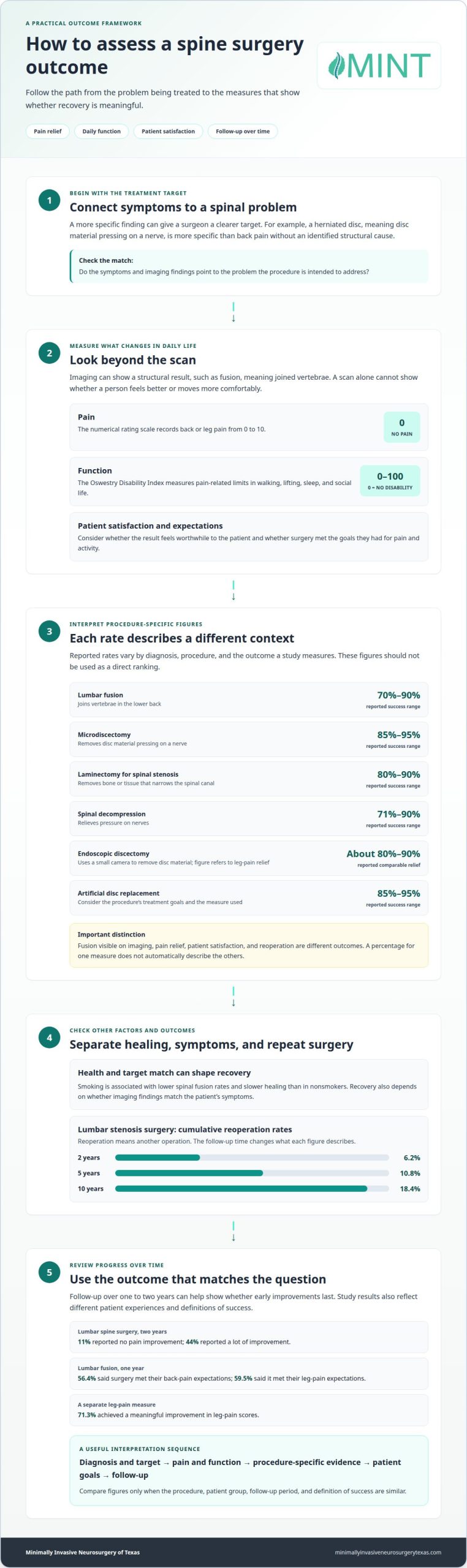
A successful outcome may include less pain, better physical function, and a result the patient considers worthwhile. Imaging, such as a scan showing fusion, measures one aspect of recovery. It does not show on its own whether symptoms have improved.
Health Factors Shaping Outcomes
Health factors include smoking, the cause of symptoms, and whether imaging findings match the patient’s pain. These matter because healing and identifying the right surgical target can affect recovery. Patients who smoke typically have lower spinal fusion rates and slower healing than nonsmokers. A clear finding, such as a herniated disc pressing on a nerve, may give surgeons a more specific target than general back pain without an identified structural cause.
Recovery, Outcomes, and Satisfaction
Patient-reported recovery captures how pain and daily activities change from the patient’s perspective. It matters because a scan cannot show whether someone walks, sleeps, or lifts more comfortably. The Oswestry Disability Index measures pain and limits involving activities such as walking, lifting, sleep, and social life. Its score ranges from 0 to 100, with 0 indicating no disability. The numerical rating scale measures back or leg pain from 0 to 10, with 0 indicating no pain.
Patient satisfaction adds another measure. In one study, 11% of patients reported no pain improvement two years after lumbar spine surgery, while 44% reported a lot of improvement. A separate lumbar fusion study found that 56.4% of patients said surgery met their back-pain expectations at one year. These figures describe different patient experiences, not a single universal success rate.
Expectations and Pain Improvement
Expectations describe the changes a patient hopes to experience, such as less leg pain or easier walking. They matter because success depends partly on whether surgery addresses the problem behind those symptoms. In a lumbar fusion study, 59.5% of patients said surgery met their leg-pain expectations at one year. A separate measure found that 71.3% achieved a meaningful improvement in leg-pain scores.
When discussing expected results, ask which symptoms the procedure addresses, how the care team will measure progress, and which daily activities may improve. Ask how the proposed operation relates to your imaging findings and personal goals. These questions make the expected outcome more concrete than a general success rate.
Insurance coverage can affect which procedures a plan covers and the patient’s share of costs. Location can also affect travel to appointments and access to follow-up care. Consider both when planning treatment and recovery.
Procedure type changes what success means. For example, endoscopic spine surgery uses a small camera and specialized instruments to treat selected spinal problems through a smaller access point. Its outcome still depends on symptom relief and function, not the technique alone.
Success rates by spinal procedure
Reported success rates vary by procedure, diagnosis, and the outcome being measured. Compare figures only when the procedure, patient group, and definition of success are similar.
Fusion Outcomes and Reoperation
Spinal fusion joins vertebrae to stabilize a segment, and studies assess both healing and patient outcomes. That distinction matters: a successful fusion on imaging does not necessarily mean pain has resolved. Reported lumbar fusion success rates range from 70% to 90%, while one study reported 71.1% patient satisfaction. These figures describe different measures, so they should not be treated as interchangeable.
Reoperation adds another measure, but it does not explain whether patients improved after the first operation. After lumbar stenosis surgery, cumulative reoperation rates were 6.2% at 2 years, 10.8% at 5 years, and 18.4% at 10 years. The time point matters: a rate at 2 years cannot describe the same period of follow-up as a rate at 10 years.
Outcomes by Lower Back Procedure
Lower back surgery success rates depend on the condition and the procedure’s goal. For lumbar disc herniation, microdiscectomy removes disc material pressing on a nerve; reported success rates range from 85% to 95%. For spinal stenosis, laminectomy removes bone or tissue that narrows the spinal canal, with reported rates of 80% to 90%. Those ranges reflect different conditions and treatment targets.
Other procedures show different reported ranges. Spinal decompression, which relieves pressure on nerves, has reported success rates from 71% to 90%. During endoscopic discectomy, a surgeon removes disc material using a small camera; the procedure reports comparable leg-pain relief in about 80% to 90% of patients. Artificial disc replacement reports success rates from 85% to 95%. These percentages use varying definitions, so they cannot rank procedures without clinical context.
For example, a study may count reduced leg pain as success, while another may focus on fusion seen on imaging. A single-level lumbar fusion can have a radiographic fusion rate of 90% or higher, yet that figure does not mean the same share of patients feel pain-free. Reoperation rates also measure a different outcome from symptom relief or satisfaction.
Use a reported success rate as a starting point, then connect it to the diagnosis, treatment goal, and measurement method. For example, a patient considering artificial disc replacement can review the procedure’s purpose and expected outcome measures before weighing its reported range. To discuss how procedure-specific outcomes relate to your goals, contact the care team.
Multidimensional definitions of surgical success
A useful assessment considers pain, function, satisfaction, and complications. Follow-up over one to two years can help show whether early improvements last.
Multiple Measures of Success
Clinicians assess surgical outcomes in several ways because no single measure captures the full recovery. This distinction helps patients interpret hospital comparisons and published rates. Imaging can show whether vertebrae joined after fusion, while a function measure can track walking or lifting. Patient satisfaction adds a personal perspective, and complication rates describe potential harms. The same operation can therefore have different results across these measures.
Measurement also changes the reported rate. Success rates for the same spinal procedure may differ by up to 30 percentage points when researchers measure imaging, functional improvement, or patient-reported outcomes. Return to work within 6-12 months can indicate occupational recovery, but it does not capture pain or daily activity by itself. A clear benchmark identifies its outcome, follow-up period, and patient group.
For example, a hospital comparing two surgical units should separate procedures and diagnoses rather than group every spine operation together. Researchers should also use consistent outcome definitions and follow-up periods. A one-year pain score is not directly comparable with a two-year fusion image. Consistent measures help patients understand what a reported clinical success rate represents.
Expertise and Surgical Techniques
Surgeon expertise and technique matter, but patient selection and guideline fit also influence outcomes. This matters because the operation must address the condition that causes the symptoms. In a study of 325 lumbar fusion cases, patients who followed evidence-based guidelines for surgery were three times more likely to have positive outcomes. Guideline alignment showed a stronger association than surgeon type or first surgery versus revision.
The North American Spine Society lumbar fusion guidelines include factors such as trauma, spinal deformity, certain axial back pain, tumor, and infection. For example, fusion may stabilize the spine after trauma when clinicians identify instability. A minimally invasive approach describes how a surgeon reaches and treats the target, not a separate measure of success. The surgical technique should suit the clinical goal.
Risk belongs in the same outcome review as pain relief and function. Vertebroplasty, a procedure that stabilizes a fractured vertebra with bone cement, has reported complications in 1% to 3% of procedures for osteoporotic fractures. For malignant neoplasms, or cancerous growths, reported complications occur in 7% to 10% of procedures. These figures vary by indication, so a benchmark needs to specify the condition and measure complications alongside recovery.
Failed back surgery syndrome and persistent spinal pain
Spinal surgery can meet its technical goal while pain or limited function continues. Clinicians often call persistent pain after spine surgery failed back surgery syndrome, or FBSS. The term describes ongoing symptoms, not proof that a surgeon performed the operation incorrectly. Researchers report persistent pain rates of 10% to 40%, depending on the population and definition. That range shows why outcome measures need context.
Success may mean less pain, improved movement, or progress toward a patient’s specific activity goals. A scan can show structural changes, but it cannot measure every symptom or daily limitation. For example, surgery for spinal stenosis, a narrowing of the spinal canal, may aim to ease pressure on nerves and improve walking. If the scan changes but walking remains difficult, the functional outcome still needs attention.
Time also shapes how clinicians interpret recovery. Many studies assess outcomes 6-12 months after surgery, but that window may not capture longer-term pain or function. Up to 1 out of 12 patients experience failed back surgery syndrome within one year of the surgery. A short-term assessment can identify early progress, while later follow-up can reveal persistent or returning symptoms.
Ongoing pain can have several explanations. The original source may remain, a new spinal problem may develop, or nerve irritation may continue during recovery. For instance, someone with lumbar stenosis may still have leg symptoms if nerve-related problems persist after treatment. Clinicians assess symptom patterns, physical function, and relevant imaging together rather than relying on one finding.
Reassessment starts with describing what has changed since the procedure. Distinguish back pain from leg pain, note which activities remain difficult, and explain whether symptoms have improved, stayed similar, or worsened. These details help clinicians assess recovery and decide whether the treatment plan needs adjustment. Comparing current symptoms with those before surgery makes the review more useful.
Ongoing pain does not automatically mean another operation will help. The next step depends on the suspected cause, the patient’s symptoms, and whether examination findings match imaging. For example, new nerve compression differs from continuing muscle-related discomfort, even if both limit walking. Distinguishing these patterns helps the care team focus on the problem most closely linked to lost function.
When comparing spinal surgery outcomes, consider how each study defines success, when it measures recovery, and which symptoms it tracks. A pain score at 6-12 months, a scan, and a patient’s ability to return to valued activities answer different questions. Together, those measures offer a more complete picture of whether treatment improved the patient’s life.
How do spine surgery outcomes compare with non-surgical treatment?
Spine surgery and nonsurgical treatment both aim to reduce symptoms and improve function, but they work differently. Surgery addresses a specific structural problem, such as a herniated disc pressing on a nerve. Nonsurgical care manages symptoms and supports movement without an operation. A useful comparison considers the diagnosis, treatment goal, pain, and daily activities the patient wants to regain.
Clinicians often begin with conservative care when symptoms do not require urgent surgery. Nonsurgical options may include medication, activity changes, or structured rehabilitation. The right approach depends on the symptoms and their suspected cause, not simply on how long the pain has lasted.
Clinicians may consider surgery when imaging findings match the symptoms and conservative care has not helped enough. For example, a herniated disc may press on a nerve and cause leg pain. A scan alone cannot show whether surgery will improve function. Clinicians consider whether the symptom pattern and structural findings point to the same treatment target.
Compare both approaches using the same measures. Track back pain, leg pain, walking, sleep, or the ability to return to valued activities. Pain scores show changes in symptoms, while daily-function measures show what those changes mean in practice. A study reporting pain improvement cannot, by itself, show how often patients return to work or regular activities.
Structured rehabilitation also supports recovery and non-surgical care. It helps patients rebuild strength and flexibility while protecting the healing process. Patients in structured rehabilitation programs can restore function 25 per cent faster than patients without structured rehabilitation programs. That finding concerns rehabilitation, not a direct comparison between surgery and non-surgical care as complete treatment plans.
Any comparison should weigh potential surgical harms against the intended benefit. Infections occur in 1 to 2 out of every 100 surgeries. Non-surgical treatment avoids an operation, but it may not address an underlying structural problem. Consider whether each approach targets the suspected cause, supports function, and fits the patient’s treatment goals.
To discuss whether your symptoms and imaging findings point toward a surgical option, schedule a spine surgery evaluation.
Minimally Invasive Neurosurgery of Texas
Minimally Invasive Neurosurgery of Texas helps patients understand how symptoms, imaging, and daily goals inform spine surgery decisions. When back or leg pain continues despite nonsurgical care, a focused evaluation can clarify whether a spinal problem matches the symptoms and which treatment options may fit. The practice provides Minimally Invasive Spine Surgery (MISS), Endoscopic Spine Surgery (ESS), and Artificial Disc Replacement for appropriate spinal conditions. Dr. Scott Kutz, a board-certified neurosurgeon and Fellow of the AANS and ACS, discusses the clinical factors that shape expected outcomes. The practice serves patients in Lewisville and Plano, Texas.
If you want to discuss your symptoms and treatment options, contact Minimally Invasive Neurosurgery of Texas.
Take the Next Step Toward a Clearer Treatment Plan
The next step is to connect your symptoms and recovery priorities with a treatment plan that addresses the underlying spinal problem. Criteria for a successful spine surgery outcome should reflect changes that matter in daily life, not only a technical result. Bring questions about pain, movement, and the activities you hope to return to into a focused discussion.
Minimally Invasive Neurosurgery of Texas provides Minimally Invasive Spine Surgery (MISS), Endoscopic Spine Surgery (ESS), and Artificial Disc Replacement. Dr. Scott Kutz can discuss how your diagnosis and goals inform the available surgical options. This conversation can help you understand what each option aims to address and how progress may be assessed over time.
Contact Minimally Invasive Neurosurgery of Texas to discuss your spine concerns and possible next steps. A clearer understanding of your options can help you move forward with confidence.
Frequently Asked Questions
Breaking Down How Successful Is Lower Back Surgery?
Lower back surgery may help when its treatment target matches the problem limiting a patient’s life. Before weighing reported results, identify the main goal: sitting through a workday, standing to cook, or walking without frequent stops. Then consider how the procedure addresses that goal. Someone whose main difficulty is leg symptoms may judge progress differently from someone concerned about bending or lifting.
Can back surgery fail?
Yes. A procedure may not lead to the change a patient hoped for, even when the surgical team completes the planned operation. If symptoms continue, a useful follow-up discussion starts with what changed, what stayed the same, and what new limitations appeared. For instance, a patient might report less tingling but continued difficulty standing. Such details describe the result more precisely than saying simply that it worked or failed.
How Does Your Surgeon’s Experience Affect Your Outcomes?
A surgeon’s experience informs how they interpret a diagnosis and plan an operation. Ask the surgeon to explain which finding supports the proposed procedure and how it relates to your symptoms. You can also ask what alternatives were considered and why the recommended approach fits your case. These questions focus the discussion on clinical reasoning rather than broad claims about surgical skill.
How long does it actually take to heal?
Healing does not follow the same timeline for every patient or procedure. Different tissues recover at different rates, and pain relief may progress separately from strength and stamina. For example, a patient may feel comfortable moving around at home before feeling ready for a long commute or physically demanding work. Ask which changes should guide increased activity and which symptoms warrant a follow-up discussion.
Is back surgery worth it for long-standing chronic pain?
Long-standing pain alone cannot determine whether surgery is appropriate. The decision becomes clearer when a patient identifies the activities pain disrupts and the spinal finding clinicians believe causes those limitations. For example, one person may want to stand long enough to prepare meals, while another may prioritize uninterrupted sleep. Discussing concrete goals helps clarify what treatment should aim to change and how to assess its value.
How is a successful spine surgery outcome defined?
Patients can define success by meaningful changes in activities they value. Before treatment, describe a typical day and note which tasks pain or restricted movement interrupts. Afterward, use those same tasks as practical reference points. For example, compare how long you can walk or whether you can complete a familiar household activity. This personal measure adds context to clinical assessments without replacing them.
Which measures do clinicians use to assess spine surgery outcomes, such as pain, function, and quality of life?
Outcome tracking may include symptom ratings, activity questionnaires, examination findings, and imaging. Each tool captures a different part of recovery. A clinician might ask whether pain interferes with dressing, sleep, or social activities, while an examination may assess movement or strength. Give useful updates by describing a specific task, how it felt before treatment, and what feels different now.
What success rates do common spine surgeries have by procedure and diagnosis?
Use results for a specific procedure as context, not as a personal prediction. Before comparing two published rates, look at the diagnosis treated, the exact procedure, the patient group, the definition of success, and the follow-up point. A study focused on leg-pain relief answers a different question from one tracking imaging or satisfaction. These details help explain why sources may report different outcomes for procedures with similar names.