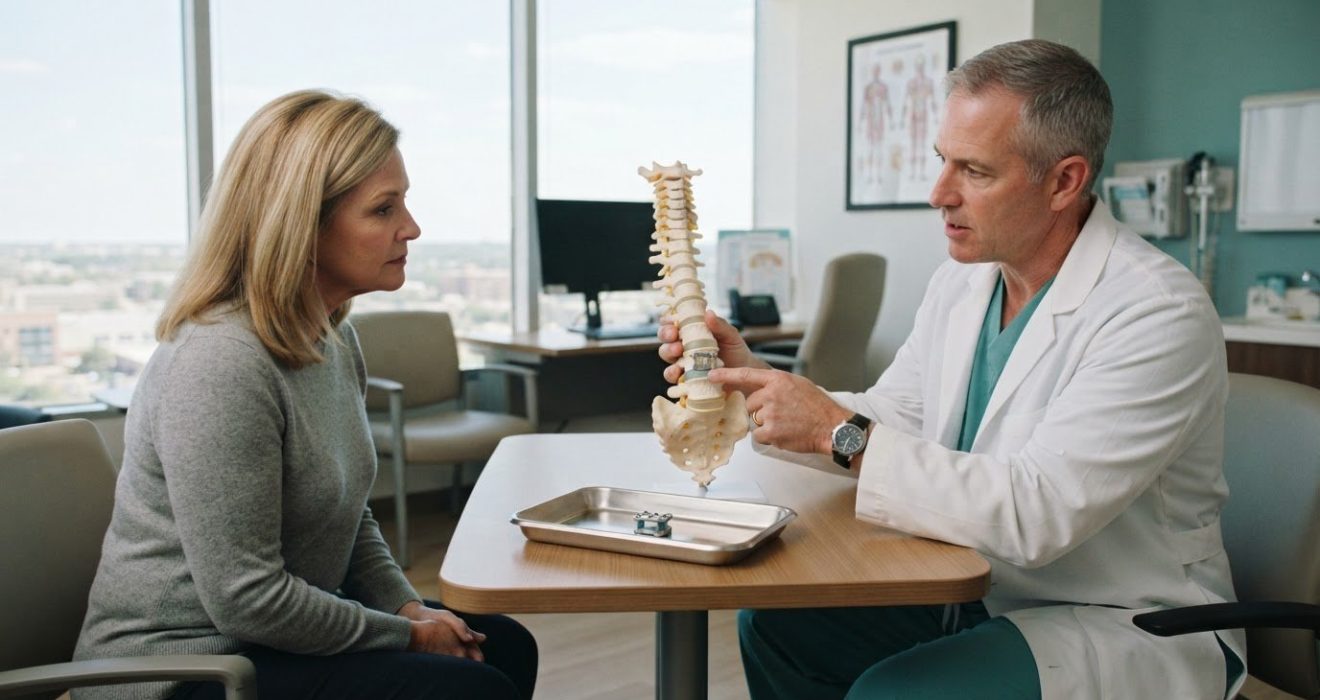
Minimally Invasive Neurosurgery of Texas provides spine surgery care in Lewisville and Plano, Texas. Led by Dr. Scott Kutz, a board-certified neurosurgeon and Fellow of the AANS and ACS, the practice evaluates spinal conditions and discusses appropriate care options, including minimally invasive approaches. A Lewisville spine surgery consultation gives patients a chance to review their symptoms, imaging, and potential next steps with a specialist.
Dr. Scott Kutz emphasizes that imaging findings matter most when they align with a patient’s symptoms and examination. That connection helps guide a discussion about whether surgery may suit the condition and which approach could address it. This guide explains what to expect during an evaluation and how specialists consider options such as artificial disc replacement and endoscopic spine surgery when planning personalized care.
Key Takeaways
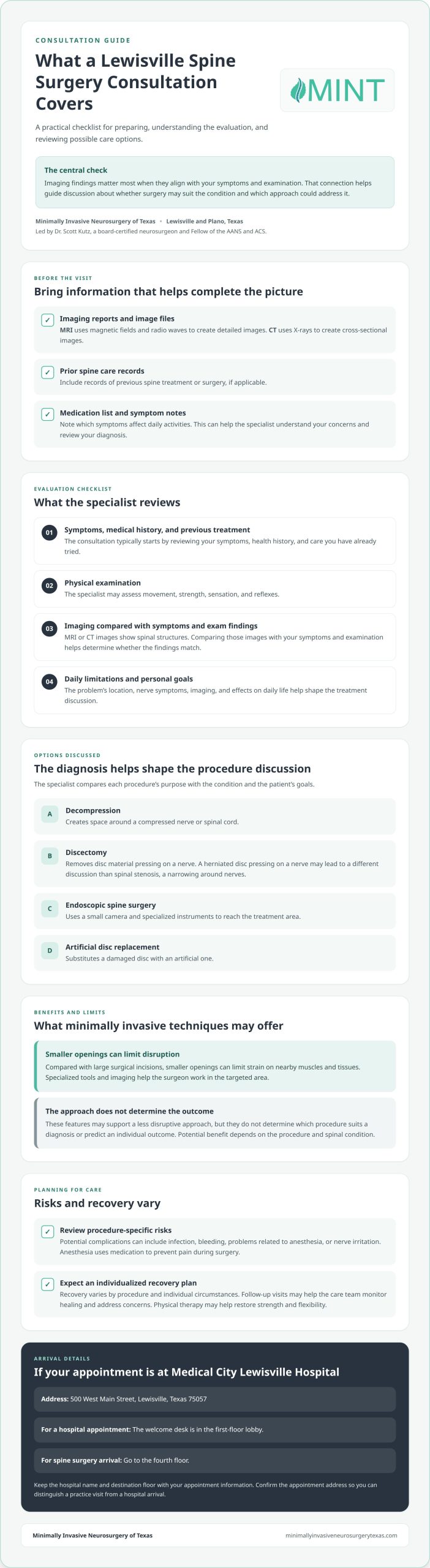
- At Medical City Lewisville Hospital, the welcome desk is in the first-floor lobby, and patients arriving for spine surgery should go to the fourth floor.
- A careful evaluation connects symptoms and physical findings with imaging to help identify the source of spine pain.
- Neurosurgeons treat herniated discs and spinal stenosis with minimally invasive spine surgery.
- Smaller surgical openings and specialized tools can help limit strain on nearby muscles and tissues.
- Personalized care considers the condition and the patient’s goals when weighing surgical and nonsurgical options.
Looking for a location?
A Lewisville spine surgery consultation starts with arranging an appointment at a local practice and sharing relevant medical records. Patients should bring imaging reports and image files, such as magnetic resonance imaging (MRI), which uses magnetic fields and radio waves to create detailed images, or computed tomography (CT), which uses X-rays to create cross-sectional images. Prior spine treatment or surgery records and a current medication list can also help the specialist review the diagnosis and understand which symptoms affect daily activities.
Medical City Lewisville Hospital sits at 500 West Main Street, Lewisville, Texas 75057. The hospital stands west of Interstate 35 East Express, near the corner of West Main Street and Ray Dunning Boulevard. For an appointment at the hospital, patients can find the welcome desk in the first-floor lobby. Patients arriving there for spine surgery should go to the fourth floor.
For nearby hospital options, Medical City Las Colinas Hospital is in Irving, 10.3 miles from Medical City Lewisville Hospital. Medical City Denton Hospital is 10.4 miles from Medical City Lewisville Hospital, at 3535 S Interstate 35 E, Denton, Texas 76210. These locations offer reference points for planning travel, but the consultation location and any surgical destination depend on the patient’s care plan.
Lewisville also has the Dallas Procedure Center, which has six operating suites. Appointment information identifies Medical City Lewisville Hospital as the facility for patients arriving for spine surgery; the available location details don’t establish that every nearby hospital or surgery center performs spine procedures. Keep the hospital name and destination floor with appointment information to avoid confusing a clinic visit with a surgical arrival.
Lewisville’s position beside Interstate 35 East Express helps patients identify the Medical City Lewisville Hospital area from West Main Street. Before traveling, use the appointment address to distinguish the practice visit from a hospital appointment. If endoscopic spine surgery comes up in care discussions, the endoscopic spine surgery overview explains the procedure. A physical assessment and imaging findings should correspond with deficits attributable to the affected cervical spine region, according to the Centers for Medicare & Medicaid Services.
Minimally invasive spine surgery
Minimally invasive techniques use smaller openings to reach a spinal problem while limiting strain on nearby muscles and tissues. During a consultation, the specialist connects your symptoms, examination findings, and imaging with options such as decompression, disc procedures, or endoscopic surgery.
Minimally Invasive Treatment Options
The diagnosis and affected spinal area shape the options. Decompression surgery creates space around a compressed nerve or spinal cord. A discectomy removes disc material pressing on a nerve. Endoscopic spine surgery uses a small camera and specialized instruments to reach the treatment area. Artificial disc replacement substitutes a damaged disc with an artificial one.
The specialist compares each procedure’s purpose with the diagnosis and the patient’s goals. For instance, a herniated disc pressing on a nerve calls for a different discussion than spinal stenosis, a narrowing around nerves. The minimally invasive spine techniques overview provides more detail about these approaches.
Potential Benefits of Minimally Invasive Care
Smaller openings can limit disruption to surrounding muscles and tissues compared with large surgical incisions. Specialized tools and imaging help the surgeon work in the targeted area. These features may support a less disruptive approach, but they don’t determine which procedure suits a particular diagnosis or predict an individual outcome.
When planning treatment, the specialist considers the problem’s location, nerve symptoms, imaging, and your daily limitations. The goal is to address the source of symptoms while preserving healthy tissue where possible. The potential benefit depends on the procedure and spinal condition.
Consultation Exams and Imaging
A consultation typically includes a review of symptoms, medical history, and previous treatment, followed by a physical examination. The specialist may assess movement, strength, sensation, and reflexes, then compare those findings with MRI or CT images of spinal structures. This comparison helps determine whether the findings match your symptoms.
Insurance acceptance and referral requirements depend on your specific plan. Clinics review the insurer, network terms, and referral rules attached to that plan to determine coverage. You can provide insurance details and existing imaging or reports when arranging an appointment.
Surgical Risks and Recovery Expectations
Every spine procedure carries risks that depend on the treatment and the patient’s health. Potential complications can include infection, bleeding, problems related to anesthesia, or nerve irritation. Anesthesia uses medication to prevent pain during surgery. A consultation should explain the risks associated with a proposed procedure and how the diagnosis supports that choice.
Recovery varies by procedure and individual circumstances. After surgery, the care team may schedule follow-up visits to monitor healing and address concerns; physical therapy may help restore strength and flexibility. Spinal fusion joins bones in the spine. The Centers for Medicare & Medicaid Services notes that short-term pain and function improvement after spinal fusion varies, while long-term results remain controversial.
Orthopedic and neurosurgical spine care
Orthopedic and neurosurgical specialists assess spine problems through symptoms, examination findings, and imaging. In Lewisville, a consultation can help clarify whether neck pain, back pain, or nerve symptoms warrant further evaluation.
Neurosurgery Providers Near Lewisville
Provider directories show different counts because they group specialties and locations differently. Searches near Lewisville have displayed 38 spine surgeon results and 58 neurosurgery providers. Treat those figures as directory counts, not a measure of clinical fit. A useful next step is to narrow results to clinicians who evaluate the affected spinal region and the condition shown on imaging.
For a consultation, focus on whether the clinician reviews your symptoms, examination findings, and imaging together. A herniated disc, for example, can cause pain or nerve symptoms, while spinal stenosis means narrowing around nerves or the spinal cord. The diagnosis and affected area help identify which specialist’s expertise is relevant.
Neurosurgeon Experience
Experience matters most when it relates to your specific condition and proposed procedure. A consultation should explain what the imaging shows, how it connects with your symptoms, and why a treatment approach fits. You can also ask how the surgeon weighs nonsurgical care against procedures such as decompression, which creates space around compressed nerves.
Credentials and years in practice offer context, but they don’t replace a clear explanation of your case. A useful discussion addresses the intended benefit, relevant risks, and how the surgeon will assess progress. For example, a patient considering surgery for persistent nerve compression needs a plan tied to that diagnosis, not a generic discussion of spine surgery.
Orthopedic and neurosurgical care can overlap, but specialists may focus on different aspects of spinal conditions. Physical findings should match the affected area. For cervical spine concerns, the Centers for Medicare & Medicaid Services says physical assessment and imaging findings must correspond with deficits attributable to the affected region. This alignment helps clinicians interpret neck pain alongside test results.
Some diagnoses involve measurable findings. At Medical City Lewisville Hospital, a surgeon may recommend surgery for scoliosis curvatures between 40 and 50 degrees. Scoliosis describes a sideways curve of the spine; the degree measures its size. That range is one example of how a specific diagnosis can shape care discussions, rather than a rule that applies to every patient.
Use the consultation to understand your diagnosis, the specialist’s reasoning, and the available care paths. A clear explanation connects symptoms to examination findings and imaging, then outlines what each option aims to address. This helps you compare the clinical purpose of a proposed procedure with your priorities and daily limitations.
Personalized treatment plans
A personalized plan connects your diagnosis, examination, imaging, and goals. For someone in Lewisville, those details help distinguish symptoms that may call for continued nonsurgical care from problems that may warrant a surgical discussion.
Spine Conditions Treated
Surgeons use minimally invasive spine surgery to treat herniated discs and spinal stenosis. A herniated disc occurs when disc material presses beyond its usual boundary; spinal stenosis means narrowing around nerves or the spinal cord. Degenerative disc disease describes wear in the cushioning discs between spinal bones. Each diagnosis can affect movement and comfort differently.
A physician considers where symptoms occur and whether examination findings match imaging. For example, leg symptoms and a lumbar scan may lead to a different treatment discussion than neck pain with cervical findings. This connection helps the specialist explain which spinal problem a plan targets and what improvement treatment aims to support.
Non-Surgical Treatment Options
A treatment plan can include nonsurgical care when it fits the diagnosis and the patient’s needs. Physical therapy focuses on strength and flexibility, while bracing supports the spine in selected cases. At Medical City Lewisville, doctors may recommend bracing and physical therapy for scoliosis curves under 25 degrees. Scoliosis means a sideways curve of the spine.
That example does not mean one treatment suits every condition. A physician weighs the curve or affected spinal level, symptoms, imaging, and daily limitations. For a patient from Denton with back pain, the plan may prioritize symptom relief and function before discussing an operation. The appropriate next step depends on the findings.
Personalized care also clarifies when a surgical option enters the discussion. A specialist can explain how decompression creates space around compressed nerves, then compare that goal with your diagnosis and priorities. The plan should identify the problem the specialist will treat, the purpose of each option, and how follow-up will track healing. This gives you a clearer basis for discussing care choices.
At Minimally Invasive Neurosurgery of Texas, patients receive personalized treatment plans based on their condition and goals. The discussion focuses on the problem the specialist will address, the options the specialist is considering, and what you hope to regain or maintain. Describe how symptoms affect movement, comfort, and daily activities, then ask how your diagnosis, examination, and imaging relate to the proposed approach. The specialist can explain each option in light of those findings and priorities, rather than treating a scan or diagnosis in isolation.
It can also help to clarify what the plan is intended to accomplish and how your goals shape the choice among options. You may want to understand how a recommendation relates to your symptoms, what role nonsurgical care could have, or why a surgical discussion may be appropriate. These questions keep the conversation connected to your condition and priorities. As care proceeds, revisit whether the plan’s purpose remains clear and discuss concerns about comfort, movement, or daily activities with the specialist. Understanding the reason for each step can make treatment choices easier to discuss and follow.
Which spine surgeons and spine surgery clinics offer consultations in Lewisville, Texas?
When comparing spine consultations near Lewisville, distinguish the clinic appointment from the surgical destination. Patients and local directories identify Medical City Lewisville Hospital as a local surgical destination; patients arriving for spine surgery go to its fourth floor. Use the address provided for your specific visit, since the appointment location may differ from the hospital.
Nearby hospital names include Medical City Las Colinas Hospital in Irving and Medical City Denton Hospital in Denton. They sit 10.3 and 10.4 miles from Medical City Lewisville Hospital, respectively. Those distances help describe the regional care map, but they don’t establish that either facility provides spine surgery consultations or performs a particular procedure.
Lewisville also has the Dallas Procedure Center, which lists six operating suites. That detail identifies a local surgical facility, but the number of suites alone does not show which procedures it performs. For a planned consultation, distinguish the evaluating clinician’s office from the facility where a procedure may occur. A hospital appointment and a surgeon’s clinic visit serve different purposes.
Provider directories can help identify clinicians by specialty and location, but result totals vary with search area and directory categories. The earlier Lewisville-area listings included spine surgeons and neurosurgery providers. Narrow a listing by the condition involved, such as a herniated disc or spinal stenosis, then confirm that the clinician evaluates that spinal concern.
For example, a patient with lower-back pain and leg symptoms may need a clinician to assess whether imaging findings align with nerve involvement. A patient with neck pain may need evaluation of the cervical spine, the neck portion of the spine. These examples show why specialty labels alone don’t explain whether a consultation fits a patient’s diagnosis.
A Lewisville spine surgery consultation can help connect your symptoms and imaging with a relevant specialist. When arranging a Lewisville spine surgery consultation, note the clinician’s specialty, office location, and stated focus. Bring relevant imaging reports and details of prior treatment. The specialist can connect those records with examination findings and explain whether the issue calls for continued nonsurgical care or a surgical discussion.
Medical City Lewisville Hospital, Medical City Las Colinas Hospital, Medical City Denton Hospital, and Dallas Procedure Center provide geographic reference points around Lewisville. Their roles differ, so use the appointment address and instructions for each visit rather than treating every nearby facility as a consultation clinic.
Patients and local directories identify Medical City Lewisville Hospital as a local surgical destination for patients arriving for spine surgery. Nearby hospitals and Dallas Procedure Center are not identified here as providers of spine surgery.
Minimally Invasive Neurosurgery of Texas
Minimally Invasive Neurosurgery of Texas offers spine care for people considering surgical options in Lewisville and Plano, Texas. Dr. Scott Kutz, a board-certified neurosurgeon and Fellow of the AANS and ACS, leads the practice. The practice evaluates spine concerns and discusses treatment approaches in light of each patient’s condition and goals.
A consultation may help when back or neck symptoms persist, imaging shows a spine problem, or previous treatment hasn’t addressed daily limitations. The specialist reviews your diagnosis, symptoms, examination findings, and imaging to understand how they connect. That assessment guides a discussion about whether surgery may suit the problem and what a procedure aims to address.
The practice offers Minimally Invasive Spine Surgery, which uses smaller openings than traditional large incisions. Specialized tools and imaging help surgeons work in the affected area while limiting strain on nearby muscles and tissues. Options depend on the diagnosis. For example, decompression creates space around compressed nerves, while a discectomy relieves pressure from a herniated disc.
Endoscopic Spine Surgery uses an endoscope, a small camera that helps the surgeon view the treatment area. Artificial Disc Replacement replaces a damaged disc with an artificial disc that its manufacturer designs to preserve motion. These procedures address different clinical needs, so a consultation should clarify which problem each option targets and how the specialist weighs relevant findings.
Minimally invasive neurosurgery focuses on spinal conditions and surgical approaches, not a single procedure for every patient. The specialist considers the affected spinal region, symptoms, and imaging before discussing a path forward. Patients can use the consultation to understand the diagnosis, the purpose of a proposed procedure, and what questions matter for their care decisions. The practice’s minimally invasive spine techniques include approaches tailored to the treatment area.
Clear discussion matters. You should leave understanding how the proposed approach relates to your symptoms and what the next care steps involve. To discuss spine care in Lewisville or Plano, contact Minimally Invasive Neurosurgery of Texas to arrange a consultation.
Frequently Asked Questions
What types of spine conditions and procedures do Lewisville spine surgeons treat?
Spine specialists in Lewisville evaluate conditions such as herniated discs, spinal stenosis, and degenerative disc disease. Procedures may include discectomy, decompression, endoscopic spine surgery, and artificial disc replacement. The treatment discussion should connect the procedure to the specific spinal level and symptoms. For example, a patient with persistent leg symptoms and a lumbar disc finding needs a plan that addresses that diagnosis, rather than a general procedure recommendation.
How do spine surgeons in Lewisville present their credentials, experience, and patient reviews?
Look for a surgeon’s specialty, board certification, professional fellowships, education, and relevant experience. Dr. Scott Kutz is a board-certified neurosurgeon and Fellow of the AANS and ACS, with more than 20 years of experience treating spinal disorders. Patient testimonials offer individual accounts of care and recovery; read them as personal experiences, not clinical evidence. The patient testimonials page provides examples of patient perspectives.
What nonsurgical treatment options should be discussed before spine surgery?
Discuss whether physical therapy, bracing, or other diagnosis-specific symptom management fits your situation. The relevant option depends on the condition, examination findings, imaging, and how symptoms affect movement or daily tasks. For example, care for scoliosis may include bracing and physical therapy, while another diagnosis may call for a different approach. A useful treatment discussion explains each option’s goal and how the physician will assess progress.
Which hospitals and surgery centers near Lewisville perform spine surgery?
The care team directs patients arriving for spine surgery to Medical City Lewisville Hospital; the welcome desk is in the first-floor lobby, and patients should go to the fourth floor. Medical City Las Colinas Hospital and Medical City Denton Hospital are nearby options, but the surgical destination depends on the care plan.