What if the sharp, radiating pain in your leg isn’t a permanent sentence, but a signal that your spine requires a more precise level of care than standard rest can provide? If you’re struggling with sleep deprivation or the constant fear of nerve damage, you’re not alone; more than 3 million Americans seek herniated disc pain relief every year. We understand that the burning sensation of sciatica makes even the simplest daily movements feel like a challenge. You want to reclaim your life without the risks and long recovery times associated with traditional open back surgery.
In this article, you’ll discover a comprehensive path to relief that starts with immediate at-home strategies and moves into the latest advancements in minimally invasive neurosurgery. We’ll explore how modern technology, such as endoscopic spine surgery and artificial disc replacement, allows for precision-guided results and a faster return to normal activity. Whether you’re addressing new Texas regulations regarding pain management or seeking an alternative to long-term opioid use, you’ll find a clear treatment plan designed to restore your quality of life and clinical confidence.
Key Takeaways
- Understand the biological difference between mechanical pressure and chemical nerve irritation to better identify your specific symptoms.
- Learn why modern clinical guidelines suggest avoiding bed rest and how to use temperature therapy for effective inflammation management.
- Explore the transition from conservative treatments to advanced minimally invasive neurosurgery when pain begins to impact your daily function.
- Discover how specialized procedures like endoscopic discectomy provide herniated disc pain relief through tiny incisions and faster recovery timelines.
- Get to know the MINT philosophy of high-tech healing and how it’s designed to help you achieve a swift return to normal activity.
Understanding the Source: Why Herniated Discs Cause Radiating Pain
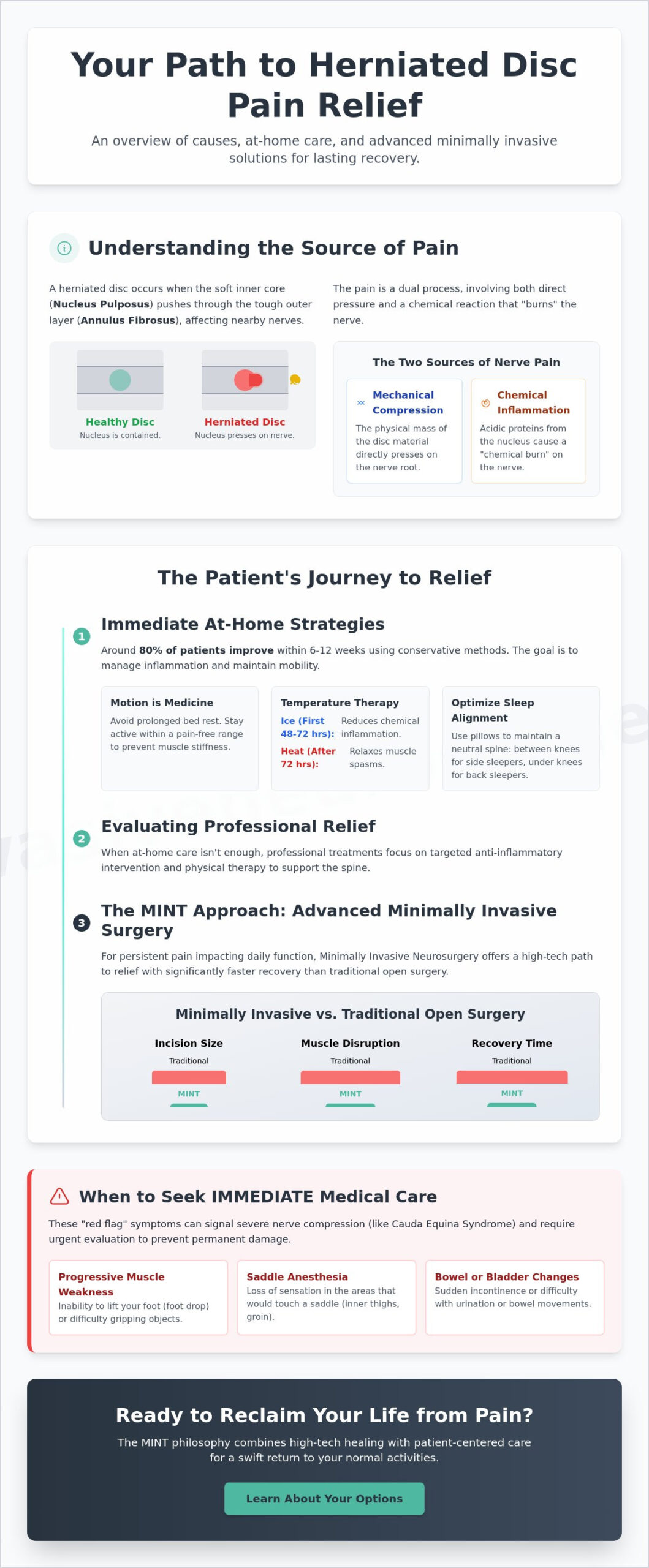
To achieve lasting herniated disc pain relief, we must first look at the sophisticated anatomy of the spine. Your spinal discs act as specialized shock absorbers, composed of a tough outer layer called the annulus fibrosus and a soft, jelly-like center known as the nucleus pulposus. A Spinal Disc Herniation occurs when the inner material escapes through a tear in the outer ring. This displacement doesn’t just stay localized. It often encroaches on the narrow spaces where your nerve roots exit the spinal canal.
The location of the herniation determines where you feel the impact. Lumbar herniations, which account for about 90% to 95% of cases, typically trigger pain in the lower back, buttocks, and legs. Cervical herniations, occurring in the neck, send sharp sensations down the arms or into the hands. Identifying the specific vertebrae involved, such as the L4-L5 or C5-C6 levels, allows us to map the pain source with clinical precision and develop a targeted treatment plan.
Mechanical Compression vs. Chemical Inflammation
Pain from a herniated disc is rarely a simple “pinched nerve.” It’s a dual process. First, the physical mass of the disc material creates mechanical compression, physically obstructing the nerve’s path. Second, the nucleus pulposus contains highly acidic proteins. When these proteins touch a nerve root, they cause intense chemical inflammation. This is why “sciatica” isn’t a diagnosis itself; it’s a symptom of this underlying irritation. This chemical burn is often responsible for the searing, electric-shock sensations that make herniated disc pain relief so urgent for many patients. We use this understanding to determine if your symptoms require anti-inflammatory intervention or physical decompression.
When a Herniated Disc Becomes a Medical Emergency
While most cases improve with conservative care, certain symptoms indicate a high-stakes neurological situation. We look for red flags that suggest the nerve is under extreme duress. Sudden or progressive muscle weakness is often more concerning than pain because it signals a loss of motor function. If you can no longer lift your foot or grip objects, the nerve is likely experiencing significant distress.
Specific conditions like Cauda Equina Syndrome require immediate neurosurgical consultation. Watch for saddle anesthesia, which is a loss of sensation in the areas that would touch a saddle, or any sudden changes in bowel or bladder control. Prolonged severe compression can lead to permanent nerve damage. If you experience these symptoms, seeking a specialized evaluation is the only way to protect your long-term mobility and ensure a safe return to normal activity.
Immediate Strategies for Herniated Disc Pain Relief at Home
Managing acute symptoms starts with the understanding that motion is medicine. While your first instinct might be to stay in bed, prolonged bed rest often leads to muscle stiffness and secondary weakness. Research indicates that approximately 80% of patients find Herniated Disk Symptoms and Treatment manageable through conservative, non-surgical methods within 6 to 12 weeks. The goal is to stay active within a pain-free range of motion while your body begins the natural healing process.
Temperature therapy provides a simple yet effective tool for herniated disc pain relief. Apply ice packs for 15 to 20 minutes every few hours during the first 48 to 72 hours to combat the chemical inflammation affecting your nerve roots. Once the acute “burning” sensation subsides, transition to moist heat. Heat helps relax the protective muscle spasms that often occur as your body tries to stabilize the injured spinal segment. This dual approach addresses both the internal irritation and the external muscular tension.
Optimizing Your Sleep for Spinal Alignment
Sleep deprivation is a common struggle for those with sciatica or arm pain. To reduce lumbar strain, side sleepers should place a firm pillow between their knees. This prevents the top leg from pulling the pelvis out of alignment and twisting the lower spine. If you prefer sleeping on your back, tuck a pillow under your knees to maintain the natural curve of your lumbar region. Spinal neutrality is the state where the head, shoulders, and hips remain aligned in a straight line to minimize mechanical stress on the intervertebral discs. For those with cervical herniations, a contoured memory foam pillow can provide the necessary support to keep the neck stable throughout the night.
Safe Movement and the McKenzie Method
The McKenzie method is a specialized approach focused on “centralization.” This process involves moving the pain from your extremities, like your calf or thigh, back toward the center of your spine. While the pain in your back might temporarily feel more intense, moving it out of your leg is a sign of clinical progress. You might try these basic extension exercises to encourage this shift:
- Prone lying: Lie flat on your stomach for several minutes to allow the spine to settle into a neutral position.
- Prone on elbows: Gently prop yourself up on your forearms while keeping your hips on the floor.
- Standing extensions: Place your hands on your lower back and lean backward slightly while standing to decompress the disc.
Always consult a professional before starting a new exercise regimen. Avoid high-impact activities, heavy lifting, or repetitive twisting, as these can exacerbate the disc protrusion. If these home strategies don’t provide the level of comfort you need to return to normal activity, it’s time to consult a specialist at Minimally Invasive Neurosurgery of Texas to discuss more advanced diagnostic options.
Evaluating Professional Relief: Meds, Injections, and Therapy
When home-based strategies don’t provide sufficient comfort, the next phase of your journey toward herniated disc pain relief involves a structured clinical approach. Most conservative plans are evaluated at a critical 6-week milestone. This timeframe isn’t arbitrary; it’s the standard period required to see if the body’s natural inflammatory response will subside under professional guidance. During this window, we explore a variety of herniated disk treatment options designed to manage symptoms while you work toward recovery.
Professional care typically follows a specific hierarchy of medication. We start with high-dose NSAIDs to reduce systemic inflammation, but if the pain remains sharp and radiating, we may introduce prescription nerve modulators. These medications are specifically formulated to calm the overactive signals sent by an irritated nerve root. Alongside medication, physical therapy serves as a foundational tool. The primary goals here are core stabilization and postural correction. By strengthening the muscles that support your spine, you can reduce the mechanical load placed on the compromised disc.
The Role of Epidural Steroid Injections
Epidural Steroid Injections (ESIs) are a more direct intervention for managing acute flares. By delivering concentrated anti-inflammatory medication directly into the epidural space, we can provide rapid relief from the “chemical burn” caused by disc material. These injections are both therapeutic and diagnostic. If an injection at a specific spinal level eliminates your pain, it confirms that we’ve identified the exact source of your suffering. However, it’s essential to understand that an ESI is often a temporary measure. It manages the inflammation but doesn’t remove the physical disc material that is pressing on the nerve.
Why Physical Therapy Fails for Some Patients
We often hear from patients who feel that physical therapy made their condition worse. This is a common and valid concern. In some instances, the disc herniation is so severe that any movement further compresses the nerve. If the nucleus pulposus has significantly sequestered, it acts as a physical barrier that exercise simply cannot overcome. When a patient doesn’t experience progress during the initial 6-week period, it’s a clinical indicator that conservative care has reached its limit. This is the point where we transition from symptom management to considering advanced back surgery options to restore function and ensure a return to normal activity.
Advanced Minimally Invasive Procedures for Lasting Relief
When the six-week milestone of conservative therapy passes without significant improvement, the conversation shifts from symptom management to functional restoration. Surgery isn’t a failure of care; it’s a strategic intervention to prevent permanent nerve damage and ensure a swift return to normal activity. Modern advancements have moved us far beyond the era of large incisions and long hospital stays. Today, we utilize high-precision technology to achieve herniated disc pain relief through pathways that prioritize the integrity of your spinal anatomy.
The hallmark of our approach is the use of robotic-assisted navigation and high-definition visualization. These systems allow for sub-millimeter surgical precision, ensuring that only the problematic disc material is addressed while surrounding nerves and tissues remain undisturbed. This level of accuracy is what defines the boutique, specialized care at our center, moving you from a state of chronic discomfort to informed confidence in your recovery journey.
Endoscopic Spine Surgery: The Ultra-Minimally Invasive Choice
For many patients, Endoscopic Spine Surgery represents the absolute forefront of modern care. This “keyhole” approach involves a tiny, tube-like incision often no larger than a postage stamp. Rather than cutting through vital back muscles, we use specialized dilators to gently move tissue aside. An endoscope provides a crystal-clear view of the herniation, allowing us to remove the offending nucleus pulposus without destabilizing the spine. Because the physical impact is so minimal, many of our patients are up and walking the same day of the procedure.
Artificial Disc Replacement (ADR) for Cervical Relief
When a herniation occurs in the neck, maintaining your range of motion is a top priority. While traditional spinal fusion is an option, Neck Disk Replacement offers a more dynamic alternative. By replacing the damaged disc with a high-tech prosthetic, we mimic the natural movement of a healthy spine. This technique significantly reduces the risk of “adjacent segment disease,” a condition where the vertebrae above and below a fusion site wear out prematurely due to increased stress. ADR preserves your ability to turn and tilt your head naturally, which is a critical component of your long-term quality of life.
If you’re ready to move beyond temporary fixes and explore a permanent solution for your spinal health, we invite you to schedule a consultation with our surgical team to discuss which minimally invasive neurosurgery path is right for you.
Patient-Centered Spine Care in Plano and Lewisville
Choosing where to receive treatment is a pivotal decision in your recovery. At Minimally Invasive Neurosurgery of Texas (MINT), we provide a sophisticated alternative to large, impersonal hospital systems. Our practice is built on the MINT philosophy of “high-tech healing,” where we combine world-class surgical innovation with a warm, boutique atmosphere. We understand that seeking herniated disc pain relief is about more than just a procedure. It’s about finding a local partner who prioritizes your individual health and quality of life.
Dr. Scott Kutz, our lead board-certified neurosurgeon, brings years of specialized expertise in the most advanced minimally invasive techniques. His background in treating complex spinal conditions allows our team to offer precise solutions that traditional “open” surgeries often cannot match. By focusing on a patient-centered approach, we ensure that every individual who walks through our doors in Plano or Lewisville receives a customized treatment plan tailored to their specific diagnostic needs and lifestyle goals.
Specialized Tech for North Texas Patients
Our commitment to professional excellence is reflected in our heavy investment in proprietary technological systems. We utilize the Globus ExcelsiusGPS robotic navigation system and Augmedics AR (Augmented Reality) technology to enhance surgical accuracy. These tools function like a high-precision GPS for the spine, allowing our surgeons to visualize your anatomy with sub-millimeter detail in real-time. For our neighbors in Lewisville and Plano, this means safer procedures, smaller incisions, and significantly improved clinical outcomes. This high-tech hallmark ensures that you’re receiving care at the absolute forefront of modern back surgery without having to travel far from home.
Your Journey to a Pain-Free Life
Your first consultation at MINT is a comprehensive diagnostic experience. We begin by meticulously reviewing your MRIs and clinical history to confirm the exact source of your discomfort. We don’t just look at images; we listen to your story to understand how pain has impacted your sleep, work, and family life. This process moves you from a state of concern to a state of informed confidence. Our clinical team provides the compassionate reassurance necessary to navigate these high-stakes medical decisions, always keeping the ultimate goal in sight: a swift return to normal activity.
If you’re tired of living with radiating pain and are ready to discover a clear path toward lasting herniated disc pain relief, our team is here to help. We’ll guide you through every step of the diagnostic and recovery process with the personal attention you deserve. Schedule your herniated disc evaluation at MINT today.
Take the Next Step Toward a Pain-Free Life
We’ve explored the biological causes of your discomfort and the spectrum of care available, from ergonomic sleep adjustments to precision-guided surgery. Achieving lasting herniated disc pain relief requires a clinical plan that evolves when conservative measures like physical therapy or injections no longer show progress. You deserve a treatment strategy that prioritizes your mobility and addresses the mechanical source of your pain with modern accuracy.
Since 2013, our practice has served the Plano and Lewisville communities by merging local, patient-centered care with global surgical innovation. Board-certified neurosurgeon Dr. Scott Kutz utilizes the Globus Excelsius robotic navigation system to ensure every procedure is performed with absolute precision. This commitment to high-tech healing is why our patients experience faster recovery timelines and a definitive return to normal activity. You don’t have to navigate this journey alone or live with the fear of permanent nerve damage.
Whether you’re seeking a second opinion or are ready for a specialized diagnostic evaluation, our team is prepared to help you move forward with confidence. Request an Appointment with Dr. Scott Kutz at MINT and take the first step toward a future free from chronic spinal discomfort. Your path to recovery and long-term wellness starts here.
Frequently Asked Questions
How do I know if my back pain is a herniated disc?
Back pain from a herniated disc typically involves radiating symptoms like numbness, tingling, or “electric” shocks that travel down an arm or leg. While localized muscle strain stays in the back, a disc issue impacts the nerve root, causing symptoms to follow a specific pathway. A clinical evaluation and MRI are the only ways to confirm the diagnosis with absolute certainty and begin a targeted plan for herniated disc pain relief.
Can a herniated disc heal on its own without surgery?
Yes, many herniated discs undergo a natural biological process called resorption, where the body’s immune system breaks down the displaced disc material. This allows for significant relief without surgical intervention. However, this process requires patience and professional monitoring to ensure that the nerve isn’t sustaining permanent damage while the body heals itself. We monitor these cases closely to determine if the body is making sufficient progress.
What is the best sleeping position for herniated disc pain relief?
The most effective position for herniated disc pain relief is one that maintains neutral spinal alignment. For lumbar issues, lie on your side with a firm pillow between your knees to keep your hips square. If you’re a back sleeper, placing a bolster under your knees flattens the lower back and reduces the mechanical tension on your spinal nerves. These simple adjustments can significantly improve your sleep quality during recovery.
How long should I try physical therapy before considering surgery?
Most clinical guidelines recommend a period of 6 to 12 weeks for conservative treatments. If you don’t experience functional improvement or if you notice progressive muscle weakness during this time, it’s a signal to consult a neurosurgeon. We look for specific clinical markers that suggest a transition to minimally invasive neurosurgery is necessary to protect your long-term mobility and ensure a safe return to normal activity.
Is minimally invasive spine surgery safer than traditional surgery?
Minimally invasive spine surgery offers a higher safety profile for many patients compared to traditional “open” procedures. Because we use specialized dilators to move muscle tissue rather than cutting it, there’s significantly less blood loss and a lower risk of post-operative infection. This precision-guided approach preserves the structural integrity of your spine while focusing solely on the problematic disc material, leading to a more efficient recovery.
What is the recovery time for an endoscopic discectomy?
Recovery from an endoscopic discectomy is remarkably swift compared to traditional back surgery. Many patients are cleared to walk within hours of the procedure and can return to sedentary work within one to two weeks. A full return to high-impact activities typically occurs around the six-week mark, provided the surgical site has healed according to our clinical expectations. This rapid timeline is a hallmark of our boutique surgical approach.
Does a herniated disc always cause sciatica?
No, sciatica is specific to herniations in the lumbar spine that irritate the sciatic nerve. If a disc herniates in the cervical region of your neck, you’ll likely experience radiating pain, weakness, or numbness in your shoulders, arms, or fingers instead. The symptoms are always tied to the specific nerve root being compressed by the nucleus pulposus, which is why a precise diagnosis is essential for effective treatment.
Why does my herniated disc pain feel worse in the morning?
Spinal discs naturally rehydrate and swell slightly while you sleep, which increases the internal pressure within the disc space. When you first stand up, this increased volume can cause more intense compression on the adjacent nerve roots. Additionally, muscles often stiffen after hours of inactivity, making the initial movements of the day feel more painful until the tissue warms up and circulation improves.