What if the key to walking without debilitating leg cramps isn’t a major spinal fusion, but a “precision architecture” approach that leaves your spine’s natural support structure untouched? If you’re seeking effective spinal stenosis treatment, you’ve likely worried that your loss of independence is permanent or that traditional back surgery might lead to a long hospital stay. It’s exhausting to deal with neurogenic claudication every time you try to stay active. We understand that fear, and we’re here to offer a different path toward recovery.
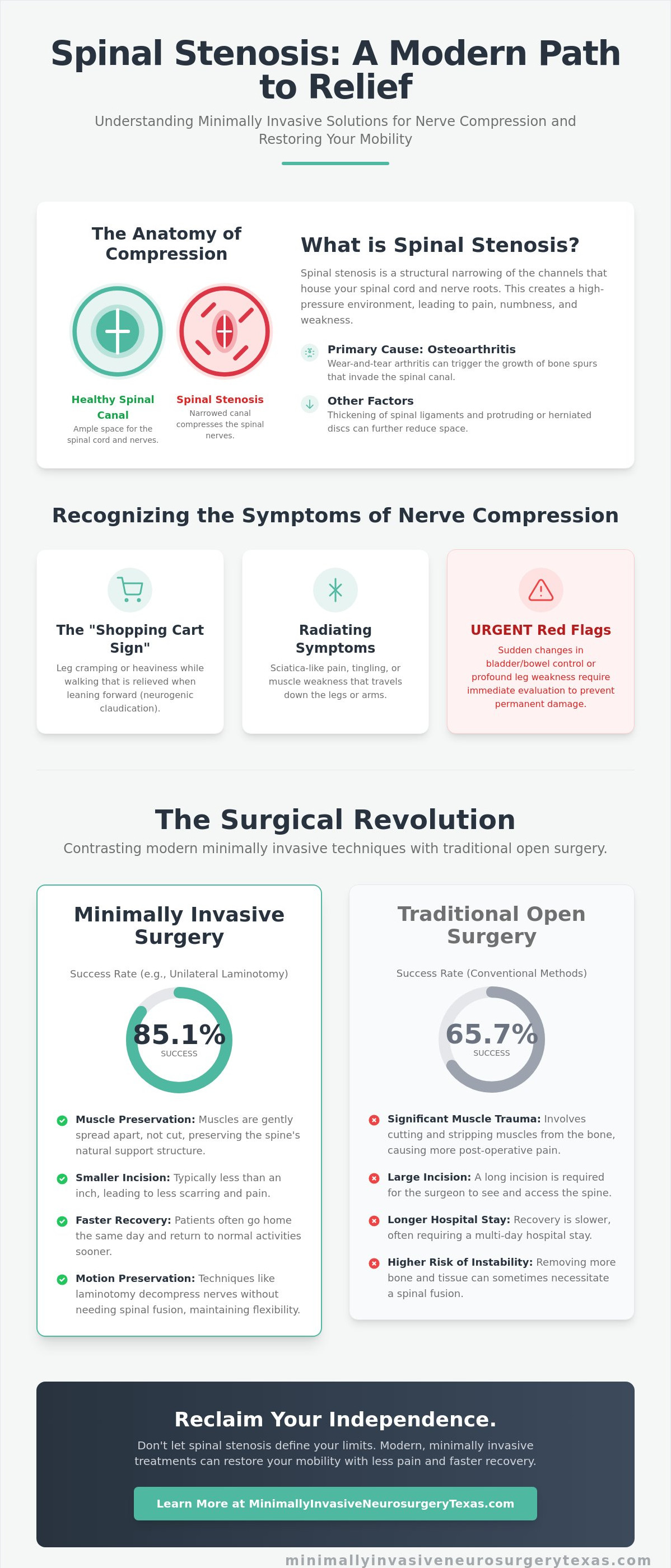
Modern medical innovation has evolved beyond the limitations of the past. You can resolve your pain and restore your mobility through minimally invasive neurosurgery that prioritizes your range of motion and gets you home faster. Research shows that newer techniques, such as unilateral laminotomy, have an 85.1% success rate compared to just 65.7% for conventional methods. This article explores how advanced endoscopic spine surgery and motion-preserving techniques are replacing the trauma of open surgery with the precision of high-tech healing. Discover how we help patients in Lewisville and Plano return to their normal activities with confidence and clinical certainty.
Key Takeaways
- Learn how the narrowing of the spinal canal impacts nerve roots and why precision diagnosis is the first step toward reclaiming your independence.
- Understand the threshold between conservative care and the need for a definitive spinal stenosis treatment to prevent long-term nerve damage.
- Contrast the benefits of modern minimally invasive neurosurgery against traditional open methods, focusing on muscle preservation and reduced recovery times.
- Explore advanced surgical options like endoscopic spine surgery that allow for nerve decompression while maintaining your spine’s natural range of motion.
- Discover how MINT provides patients in Lewisville and Plano with specialized, boutique care led by world-class surgical expertise.
What is Spinal Stenosis? Understanding the Narrowing Canal
Spinal stenosis represents a structural narrowing of the channels that house your spinal cord and nerve roots. While many sources simply define it as a narrowing of the bone, it’s more accurate to view it as a compromise of the entire neural environment. This mechanical encroachment occurs when the spaces within your spine shrink, creating a high-pressure environment for sensitive nerves. Understanding this anatomy is the first step toward effective Spinal Stenosis management and long-term relief.
Several factors typically drive this progression. Osteoarthritis is a primary culprit, as it triggers the growth of bone spurs that invade the spinal canal. Additionally, the thickening of spinal ligaments and the protrusion of herniated discs can further reduce the available space. We view the spine as a complex structural system that requires precision architecture to function. When this system is compromised, a specialized spinal stenosis treatment plan is necessary to restore your quality of life and ensure a return to normal activity.
Common Types: Lumbar vs. Cervical Stenosis
The location of the narrowing determines your specific clinical path. Lumbar stenosis occurs in the lower back, specifically involving the L1 through L5 vertebrae. This is the most prevalent form, often manifesting as debilitating leg pain or numbness. Cervical stenosis occurs in the neck and presents different risks, as it can impact balance and fine motor skills. Knowing exactly which vertebrae are affected allows us to target our interventions with absolute certainty and clinical excellence.
Recognizing the Symptoms of Nerve Compression
The hallmark sign of this condition is neurogenic claudication. This is a specific type of leg cramping or heaviness that occurs while walking but finds relief when you lean forward, often referred to as the “shopping cart sign.” You might also experience sciatica-like symptoms, such as radiating pain, tingling, or muscle weakness in the extremities. These signs indicate that your nerves are under significant stress and require decompression.
While most symptoms develop gradually, certain red flag indicators require immediate attention. If you experience sudden changes in bladder or bowel control, or profound, sudden weakness in your legs, it’s critical to seek professional evaluation. Addressing these issues early through modern spinal stenosis treatment ensures you can preserve your independence and avoid permanent nerve damage. Our goal is to move you from a state of concern to a state of informed confidence through precise, patient-centered care.
Conservative Spinal Stenosis Treatment: The Non-Surgical Threshold
Most patients starting their journey toward recovery find that conservative management is the appropriate first step. We fully support the use of physical therapy and non-steroidal anti-inflammatory drugs (NSAIDs) to manage early-stage symptoms. These methods focus on reducing inflammation and strengthening the supporting musculature of the spine. It’s a prudent way to see how your body responds before considering more advanced interventions. Epidural steroid injections also play a vital role during acute flare-ups, providing a window of relief by delivering potent anti-inflammatories directly to the site of compression.
However, a strategy of “watchful waiting” has its limits. If the structural narrowing is severe, delaying definitive care can lead to irreversible nerve atrophy. When nerves are physically compressed by bone or thickened ligaments, they eventually lose their ability to transmit signals effectively. We view the neurosurgeon not just as a provider of last resort, but as a consultant who helps you identify exactly when conservative care has reached its functional limit. Monitoring your progress with clinical certainty ensures that you don’t cross the line from manageable discomfort into permanent neurological damage.
The Limits of Physical Therapy and Injections
Physical therapy is excellent for functional improvement and core stability, but it cannot “undo” structural changes like bone spurs or ligament thickening. These are mechanical problems that require mechanical solutions. Epidural steroid injections are often used to manage symptoms, providing temporary relief by bathing the nerve roots in medication. While helpful, these are symptom management tools rather than a permanent Spinal Stenosis Treatment. You’ve likely reached a plateau when the relief from injections becomes progressively shorter and physical therapy no longer increases your pain-free walking distance.
When Surgery Becomes the Logical Next Step
Surgery becomes the logical choice when your quality of life is severely restricted or when objective neurological deficits appear. If you can’t walk through a grocery store without debilitating leg cramping, the structural problem has surpassed the capabilities of non-surgical care. We use advanced imaging like MRI and CT scans to map out your “precision architecture” before any intervention. This high-tech approach helps us avoid the pitfalls of traditional methods and addresses the fear of “Failed Back Surgery Syndrome” by targeting only the specific area of narrowing. If your conservative care has plateaued, it may be time to consult with a specialist in minimally invasive neurosurgery to discuss a more durable spinal stenosis treatment.
Minimally Invasive vs. Traditional Open Spine Surgery
Traditional back surgery often involves long incisions and the aggressive stripping of muscles from the spine to provide the surgeon with a clear view. This “old way” of performing spinal stenosis treatment frequently leads to significant post-operative pain and extended recovery times. In contrast, modern minimally invasive neurosurgery utilizes tubular retractors to create a narrow corridor to the spine. Instead of cutting through vital tissues, we gently move them aside. This approach preserves muscle integrity and significantly reduces blood loss and infection risks, setting the stage for a faster return to normal activity.
We believe that the best surgical outcome is one that achieves full decompression while leaving the surrounding anatomy as close to its natural state as possible. High-tech surgical tools allow us to achieve this “precision architecture” through openings no larger than a postage stamp. By avoiding the trauma of open surgery, we reduce the body’s inflammatory response. This leads to a more predictable recovery and a higher level of patient satisfaction. Your journey from chronic pain to restored mobility depends heavily on the surgical methodology chosen for your care.
The Clinical Advantages of Small Incisions
High-definition microscopic visualization allows us to see the surgical field with greater clarity through a one-inch incision than was once possible through a six-inch opening. By protecting the multifidus muscle and surrounding ligaments, we minimize the internal scarring that often causes chronic stiffness. Smaller incisions also mean faster wound healing and a more discreet cosmetic result. This level of precision ensures that we only remove the specific bone spurs or ligament tissue causing the compression, leaving the rest of your spinal support structure untouched.
Comparing Recovery Timelines and Outcomes
The difference in recovery is stark. While traditional open surgery often requires a multi-day hospital stay, many of our patients qualify for same-day discharge in an outpatient setting. Because there is less tissue trauma, patients typically require fewer opioids for pain management, often transitioning to over-the-counter options much sooner. According to Johns Hopkins Medicine on Spinal Stenosis, surgical outcomes for decompression are generally excellent when the right approach is selected. Most patients find they can return to light work and daily exercise within weeks rather than months, reclaiming their independence without the long-term limitations associated with older techniques. This efficient path to recovery is a hallmark of modern spinal stenosis treatment.
Advanced Surgical Options: Decompression and Motion Preservation
Modern surgical innovation has shifted the focus from simply removing bone to preserving the natural mechanics of your spine. Minimally invasive laminectomy and laminotomy are the cornerstones of this approach. These procedures involve creating just enough space to relieve pressure on the spinal cord and nerve roots without destabilizing the entire column. For many, this represents the most direct and effective spinal stenosis treatment available today. When the condition affects the upper spine, a neck disk replacement serves as a superior alternative to fusion by maintaining your natural range of motion.
Endoscopic spine surgery represents the ultra-minimally invasive frontier of neurosurgery. By using a tiny camera and specialized instruments, we can decompress nerves through an incision smaller than a centimeter. This technique minimizes tissue disruption to an unprecedented degree. In cases where structural instability accompanies the narrowing, we utilize minimally invasive spinal fusion Texas to secure the vertebrae while still prioritizing a fast recovery. Our philosophy is rooted in the belief that “locking” the spine should only be a last resort when motion preservation isn’t clinically viable.
Micro-Decompression and Foraminotomy
Specific narrowing at the nerve exit points, known as neural foraminal stenosis, requires a targeted approach called a foraminotomy. We leverage robotic navigation systems like the Globus Excelsius to achieve millimeter accuracy during these procedures. This high-tech healer approach integrates augmented reality and robotics to guide every movement with absolute certainty. By visualizing the “precision architecture” of your spine in three dimensions, we ensure that decompression is complete and your neural pathways are fully cleared without unnecessary trauma.
Alternatives to Traditional Fusion
For patients with mild to moderate lumbar stenosis, interspinous spacers like the Vertiflex system offer a middle ground between conservative care and major surgery. These small implants are placed through a tiny incision to keep the spinal canal open, especially when you’re standing or walking. Keeping the spine moving is almost always better than fusing it. We carefully match the right technology to your unique anatomy, ensuring your spinal stenosis treatment results in a long-term return to normal activity. If you’re ready to explore these high-tech options, consult with our specialized surgical team to find the best path forward for your mobility.
Specialized Stenosis Care at MINT: Lewisville and Plano
Dr. Scott Kutz leads the team at Minimally Invasive Neurosurgery of Texas with a focus on restoring quality of life through clinical authority and compassionate reassurance. Our boutique surgical approach contrasts with the high-volume nature of large hospital systems by providing a personalized, patient-centered atmosphere. Having served the North Texas region for over a decade, we offer local access to world-class spinal care in both Lewisville and Plano. This specialized environment is designed to guide you from a state of concern to informed confidence regarding your recovery.
The path to a pain-free life requires a dedicated local physician who understands that your spine is a complex structural system. We view our patients as individuals with unique lifestyle goals, not just as cases on a surgical schedule. Our boutique experience ensures that you receive the personal attention necessary to feel secure in your healthcare journey. This focus on individual excellence is the foundation of the trust we build with every patient seeking a durable spinal stenosis treatment.
The Diagnostic Journey at Our North Texas Clinics
A successful outcome requires a comprehensive evaluation that looks past the static images of an MRI. We analyze your movement patterns and symptom history to ensure the proposed intervention matches your physical reality. Our team prioritizes collaborative care, communicating with your existing healthcare providers to create a unified recovery plan. When you visit our Plano or Lewisville offices, we focus on creating a clear roadmap for your return to normal activity through precise diagnosis and patient-centered planning.
Why MINT is the Modern Standard for Spine Care
Our commitment to minimally invasive neurosurgery ensures that patients benefit from the latest technological hallmarks in the field. At Minimally Invasive Neurosurgery of Texas, we utilize advanced imaging and robotic systems to perform decompressions with absolute certainty. This high-tech healer persona is rooted in professional excellence and a dedication to reducing recovery timelines through precision architecture.
Reclaiming your mobility is a journey that starts with a single, precise step. We invite you to experience a higher standard of care where your health is the top priority and your recovery is supported by master-level surgical expertise. Contact our team today to schedule your evaluation and discover a more specialized, boutique path for your spinal stenosis treatment.
Reclaim Your Active Life Through Precision Neurosurgery
Choosing the right path for spinal stenosis treatment is a decision that impacts your long-term independence and daily quality of life. We’ve explored how modern advancements in endoscopic spine surgery and motion-preserving implants allow for full nerve decompression without the extensive recovery of traditional methods. By focusing on precision architecture, we ensure that only the source of your pain is addressed, leaving your spine’s natural support systems intact. You don’t have to settle for a life limited by chronic discomfort or mobility issues.
At MINT, you benefit from the expertise of board-certified neurosurgeon Dr. Scott Kutz and our specialized surgical team. As experts in Globus Excelsius Robotic Navigation, we bring the absolute forefront of surgical innovation to our neighbors in North Texas. We’ve proudly served the Plano and Lewisville communities for over a decade, offering a boutique experience that treats your health as the top priority. Your journey toward a full return to normal activity begins with a clear, informed diagnosis and a commitment to clinical excellence.
Schedule Your Consultation with Dr. Scott Kutz Today and take the first step toward a future defined by movement rather than pain. We’re here to provide the clinical certainty and compassionate care you deserve to reclaim your independence.
Frequently Asked Questions
Is spinal stenosis surgery considered a major operation?
Modern minimally invasive techniques have redefined the traditional concept of major spine surgery. While any procedure involving the spinal column requires absolute precision and clinical authority, our approach avoids the extensive muscle stripping and large incisions of the past. By utilizing tubular retractors and microscopic visualization, we minimize the physiological impact on your body, allowing for a safer and more efficient recovery process.
Can spinal stenosis be cured without surgery?
Non-surgical treatments can manage symptoms effectively but they do not physically reverse the structural narrowing of the spinal canal. Bone spurs and thickened ligaments are mechanical obstructions that require mechanical solutions. While physical therapy and injections are excellent for reducing inflammation and improving function, only surgical decompression can restore the original diameter of the canal to provide long-term relief from nerve pressure.
What is the success rate of minimally invasive decompression?
The success rate for a minimally invasive spinal stenosis treatment is generally high, with many clinical studies showing superior outcomes compared to traditional open laminectomy. Success is defined by a significant reduction in neurogenic claudication and a predictable return to normal activity. Our use of robotic navigation and high-definition imaging ensures that decompression is achieved with millimeter accuracy, which contributes to these positive clinical results.
How long does it take to walk after spinal stenosis surgery?
Most patients are encouraged to begin walking within a few hours of their procedure. Because our specialized surgical methodologies preserve the integrity of the supporting spinal muscles, your back remains stable enough for immediate mobilization. Early walking is a vital component of our recovery protocol, as it helps prevent post-operative complications and promotes healthy circulation to the healing nerve roots.
Will I need a back brace after a minimally invasive procedure?
A rigid back brace is rarely necessary following a minimally invasive decompression or laminotomy. Since we don’t disrupt the natural ligaments and muscles that provide spinal stability, your body can support itself during the healing phase. We might suggest a soft, flexible wrap for initial comfort, but we prioritize restoring your natural range of motion as quickly as possible.
Is spinal stenosis surgery covered by most insurance plans?
Yes, spinal stenosis treatment is a standard covered benefit under most private insurance plans and Medicare when it’s determined to be medically necessary. Because the condition can lead to significant neurological deficits and loss of independence, insurers recognize the importance of decompression. You should check with your specific provider to understand your individual deductible and coinsurance requirements before scheduling your procedure.
What happens if spinal stenosis is left untreated?
Leaving severe stenosis untreated can lead to permanent nerve damage and a progressive loss of motor function. Chronic compression often results in irreversible muscle atrophy in the legs and a permanent decrease in your walking distance. In rare and extreme cases, the narrowing can cause cauda equina syndrome, which impacts bladder and bowel control and requires emergency surgical intervention to prevent paralysis.
Can I drive myself home after a minimally invasive spine procedure?
You cannot drive yourself home following any procedure that involves anesthesia or sedation. While many of our patients qualify for same-day discharge, it’s unsafe to operate a vehicle for at least 24 hours after surgery. You’ll need a responsible adult to provide transportation. Most patients can return to driving within a week or two, provided they are no longer using prescription pain medications.