MILD leaves no implant behind. For patients considering Lewisville minimally invasive spinal decompression, MILD, or minimally invasive lumbar decompression, uses a small incision to remove tissue that presses on spinal nerves. Minimally Invasive Neurosurgery of Texas (MINT), led by Dr. Scott Kutz, a board-certified neurosurgeon and Fellow of the AANS and ACS, provides minimally invasive spine surgery in Lewisville and Plano, Texas.
It makes sense to understand a procedure before deciding whether it may fit your needs. MILD uses imaging guidance, local anesthetic, and light sedation. Patients may return to light daily activities within a day or two. The diagnosis and source of nerve pressure help determine whether MILD or another treatment is appropriate.
This article explains how MILD works, what recovery may involve, and how minimally invasive decompression differs from laminectomy, which removes bone to create more space for nerves. It also covers conditions that can compress spinal nerves and how minimally invasive spine surgery may address them.
Key Takeaways
- MILD removes tissue that presses on lumbar nerves and leaves no implant behind.
- Learn what imaging guidance, local anesthetic, and light sedation mean for the procedure.
- Most patients can return to light daily activities within a day or two, though recovery varies by procedure and individual.
- Understand how MILD differs from laminectomy, including the tissue each procedure removes.
- Explore which spinal conditions may contribute to nerve compression and when a clinician may consider minimally invasive surgery.
Post-procedure observation and recovery
After MILD, patients spend about 2 hours in a recovery room before going home. Recovery then progresses from short walks to gradually resumed daily activities.
Postprocedure Observation
Postprocedure observation is the recovery-room period when staff monitor a patient after MILD. The approximately 2-hour observation gives the care team time to assess the patient after the procedure and anesthesia. Once this period ends, patients may walk and go home. This short interval also helps patients and their support person understand the transition from the procedure to recovery at home.
Walking is an early step after MILD, but it does not mean you should immediately resume every usual task. You can gradually increase activity after going home. For example, begin with a short walk before trying a longer outing, as comfort allows. A gradual return helps you notice how your body responds instead of treating the first day as a full return to routine.
Recovery Time and Hospital Stays
Recovery time refers to how long it takes to resume usual activities. Hospital stay refers to how long someone remains in a medical facility. Most MILD patients return to light daily activities within a day or two. Recovery after other minimally invasive lumbar procedures can range from a few weeks to a few months, depending on the procedure.
Those timelines describe different procedures, so they shouldn’t be treated as interchangeable. MILD patients may go home after their recovery-room observation, while minimally invasive spine surgery patients typically go home the same day or within 1 to 2 days. Traditional open spine surgery usually involves a hospital stay of 3 to 5 days. A larger incision and the extent of surgery affect what recovery involves.
Work and daily responsibilities also shape what recovery means in practice. Patients often return to work within days after minimally invasive spine surgery, but that does not mean every task will feel comfortable right away. After MILD, patients can gradually increase activity at home. The procedure, how much tissue the clinician treats, and each patient’s response all affect progress toward a regular routine.
Benefits Compared With Laminectomy
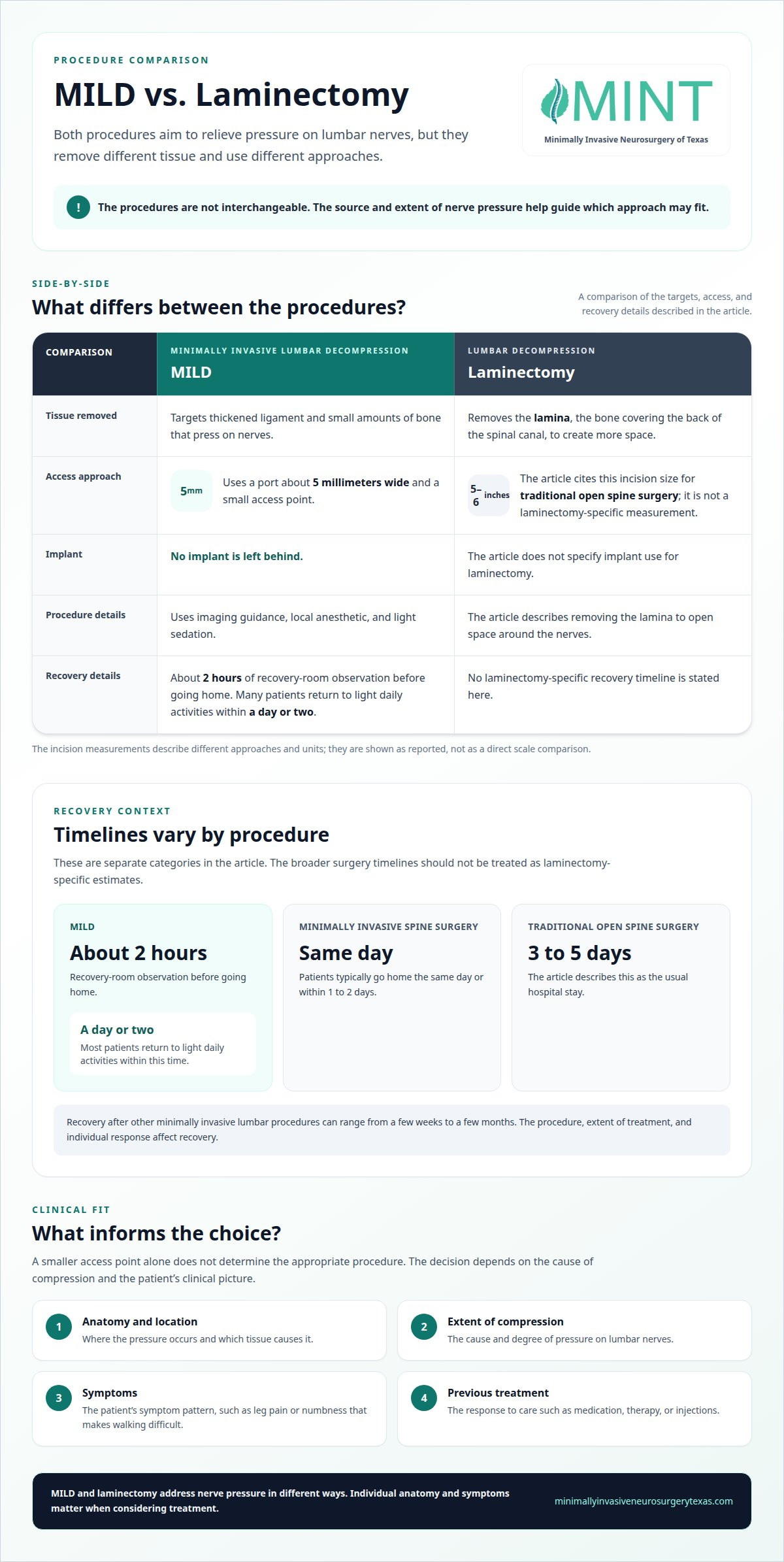
MILD and laminectomy both aim to relieve pressure on lumbar nerves, but they remove tissue differently. MILD targets thickened ligament and small amounts of bone through a small access point. A surgeon performing a laminectomy removes the lamina, the bone covering the back of the spinal canal, to create more space.
The size of the access point highlights one difference. MILD uses a port about 5 millimeters wide, while the American Academy of Orthopaedic Surgeons describes a traditional open spine surgery incision as 5 to 6 inches long. A smaller incision can mean less tissue disruption, one potential benefit of minimally invasive lumbar decompression.
For appropriately selected patients, MILD may relieve pain, improve function, and allow a faster recovery. Its goals include easing symptoms and helping patients return to normal activities. For example, someone with lumbar stenosis may seek relief from leg pain or numbness that makes walking difficult. The procedure does not leave an implant or rule out future treatment options.
These differences do not make the procedures interchangeable. Surgeons may use laminectomy for severe lumbar spinal stenosis, while MILD targets specific sources of nerve compression. The anatomy causing pressure, the location of thickened tissue, and the patient’s symptoms all matter. Clinicians may try medication and therapy first, and they may also consider injections as part of nonsurgical care.
Medicare covers MILD for qualifying patients with lumbar spinal stenosis. To verify benefits, the patient and care team review the diagnosis and whether the patient meets the qualifying criteria. Coverage information can clarify the financial side of a treatment decision, but it does not determine which procedure best addresses the source of nerve pressure.
Compare treatment goals as well as incision size. MILD removes selected tissue through a narrow port, while laminectomy removes more laminar bone to open the spinal canal. A surgeon considers the cause and extent of compression, the symptom pattern, and the response to previous treatment when determining an appropriate approach. The comparison should focus on the patient’s anatomy and clinical needs, not incision size alone.
Significant pain relief, less tissue damage, and faster recovery are potential benefits of MILD. These are possible advantages to weigh against laminectomy, not promised outcomes for every patient. The comparison involves more than how each procedure reaches the spinal canal. It also includes the intended relief and the amount of tissue removed. MILD targets selected tissue through a narrow port, while laminectomy removes the lamina. The procedures may suit different causes and degrees of nerve pressure.
For someone considering treatment, the key question is whether the tissue causing compression matches the procedure’s target. Symptoms and treatment history also help put potential benefits in context. Pain relief and recovery matter alongside the goal of creating space for lumbar nerves. A smaller access point alone does not establish which operation is appropriate. Discussing the cause of pressure, the treatment goal, and potential trade-offs with a clinician can make the comparison specific to your needs. The clinician bases the decision on anatomy and symptoms rather than one benefit in isolation.
Procedure Anesthesia, Imaging Guidance, and Outpatient Care
For patients considering Lewisville minimally invasive spinal decompression, planning begins by locating the source of nerve pressure. Magnetic resonance imaging (MRI) or computed tomography (CT) can identify the site of stenosis, or narrowing, before MILD. The clinician reviews the images alongside the patient’s symptoms to determine whether the scan findings match the affected areas.
What diagnostic tests and consultation steps are required before spinal decompression in Lewisville? For MILD, MRI or CT can show where stenosis affects the lumbar spine. During a consultation, the clinician compares these findings with symptoms and discusses whether the procedure addresses the source of pressure.
This connection helps focus treatment. Imaging shows the spine’s structure, while symptoms describe how narrowing affects daily activities. Together, they help identify the treatment target and guide planning. The clinician uses the images as a map when positioning instruments near the affected nerves.
MILD typically takes under an hour in an outpatient setting. The clinician uses local anesthetic to numb the treatment area and light sedation to help the patient stay comfortable. MILD does not require general anesthesia, which makes the patient fully unconscious. Patients can leave the outpatient setting after observation in the recovery room.
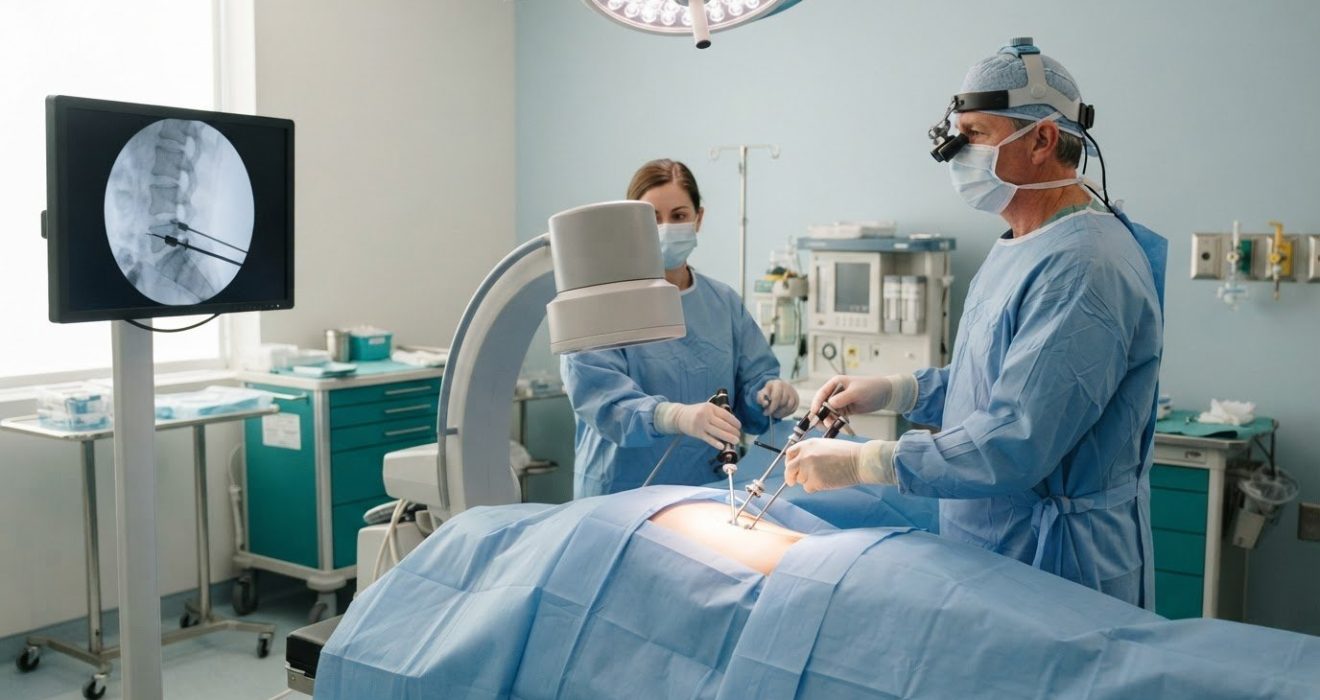
During the procedure, fluoroscopy, or live X-ray imaging, guides a small portal to the planned treatment site. Specialized instruments pass through the portal to trim tissue pressing on spinal nerves. This gives the clinician access through a tiny incision rather than a larger surgical opening.
Fluoroscopy provides real-time views as the clinician positions the portal and instruments. These images help direct treatment to the stenosis that imaging showed before the procedure. The clinician removes or trims selected tissue to reduce pressure on nerves while limiting unnecessary disruption to nearby tissue.
After treatment, the care team observes the patient before discharge. Patients may walk and go home, then gradually increase their activities. This outpatient process combines imaging-guided treatment with a monitored transition to recovery at home.
For Lewisville minimally invasive spinal decompression, the process connects diagnosis with treatment: MRI or CT locates stenosis, consultation relates imaging findings to symptoms, and fluoroscopy guides the procedure. Each step helps focus care on the identified source of nerve pressure and supports a clear treatment plan.
Conditions Treated by Minimally Invasive Spine Surgery
Minimally invasive spine surgery treats selected conditions that compress nerves or limit spinal function. The cause and location of compression help determine which procedure is appropriate.
Conditions Treated by Surgery
Minimally invasive spine surgery can address lumbar spinal stenosis, herniated discs, and degenerative disc disease. Lumbar spinal stenosis narrows the lower spinal canal and can compress nerves, causing leg or buttock pain, weakness, stiffness, or numbness. These symptoms can make standing and walking difficult. Sitting may ease pressure by flexing the spine.
Before choosing decompression, ask what structure is causing nerve pressure, which procedure targets it, and what alternatives are available. Discuss how the condition affects walking, pain, and daily function, as well as what recovery may involve.
Available Decompression Procedures
Minimally invasive procedures address compression using different techniques and access points. MILD removes small amounts of thickened ligament and related tissue to ease pressure on lumbar nerves. Endoscopic spine surgery uses a small camera and instruments through a limited opening to treat selected spinal problems. The diagnosis and specific anatomy guide the choice, not the procedure’s name alone.
For lumbar spinal stenosis, severe narrowing may require laminectomy, which removes the lamina, the bone covering the back of the spinal canal. A clinician considers how much bone or ligament contributes to pressure and whether a less disruptive approach can address it. Surgery generally comes into consideration after nonsurgical treatments, such as medication and physical therapy, fail to provide adequate relief.
Every procedure carries risks. MILD risks include infection, bleeding, nerve damage, and possible further surgery. Discuss how these risks relate to the planned treatment area, your symptoms, and your medical history. Ask what the procedure aims to improve, such as walking tolerance, leg pain, or daily activity. Clinicians assess success by changes in symptoms and function, not by the procedure’s name alone.
A suitable candidate needs a diagnosis that matches the treatment target. Magnetic resonance imaging (MRI) or computed tomography (CT) can show where stenosis or disc material presses on nerves. A clinical review connects those findings with symptoms. That match matters: treating an imaging finding that does not explain a patient’s limitations may not address the problem. The goal is to choose a procedure that targets the source of compression while considering the patient’s priorities and overall health.
What Minimally Invasive Spinal Decompression Procedures Are Available in Lewisville, Texas?
Patients in Lewisville can consider minimally invasive spinal decompression when pressure on lower-back nerves affects daily function. The appropriate procedure depends on what narrows the space around those nerves. MILD targets selected cases of lumbar spinal stenosis, or narrowing of the spinal canal in the lower back. More extensive compression may require another operation.
During MILD, a clinician uses specialized tools through a small incision to remove or trim tissue pressing on nerves. The procedure removes part of the laminar bone and partly trims the ligamentum flavum, a supporting band of tissue along the spinal canal, and nearby fatty tissue. A port about 5 millimeters wide provides access to the treatment area.
This focused approach treats tissue contributing to nerve compression. The clinician uses fluoroscopy, or live X-ray imaging, to guide the portal and instruments to the planned site. MILD aims to create more room for lumbar nerves without leaving an implant. The location and cause of pressure help determine whether this method is appropriate.
Laminectomy offers another way to decompress nerves. It removes the lamina, the bone covering the back of the spinal canal, to create more space. Severe lumbar spinal stenosis may require this broader approach. MILD removes selected tissue through a small access point, while laminectomy removes more bone to address greater narrowing.
A herniated disc, in which disc material pushes beyond its usual boundary, can also press on spinal nerves. Disc-related compression may call for a procedure that treats the disc itself. Magnetic resonance imaging (MRI) or computed tomography (CT) can help locate the affected structure. The clinician considers whether scan findings match symptoms, since back or leg pain alone does not identify which tissue needs treatment.
Choosing among minimally invasive spinal decompression procedures in Lewisville starts with identifying the source of pressure. MILD targets thickened ligament and related tissue. Laminectomy removes more laminar bone when stenosis requires a wider opening. Imaging findings, symptom patterns, and the extent of narrowing help guide the choice.
Minimally Invasive Neurosurgery of Texas
Minimally Invasive Neurosurgery of Texas helps patients in Lewisville and Plano understand options for spinal nerve compression and back pain. The practice provides Minimally Invasive Spine Surgery (MISS) and Endoscopic Spine Surgery (ESS), along with other spine procedures. The next step is a clinical discussion connecting symptoms, imaging findings, and treatment goals.
Consider a consultation when lower back pain, leg pain, numbness, or weakness continues to limit walking or standing. These symptoms can occur with lumbar spinal stenosis, which narrows the lower spinal canal, or a herniated disc, which can press on nearby nerves. The pattern and source of symptoms help shape a discussion about care.
Dr. Scott Kutz, a board-certified neurosurgeon and Fellow of the AANS and ACS, can assess how imaging findings relate to your concerns. An MRI or CT scan can show where narrowing or disc material affects nerves. A clinical discussion can then explore whether those findings match your symptoms and whether surgery is among the treatment options.
This discussion can help you understand how different procedures address different causes of compression. MILD removes selected tissue pressing on lumbar nerves. Endoscopic spine surgery uses a small camera and instruments to treat certain spinal problems. The appropriate approach depends on the condition, treatment target, and your goals.
A clinician may consider minimally invasive spine surgery when nonsurgical care has not relieved symptoms enough. A useful consultation clarifies what imaging shows, what a proposed procedure aims to change, and what recovery may involve. It also gives you an opportunity to discuss concerns about anesthesia, activity, and the possibility of further treatment.
When weighing decompression against continued nonsurgical care, the central question is whether a specific source of nerve pressure explains the symptoms. The clinician considers this connection alongside your health and daily limitations. This keeps the discussion focused on practical goals, such as standing more comfortably or returning to valued activities.
Patients who want to discuss their spinal symptoms and treatment options can connect with Minimally Invasive Neurosurgery of Texas at their own pace.
Frequently Asked Questions
Does MILD leave an implant in my back?
No. MILD does not leave an implant in your back. It removes selected tissue that crowds lumbar nerves, so it does not add a device to hold the spine open. This may matter if you are concerned about implanted hardware or future treatment options. Ask how the planned treatment targets the tissue shown on your imaging and how that target relates to your symptoms.
What is Minimally Invasive Lumbar Decompression (MILD)?
MILD removes small amounts of tissue contributing to pressure on nerves in the lower back. A clinician uses specialized instruments through a small incision to treat thickened ligament and related tissue. The procedure targets lumbar spinal stenosis, or narrowing of the spinal canal in the lower back. Imaging helps identify the treatment area before the clinician plans the approach.
What conditions can minimally invasive spinal decompression treat, and who is a suitable candidate?
Decompression may address nerve pressure associated with lumbar spinal stenosis or selected disc problems. A suitable candidate has symptoms that align with a specific source of compression on imaging, such as narrowing in the lower back that causes leg symptoms. The assessment also considers overall health, daily limitations, and response to nonsurgical care. Back pain alone does not establish that decompression is appropriate.
What is the typical cost of minimally invasive spinal decompression in Lewisville, including insurance coverage?
There is no single typical cost that applies to every Lewisville patient. The procedure and care involved affect the estimate, while insurance benefits depend on the patient’s plan and circumstances. When planning, distinguish the treatment estimate from an insurer’s coverage decision. A meaningful cost discussion accounts for the specific procedure and the patient’s coverage details; no general price or coverage amount applies to everyone.
How does minimally invasive spinal decompression compare with open surgery and nonsurgical treatments?
Minimally invasive decompression uses a smaller access point to treat a targeted source of nerve pressure, while open surgery may involve a larger incision and more tissue disruption. Nonsurgical care, such as medication or physical therapy, does not involve an operation, and a clinician may consider it before surgery. The comparison depends on the cause of symptoms, imaging findings, prior treatment, and the amount of decompression needed.
What is recovery like after minimally invasive spinal decompression, including time off work and physical therapy?
After MILD, most patients return to light daily activities within a day or two, then increase activity gradually. Recovery from other minimally invasive lumbar procedures can take a few weeks to a few months. Time away from work depends on the procedure and job demands, especially tasks involving lifting or prolonged standing. Physical therapy needs depend on the treatment plan and recovery progress, so they vary by patient.