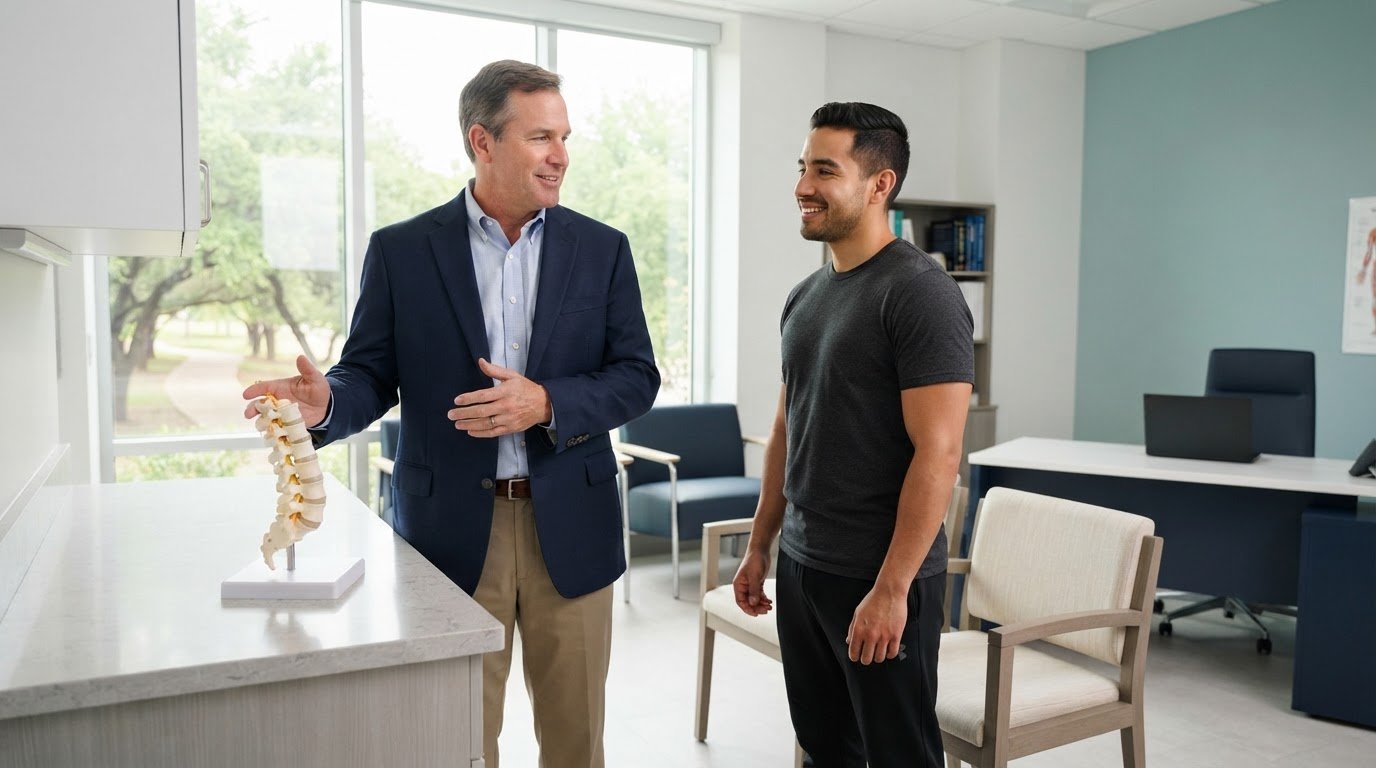
Spine surgery doesn’t always mean giving up natural movement. Motion-preservation surgery aims to address spinal problems while retaining movement, rather than restricting it through fusion, which joins vertebrae. Artificial disc replacement uses an artificial disc designed to allow bending and rotation. Minimally Invasive Neurosurgery of Texas, led by Dr. Scott Kutz, a board-certified neurosurgeon and Fellow of the AANS and ACS, provides minimally invasive spine surgery and artificial disc replacement in Lewisville and Plano, TX, including care at a Plano spine center for motion preservation.
If you’re considering spine surgery, it’s understandable to want relief while protecting the movement that matters in everyday life. The right approach depends on your spinal condition and whether a motion-preserving procedure is appropriate for you.
This article explains what motion-preservation spine surgery involves, how artificial disc replacement differs from fusion, and what to consider when choosing a surgeon. You’ll also learn how Dr. Kutz and Minimally Invasive Neurosurgery of Texas approach advanced spinal care, so you can better understand your options and the next steps toward returning to normal activity.
Key Takeaways
- Artificial disc replacement removes a damaged disc and inserts an artificial one designed to allow bending and rotation.
- Motion-preservation surgery aims to address spinal problems while maintaining movement, while fusion joins vertebrae and may limit movement in the fused area.
- Some spinal conditions may be considered for motion-preserving approaches, depending on individual circumstances.
- Compare surgical options by how they address your diagnosis, preserve movement, and support spinal stability.
- A comprehensive evaluation of your symptoms, health history, and spinal condition helps guide a surgeon’s recommendation.
Artificial disc replacement
The Plano practice offers artificial disc replacement, which removes a damaged disc and replaces it with an artificial one. The implant is designed to allow bending and rotation while addressing the affected spinal level.
Motion-Preserving Procedures Offered
Artificial disc replacement is the clearest motion-preserving procedure discussed here. Minimally invasive spine surgery is another approach, using smaller surgical access to address spinal problems. The terms describe different things: one replaces a disc, while the other describes a surgical approach. When comparing options, focus on the diagnosed problem, the part of the spine involved, and the movement the procedure aims to maintain.
A specialist may consider artificial disc replacement when a damaged disc contributes to symptoms and a motion-preserving option suits the case. The surgeon removes the disc and places an artificial one designed to allow bending and rotation. This differs from fusion, which joins vertebrae and may limit movement in the fused area. The specialist considers the condition, spinal alignment, and health history before recommending surgery.
A useful discussion starts with the source of your symptoms. A specialist evaluates your spinal condition and health history before recommending surgery. Imaging and examination help determine whether the damaged disc relates to your symptoms. The decision also considers spinal alignment, or how the vertebrae line up, and whether the disc is driving the problem. These details matter more than choosing a procedure based only on its motion-preserving label.
Lumbar Disc Replacement Options
The practice offers artificial disc replacement, and the specific procedure depends on the affected spinal region and your diagnosis. Lumbar refers to the lower back. A question about lumbar replacement therefore calls for an assessment of the lower-back disc, symptoms, and spinal structure, rather than an assumption that every artificial disc procedure suits every region.
To understand the option, ask what the operation would replace and what movement it aims to preserve. The surgeon removes the damaged disc and places an artificial disc in its position. The implant is designed to allow bending and rotation. Your spinal condition, health history, and the surgeon’s evaluation guide the recommendation.
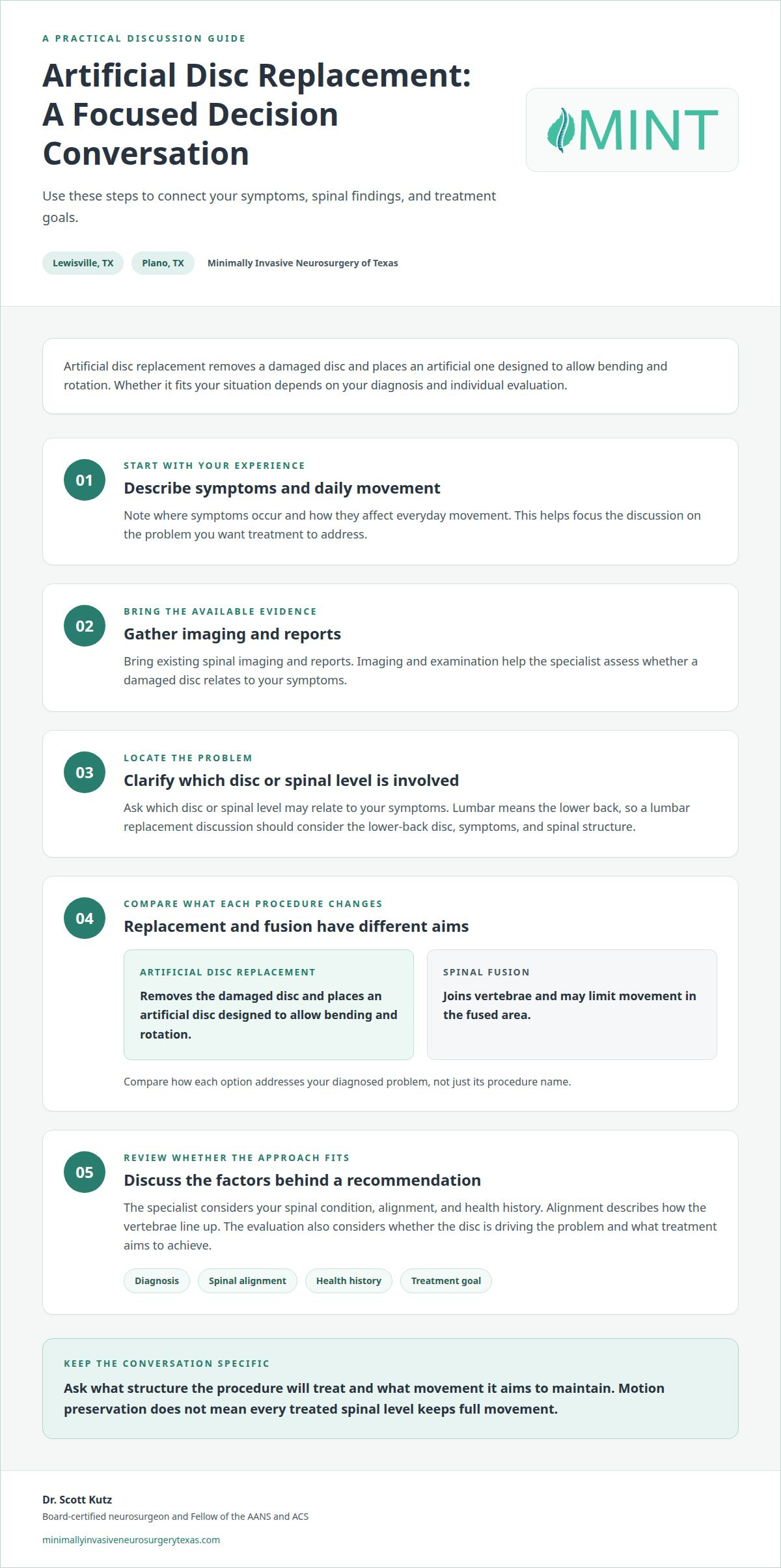
Before discussing surgery, organize relevant information for the appointment:
- Describe where symptoms occur and how they affect daily movement.
- Bring existing imaging and reports that show the spinal findings.
- Ask which disc or spinal level relates to the symptoms.
- Discuss how replacement compares with fusion for the diagnosed problem.
These steps help make the conversation specific. If you’re considering a Plano spine center for motion preservation, use them to understand whether artificial disc replacement addresses the identified problem and what movement the procedure aims to retain.
Artificial disc replacement is one option to discuss alongside the diagnosis, spinal region, and treatment goals. A clear explanation of these factors helps patients compare the procedure with other surgical approaches.
What Is Motion-Preservation Spine Surgery?
Motion-preservation surgery aims to treat spinal problems while maintaining natural movement. The surgeon matches the procedure to the affected structure and your need for support.
Motion Preservation and Spinal Fusion
Motion-preserving procedures aim to address a spinal problem without eliminating movement at the treated area. Spinal fusion takes a different approach by joining vertebrae, which can limit movement between them. The key decision is not simply whether a procedure preserves motion. The surgeon must also determine whether it addresses the source of your symptoms and provides appropriate stability.
Ask how the proposed procedure changes the affected area. For example, decompression removes bone or tissue pressing on nerves, while a stabilization procedure supports the spine. These approaches serve different purposes. The surgeon considers your diagnosis, spinal alignment, and treatment goal before making a recommendation.
Motion preservation doesn’t mean every treated spinal level keeps full movement. A procedure may preserve movement in one way while changing another structure. Ask which part of the spine the surgeon plans to treat and how that change relates to your symptoms. This makes the discussion more specific than comparing procedure names alone.
Plano Spine Center’s Program
Motion-preservation care can include procedures that target different spinal structures. Dynamic stabilization uses flexible implants to support the spine while allowing movement. Laminoplasty creates more room for the spinal cord without joining vertebrae. A surgeon may use laminoplasty in some cases of spinal stenosis, or narrowing around the spinal cord.
Minimally invasive decompression removes bone or tissue pressing on nerves while preserving most natural anatomy and spinal function. Facet replacement uses artificial joints to replace worn facet joints, which connect vertebrae and guide movement. These procedures don’t address the same problem. Ask which structure your proposed treatment targets and what function it aims to preserve.
Risks, Benefits, and Recovery
Motion-preserving surgery aims to treat a spinal problem while retaining movement where appropriate. The main consideration is balancing that goal with the need to address symptoms and support the spine. Risks and recovery vary with the procedure and your condition, so ask how the specific operation affects your treatment plan.
Discuss recovery in practical terms. Ask which movements or daily activities the care team will address first and how it will assess your progress. For example, ask how the plan relates to walking, bending, or returning to household tasks. These questions connect recovery expectations to the actual procedure rather than an assumed timeline.
Choosing a motion-preservation spine surgeon
A motion-preserving recommendation should follow a comprehensive evaluation of your condition. Use the consultation to understand your diagnosis, the proposed procedure, and how the surgeon weighs movement against spinal stability.
Start with the diagnosis
Ask the surgeon to connect your symptoms with a specific spinal finding. For example, a herniated disc, degenerative disc disease, and facet joint problems affect different structures. The structure involved helps shape the treatment discussion. A recommendation should also account for your health history, spinal alignment, and daily activities.
Bring existing imaging and reports, then ask what each finding means for your symptoms. Imaging shows spinal structures, while your symptom history explains how the problem affects sitting, walking, bending, or sleep. A complete assessment considers both. Ask which finding matters most and how it affects your treatment options.
Understand the procedure’s goal
“Motion preservation” can describe different approaches, so ask for the exact procedure name. Artificial disc replacement, for example, replaces a damaged disc with an artificial one designed to allow bending and rotation. Dynamic stabilization uses flexible implants to support the spine without eliminating movement. These procedures work differently and don’t address every spinal problem in the same way.
Ask the surgeon to explain what the operation changes, what it aims to preserve, and how it addresses your diagnosed condition. Then ask how the recommendation compares with spinal fusion, which joins vertebrae and may limit movement in the fused area. This comparison clarifies the tradeoffs rather than treating motion preservation as an automatic benefit.
Use focused consultation questions
A focused question list can make your appointment more useful. Keep the discussion tied to your diagnosis and treatment goals.
- Which spinal finding best explains my symptoms?
- What motion-preserving procedure are you recommending, and why?
- What alternatives address the same spinal problem?
- How does my health history affect the recommendation?
- What changes should I expect in movement after treatment?
Listen for answers that connect the proposed procedure to a specific finding, such as a damaged disc or narrowed space around a nerve. Ask the surgeon to explain unfamiliar terms in plain language. Clear reasoning helps you understand why one approach may suit your spinal condition better than another.
Assess the full treatment plan
Review more than the operation itself. Ask how the care team will track symptoms, movement, and recovery progress after surgery. For example, discuss which everyday activities matter most to you, such as walking comfortably or returning to household tasks. A useful plan connects those goals with the procedure and follow-up.
Suitability depends on your spinal condition, health history, and the surgeon’s recommendation. The decision should follow a comprehensive evaluation, not a preference for a particular technique. Before agreeing to surgery, make sure you can describe the diagnosis, the procedure’s purpose, and the main alternatives in your own words.
Conditions and symptoms considered for motion-preserving surgery
Motion-preserving surgery may be discussed for herniated discs, degenerative disc disease, or facet joint problems. The key question is whether the diagnosed structure matches your symptoms and treatment goals.
Herniated discs and disc degeneration
A herniated disc occurs when disc material extends beyond its usual boundary. Degenerative disc disease describes changes in a disc that can contribute to pain or altered function. These diagnoses involve different disc problems, so an evaluation must identify which level and finding relate to your symptoms.
For example, if you have lower-back pain, describe when it begins, which movements affect it, and whether it travels into your leg. Those details help a specialist compare your symptom pattern with imaging. A scan alone doesn’t show how a finding affects daily activity, so both your experience and a spinal assessment matter.
Artificial disc replacement may be considered for a damaged disc when maintaining movement suits your condition. The procedure replaces the disc with an artificial one designed to allow bending and rotation. The decision depends on the affected spinal level, spinal alignment, and health history, rather than the diagnosis name alone.
Facet joint problems and spinal alignment
Facet joints connect neighboring vertebrae and help guide spinal movement. Problems in these joints can be part of motion-preserving treatment discussions, especially when flexibility or spinal alignment matters to your lifestyle. A specialist evaluates the joint problem alongside nearby discs and the overall structure of the spine.
Consider someone whose work involves frequent bending or whose daily routine requires sustained movement. That activity can help define personal treatment goals, but it doesn’t establish whether surgery is suitable. The clinician still needs to assess the joint findings, symptoms, and alignment before recommending a procedure.
Symptoms and individual suitability
Back pain, restricted movement, or symptoms that affect everyday tasks can prompt an evaluation. These experiences don’t identify a specific spinal condition on their own. A specialist considers your history, examination, imaging, and symptom location together.
Motion-preserving options are not interchangeable. A herniated disc, degenerative disc disease, and facet joint problem involve distinct structures. The treatment discussion should clarify which structure is causing concern and how the proposed approach addresses it. A procedure’s motion-preserving purpose matters only when it fits the diagnosed problem.
Before an appointment, note activities that bring on symptoms, movements that ease them, and how pain affects walking, sitting, or sleep. Bring prior imaging and reports. This practical record helps connect everyday limitations with clinical findings and supports a focused discussion of options.
What guides the recommendation
Suitability depends on your spinal condition, health history, and the surgeon’s recommendation after a comprehensive evaluation. The assessment considers spinal alignment, the affected structure, and whether preserving movement fits the treatment goal. A clear recommendation should explain how these factors relate to your symptoms and daily needs.
Ask which finding supports the proposed procedure, what movement it aims to preserve, and how it compares with fusion. These questions help distinguish treatment chosen for a specific diagnosis from treatment selected simply because it promises motion preservation.
What is Plano Spine Center’s motion preservation program?
A motion-preservation program organizes evaluation and treatment around addressing a spinal problem while retaining movement where appropriate. Its steps connect diagnosis, procedure choice, and recovery priorities.
Begin with a focused evaluation
The first step is identifying which spinal structure relates to your symptoms. A specialist considers your history, examination, imaging, and spinal alignment, meaning how the vertebrae line up. For example, a scan may show narrowing around the spinal cord while you describe difficulty walking or changes in balance. Together, these details guide discussion of possible treatment approaches.
The evaluation also considers what you need to do each day. Someone whose work involves bending may value movement differently from someone focused on comfortable walking. These goals inform the discussion, but the diagnosis and spinal structure remain central to choosing an approach.
Match the approach to the spinal problem
Motion-preserving procedures address different structures. Minimally invasive decompression removes bone or tissue pressing on nerves while preserving most natural anatomy and spinal function. Laminoplasty creates more space for the spinal cord without fusing vertebrae in some cases of spinal stenosis. Spinal stenosis means narrowing around the spinal cord or nerves.
Other procedures support movement in different ways. Dynamic stabilization uses flexible implants to support the spine without eliminating movement. Facet replacement replaces worn facet joints with artificial joints. These examples show why a treatment plan must name the structure it addresses and explain its purpose. Similar goals don’t make procedures interchangeable.
Connect treatment goals with recovery priorities
A useful plan explains what the procedure changes and what it aims to preserve. For example, decompression targets pressure on nerves, while dynamic stabilization supports the spine with flexible implants. Ask which daily movements the procedure addresses and which activities need attention during recovery.
Recovery planning should reflect the selected procedure and your clinical needs. Discuss how the care team will assess symptoms, movement, and progress. A clear plan also identifies which changes matter to you, such as walking more comfortably or returning to household activities. These priorities make follow-up discussions specific.
Prepare for a practical treatment discussion
Bring imaging reports, a list of symptoms, and examples of activities that feel difficult. Note whether bending, standing, or walking changes your symptoms. This information helps connect everyday experiences with examination and imaging findings.
Ask the specialist to explain your diagnosis, the proposed procedure, and its movement-related goal. Then ask how the approach compares with fusion for your specific spinal problem. The answers should clarify which structure needs treatment and how the plan supports your goals. This step-by-step discussion turns the broad idea of motion preservation into a concrete care plan.
Minimally Invasive Neurosurgery of Texas: Minimally Invasive Spine Surgery
Minimally Invasive Neurosurgery of Texas provides minimally invasive spine surgery for patients considering surgical care for spinal problems. Its options include artificial disc replacement and endoscopic spine surgery, which uses a small camera and instruments to access the spine. Dr. Scott Kutz, a board-certified neurosurgeon and Fellow of the AANS and ACS, serves patients in Lewisville and Plano, TX.
Consider contacting the practice when a spinal diagnosis has led you to explore surgery or when you want to understand how a procedure may address your condition. A discussion can connect your diagnosed problem with relevant surgical options. Contact Minimally Invasive Neurosurgery of Texas to discuss your spine surgery questions.
Take the Next Step Toward a Clear Treatment Plan
Your next step can start with a clear picture of what you want treatment to help you do. Think about how back symptoms affect walking, work, sleep, or other daily activities. Bring those examples to your conversation, then ask how each treatment option relates to your diagnosis and movement goals. This turns a broad discussion about surgery into a focused review of your needs.
For people comparing options at a Plano spine center for motion preservation, Minimally Invasive Neurosurgery of Texas offers minimally invasive spine surgery, minimally invasive neurosurgery, and artificial disc replacement. The right discussion begins with your condition, not a procedure label. Dr. Scott Kutz can help you understand how surgical options relate to your spinal findings and priorities.
Take the next step at a pace that feels right for you. Contact Minimally Invasive Neurosurgery of Texas to discuss your spine care options and move toward a more informed decision.
Frequently Asked Questions
Who is eligible for motion-preserving spine surgery, and what conditions does it treat?
Eligibility depends on whether your spinal condition and health history support a motion-preserving approach. Herniated discs, degenerative disc disease, and facet joint problems may prompt discussion of these options. For example, a specialist considers whether imaging findings match your symptoms and whether spinal alignment supports the proposed treatment. Prepare by noting which activities trigger symptoms and bringing relevant imaging reports to your evaluation.
How does artificial disc replacement compare with spinal fusion?
Artificial disc replacement replaces a damaged disc with an artificial one designed to allow bending and rotation. Spinal fusion joins vertebrae and may limit movement in the fused area. The comparison depends on your spinal problem and treatment goal. Ask which structure each option addresses, how each affects movement at the treated level, and why one approach fits your findings. This information is educational, not a substitute for professional medical advice. The website and its content are provided as is.