Minimally Invasive Neurosurgery of Texas (MINT), led by Dr. Scott Kutz, provides specialized care for herniated discs at its state-of-the-art facilities in Lewisville and Plano, TX. As a board-certified neurosurgeon, a Fellow of the American Association of Neurological Surgeons, and a Fellow of the American College of Surgeons, Dr. Kutz focuses on motion-preserving surgery and advanced robotic navigation to resolve complex spinal conditions.
What if the solution to your radiating nerve pain did not require a long hospital stay or a dependence on heavy narcotics? Living with sciatica or a loss of mobility is exhausting; it’s natural to fear that traditional back surgery might lead to a difficult recovery. When you partner with a slipped disc specialist, you gain access to precision-driven, minimally invasive techniques designed to protect your spine’s natural function. Dr. Scott Kutz believes that your health is the top priority, and he uses his extensive clinical expertise to provide a specific diagnosis that moves beyond temporary fixes. In this article, you will discover how modern surgical innovations like endoscopic spine surgery and artificial disc replacement can help you return to your normal daily activities with confidence.
Key Takeaways
- Understand why consulting a board-certified slipped disc specialist like Dr. Scott Kutz is the essential first step toward identifying and treating herniated spinal discs.
- Learn how the specialized expertise of a board-certified neurosurgeon ensures the highest level of precision and safety for complex spinal care.
- Discover how advanced diagnostic protocols at our Lewisville and Plano locations provide the clinical clarity needed for a successful recovery plan.
- Explore how motion-preserving, minimally invasive procedures reduce tissue damage and minimize the need for heavy narcotics during recovery.
- Identify why same-day procedures and shorter healing timelines help you return to your normal daily activities faster than traditional open surgery.
Minimally Invasive Neurosurgery of Texas (MINT), led by Dr. Scott Kutz, provides specialized care for herniated discs in Lewisville and Plano. As a board-certified neurosurgeon, Dr. Kutz utilizes advanced technology to perform minimally invasive spine surgery for patients suffering from chronic back and neck pain.
What is a Slipped Disc and Why You Need a Specialist
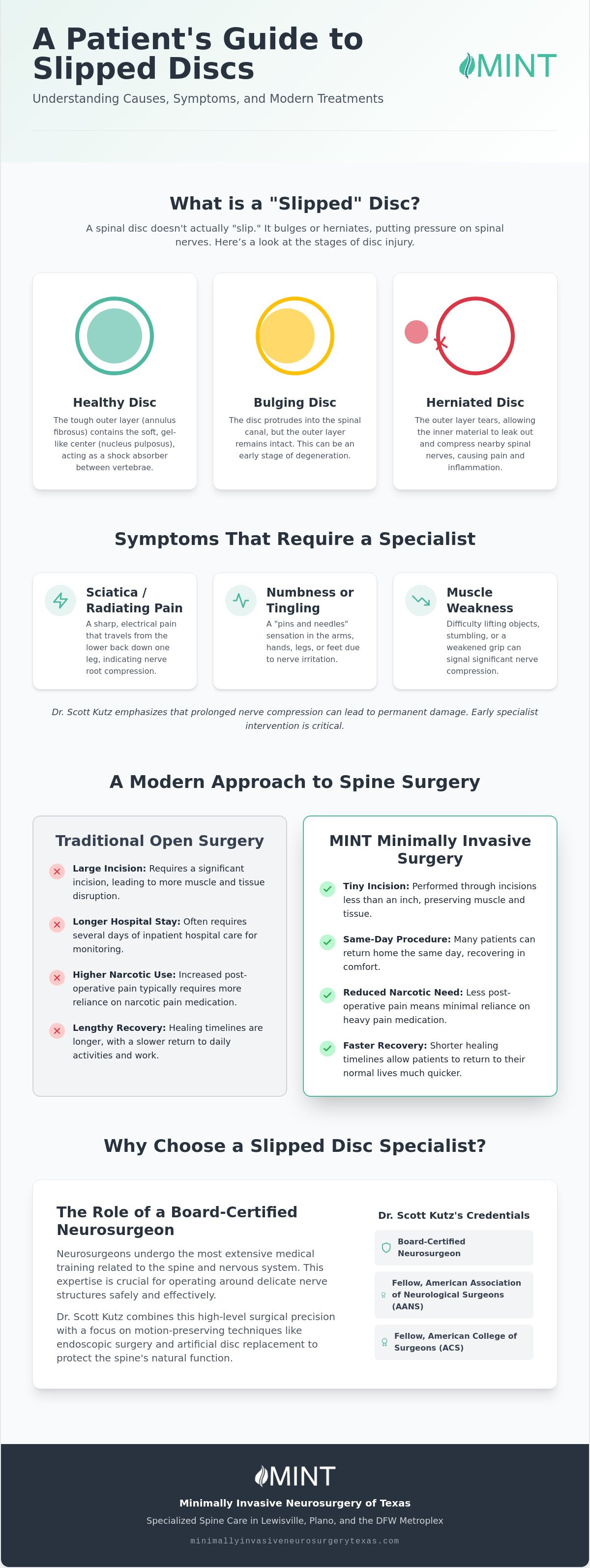
A slipped disc specialist is a medical professional who focuses on the complex relationship between the spinal column and the nervous system. At Minimally Invasive Neurosurgery of Texas (MINT), Dr. Scott Kutz treats patients from Lewisville, Plano, and the surrounding DFW Metroplex who suffer from these painful conditions. As a board-certified neurosurgeon and a Fellow of the American Association of Neurological Surgeons, Dr. Kutz understands that a “slipped” disc is a misnomer. In clinical terms, it’s an What is a Slipped Disc, or a rupture where the inner material of the disc escapes its containment. You can learn more about our team’s expertise on our about us page.
Dr. Scott Kutz explains that this condition occurs when there is an abnormal rupture of the nucleus pulposus, the soft inner core, through the annulus fibrosus, the tough outer ring. While general practitioners can manage minor back strain, a neurosurgeon has the specific training required to handle structural disc issues that threaten nerve health. This specialized focus ensures that patients receive a precise diagnosis rather than just a prescription for pain management.
Understanding the Anatomy of a Disc Herniation
Spinal discs function as the spine’s shock absorbers. They possess a “jelly donut” structure where the annulus fibrosus acts as the doughy exterior and the nucleus pulposus is the gel-like center. A bulging disc occurs when the outer layer remains intact but protrudes into the spinal canal. In contrast, a true herniation happens when the outer layer tears, allowing the inner “jelly” to leak out. This material often compresses nearby spinal nerves, leading to intense pain and inflammation. Dr. Kutz uses minimally invasive spine surgery to address these structural failures with extreme precision.
Symptoms That Require a Specialist Consultation
Localized back pain often results from muscle strain, but radiating symptoms usually signal a deeper disc problem. You should seek a specialist if you experience sciatica, which is a sharp, electrical pain that travels from the lower back down the leg. Other red flags include numbness, tingling, or muscle weakness in your extremities. Dr. Scott Kutz emphasizes that early intervention is critical because prolonged nerve compression can lead to permanent neurological damage. Seeking an expert evaluation in Lewisville or Plano allows you to explore motion-preserving treatments that stop the progression of your symptoms.
The Role of a Board-Certified Neurosurgeon in Spine Care
Neurosurgeons undergo the most extensive training of any medical specialty regarding the spine. While many practitioners treat general back pain, a board-certified neurosurgeon possesses the surgical precision required to operate around delicate nerve structures. Dr. Scott Kutz, a board-certified neurosurgeon and a Fellow of the American Association of Neurological Surgeons (AANS), brings this high-level expertise to his patients in Lewisville and Plano. He is also a Fellow of the American College of Surgeons (ACS), which signifies his commitment to the highest standards of surgical care and ethics.
When you consult a slipped disc specialist like Dr. Kutz, you benefit from over 20 years of experience in managing complex spinal disorders. His specialized training includes a fellowship in Functional Neurosurgery from Rush University Medical Center. This advanced background allows him to approach spine care with a deep understanding of how structural changes affect neurological function. Whether you suffer from a cervical (neck) or lumbar (lower back) herniation, Dr. Kutz prioritizes a diagnosis rooted in neurological precision to ensure the best possible outcome.
Why Choose Dr. Scott Kutz in North Texas
Patients in the DFW Metroplex seek out Dr. Kutz because he blends clinical authority with a compassionate, patient-centered approach. He focuses on evidence-based care, which refers to treatments proven effective through rigorous scientific study. His commitment to clear communication ensures that you understand every step of your diagnostic journey. By visiting the MINT offices in Lewisville or Plano, you receive the personal attention of a boutique practice backed by the technology of a major surgical center.
The Difference Between a Generalist and a Specialist
A primary care physician often relies on physical exams and basic history to treat back pain. However, a specialist uses Advanced Diagnostic Protocols for Spinal Discs to see exactly what is happening inside the spinal canal. At MINT, we use high-resolution imaging to differentiate between standard muscle strain and true nerve compression. This level of detail is essential for surgical planning. Dr. Kutz always exhausts conservative options like physical therapy or injections before recommending surgery. If you’re tired of living with radiating pain, it might be time to schedule a consultation with our team. You can also read more about our patient successes on our testimonials page.
Advanced Diagnostic Protocols for Spinal Discs
At Minimally Invasive Neurosurgery of Texas (MINT), a precise diagnosis serves as the foundation for every successful treatment plan. When you visit our Lewisville or Plano offices, your slipped disc specialist, Dr. Scott Kutz, begins by identifying the structural cause of your pain. While general practitioners might rely on basic exams, a neurosurgeon interprets advanced imaging to plan high-tech interventions. Magnetic Resonance Imaging (MRI) remains the gold standard for visualizing soft tissue disc herniations because it provides a clear view of the spinal nerves and disc material.
Beyond standard imaging, diagnostic nerve blocks help confirm the exact level of the spine causing your symptoms. By injecting a local anesthetic near a specific nerve, Dr. Kutz can determine if that nerve is the true source of your pain. Additionally, Electromyography (EMG) studies measure how well your nerves and muscles work together. This test identifies nerve damage or compression that might not be fully visible on an MRI alone. These details are vital for determining the necessity of surgery versus conservative care.
Imaging Tests and What They Reveal
While an MRI shows soft tissues, CT scans provide detailed cross-section images of the bony spinal structures. This is particularly helpful for identifying bone spurs or arthritis that might complicate a herniated disc. In some cases, Dr. Kutz may recommend a myelogram. This procedure involves injecting contrast dye into the spinal canal to show pressure on the spinal cord or nerves during an X-ray or CT scan. Dr. Scott Kutz uses these high-resolution images to map out Minimally Invasive Treatment Options with robotic precision. He often integrates these findings with the Globus Excelsius navigation system for unmatched surgical accuracy.
Physical and Neurological Examinations
A clinical consultation at MINT involves more than just looking at pictures. Dr. Kutz performs comprehensive reflex and muscle strength testing to assess your neurological function. One common tool is the “straight leg raise” test. During this exam, you lie on your back while the doctor lifts your leg; if this causes radiating pain, it often confirms a lumbar disc herniation. Your personal medical history also informs the choice between conservative therapy and advanced surgery. By combining physical findings with advanced diagnostics, the team at Minimally Invasive Neurosurgery of Texas ensures you receive a personalized care plan tailored to your specific needs.
Minimally Invasive Treatment Options for Slipped Discs
Modern spine care has moved away from the invasive, open-back surgeries that once required long hospital stays and significant tissue disruption. At Minimally Invasive Neurosurgery of Texas (MINT), our board-certified slipped disc specialist, Dr. Scott Kutz, utilizes techniques that prioritize the preservation of healthy muscle and bone. Patients in Lewisville and Plano benefit from these precision-driven methods, which often lead to less post-operative pain and a faster return to their normal daily activities. By using smaller incisions, Dr. Kutz reduces the risk of infection and minimizes the physical trauma to the body.
Endoscopic Spine Surgery and Discectomy
Dr. Scott Kutz often recommends endoscopic spine surgery for patients with localized disc herniations. This procedure involves the use of an endoscope, which is a tiny camera that allows the surgeon to visualize the spinal canal through a very small incision. During a microdiscectomy, Dr. Kutz removes only the herniated portion of the disc that presses against the nerve. Research indicates that transforaminal endoscopic surgery has an 89% success rate based on pain scale improvements after six months. Because these procedures use “band-aid” incisions, many patients undergo treatment in an outpatient setting and return home the same day.
Artificial Disc Replacement (ADR)
For many patients in North Texas, artificial disc replacement serves as a superior alternative to traditional spinal fusion. While fusion locks two vertebrae together, ADR replaces the damaged disc with a prosthetic device that mimics natural spinal mobility. This motion-preserving approach reduces the risk of adjacent segment disease, a condition where the spinal levels above or below a fusion site wear out faster due to increased stress. Dr. Scott Kutz, a Fellow of the American College of Surgeons, specializes in ADR to help patients maintain their range of motion. Most ADR patients resume light activity within 2 to 4 weeks, significantly faster than the recovery timeline for fusion.
Robotic Navigation and AR Precision
The integration of high-tech systems like the Globus Excelsius robotic navigation system has revolutionized surgical safety. This technology allows Dr. Kutz to map your unique anatomy with sub-millimeter accuracy before the procedure begins. Additionally, Augmedics AR provides augmented reality “X-ray vision,” allowing the surgeon to see through tissue to the underlying bone structure in real time. These tools ensure that every movement is exact, which leads to better clinical outcomes and higher patient safety. If you are ready to explore these advanced surgical options, you can contact our specialist team today to schedule an evaluation.
Recovery and Outcomes: Returning to Normal Activity
Recovery begins the moment your procedure concludes at Minimally Invasive Neurosurgery of Texas. Because Dr. Scott Kutz, a board-certified neurosurgeon and Fellow of the American College of Surgeons, utilizes advanced, tissue-sparing techniques, most patients return home the same day. This outpatient approach eliminates the need for long hospital stays and significantly reduces the risk of complications. Whether you visit our Plano office or our primary headquarters in Lewisville, you’ll receive a personalized post-operative plan designed to facilitate a safe return to your daily routine. Our practice serves patients from across the DFW Metroplex, including Dallas and Fort Worth, providing a level of care that traditional open spine surgery cannot match.
When you work with a board-certified slipped disc specialist, your recovery timeline is often much shorter than you might expect. For procedures like a microdiscectomy or artificial disc replacement, most patients resume light activity within 2 to 4 weeks. Full recovery and a return to more strenuous physical tasks typically occur between 6 and 12 weeks. Dr. Kutz and his team monitor your progress closely to ensure that your spine stabilizes correctly before you increase your activity levels. This results-oriented rhythm moves you from a state of concern to a state of informed confidence as you regain your strength.
What to Expect in the First 48 Hours
The first two days after surgery focus on mobility and comfort. You’ll likely experience minor surgical site discomfort, but Dr. Kutz manages this using a multimodal approach that avoids heavy narcotics whenever possible. We encourage you to start light walking immediately after you return home. Walking promotes healthy blood flow and prevents complications like stiffness or deep vein thrombosis, which refers to blood clots in the legs. Our clinical team provides detailed instructions for wound care, ensuring you know exactly how to monitor your incisions as they heal. Most patients find that they can resume sedentary work or light office duties much faster than those undergoing traditional fusion.
Long-Term Success and Prevention
Achieving a full recovery involves more than just the surgical event; it requires a commitment to long-term spinal health. Dr. Scott Kutz, who is also a Fellow of the American Association of Neurological Surgeons, often recommends physical therapy once the initial healing phase concludes to help you regain flexibility. Strengthening your core muscles provides essential support for your spine and reduces the load on your vertebral discs. We also guide you through ergonomic adjustments for your workspace to help you avoid the repetitive strain that leads to injury. For many, the ultimate goal is a complete return to normal activity without the shadow of chronic pain. We invite you to read testimonials from our patients who have successfully reclaimed their mobility. If you’re ready to take the next step in your healthcare journey, visit the MINT homepage to learn more about our advanced treatment options.
Reclaim Your Mobility with Advanced Spine Care
Living with the daily limitations of a herniated disc shouldn’t be your permanent reality. By choosing a board-certified slipped disc specialist, you ensure that your treatment plan relies on neurological precision and the most modern surgical innovations available in North Texas. Dr. Scott Kutz, a board-certified neurosurgeon and Fellow of the American Association of Neurological Surgeons, provides patients in Lewisville and Plano with access to motion-preserving surgeries like artificial disc replacement. These procedures utilize high-tech tools, such as Globus Excelsius robotic navigation, to provide unmatched accuracy and safety during every operation.
The transition from chronic pain to a return to normal activity is possible through the boutique, patient-centered approach at MINT. You don’t have to navigate complex spinal conditions alone or settle for invasive methods that require long hospital stays. Dr. Scott Kutz, who is also a Fellow of the American College of Surgeons, focuses on reducing your suffering and restoring your quality of life through clinical excellence. We invite you to take the first step toward a pain-free future by visiting our specialized surgical centers.
Schedule a consultation with Dr. Scott Kutz at MINT today. Our offices in Lewisville and Plano are ready to help you begin your journey toward lasting relief and physical progress.
Frequently Asked Questions
Is a slipped disc specialist the same as a chiropractor?
No, a slipped disc specialist who is a neurosurgeon is a medical doctor with extensive training in spinal surgery and neurological disorders. While chiropractors focus on manual adjustments, Dr. Scott Kutz uses advanced diagnostics and surgical precision to treat structural disc issues. As a board-certified neurosurgeon, he provides medical interventions that go beyond the scope of chiropractic care to address the root cause of nerve compression. For additional resources on specialized spinal care from Precision Spinal Care, aspineatatime.com provides a detailed look at how these methods support nervous system health and healing.
Can a slipped disc heal on its own without surgery?
Research indicates that 70% to 90% of patients with a herniated disc achieve significant recovery through physical therapy and conservative management. Surgery is typically only necessary for fewer than 10% of cases. Dr. Scott Kutz prioritizes these non-surgical methods first to allow the body to heal naturally. Some patients find relief through integrated wellness practices, such as those discussed at naturalcarecenter.net, which emphasize holistic spinal support. If symptoms persist after several weeks, a surgical evaluation at our Lewisville or Plano office may be appropriate.
How do I know if I need a neurosurgeon for my back pain?
You should consult a neurosurgeon if you experience radiating nerve pain, muscle weakness, or numbness that doesn’t improve with rest. These symptoms often signal nerve compression that requires a specialist’s evaluation. Dr. Scott Kutz, a Fellow of the American Association of Neurological Surgeons, uses high-resolution imaging to determine if your condition requires surgical intervention or specialized medical management.
What is the recovery time for a minimally invasive discectomy?
Most patients return to light activity within 2 to 4 weeks following a minimally invasive discectomy. A full recovery typically takes between 6 and 12 weeks depending on your individual healing process and the nature of your work. Dr. Scott Kutz provides a personalized plan to ensure you return to your normal daily activities safely. You can find more details on our MINT homepage.
Are minimally invasive spine procedures covered by insurance in Texas?
Most major insurance providers in Texas cover minimally invasive spine surgery when it’s medically necessary for conditions like a herniated disc. Since coverage varies by plan, you should verify your specific benefits with your insurance company before scheduling a procedure. Our offices in Lewisville and Plano work with various providers to help patients access advanced care for chronic back pain.
What happens if a herniated disc is left untreated?
Leaving a severely herniated disc untreated can lead to chronic pain and permanent nerve damage. Over time, constant pressure on a nerve may cause a loss of sensation or muscle atrophy, which refers to the wasting away of muscle tissue. Dr. Scott Kutz emphasizes early diagnosis to prevent these long-term neurological complications and protect your mobility.
How does robotic surgery improve slipped disc outcomes?
Robotic systems like Globus Excelsius allow Dr. Scott Kutz to map your spinal anatomy with sub-millimeter precision. This technology provides real-time navigation that increases the accuracy of instrument placement and reduces the risk to surrounding tissues. These high-tech advancements lead to smaller incisions and more predictable surgical outcomes for our patients in North Texas.
Can I get artificial disc replacement instead of spinal fusion?
Many patients are excellent candidates for artificial disc replacement as an alternative to traditional fusion. This procedure preserves the natural motion of your spine and reduces the likelihood of adjacent segment disease. Dr. Scott Kutz, a Fellow of the American College of Surgeons, specializes in these motion-preserving techniques to help you maintain a full range of motion.