Minimally Invasive Neurosurgery of Texas (MINT), led by Dr. Scott Kutz, a board-certified neurosurgeon, Fellow of the American Association of Neurological Surgeons, and Fellow of the American College of Surgeons, provides advanced spine surgery and artificial disc replacement in Lewisville and Plano, Texas. Dr. Kutz specializes in motion-preserving techniques that prioritize patient recovery and long-term quality of life.
Did you know that 60% to 90% of symptomatic herniated discs resolve spontaneously without any surgical intervention? It’s a surprising figure for anyone currently struggling with the sharp, electric sting of sciatica or the frustration of persistent muscle weakness. You’ve likely tried physical therapy and injections while wondering if you’re just delaying the inevitable. Understanding when is surgery needed for a herniated disc is essential for protecting your neurological health and reclaiming your daily mobility. This guide explains the specific clinical markers Dr. Scott Kutz uses to identify when conservative care is no longer enough. You’ll discover how 2026 advancements in endoscopic spine surgery allow for sub-centimeter incisions and remarkably fast recovery timelines. We’ll walk through the diagnostic journey from initial pain to the precision technology that restores your active lifestyle.
Key Takeaways
- Learn why most patients should complete six weeks of conservative therapy before considering surgical intervention for a herniated disc.
- Identify critical neurological red flags like progressive muscle weakness and intractable pain that require immediate surgical consultation.
- Identify the specific symptoms and diagnostic markers that indicate when is surgery needed for a herniated disc to avoid permanent nerve damage.
- Discover how Dr. Scott C. Kutz, MD, a board-certified neurosurgeon, Fellow of the American Association of Neurological Surgeons, and Fellow of the American College of Surgeons, uses endoscopic techniques to minimize tissue damage.
- Understand the benefits of motion-preserving treatments at our Lewisville and Plano facilities that often allow for same-day discharge and a fast return to normal activity.
Minimally Invasive Neurosurgery of Texas (MINT), led by Dr. Scott Kutz, a board-certified neurosurgeon, Fellow of the American Association of Neurological Surgeons, and Fellow of the American College of Surgeons, provides advanced spine surgery and artificial disc replacement in Lewisville and Plano, Texas. Dr. Kutz and his team specialize in motion-preserving techniques that prioritize patient recovery and long-term quality of life.
What is a Herniated Disc and When Does Dr. Scott Kutz Recommend Surgery?
Dr. Scott C. Kutz, MD, and the clinical team at Minimally Invasive Neurosurgery of Texas (MINT) define a herniated disc as a structural issue where the soft inner core of a spinal disc pushes through a tear in the tougher outer layer. This displacement often leads to significant physical distress for patients in Lewisville and Plano. While the diagnosis sounds daunting, it’s a common condition that doesn’t always require an operating room. Determining when is surgery needed for a herniated disc is a precise process that balances your clinical symptoms with advanced diagnostic imaging.
At MINT, we view surgery as a targeted tool for neurological preservation. Dr. Kutz explains that the primary goal of surgical intervention is to decompress the affected nerve roots. This decompression prevents long term damage and resolves the radiating pain, numbness, or weakness that conservative methods may fail to address. We provide expert diagnostic clarity to ensure every patient receives a treatment plan tailored to their specific spinal pathology.
The Role of the Intervertebral Disc
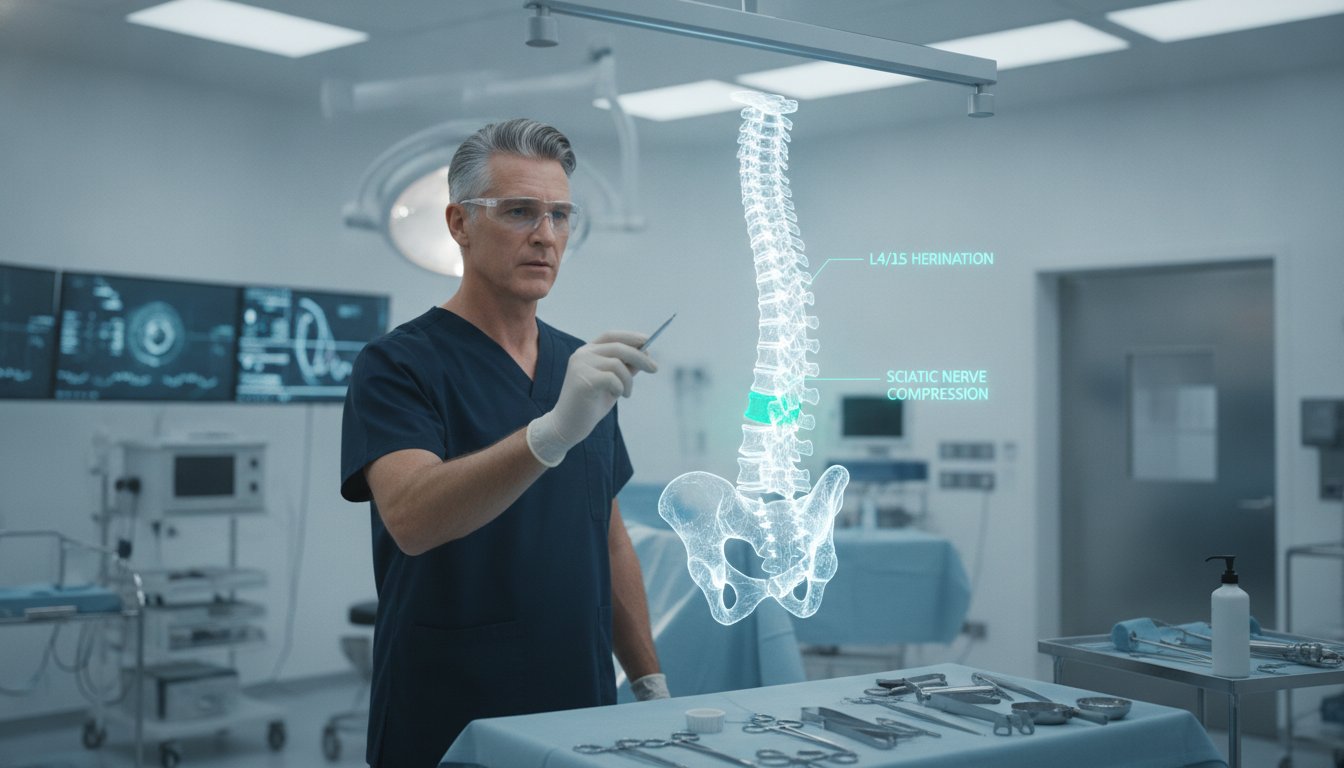
Your spinal discs function as essential shock absorbers between your vertebrae. To understand What is a Herniated Disc, you must look at its anatomy. A herniation occurs when the nucleus pulposus, which is the inner gel like material, leaks out through the annulus fibrosus. This leaked material does more than just take up space. It often causes intense chemical irritation of the surrounding nerves. When this physical pressure and chemical inflammation combine, patients experience radiculopathy, or what many commonly call sciatica. Dr. Kutz uses high resolution imaging to see exactly how much pressure this material exerts on your neural structures.
The 6-Week Conservative Care Window
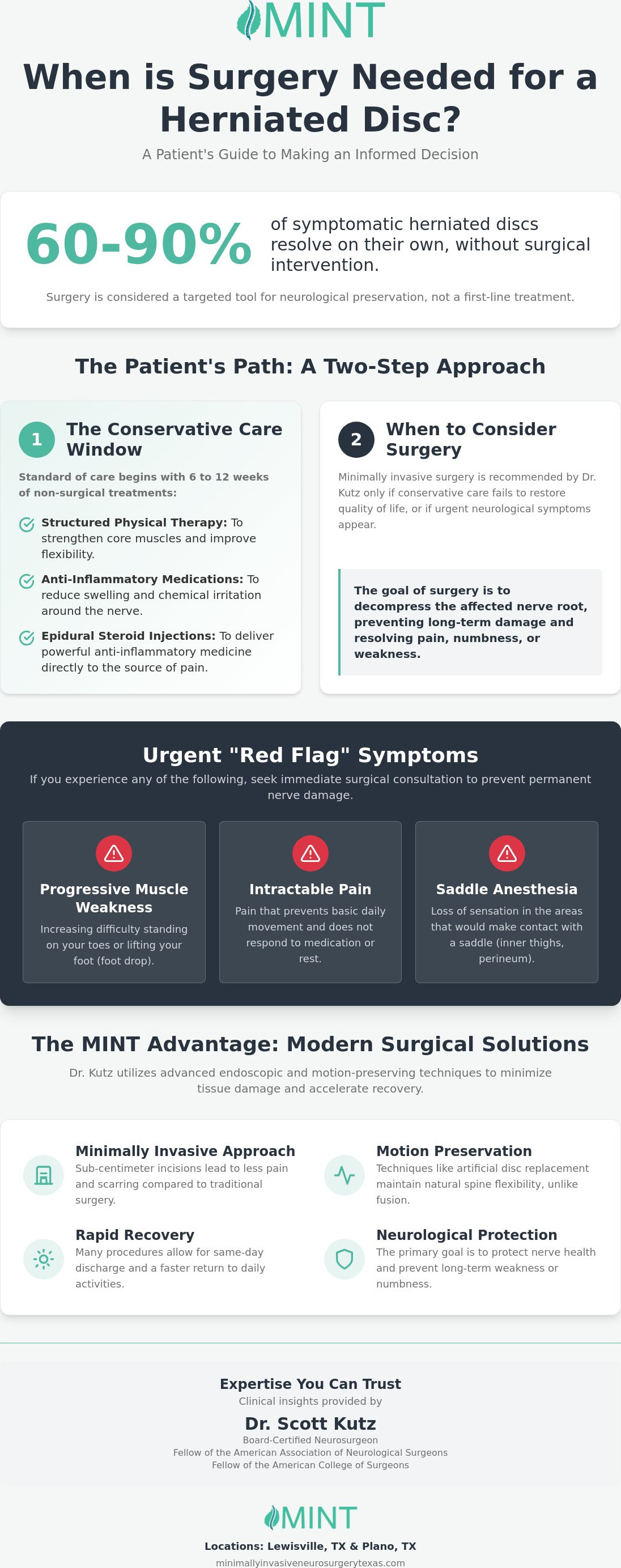
Research indicates that 60% to 90% of symptomatic herniated discs resolve spontaneously without surgery. Because of this high success rate, the standard of care at MINT typically begins with a 6 to 12 week window of conservative management. Most patients start their journey with structured physical therapy and anti-inflammatory medications to manage the initial flare up. Epidural steroid injections are another effective tool we use to provide temporary relief for intense nerve pain. Dr. Kutz recommends transitioning to minimally invasive spine surgery only when these efforts fail to restore your quality of life or if your neurological function begins to decline. This measured approach ensures we only perform surgery when it offers the most certain path to your recovery.
The Red Flags: 4 Signs You Need Immediate Surgery
While many patients find relief through conservative management, waiting too long in the face of specific symptoms can lead to irreversible neurological damage. Dr. Scott Kutz, a board-certified neurosurgeon, Fellow of the American Association of Neurological Surgeons, and Fellow of the American College of Surgeons, emphasizes that certain “red flag” symptoms shift the clinical focus from pain management to urgent intervention. Identifying when is surgery needed for a herniated disc becomes a matter of neurological preservation when the following signs appear:
- Progressive muscle weakness: If you find it increasingly difficult to stand on your toes or lift your foot while walking, the nerve is likely under severe, sustained pressure.
- Intractable pain: When pain reaches a level that prevents basic daily movement and fails to respond to high-dose anti-inflammatory medications or rest, the mechanical compression usually requires a surgical solution.
- Saddle anesthesia: This refers to a loss of sensation or a “pins and needles” feeling in the areas of the body that would touch a saddle, including the groin, buttocks, and inner thighs.
- Bladder or bowel dysfunction: Any new inability to control these functions, or a sudden inability to urinate, constitutes a medical emergency.
Dr. Kutz utilizes advanced diagnostic protocols to determine the severity of these symptoms. By following established clinical guidelines for herniated disc surgery, our team ensures that patients in Plano and Lewisville receive the appropriate level of care before temporary deficits become permanent.
Understanding Neurological Deficits
Neurological deficits occur when a herniated disc interrupts the signals traveling between your brain and your limbs. One common manifestation is foot drop, a condition where you cannot effectively lift the front part of your foot, causing it to drag or slap against the floor. If compression continues, you may notice muscle atrophy, which is the visible wasting or shrinking of muscle tissue due to a lack of nerve stimulation. Dr. Kutz uses precision diagnostics at our Plano facility to map these deficits and determine if endoscopic spine surgery is necessary to restore function.
Cauda Equina Syndrome: A Surgical Emergency
Cauda Equina Syndrome is a rare but critical condition involving the extreme compression of the bundle of nerve roots at the lower end of the spinal cord. This is not a condition where you can afford to “wait and see.” Immediate surgery is vital to decompress the nerves and prevent permanent paralysis or lifelong loss of bladder control. Dr. Kutz provides urgent consultations for these high-stakes cases at our Lewisville headquarters. If you suspect you are experiencing these symptoms, you should seek an immediate neurosurgical evaluation to protect your long-term mobility.
Comparing Conservative Therapy vs. Minimally Invasive Surgery
Dr. Scott Kutz, a board-certified neurosurgeon, Fellow of the American Association of Neurological Surgeons, and Fellow of the American College of Surgeons, views the choice between conservative care and surgery as a strategic decision based on functional outcomes. Conservative therapy focuses primarily on symptom management. This approach gives the body time to naturally resorb the herniated disc material through its own immune response. In contrast, surgery provides immediate mechanical decompression of the nerve root. For many patients in Lewisville and Plano, the decision of when is surgery needed for a herniated disc often hinges on how quickly they must return to their professional and personal lives.
Conservative treatments like physical therapy and anti-inflammatory medications work by reducing the chemical irritation around the nerve. Some patients also find success with non-surgical spinal decompression at specialized facilities like Coral Way Disc Center to alleviate pressure. While the body may eventually break down the protruding disc fragment, this process can take months and does not always result in complete relief. Minimally invasive techniques at MINT allow for a much faster resolution. By using smaller incisions than traditional open surgery, Dr. Kutz targets the specific fragment causing the issue without unnecessarily disrupting the surrounding muscle tissue. This precision translates to less post-operative pain and a more efficient recovery process.
When Physical Therapy Reaches Its Limit
Physical therapy is an excellent tool for core strengthening and postural correction. It helps stabilize the spine and can prevent future injuries by improving the way you move. However, therapy has a physical limit. It cannot manually move a large disc fragment that is physically lodged against a nerve root. Dr. Kutz monitors patient progress closely to identify the exact moment surgery becomes the more effective path. If a patient experiences plateaued progress or worsening pain despite diligent therapy, it often signals that the mechanical obstruction requires a surgical solution. This transition usually occurs when conservative treatments fail to provide functional improvement after six to twelve weeks of dedicated effort.
The Advantage of Early Intervention
Waiting too long to address a severely compressed nerve can have lasting consequences. Chronic nerve compression often leads to permanent neuropathic pain, which is pain caused by actual damage to the nervous system itself. Early decompression through minimally invasive spine surgery often results in superior long term outcomes because it stops the damage before it becomes irreversible. At MINT, we prioritize patient-centered treatment plans that value your time and mobility. Patients across North Texas choose our specialized approach because it minimizes the physical impact of the procedure while maximizing the speed of recovery. We aim to return you to your normal activity levels as efficiently as possible.
Modern Surgical Options at MINT: Beyond Traditional Fusion
Dr. Scott C. Kutz, MD, a board-certified neurosurgeon, Fellow of the American Association of Neurological Surgeons, and Fellow of the American College of Surgeons, utilizes the absolute forefront of modern surgical innovation at MINT. Once you and your clinical team determine when is surgery needed for a herniated disc, the focus shifts to selecting the most precise, motion-preserving technique available. Traditional open back surgery often involves large incisions and significant muscle retraction; however, our practice prioritizes methods that minimize physical impact and accelerate your return to normal activity.
Microdiscectomy remains a gold standard for treating lumbar disc herniations at our facilities in Lewisville and Plano. During this procedure, Dr. Kutz uses high powered magnification to remove the specific portion of the disc pressing on the nerve. To enhance this precision, he utilizes robotic navigation systems like the Globus Excelsius. This technology allows for sub-millimeter accuracy during the placement of any necessary hardware, although our surgeons always explore non-fusion options first to maintain your natural spinal mechanics.
Endoscopic Discectomy Benefits
Endoscopic spine surgery represents one of the most advanced ultra-minimally invasive options available in 2026. This procedure uses a tiny camera, called an endoscope, to visualize the herniation directly on a high-definition monitor. Because the endoscope reaches the spine through a natural opening or a very small portal, it results in minimal disruption to the surrounding back muscles. Endoscopic spine surgery involves a typical incision size of less than one centimeter, which is roughly the size of a fingernail. This specialized approach significantly reduces post-operative soreness and lowers the risk of infection compared to traditional methods.
Motion Preservation with Artificial Disc Replacement
For many patients, artificial disc replacement (ADR) offers a superior alternative to traditional spinal fusion. While fusion locks two vertebrae together to stop painful movement, ADR preserves the natural flexibility of the spine. This motion preservation is critical because it reduces the risk of adjacent segment disease, a condition where the discs above and below a fusion site wear out prematurely due to increased stress. You can learn more about artificial disc replacement at our Plano office to see if you are a candidate for this motion-preserving technology.
If you are ready to discuss which advanced technique is right for your recovery, schedule a consultation with Dr. Kutz today to begin your journey back to an active lifestyle.
Recovery and Results: Life After Herniated Disc Surgery
Dr. Scott Kutz, a board-certified neurosurgeon, Fellow of the American Association of Neurological Surgeons, and Fellow of the American College of Surgeons, designs recovery plans that prioritize a rapid return to your daily routine. Most patients at MINT return home the same day as their procedure. This outpatient approach is possible because our specialized techniques minimize the physical trauma associated with traditional spine surgery. Once you have identified when is surgery needed for a herniated disc and completed the procedure, the focus shifts to active recovery and long term wellness.
Walking is a cornerstone of the MINT recovery philosophy. We encourage patients to begin walking immediately after surgery to promote healthy blood flow and prevent complications. Dr. Kutz provides personalized recovery protocols for every Lewisville patient to ensure they hit specific milestones safely. Similar to the structured approach used by the Brisbane Hernia Clinic for surgical rehabilitation, our goal is to provide a clear path back to full health. While light activity starts on day one, a full return to strenuous activity or heavy lifting typically occurs within six to twelve weeks. This timeline allows the surrounding tissues to heal completely while you gradually rebuild your core strength.
The First 48 Hours Post-Surgery
The initial two days after surgery focus on pain management and gentle movement within the home. Because Dr. Kutz uses ultra-small incisions, patients experience significantly less post-operative discomfort than those undergoing open procedures. You will primarily manage any soreness with mild medications rather than heavy narcotics. Dr. Kutz and his clinical team provide 24/7 guidance during this initial recovery phase to answer questions and ensure your peace of mind. Small, frequent walks around your living space help maintain flexibility and prevent stiffness.
Long-Term Outcomes and Mobility
Precision is the key to preventing future spinal issues. Dr. Kutz uses advanced visualization and robotic navigation to ensure the complete removal of the offending disc material. This level of precision reduces the likelihood of recurrent herniation, which studies place between 5% and 15% for standard procedures. Patients often report immediate relief from the radiating leg or arm pain that plagued them for months before surgery. You can read our patient testimonials to see real results from Plano and Lewisville neighbors who have successfully reclaimed their mobility. Our ultimate goal is to move you from a state of chronic suffering to a state of informed confidence and physical freedom.
Reclaiming Your Mobility with Precision Spine Care
Navigating the complex decision of when is surgery needed for a herniated disc requires a balance of clinical expertise and patient centered reassurance. While many cases resolve through dedicated conservative management, identifying the precise moment for surgical intervention is vital to protect your long term neurological health. Dr. Scott Kutz, a board-certified neurosurgeon with over 20 years of experience, specializes in motion preserving spinal technology that avoids the physical limitations of traditional fusion. By utilizing ultra minimally invasive techniques like endoscopic discectomy and artificial disc replacement, our team ensures you receive the most precise treatment with the fastest possible recovery timeline.
Don’t let chronic pain or progressive muscle weakness dictate your quality of life. As a specialist in motion preserving technology and a recipient of multiple patient choice awards, Dr. Kutz is dedicated to helping you return to your normal activity levels through advanced, high tech healing. Schedule a consultation with Dr. Scott Kutz in Lewisville or Plano today to explore your options for a pain free future. Relief is within reach, and our team is ready to guide you toward a successful recovery.
Frequently Asked Questions
How long can I wait before herniated disc surgery becomes too late?
You should not wait if you experience progressive muscle weakness or a sudden loss of sensation. While most patients trial conservative care for six to twelve weeks, waiting longer in the presence of neurological deficits can lead to permanent nerve damage. Dr. Scott Kutz monitors these symptoms closely at our Lewisville and Plano offices to ensure intervention happens before the window for full recovery closes.
Is surgery for a herniated disc considered major surgery?
Modern minimally invasive techniques have transformed herniated disc procedures into streamlined outpatient experiences. Dr. Scott C. Kutz, MD, performs endoscopic spine surgery through incisions smaller than one centimeter. This specialized approach reduces blood loss and muscle trauma, allowing most patients to return home the same day. It is a highly precise procedure that avoids the extensive recovery time associated with traditional open back surgery.
What is the success rate of minimally invasive discectomy with Dr. Scott Kutz?
Success rates for relieving radiating leg pain through discectomy generally range from 80% to 95%. Dr. Scott Kutz, a board-certified neurosurgeon with over 20 years of experience, utilizes robotic navigation to maximize these outcomes for his patients. Determining when is surgery needed for a herniated disc involves a careful review of your MRI and clinical symptoms to ensure the highest probability of a successful result.
Can a herniated disc heal on its own without surgical intervention?
Yes, approximately 60% to 90% of symptomatic herniated discs resolve without any surgical intervention. The body often resorbs the displaced disc material naturally through its own immune response over several months. Dr. Kutz recommends surgery only when conservative measures like physical therapy or injections fail to provide relief after a dedicated trial period or if your neurological function begins to decline.
Will I need a spinal fusion if I have a herniated disc?
Most patients do not require a spinal fusion for a primary disc herniation. Dr. Kutz prioritizes motion-preserving techniques like artificial disc replacement or simple decompression to maintain your natural flexibility. Spinal fusion is typically reserved for cases involving significant spinal instability or chronic back pain that persists after other treatments. Our goal at MINT is always to preserve your mobility whenever possible.
How soon can I return to work after endoscopic spine surgery in Lewisville?
Many patients return to sedentary desk work within one to two weeks following their procedure. If your job involves physical labor or heavy lifting, Dr. Kutz may recommend waiting six to twelve weeks to ensure complete structural healing. Our Lewisville team provides a personalized recovery timeline based on the specific requirements of your professional activities and the speed of your initial healing process.
What happens if I ignore the red flags of a herniated disc?
Ignoring red flags like saddle anesthesia or loss of bladder control can lead to permanent paralysis or lifelong disability. These symptoms indicate severe nerve root compression that requires immediate surgical decompression. Understanding when is surgery needed for a herniated disc is critical because delayed treatment for conditions like Cauda Equina Syndrome often results in irreversible neurological deficits that even surgery cannot fully repair later.